

How Much is 1 Ounce of Gold Really Worth
Why Understanding Gold Weight and Value Matters

1 ounce of gold is worth its current spot price plus a premium for minting and distribution. Here's what you need to know:
- Weight: 1 troy ounce = 31.1034768 grams (not the same as a regular ounce)
- Purity: Most bars are 999.9 fine gold (24-karat)
- Current Value: Spot price plus 1-20% premium depending on dealer and form
- Popular Forms: PAMP Suisse Lady Fortuna, Valcambi, Royal Canadian Mint bars
- Where to Buy: Bullion dealers, specialized retailers, and trusted local jewelers
If you've ever wondered why a small gold bar costs thousands of dollars, you're not alone. The price reflects more than just the metal itself—it captures centuries of value, the massive effort required to extract it from the earth, and the security features that protect your investment.
Gold is incredibly rare. All the gold ever mined in human history would fit into a cube just 70 feet on each side. Producing a single ounce requires extracting between 3 and 10 tons of ore from the ground. This scarcity, combined with gold's role as a store of wealth across millennia, explains why even one ounce commands significant value.
The spot price you see quoted online is just the starting point. When you actually purchase a physical gold bar, you'll pay additional premiums for refining, minting, authentication features like Veriscan technology, and dealer margins. Understanding these costs helps you make informed decisions about which form of gold best suits your investment goals.
I'm Morgan Price, and I've spent years researching precious metals markets and helping investors understand the true value behind 1 ounce of gold investments, from authentication methods to long-term wealth preservation strategies. This guide breaks down everything you need to know about gold weight, purity, pricing, and purchasing considerations.
Understanding the Weight and Purity of 1 Ounce of Gold
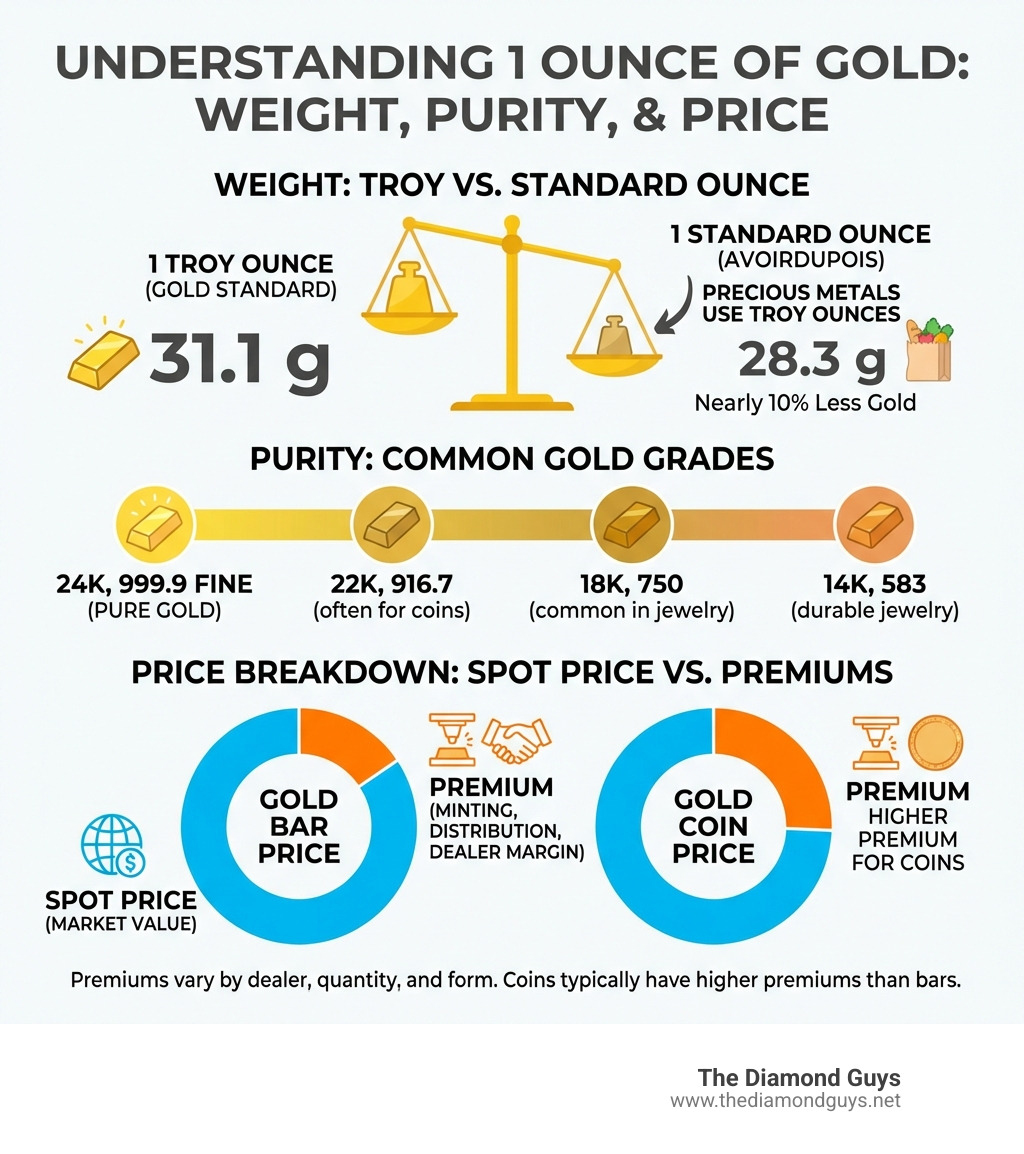
When we talk about 1 ounce of gold, we aren't using the same "ounce" you use to weigh flour in your kitchen. In precious metals, the standard is the Troy ounce. This is a historical unit of measure that dates back to the Middle Ages, and it remains the global benchmark for gold, silver, and platinum.
A Troy ounce is exactly 31.1034768 grams. In contrast, a standard (Avoirdupois) ounce—the kind used for groceries—is only about 28.35 grams. This means a gold ounce is nearly 10% heavier than a regular ounce. If you are buying gold and someone tries to sell you a bar weighed in standard ounces, you are getting less gold than you bargained for!
Purity is the other half of the equation. Investment-grade gold bars are typically 999.9 fine, which is the technical way of saying they are 99.99% pure gold. This is also known as 24-karat gold. At this level of purity, the metal is incredibly soft and has a rich, deep yellow glow.
Troy Ounce vs. Standard Ounce Comparison
| Unit of Measure | Grams | Used For |
|---|---|---|
| Troy Ounce | 31.1034768 | Precious Metals (Gold, Silver) |
| Standard (Avoirdupois) Ounce | 28.3495 | Groceries, Mail, General Items |
Tracking the Gold Price per Ounce is the best way to stay updated on what your 31.1 grams of pure metal are worth at any given moment.
The Physical Reality of Gold Mining
It is easy to forget how much work goes into that small, shiny bar. To produce just 1 ounce of gold, miners often have to extract and process between 3 and 10 tons of earth and ore. Imagine a massive dump truck full of dirt—all of that effort just to find a single ounce of yellow metal.
Once extracted, the gold must be refined to meet the strict standards of the London Bullion Market Association (LBMA). Refiners like PAMP Suisse or the Royal Canadian Mint take the raw "doré" bars and purify them until they reach that coveted 999.9 fineness. This rigorous process ensures that when you see an LBMA Good Delivery stamp, you know the weight and purity are guaranteed. As we mentioned earlier, if you took all the gold ever mined in human history, it would fit into a cube only 70 feet on each side. Its rarity isn't just a marketing slogan; it’s a geological fact.
Historical Value and Purchasing Power
Gold is often called the "ultimate store of value" because its purchasing power remains remarkably stable over long periods. There is a famous analogy involving a Roman toga: in 100 A.D., 1 ounce of gold could buy a high-quality toga and accessories. Today, that same ounce of gold will still buy you a very nice, high-end tailor-made suit.
While paper currencies (like the dollar) lose value over time due to inflation, gold tends to hold its ground. This makes it a popular hedge against currency devaluation. For those looking at smaller entries into the luxury market, understanding the 1 carat gold price can provide a different perspective on how gold is valued when used in jewelry versus pure investment bullion.
Spot Price vs. Premiums: What You Actually Pay
If you check a financial app and see gold trading at $2,500, don't expect to walk into a shop and buy a 1 oz bar for exactly $2,500. The price you see on the news is the spot price.
The spot price is derived from the COMEX futures market. It represents the price of gold for immediate delivery in large, wholesale quantities (usually 400-ounce bars). When you buy a 1 ounce of gold bar, you pay the spot price plus a premium.
The premium covers several things:
- Minting Costs: Turning raw gold into a beautiful, stamped bar.
- Assay Packaging: The protective card and certificate that proves authenticity.
- Dealer Markup: The profit margin for the business selling you the metal.
- Logistics: Shipping and high-value insurance.
Many dealers offer tiered pricing. For example, a single PAMP Suisse 1 oz Gold Bar might sell for $3,423.29, but if you buy 20 or more units, you might receive a significant discount—sometimes as much as 23% off the premium.
Factors Influencing the Price of 1 Ounce of Gold
The price of gold doesn't move in a vacuum. It is influenced by a complex web of global factors:
- USD Strength: Gold is priced in U.S. Dollars globally. Usually, when the dollar gets stronger, gold prices soften for U.S. buyers. When the dollar weakens, gold often rises.
- Central Bank Reserves: Governments around the world, like those in China and India, buy massive amounts of gold to back their currencies.
- Interest Rates: Since gold doesn't pay a dividend or interest, high interest rates can sometimes make it less attractive than bonds. However, in times of high inflation, gold often outperforms regardless of rates.
- Geopolitical Tension: Gold is the "safe haven" asset. When there is conflict or political instability, investors flock to gold, driving the price up.
Why Premiums Vary Between Dealers
You might notice that a 1 ounce of gold bar at a large warehouse club costs less than at a specialized boutique, or more than at a high-volume online bullion dealer. These differences come down to overhead.
Online dealers have massive warehouses and low retail costs, allowing them to squeeze premiums. Some big-box retailers use gold as a "loss leader" to drive memberships, often limiting sales to one transaction per membership and a maximum of five units. However, be aware of the "fine print." Most gold purchases are non-refundable, have no price adjustments if the market drops the next day, and require a signature upon delivery.
Popular Forms and Security of 1 Ounce Gold Bars
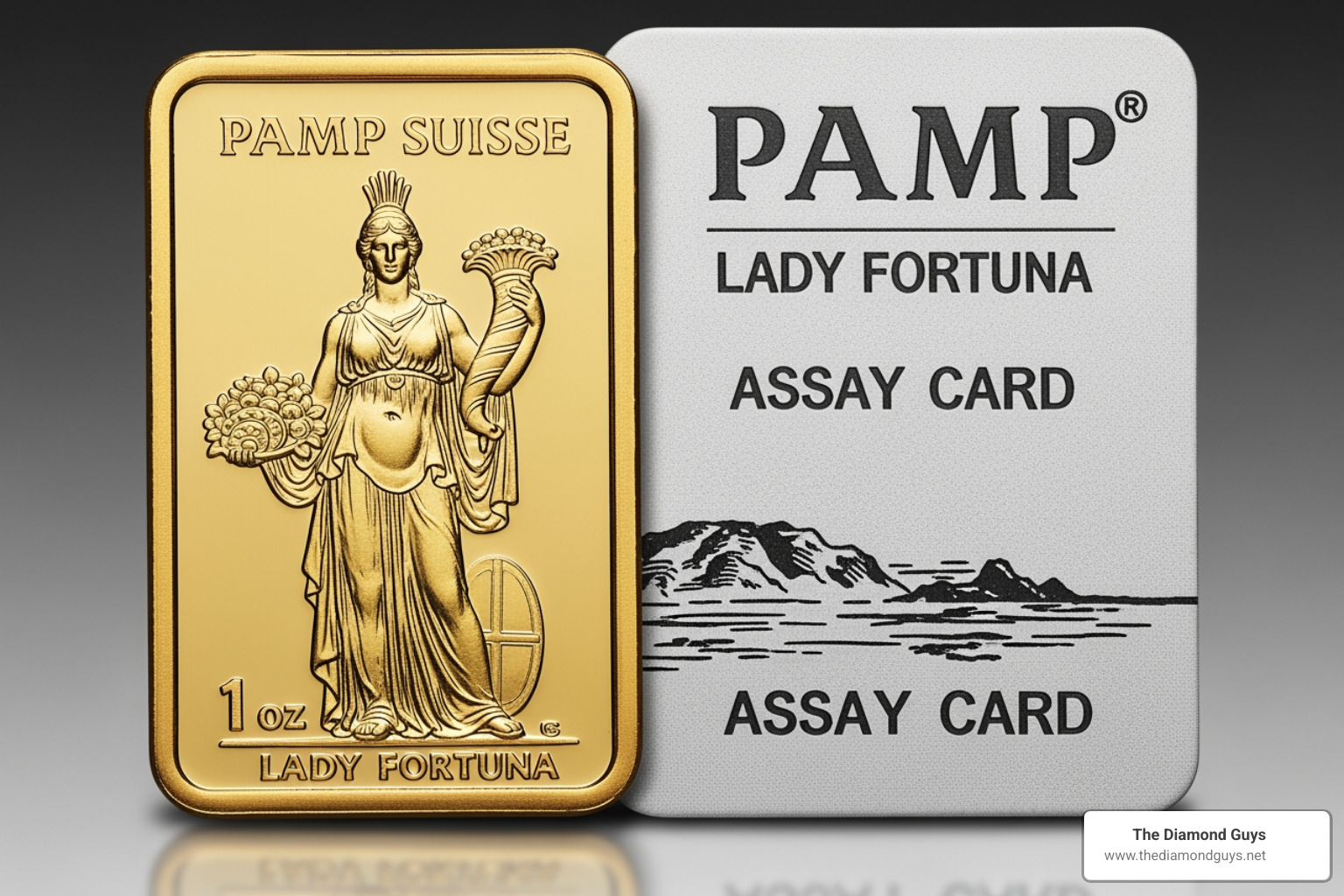
When you decide to buy, you'll find two main types of bars: minted and cast. Minted bars are punched from a flat sheet of gold, giving them sharp edges and a mirror-like finish. Cast bars are made by pouring molten gold into a mold, giving them a more rugged, "old-world" look.
The PAMP Suisse Lady Fortuna is perhaps the most iconic 1 oz gold bar in the world. It features the Roman goddess of luck and abundance, depicted with a cornucopia. Other reputable mints include the Scottsdale Mint, Valcambi, and the Royal Canadian Mint.
Authenticating Your 1 Ounce of Gold Investment
In a world of sophisticated fakes, authentication is everything. High-end bars like those from PAMP Suisse utilize Veriscan technology. This system uses the microscopic topography of the metal—like a fingerprint—to identify the bar. You can actually scan the bar with an iPhone app to verify it against the mint's database.
Other security features include:
- CertiPAMP Packaging: A tamper-evident "assay" card that contains the bar's serial number and the refiner's signature.
- Digital QR Codes: Found on the back of modern assay cards for instant verification.
- Weight Verification: Any reputable dealer will allow you to weigh the bar on a calibrated scale (it should be exactly 31.1 grams).
For more details on how the pros verify these assets, you can check out the official Veriscan technology page.
Storage and Delivery Considerations
Owning 1 ounce of gold means you are your own central bank. That comes with responsibility. If you buy online, the package should always be shipped in discreet packaging (no "GOLD INSIDE" stickers!) and require a signature for delivery.
Once you have it, where do you put it?
- Home Safes: Convenient, but you need a high-quality, bolted-down safe.
- Bank Safety Deposit Boxes: Secure, but you can only access your gold during bank hours.
- Private Vaults: These offer the highest security and are often located in tax-friendly jurisdictions, though they charge monthly storage fees.
Why Investors Choose 1 Ounce Gold Bars
The 1 oz size is the "Goldilocks" of the bullion world. It is small enough to be portable but large enough to carry a lower premium than fractional ounces (like 1/10 oz or 1 gram bars).
Historically, gold has been a solid performer. From 1971 to 2022, gold saw an average annual return of approximately 7.78%. It provides essential portfolio diversification because it often moves in the opposite direction of the stock market. When stocks crash, gold usually shines.
Comparing Bars to Gold Coins and Rounds
Why choose a bar over a gold coin like an American Eagle or a South African Krugerrand?
- Lower Premiums: Bars are generally cheaper to produce than legal tender coins, so you get more gold for your dollar.
- Compact Storage: Rectangular bars stack much more neatly in a safe than round coins.
- Uniformity: 1 oz bars are standardized globally, making them very easy to trade or sell to any bullion dealer in the world.
Frequently Asked Questions about 1 Ounce of Gold
Is a troy ounce different from a regular ounce?
Yes! As we’ve noted, a troy ounce is 31.1 grams, while a standard ounce is 28.3 grams. The troy ounce is the heavier, international standard for all precious metals. If you're calculating the value of your gold, always ensure you're using the 31.1-gram conversion.
Why is the price higher than the spot price?
The spot price is the "raw" price of the metal on the commodities exchange. The price you pay includes the cost of refining the ore, minting the design, the assay security packaging, insurance for shipping, and a small profit for the dealer who facilitates the trade.
Can I return a gold bar if the price drops?
Almost never. Because gold is a highly volatile commodity, most retailers have a strict no-return policy. Once you buy 1 ounce of gold, you own it. If the market price drops ten minutes after your purchase, the dealer will not refund the difference. This is why it’s important to view gold as a long-term investment rather than a quick flip.
Conclusion
Understanding the value of 1 ounce of gold is about more than just checking a ticker symbol. It’s about appreciating the rarity of the metal, the security of the minting process, and the historical stability that gold brings to a modern investment portfolio. Whether you're looking for the artistic beauty of a PAMP Suisse bar or the simple utility of a cast bar, gold remains one of the most trusted ways to preserve wealth.
At The Diamond Guys, we pride ourselves on providing expert guidance and a personalized experience that you simply won't find at big-box retailers. Whether you are in Scottsdale, AZ, or Los Angeles, CA, we are here to help you navigate precious metals with transparency and ethical sourcing.
Ready to turn your gold into cash or looking for expert advice on your next high-value purchase? More info about our gold buying services is just a click away. We look forward to seeing you at one of our locations in Arizona or California!


