

From One Carat to Ten: Your Tennis Bracelet Pricing Cheat Sheet
How Much Does a 10 Carat Tennis Bracelet Actually Cost?
The 10 carat tennis bracelet price spans a wide range — and where you land depends on a few key choices.
Here's a quick snapshot:
| Diamond Type | Quality | Metal | Price Range |
|---|---|---|---|
| Lab-grown | E-F / VS1 | 14k white gold | $4,750 – $10,200 |
| Natural | I / VS2 | 14k white gold | $10,000 – $22,000 |
| Natural | E-F / VS1-VS2 | 18k gold or platinum | $16,000 – $36,000 |
Prices vary by retailer, diamond quality, and metal type.
So the honest answer? You can spend anywhere from under $5,000 to well over $35,000 on a 10 carat tennis bracelet — and both ends of that range can make sense depending on your priorities.
That wide gap can feel overwhelming. But once you understand what's actually driving the price, the decision becomes much clearer.
The name "tennis bracelet" itself has a great origin story: in 1978, tennis champion Chris Evert's diamond bracelet snapped off mid-match at the U.S. Open, and she paused the game to find it. The name stuck — and so did the style.
I'm Morgan Price, a jewelry research specialist who has spent years analyzing fine jewelry pricing and value — including breaking down what makes a 10 carat tennis bracelet price tick across natural, lab-grown, and mixed-quality options. In the sections below, I'll walk you through exactly what moves the needle on price so you can shop with confidence.
10 carat tennis bracelet price vocabulary:
Key Factors Influencing a 10 Carat Tennis Bracelet Price
When we talk about a 10-carat piece, we aren't talking about a single massive stone. We are talking about a "total carat weight" (tcw) distributed across 38 to 45 individual diamonds. Because each of these stones must be matched for color, clarity, and cut, the labor and sourcing involved are significant.
At The Diamond Guys, we’ve seen how small adjustments in these factors can lead to thousands of dollars in price differences. Here are the primary drivers:
- Diamond Origin: Natural diamonds carry a rarity premium, while lab-grown diamonds offer a more accessible entry point for the same aesthetic.
- The 4Cs: Even in smaller stones (roughly 0.22ct to 0.25ct each for a 10ct bracelet), the color and clarity grades are amplified when viewed in a continuous row.
- Metal Weight: A 10-carat bracelet requires a substantial setting. You can expect about 12 to 15 grams of gold or platinum to hold that much "ice" securely.
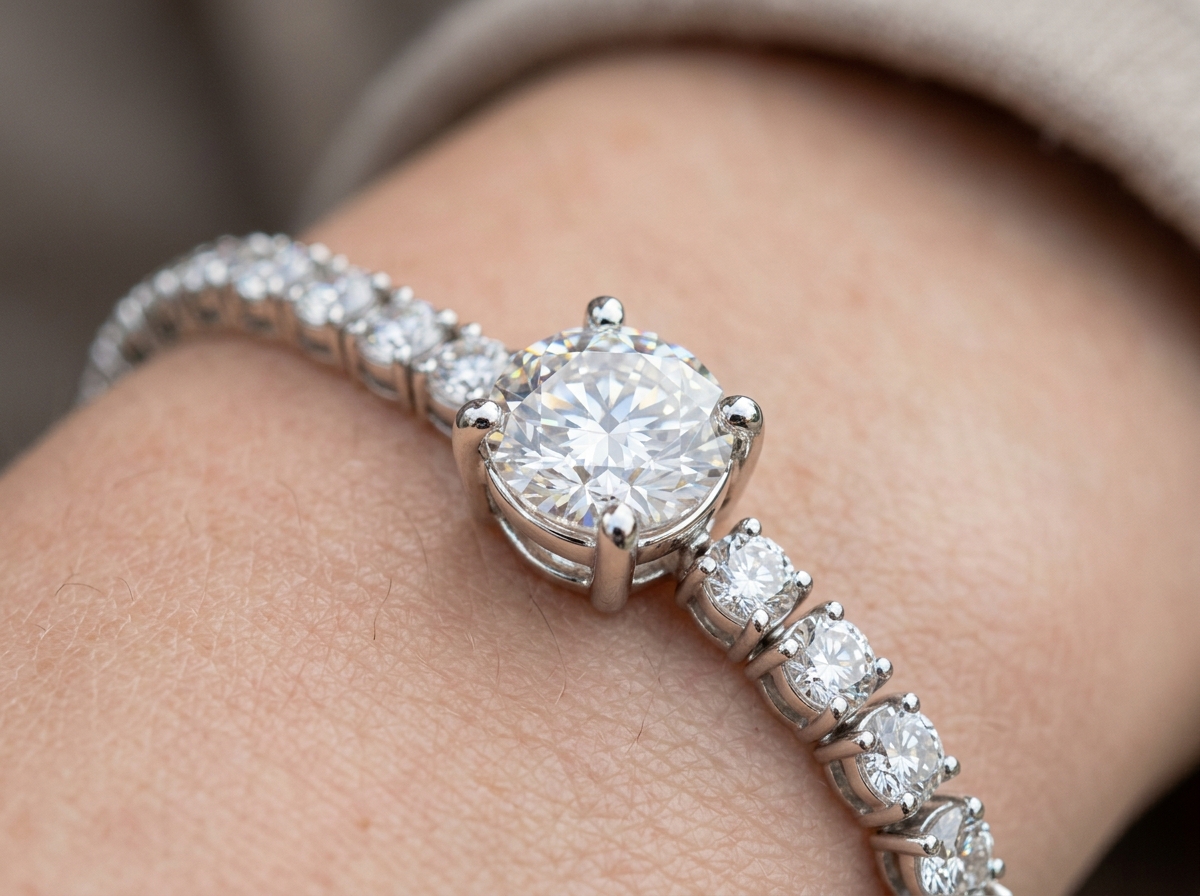
- Setting Style: The most common is the four-prong setting, which maximizes light entry. However, bezel or channel settings can increase the metal weight and labor costs.
If you are just starting your journey, our diamond tennis bracelets complete guide covers the basics of construction and style. You can also Shop The Diamond Guys Tennis Bracelets to see how these specs translate to real-world sparkle.
The Impact of Diamond Quality on 10 Carat Tennis Bracelet Price
The "sparkle factor" is where the budget often gets stretched. In a 10-carat bracelet, each diamond is large enough that flaws or yellow tints can become visible to the naked eye if the quality is too low.
- Color Grades: Most high-end 10-carat bracelets use diamonds in the E-F (colorless) or G-H (near-colorless) range. If you drop into the I-J-K range, you may notice a slight warm tint, but the price might drop by 20-30%.
- Clarity Levels: We generally recommend "eye-clean" diamonds. VS1 or VS2 clarity ensures that no inclusions are visible without a microscope. Some retailers offer SI1-I1 clarity to keep the 10 carat tennis bracelet price closer to the $20,000 mark for natural stones, but be wary of "cloudy" appearances.
- Cut Precision: This is the most underrated factor. Excellent or Very Good cuts ensure the diamonds reflect light properly. Poorly cut diamonds will look dull, no matter how high the carat weight is.
- Certification: For a purchase of this magnitude, GIA (Gemological Institute of America) certification is the gold standard. It provides independent verification that you are getting exactly what you paid for.
For more on choosing the right gold to pair with high-quality stones, check out our 18k gold tennis bracelet ultimate guide.
Metal Choice: 14k Gold vs. 18k Gold vs. Platinum
The "frame" for your diamonds matters for both durability and price.
- 14k Gold: This is the industry standard for tennis bracelets. It is 58.3% pure gold mixed with alloy metals, making it incredibly durable for daily wear. It’s also the most cost-effective option.
- 18k Gold: Containing 75% pure gold, this option is richer in color (for yellow gold) and feels heavier on the wrist. It’s more prestigious but slightly softer than 14k.
- Platinum: The heaviest and most durable option. Platinum is naturally white (no rhodium plating required) and hypoallergenic. Expect to pay a premium for the metal itself and the specialized labor required to work with it.
- Rhodium Plating: Most white gold bracelets receive a rhodium finish to give them that "mirror" shine. Over time, this may need to be reapplied to maintain the bright white look.
If you're looking for a more entry-level metal, you might explore a 10k white gold tennis bracelet, though for a 10-carat weight, 14k is usually the minimum recommended for structural integrity.
Natural vs. Lab-Grown: A Massive Price Divide
The biggest decision you will make regarding the 10 carat tennis bracelet price is the origin of the diamonds. Lab-grown diamonds have revolutionized the luxury market by offering stones that are chemically, physically, and optically identical to mined diamonds at a fraction of the cost.
| Feature | Natural Diamond (10ct) | Lab-Grown Diamond (10ct) |
|---|---|---|
| Typical Price | $18,000 - $35,000+ | $4,500 - $10,000 |
| Resale Value | Higher (50-70% of market) | Very Low |
| Rarity | Earth-mined over billions of years | Created in weeks |
| Appearance | Identical | Identical |
| Certification | GIA / IGI | IGI / GIA |
Whether you choose natural for its "investment" feel or lab-grown for the "wow" factor at a lower price, we can help you navigate both at our Scottsdale or Los Angeles showrooms. Shop The Diamond Guys Tennis Bracelets to compare these options side-by-side.
Why Lab-Grown 10 Carat Tennis Bracelet Price Points are Lower
It’s a common question: "If they are the same, why is the price so different?" It comes down to the supply chain.
Natural diamonds require massive mining operations, global shipping, and a limited supply controlled by nature. Lab-grown diamonds are created using High Pressure-High Temperature (HPHT) or Chemical Vapor Deposition (CVD) processes. This "factory" environment allows for a consistent supply without the overhead of earth-mining.
This price flexibility allows buyers to opt for much higher quality specs. For example, a $5,000 budget might get you a 3-carat natural bracelet, but it could get you a stunning 10-carat lab-grown bracelet with E-F color and VS1 clarity. For many, this makes the 3ct diamond tennis bracelet complete guide a thing of the past as they "size up" to 10 carats.
Understanding the Total Cost of Ownership
The price tag on the jewelry box isn't always the final number. When buying a high-carat piece, you need to consider the "long game."
- Security First: A 10-carat bracelet is heavy. Ensure it has a secure box clasp with a double safety wing. Losing a $20,000 bracelet because of a weak latch is a nightmare no one wants.
- Bracelet Length: Most standard bracelets are 7 inches. If you have a larger wrist and need 7.5 or 8 inches, the total carat weight will increase—and so will the price. Conversely, shortening a bracelet may involve a labor fee, though you get to keep the extra diamonds!
- Appraisals and Insurance: Most reputable jewelers include an appraisal for items over $1,000. You will need this to get jewelry insurance, which typically costs 1-2% of the item's value per year.
- Maintenance: To keep that 10-carat shine, we recommend professional cleaning and prong inspections every six months.
For more tips on choosing a piece that lasts, read our post on game set match discovering the best tennis bracelets.
Frequently Asked Questions about 10 Carat Tennis Bracelets
Is a 10 carat tennis bracelet a good investment?
While jewelry should primarily be bought for enjoyment, natural 10-carat bracelets hold their value better than smaller weights because large, high-quality natural diamonds are rare. However, "investment" usually implies a profit—jewelry is more of a "store of value." If resale is your goal, stick to natural diamonds with GIA certificates. If you want the most "look" for your money, lab-grown is the winner. For those looking for even more impact, you might even consider a 15 ct tennis bracelet.
How many diamonds are typically in a 10 carat bracelet?
A standard 7-inch bracelet usually contains between 38 and 45 diamonds. The fewer the diamonds, the larger each individual stone must be to reach the 10-carat total. For example, a 40-stone bracelet means each diamond is 0.25 carats. This is a substantial size that offers incredible "fire." While we often focus on women's styles, the same rules apply to the ultimate mens silver tennis bracelet collection or gold versions for men.
Does GIA certification affect the price?
Absolutely. A GIA report is like a "logbook" for a diamond. It ensures that the H-color, VS2-clarity diamond you’re paying for is actually an H/VS2. Bracelets sold without independent grading often have "inflated" grades, meaning you might pay for high quality but receive mediocre stones. At The Diamond Guys, we prioritize transparency through independent verification.
Conclusion
Finding the right 10 carat tennis bracelet price is about balancing your desire for size with your standards for quality. Whether you are visiting us in Scottsdale, AZ, or working with our team in Los Angeles, we are here to provide the expert guidance you won't find at a big-box retailer.
From ethically sourced natural stones to the brilliant value of lab-grown diamonds, we specialize in creating custom pieces that fit your style and your budget. A 10-carat tennis bracelet is a "main character" piece of jewelry—it deserves a personalized shopping experience to match.
Ready to see the sparkle in person? Find your perfect 10 carat tennis bracelet and let us help you make a statement that lasts a lifetime.


