

The Great Diamond Hunt: Where to Find Your Perfect Rock
Where Is the Best Place to Buy a Diamond?

The best place buy diamond depends on your priorities, but here are the top options to consider:
- Local jewelry districts (like Downtown LA) - Best for custom design, negotiation, and expert guidance
- Reputable online retailers - Best for wide selection and competitive pricing
- Boutique jewelers - Best for personalized service, ethical sourcing, and lifetime warranties
- Factory-direct stores - Best for lower prices through direct sourcing
No matter where you shop, always insist on a GIA-certified diamond and a clear return policy before you buy.
Buying a diamond is one of the biggest purchases most people ever make. It is exciting - but also overwhelming.
There are thousands of places to buy. Prices vary wildly. And the terminology alone - 4Cs, clarity grades, carat weight, cut performance - can make your head spin fast.
Here is the truth: there is no single "best" retailer for everyone. The right place to buy depends on your budget, values, and what kind of experience you want. Some people want to browse thousands of diamonds online at 3am. Others want to sit across from an expert who can walk them through every option.
What everyone deserves is transparency, fair pricing, and a diamond they can feel confident about.
That is exactly what this guide is built to help you find.
I'm Morgan Price, a backlink outreach and content strategist who has spent years researching the diamond and fine jewelry industry to help buyers make smarter, more confident decisions about the best place buy diamond. In that time, I've dug deep into what separates trustworthy jewelers from the rest - and I'm sharing everything I've learned here.
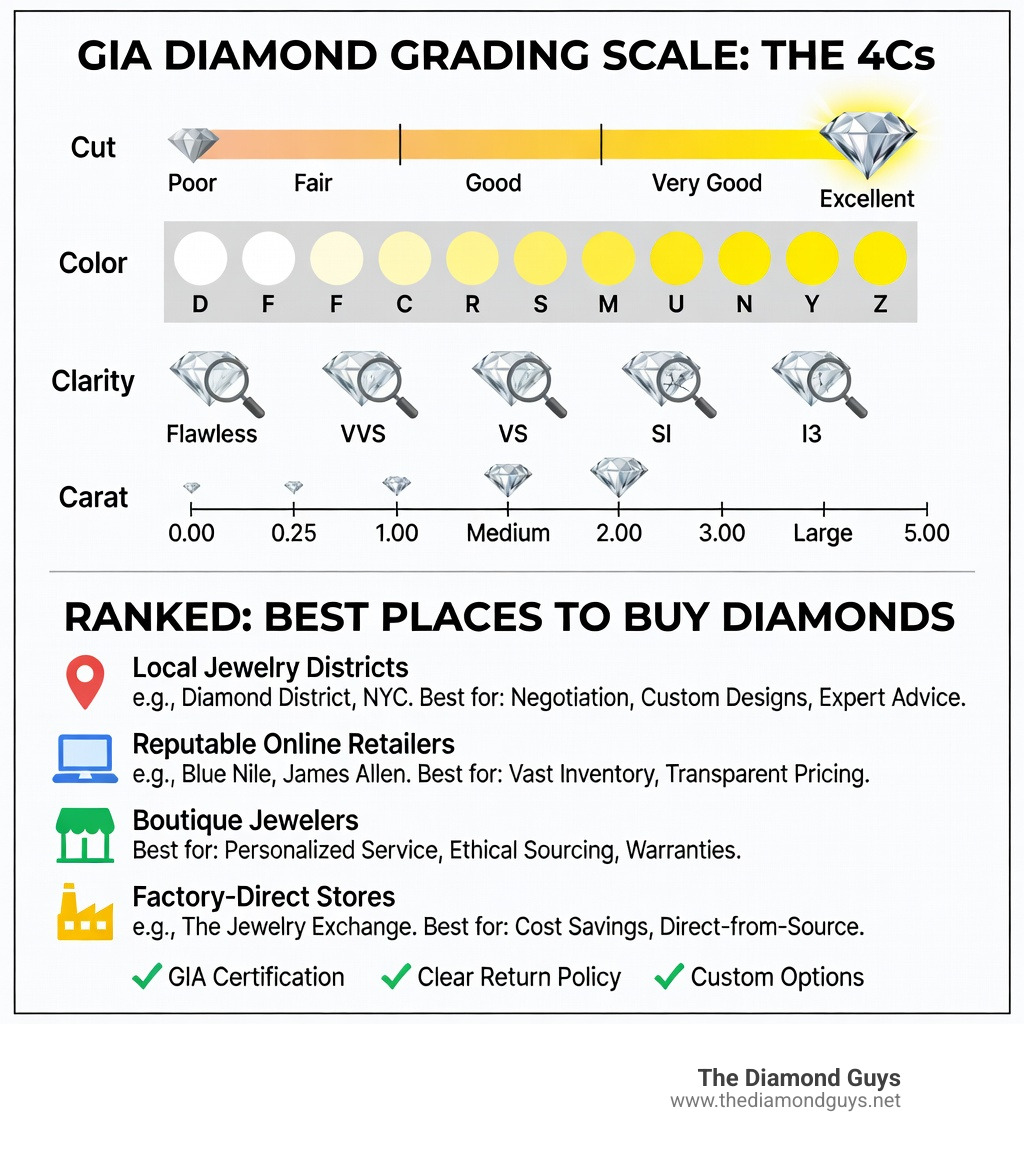
Know your Best place buy diamond terms:
Navigating the Best Place to Buy Diamond: Online vs. In-Store
When you start your search, the first fork in the road is deciding between the digital world and the physical showroom. Both have distinct advantages, and often, the most successful buyers use a "hybrid" approach—researching online to understand pricing and then visiting a trusted jeweler to see the stones in person.
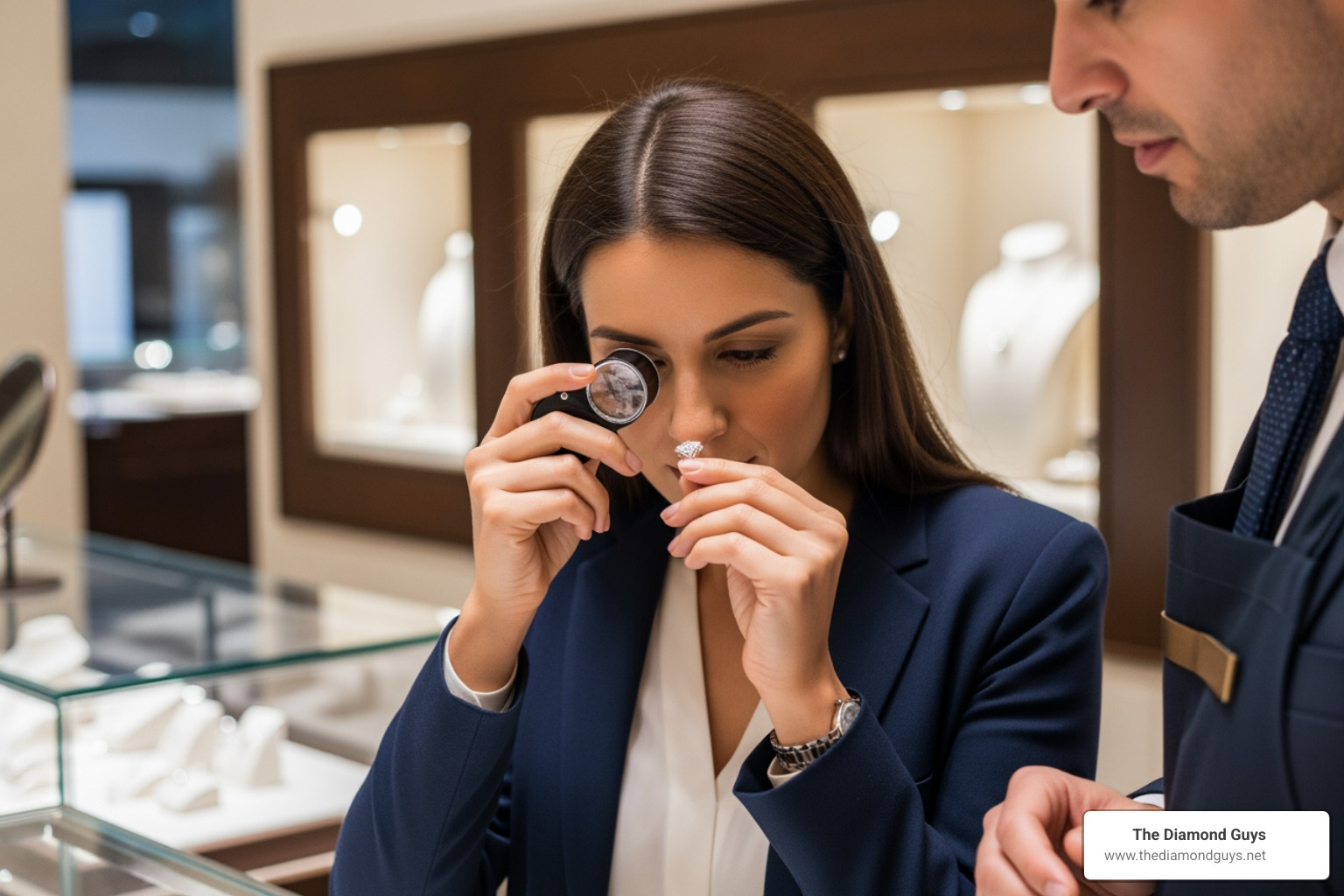
Online retailers offer an incredible breadth of inventory. Major digital platforms often display over 180,000 diamonds at any given time. These sites use 360-degree high-definition video to let you zoom in on inclusions that the naked eye might miss. If you are looking for a very specific combination of the 4Cs (Cut, Color, Clarity, and Carat) on a tight budget, the internet is a powerful tool.
However, a diamond is more than its "spec sheet." Two diamonds with identical GIA grades can look completely different in person. One might have a "lazy" sparkle, while the other dances with light. This is where the tactile experience of a brick-and-mortar store wins. When you walk into a shop, you get personalized service from an expert who can explain why a slightly lower color grade might actually look better in a yellow gold setting.
For those specifically interested in modern alternatives, our lab diamond jewelry store guide dives deep into how to choose a retailer that balances tech-savvy selection with old-school service. As the GIA suggests, we should Buy for beauty. Select with science. to ensure the diamond doesn't just look good on paper, but glows on the finger.
The DTLA Jewelry District and Custom Design
If you are in California, the Downtown Los Angeles (DTLA) Jewelry District is a legendary destination. It is the largest jewelry district in the United States, housing approximately 5,000 businesses and generating nearly $3 billion in annual sales. It is a bustling hub where you can find everything from high-end boutiques to wholesale dealers.
The real magic of the district lies in artisan craftsmanship and custom engagement rings. Many jewelers here specialize in taking a "loose" stone and building a one-of-a-kind masterpiece around it. This "bench-to-finger" approach often cuts out the middleman, offering wholesale pricing that big-box retailers simply can't match.
Whether you are looking for a vintage-inspired halo or a sleek, modern solitaire, the district offers unparalleled access to master setters and designers. For a curated look at the top players in the area, check out our insights on the best engagement ring stores in Los Angeles. The benefit of shopping here is the ability to negotiate and see the actual hands that will be crafting your ring.
Why GIA Certification is the Best Place to Buy Diamond Security
In diamonds, a GIA (Gemological Institute of America) grading report is your "passport" to a secure purchase. The GIA is an independent, non-profit laboratory that provides an unbiased assessment of a diamond’s quality. Unlike "in-house" certifications which can be biased, GIA standards are the global benchmark.
When you find the best place buy diamond, they will insist on GIA reports. These reports often correspond to a microscopic laser inscription on the diamond's girdle. This allows you to verify that the stone in your hand is the exact stone described in the paperwork. It provides ultimate quality assurance and protects your financial investment.
Quality Assurance: Certifications, Scams, and Value
A reputable jeweler doesn't just sell you a stone; they provide a safety net. This includes robust return policies, lifetime warranties, and upgrade options. Many top-rated stores offer a 30-day return window, giving you peace of mind if the proposal doesn't go exactly as planned or if you decide a different shape would be better.
Lifetime warranties are particularly important for maintaining the structural integrity of your ring—covering things like prong tightening and professional cleaning. If you're looking for this level of long-term care in Arizona, we have a guide for finding your perfect jeweler in scottsdale. Most high-end jewelers also provide insured shipping and flexible payment methods to make the transaction as smooth as possible.
Natural vs. Lab-Grown: The Best Place to Buy Diamond Value
The choice between natural and lab-grown diamonds is one of the most frequent questions we encounter. Chemically, physically, and optically, they are identical. The difference lies in their origin and their price point.
| Feature | Natural Diamonds | Lab-Grown Diamonds |
|---|---|---|
| Origin | Mined from the Earth | Created in a lab (CVD or HPHT) |
| Price | Premium (High rarity value) | 30% to 70% less expensive |
| Resale Value | Higher historical retention | Lower (market is still stabilizing) |
| Ethics | Requires conflict-free vetting | Generally considered sustainable |
When hunting for value, pay attention to "magic numbers." Diamond prices jump significantly at benchmarks like 1.00ct, 1.50ct, and 2.00ct. By choosing a 0.90ct or a 1.90ct stone, you can save thousands of dollars while the visual difference remains virtually imperceptible. For more tactical advice, refer to the GIA’s 10 Tips for Buying a Diamond Engagement Ring.
Avoiding Common Diamond Scams and Misrepresentation
Unfortunately, the high value of diamonds attracts bad actors. Common scams include selling lab-grown diamonds as natural without disclosure, or providing "fake" certifications from labs with lax standards. Other red flags include gold karat fraud (selling 10K gold as 14K or 18K) and undisclosed treatments like fracture filling or laser drilling to hide inclusions.
To protect yourself, always seek an independent appraisal if a deal feels "too good to be true." A reputable jeweler will be transparent about every aspect of the stone's history. For those who value the security of seeing the process from start to finish, our handmade engagement rings in Los Angeles guide highlights the importance of transparency in the design process.
Frequently Asked Questions
How can I tell if a diamond is real at home?
While "fog tests" (breathing on the stone to see if the fog dissipates quickly) or "water tests" can provide a hint, they are not foolproof. The only way to be 100% certain is to check for a GIA laser inscription with a loupe or have it tested by a professional gemologist using a thermal conductivity probe.
What is the most important of the 4Cs?
Most experts agree that Cut is the most important. A diamond with a "Fair" or "Poor" cut will look dull even if it has perfect color and clarity. An "Excellent" or "Ideal" cut maximizes sparkle and can even make a diamond appear larger than its actual carat weight.
Are lab-grown diamonds worth buying?
Yes, if your priority is getting the largest, highest-quality stone for your budget. They are real diamonds. However, if you view your diamond as a long-term financial asset or value the "story" of a stone formed by the earth over billions of years, natural diamonds remain the gold standard.
Conclusion
Finding the best place buy diamond is about finding a partner you can trust. Whether you are visiting us in Scottsdale or Sherman Oaks, our goal is to move you away from the high-pressure tactics of big-box retailers and toward a personalized, expert-led experience.
At The Diamond Guys, we pride ourselves on ethical sourcing and artisan craftsmanship. We believe the "Great Diamond Hunt" should be a joyful milestone, not a stressful chore. From the initial education on the 4Cs to the moment you see your custom design come to life, we are here to ensure your "perfect rock" is everything you dreamed of and more.
Find your perfect diamond today and let's start creating something brilliant together.


