

Pre-Owned Cartier Santos: Vintage vs New Model Guide
Why a Cartier Santos Vintage Watch Still Matters
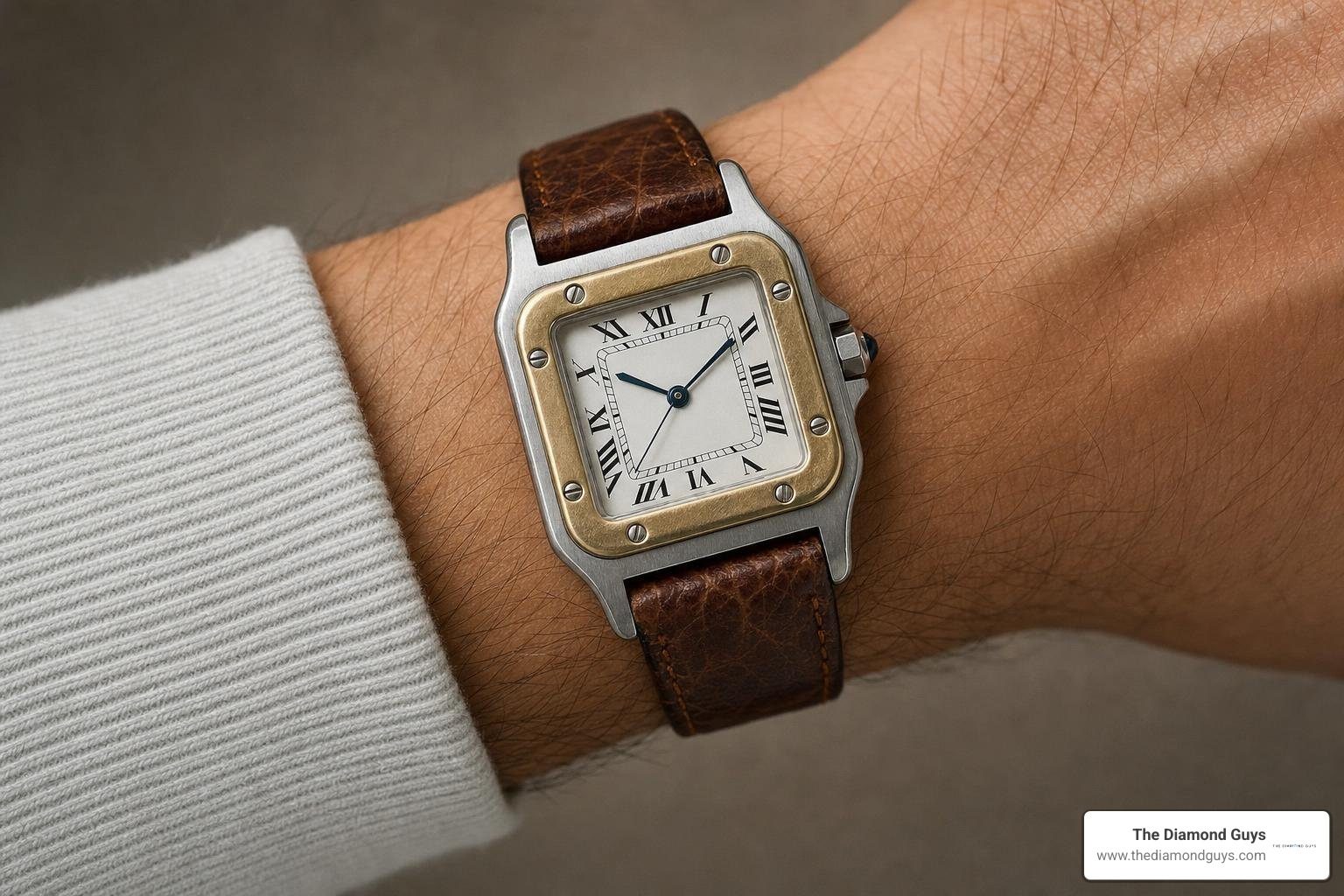
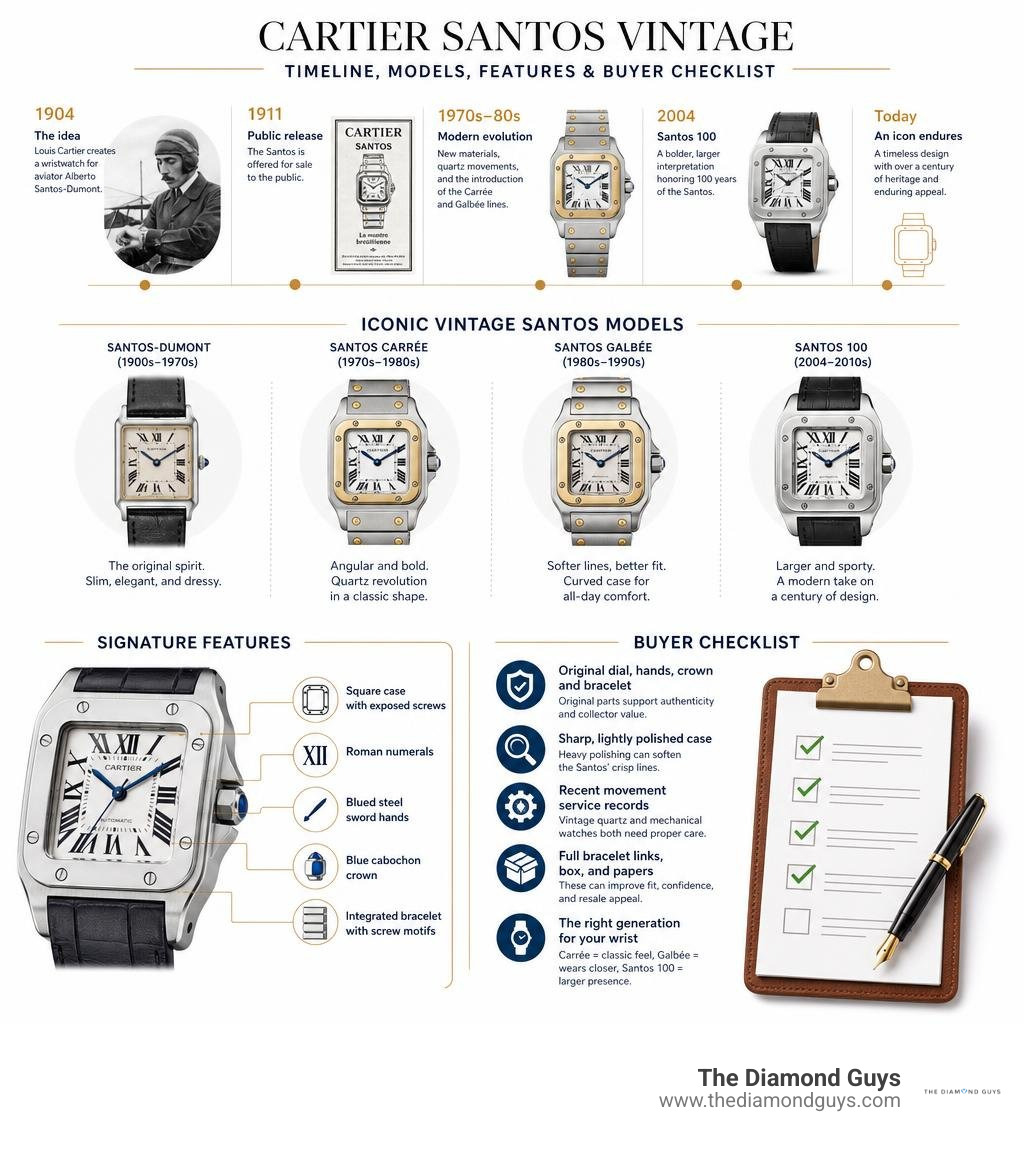
A Cartier Santos vintage watch offers one of the clearest paths into meaningful watch collecting: a design with real history, a recognizable look, and prices that can be far below a new Cartier. Created by Louis Cartier for aviator Alberto Santos-Dumont in 1904, the Santos is widely regarded as the first wristwatch made specifically for a man and one of the earliest pilot's watches. It reached public sale in 1911.
For a quick buying answer, focus on these points:
| What to look for | Why it matters |
|---|---|
| Original dial, hands, crown, and bracelet | Original parts support authenticity and collector value |
| A sharp, lightly polished case | Heavy polishing can soften the Santos' crisp lines |
| Recent movement service records | Vintage quartz and mechanical watches both need proper care |
| Full bracelet links, box, and papers where possible | These can improve fit, confidence, and resale appeal |
| The right generation for your wrist | Flat Carrée models feel classic; curved Galbée models wear closer; Santos 100 models wear much larger |
The appeal is easy to see. The square case, Roman numerals, blued sword hands, blue cabochon crown, and visible screws create a look that has changed very little in spirit over more than a century. Yet "vintage Santos" can mean several very different watches, from slim manual-wind Santos-Dumont pieces to 1980s steel-and-gold Carrée models, curved Galbée references, and the larger Santos 100.
I am Morgan Price, a strategic research and outreach specialist focused on creating useful, well-sourced luxury content, including guidance for buyers comparing a Cartier Santos vintage watch with newer alternatives. In this guide, I will help you understand the key models, the signals of originality, and the trade-offs worth considering before you buy.
Terms related to Cartier Santos vintage:
History and Design Features of the Cartier Santos Vintage
The origin of the Cartier Santos is one of the most legendary stories in horology. In 1904, Brazilian aviation pioneer Alberto Santos-Dumont voiced a practical problem to his friend Louis Cartier: pocket watches were completely impractical to operate while keeping two hands on the controls of an aircraft during flight. Louis Cartier solved this challenge by designing a flat, square wristwatch with an ultra-legible dial that could be strapped directly to the wrist. When Santos-Dumont flew his aircraft in front of crowds in 1906, he wore his custom Cartier wristwatch, forever linking high aviation with luxury horology. The watch was released to the commercial public in 1911.
What makes a Cartier Santos vintage timepiece instantly identifiable across any era is its strict geometric DNA. Rather than trying to disguise the functional elements, Louis Cartier celebrated them. The signature aesthetic elements include:
- Square Case Profile: Inspired by the symmetry of traditional Parisian architecture and classical geometric balance.
- Exposed Bezel and Bracelet Screws: Industrial riveted details reminiscent of aircraft fuselage construction from early 20th-century aviation.
- Roman Numeral Hour Markers: Bold, radial Roman numerals encircling a inner square minute track (chemin de fer).
- Sapphire Cabochon Crown: A faceted blue sapphire or spinel gemstone set directly into the winding crown, serving as Cartier's hallmark jewelry accent.
- Blued Steel Sword Hands: Heat-treated steel hands that glint electric blue in natural light.
To help visualize how the collection evolved across different decades, consider this overview of prominent vintage references:
| Era / Reference | Model Name | Primary Case Sizes | Movement Types | Key Design Characteristic |
|---|---|---|---|---|
| 1978–1987 (Ref. 2960 / 2961) | Santos Carrée | 29mm x 41mm | Automatic (Cal. 077 / 2671) | Flat caseback, sharp angular bevels, integrated bimetal bracelet |
| 1980s–1990s (Ref. 0907 / 187903) | Santos Octagon | 25mm, 29mm | Automatic & Quartz | Eight-sided 18k yellow gold bezel with 8 visible screws |
| 1987–2010s (Ref. 1564 / 2823) | Santos Galbée | 29mm, 32mm (XL) | Quartz & Automatic | Ergonomic curved (galbée) caseback and bracelet links |
| 2004–2018 (Ref. 2656 / W20073X8) | Santos 100 | 33mm, 38mm, 42mm | Automatic (Cal. 049 / 1904-PS) | Oversized bold case, crown guard, 100m water resistance rating |
Santos Carrée Ref 2960 and 2961: The Bimetal Pioneer
Prior to 1978, Cartier timepieces were almost exclusively crafted in solid precious metals such as 18k gold or platinum. However, under the visionary leadership of CEO Alain-Dominique Perrin, Cartier launched a dramatic revolution on October 20, 1978, by introducing a sports-chic luxury watch featuring an integrated stainless steel and 18k yellow gold construction. This marked Cartier's very first use of stainless steel in watchmaking.
This generation became known retroactively as the Santos Carrée (derived from the French word for "square"). The two most famous iterations from this era are the Cartier Santos Carrée Two Tone (Ref. 2961) and the full stainless steel Cartier Santos Carrée Ref. 2960.
Measuring 29mm in width by 41mm lug-to-lug, the Carrée featured a distinctively flat case profile with crisp, razor-sharp bevels (chamfers) running down the case sides. Powered by robust self-winding automatic calibers like the Caliber 077 (ETA base), these watches possessed classic 1980s presence while remaining remarkably slim on the wrist.
Santos Galbée and Octagon: Ergonomics and Geometry in a Cartier Santos Vintage
As watchmaking shifted during the mid-1980s, Cartier refined the classic square silhouette. In 1987, Cartier introduced the Santos Galbée ("galbée" translating directly to "curved"). The Galbée replaced the rigid, boxy flat back of the Carrée with an ergonomically contoured case that wrapped seamlessly around the curve of the wrist. The bracelet links were similarly redesigned with a gentle curve, preventing the watch from sitting awkwardly flat on slender wrists.
Concurrently during the 1980s and 1990s, Cartier experimented with geometric variations. The most famous was the Vintage Cartier Santos Octagonal Watch. This distinctive series swapped the traditional square bezel for an eight-sided 18k yellow gold octagon secured by eight exposed screws. Offered in a 25mm ladies size (Ref. 0907) and a 29mm unisex size, it featured both high-grade quartz movements and compact automatic calibers. For watch enthusiasts collecting used automatic watches, the Santos Galbée and Santos Octagon represent some of the most versatile two-tone dress watches ever produced.
Santos 100 and Modern Santos de Cartier Iterations
To mark the 100th anniversary of Alberto Santos-Dumont's iconic watch in 2004, Cartier released the Santos 100. Discontinued in 2018, the Santos 100 shifted the aesthetic into bold, modern dimensions with case sizes in Midsize (33mm), Large (38mm x 38mm), and Extra Large (42mm x 51mm). It also brought enhanced durability with a 100-meter water resistance rating and a beefed-up crown guard structure.
In 2018, Cartier completely refreshed the core line with the contemporary Santos de Cartier. Modern references brought user-friendly innovations:
- QuickSwitch System: Allows owners to instantly swap between metal bracelets and leather or rubber straps at the press of an under-lug release button without tools.
- SmartLink System: Enables owners to add or remove individual metal bracelet links by depressing a tiny push-button on each link, eliminating the need for jeweler sizing tools.
Comparing modern dimensions against vintage pieces shows a clear evolution: vintage 29mm Carrée models offer understated classic elegance, whereas modern Medium (35.1mm) and Large (39.8mm) models cater to contemporary preference for wrist presence.
Collector Guide: Authenticating and Evaluating Condition
Because vintage Santos references—particularly late-1970s and 1980s two-tone models—became tremendously popular worldwide, they remain heavily targeted by counterfeiting or sloppy aftermarket modifications. When evaluating a pre-owned piece, close examination under magnifying magnification is essential.
Key detail areas requiring close inspection:
- Dial Printing and "Secret Signature": Look at the VII or X Roman numeral hour marker. On authentic Cartier dials, the brand name "CARTIER" is micro-printed in microscopic text forming one leg of the numeral.
- Case Chamfers & Lugs: Over-polishing is the single biggest enemy of a Cartier Santos vintage case. A pristine Carrée or Galbée should feature sharp, crisp, polished bevel angles contrasting against brushed top surfaces. Soft, rounded edges mean the case has been aggressively buffed on a polishing wheel.
- The Crown & Cabochon: Original crown stones are smooth, deep blue sapphires or spinels set firmly into the metal crown housing. Cheap replacements often feature dull, glued-on plastic or glass cabs that sit crookedly.
- Bracelet Stretch and Screws: Inspect the integrated steel and gold bracelet for excessive play or sagging ("bracelet stretch"). Verify that the 18k gold accent screws sit perfectly flush with the stainless steel bracelet links.
Much like evaluating authentic vintage rolex watches, verifying case serial numbers against guarantee certificates provides complete peace of mind.
Evaluating Condition, Movements, and Materials
When shopping for pre-owned timepieces through trusted dealers offering curated Pre-Owned Cartier Santos Watches, understanding movement variations will dictate both maintenance expectations and overall value:
- Automatic Mechanical Movements: Found in the original Carrée (Ref. 2960/2961) and automatic Galbée variants. Mechanical movements offer traditional horological prestige and sweeping second-hand motion. They require routine mechanical servicing every 5 to 7 years to clean and lubricate internal gears.
- Quartz Movements: Introduced widely in the 1980s during the quartz era. Cartier quartz calibers offer grab-and-go grab-and-wear precision and slimmer case profiles. Modern battery replacements and gasket seals are straightforward, making quartz Galbée and Octagon models wonderfully easy daily wearers.
- Precious Metals & Bimetal: Two-tone stainless steel and 18k yellow gold represents the classic 1980s Santos palette. Solid 18k yellow gold, solid white gold, or platinum variants command significant market premiums due to intrinsic precious metal melt and extreme collector rarity.
Spotting Red Flags when Purchasing a Cartier Santos Vintage
Be on high alert for these common warning signs when examining a prospective vintage Santos purchase:
- Spider Web Dials (Cracked Lacquer): Many 1980s white lacquer dials developed hairline micro-fractures over time due to UV exposure and humidity changes. While some collectors appreciate light "spider dial" patina, severe paint flaking or cracking drastically reduces value.
- Misaligned or Aftermarket Screws: Authentic bezel and bracelet screws are individually machined to tight tolerances. Cheap aftermarket screws feature uneven slot widths or incorrect yellow gold alloy colors.
- Repainted Dials: Dials that have been poorly restored or repainted by third parties frequently display overly thick paint, fuzzy Roman numeral lines, or missing minute tracks.
- Mismatched Serial Engravings: The deep, sharp caseback engravings detailing the reference number and individual serial number must match paperwork documentation precisely.
Market Valuation and Investment Potential
The secondary market for pre-owned Cartier Santos models has experienced steady, healthy growth over recent years. Its classic design heritage ensures that it avoids the extreme speculative bubbles seen in hype sports watches, offering stable value retention for collectors.

Current market price expectations in 2026 across key pre-owned categories:
- Entry-Level Vintage ($2,800 – $4,200): Consists primarily of 1980s/1990s quartz Santos Octagon (Ref. 187903) and 24mm/29mm quartz Santos Galbée models in steel or two-tone. Excellent value entry point for daily wear.
- Classic Automatic Bimetal ($6,500 – $9,500): Crisp, well-preserved Santos Carrée Ref. 2961 and automatic Santos Galbée models in steel and 18k yellow gold. Models featuring rare factory dial variants (such as slate grey, burgundy, or dark blue lacquer) easily cross the $8,500 mark.
- Santos 100 & Neo-Vintage Steel ($5,500 – $7,500): Stainless steel Santos 100 Large models (Ref. 2656) and modern pre-owned Santos de Cartier Medium/Large references complete with original box and papers.
- Rare Precious Metal & Skeletons ($12,000 – $35,000+): Solid 18k gold Santos-Dumont Extra Plate references, vintage solid gold Galbée models, and modern skeletonized movement editions.
Collectors looking for strong future appreciation consistently prioritize "full sets"—watches accompanied by their period-correct red leather Cartier box, stamped guarantee certificate, operating manuals, and all original bracelet links.
Comparing pre-owned luxury sports options like an iwc pilot pre-owned or iconic dress models shows that the Cartier Santos occupies a rare sweet spot: it delivers high-fashion luxury pedigree paired with genuine pilot heritage.
Frequently Asked Questions About Pre-Owned Cartier Santos Watches
Why is the Cartier Santos historically significant?
The Cartier Santos was created in 1904 by Louis Cartier for aviation pioneer Alberto Santos-Dumont, making it the world's very first purpose-built pilot's watch and the first wristwatch designed specifically for men. Prior to its creation, men relied exclusively on pocket watches, viewing wrist-worn timepieces as delicate women's novelties.
How does a vintage Santos compare to modern models in size and daily wear?
Vintage models from the 1970s and 1980s (such as the 29mm Carrée and Galbée) feature classic mid-century proportions that wear discreetly under a shirt cuff. Modern Santos de Cartier models feature larger 35mm (Medium) and 39.8mm (Large) case widths designed for bolder modern wrist presence. Modern editions also feature tool-free QuickSwitch strap systems and higher water resistance, whereas vintage pieces require careful handling around moisture.
What is the expected price range for pre-owned Cartier Santos models in 2026?
Pre-owned prices in 2026 typically start around $2,800 to $3,500 for vintage quartz Octagon or small Galbée references. Iconic two-tone automatic Santos Carrée Ref. 2961 models range between $6,500 and $9,500 depending on case condition, unpolished chamfers, and original paperwork. Solid gold or limited edition skeletonized versions command from $12,000 to over $35,000.
Conclusion

Whether you are drawn to the historical significance of the world's first aviator watch or the sharp 1980s luxury aesthetic of two-tone steel and gold, acquiring a Cartier Santos vintage timepiece is a deeply rewarding investment in horological art. Its square geometry, exposed screws, and blue cabochon crown have remained timeless for well over a century, proving that true style never goes out of fashion.
At The Diamond Guys, operating from our premier showrooms in Scottsdale, AZ, and Los Angeles, CA, we bring expert guidance, ethical sourcing, and a personalized shopping experience to watch enthusiasts and jewelry collectors alike. Whether you are seeking a verified pre-owned timepiece, comparing classic luxury references against modern icons like audemars piguet used watches, or designing a custom jewelry piece, our team is dedicated to helping you make every purchase with absolute confidence. Visit us in Scottsdale or reach out directly to explore our curated luxury collection today.


