

10 Expert Tips to Keep Your Engagement Ring Looking Brand New
Why Engagement Ring Maintenance Is Worth Taking Seriously

Engagement ring maintenance is the set of regular habits — from at-home cleaning to professional inspections — that keep your ring sparkling, structurally sound, and protected for a lifetime.
Quick answer: Here's what good ring maintenance looks like:
| Task | How Often |
|---|---|
| Wipe with a jewelry cloth | Daily |
| Clean with warm soapy water and soft toothbrush | Weekly |
| Check for loose stones (tap test near your ear) | Monthly |
| Professional inspection and cleaning | Every 6-12 months |
| Professional polishing | Every 1-2 years |
| Updated appraisal for insurance | Every 2-3 years |
The average American spends over $5,000 on an engagement ring. That's not just a piece of jewelry — it's a serious financial investment and a symbol that carries deep personal meaning. Yet most people give their ring far less care than it deserves.
The good news? Protecting your ring doesn't require expensive tools or complicated routines. A few simple daily habits and the occasional visit to your jeweler can prevent the kind of damage that costs thousands to fix — or results in a lost stone that can't be replaced at all.
I'm Morgan Price, a jewelry content specialist with hands-on experience researching and writing about engagement ring maintenance and long-term jewelry care. In this guide, I'll walk you through exactly what the experts recommend — so your ring looks as stunning on your 25th anniversary as it did the day you first put it on.
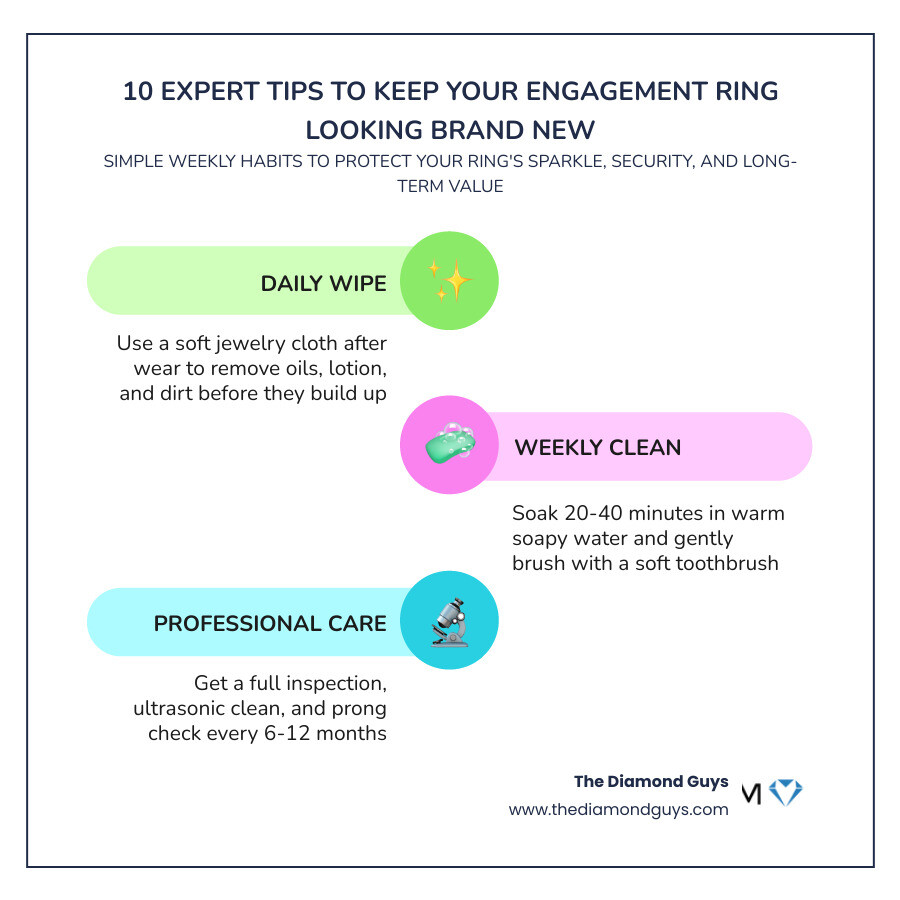
Simple guide to Engagement ring maintenance terms:
Master the Art of At-Home Engagement Ring Maintenance
Maintaining that "just left the showroom" glow doesn't require a degree in gemology. In fact, some of the most effective engagement ring maintenance happens right at your kitchen sink. Diamonds are naturally "oleophilic," which is a fancy way of saying they are grease magnets. They attract oils from your skin, lotions, and even cooking fats, which create a film that blocks light from entering the stone, making it look dull and cloudy.

To keep your center stone firing on all cylinders, we recommend a The Diamond Guys Guide to At-Home Jewelry Care approach. The "Gold Standard" for home cleaning is a simple soak.
Start by filling a small bowl with warm (not boiling) water and adding a few drops of mild dish soap. Avoid "moisturizing" soaps or anything with harsh chemicals. Soak your ring for 20 to 40 minutes. This softens the grime tucked away in the tiny crevices of the setting. After the soak, use a soft-bristled toothbrush to gently scrub the stone and the metal.
Weekly DIY Engagement Ring Maintenance Routine
Consistency is the secret sauce of engagement ring maintenance. If you wait six months to clean your ring, the dirt can become "compacted," making it much harder to remove without professional equipment.
When you do your weekly scrub, pay special attention to the underside of the stone. This is where the most buildup occurs because it sits directly against your skin. A clean underside allows light to pass through the diamond more effectively, maximizing its brilliance. Once you're finished scrubbing, rinse the ring under warm running water (make sure the drain is plugged!) and pat it dry with a lint-free cloth. Avoid paper towels, as they can leave tiny fibers behind or even cause micro-scratches on softer metals.
Safe Cleaning for Different Metals and Gemstones
Not all rings are created equal, and your cleaning method should reflect the specific materials of your piece. While diamonds, sapphires, and rubies are incredibly durable, other gemstones and metals require a more delicate touch.
| Material | Hardness (Mohs) | Maintenance Note |
|---|---|---|
| Diamond | 10 | Extremely durable; safe for soapy water and soft brushes. |
| Platinum | 4-4.5 | Displaces metal rather than losing it; develops a "patina" (soft glow). |
| White Gold | 2.5-4 | Requires rhodium plating every 1-2 years to stay bright white. |
| Emerald | 7.5-8 | Often oil-treated; avoid ultrasonic cleaners and hot water. |
| Opal/Pearl | 2.5-6.5 | Porous and soft; wipe with a damp cloth only; avoid all chemicals. |
For white gold owners, the silvery finish comes from rhodium plating. Over time, this wears away, revealing a slightly yellowish gold underneath. This is a normal part of engagement ring maintenance and can be easily refreshed by a professional jeweler. Platinum, on the other hand, doesn't wear away; it develops tiny scratches that create a matte finish known as a patina. Some people love this look as a sign of the ring's history, while others prefer to have it polished back to a high shine every few years.
When to Take It Off: Protecting Your Ring from Daily Hazards
One of the most important parts of engagement ring maintenance is knowing when not to wear your ring. We often see clients who treat their rings like they are indestructible, but even a diamond can chip if hit at the right angle, and metal prongs are surprisingly easy to bend.
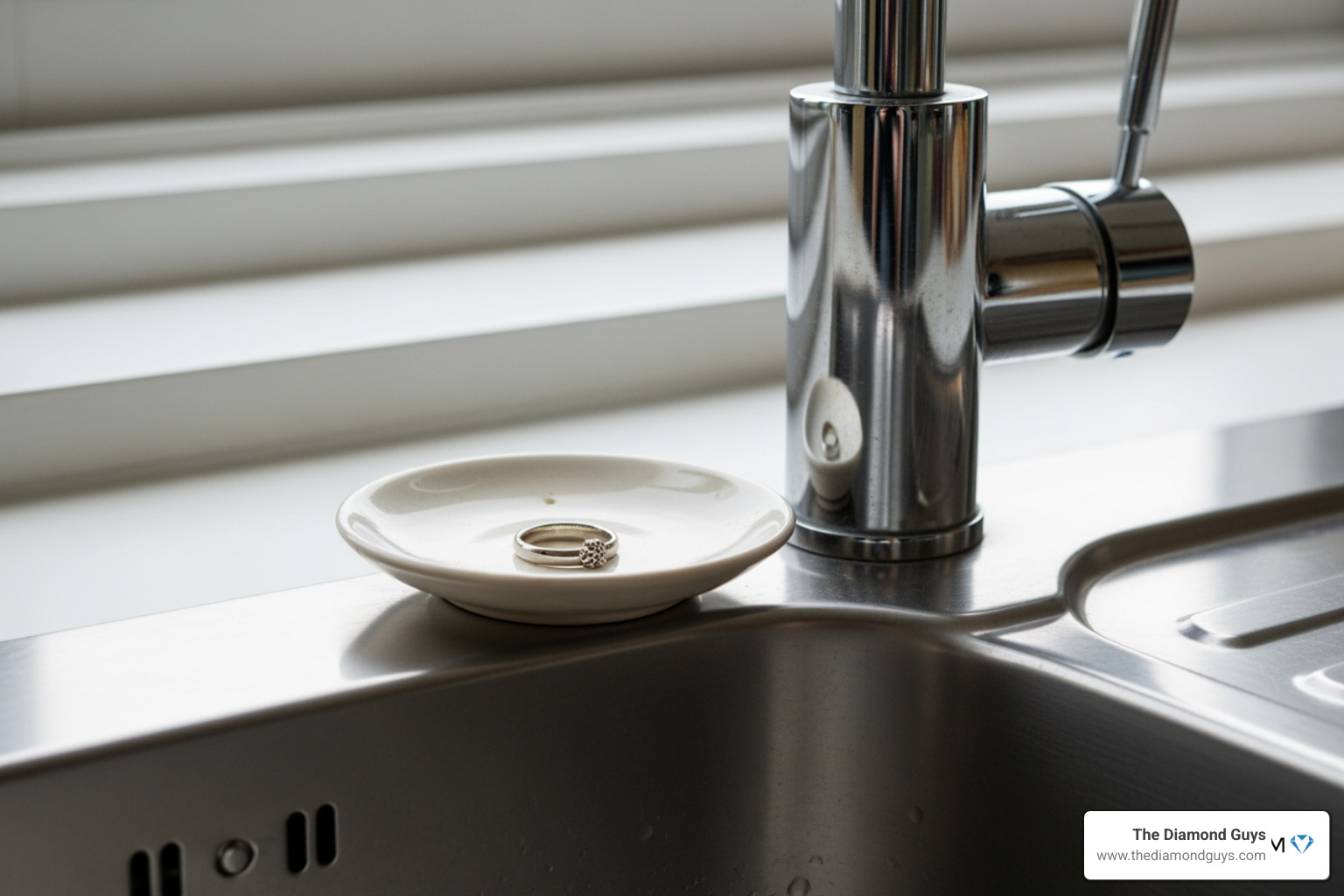
A good rule of thumb? If you’re doing something that requires "elbow grease" or involves chemicals, the ring should come off. We suggest setting up "ring stations" throughout your home—small, dedicated dishes in the kitchen, bathroom, and on your nightstand. This prevents you from leaving the ring on a random counter where it could be knocked behind a cabinet or swept into the trash. For more specific scenarios, check out our guide on Protecting Your Investment: When to Remove Your Ring.
Avoiding Chemical Exposure and Buildup
Your daily beauty and hygiene routine can be a minefield for fine jewelry. Hand sanitizer is one of the biggest culprits in modern engagement ring maintenance. While it won't hurt a diamond, the high alcohol content can dull the finish of gold and platinum over time and can be devastating to porous stones like pearls.
Similarly, moisturizing lotions, hairsprays, and perfumes leave a sticky film that acts like glue for dust and dirt. Always follow the "Last On, First Off" rule: your ring should be the very last thing you put on in the morning after all your products have dried, and the first thing you take off when you get home.
Why You Should Remove Your Ring Before Sleep
It might seem romantic to never take your ring off, but sleeping with it can actually be hazardous to the ring's health. During the night, your fingers can swell, leading to circulation issues. More importantly, your ring can snag on bedsheets or your own hair. This constant tugging puts unnecessary prong tension on the setting, which can eventually lead to a loose or lost stone.
Furthermore, if you have a pavé setting (lots of tiny diamonds), the friction against the fabric of your pillows and blankets can gradually wear down the tiny beads of metal holding those stones in place. Keeping a dedicated ring dish on your nightstand is a simple habit that preserves the structural integrity of your piece.
Professional Inspections and Structural Integrity
While at-home care is great for sparkle, professional engagement ring maintenance is essential for security. Think of it like a car: you can wash it at home, but you still need a mechanic to check the brakes and the engine.
We recommend bringing your ring to a professional every 6 to 12 months. During these visits, a jeweler will use a 10x magnification loupe to inspect the prongs (the metal claws holding your diamond). Even a slight "lift" in a prong can allow a stone to rotate or fall out. For those in the Phoenix or Scottsdale area, you can take advantage of the Professional Jewelry Services at The Diamond Guys to ensure your setting is rock solid.
The Importance of Professional Engagement Ring Maintenance
A professional cleaning goes far beyond what a toothbrush can achieve. Jewelers use ultrasonic cleaners, which use high-frequency sound waves to create tiny bubbles that "blast" dirt out of places you can't even see. They also use high-pressure steam to remove stubborn oils and waxes.
More importantly, a professional check-up catches "metal fatigue." Over years of wear, the bottom of the ring (the shank) can become thin, or the prongs can wear down until they are no longer safe. Catching these issues early means a simple prong tightening or "re-tipping" (adding a bit of metal to the top of the prong), which is significantly cheaper than replacing a lost center stone.
Understanding Resizing and Metal Fatigue
Your body changes over time, and your ring fit will too. Factors like seasonal temperature changes (fingers shrink in the winter and swell in the summer), pregnancy, and weight fluctuations all affect how your ring sits. However, you should be cautious about frequent resizing.
Every time a ring is resized, the metal is cut and soldered back together. This creates a "join" that is a potential weak point. We generally recommend limiting resizing to 1-2 times over the lifetime of a ring to avoid significant structural weakening. If your ring is only slightly loose, consider "sizing beads" or a temporary silicone insert rather than a permanent cut. If you do need a permanent change, ensure you use Expert Jewelry Repair and Resizing Services to maintain the ring's strength.
Smart Storage and Financial Protection
When your ring isn't on your finger, where is it? Proper storage is a key pillar of engagement ring maintenance. Diamonds are the hardest natural substance on Earth, which means the only thing that can scratch a diamond is another diamond. If you throw your engagement ring into a jewelry box with other diamond pieces, they will inevitably scratch each other and the metal settings.
Insuring Your Investment for Peace of Mind
Even with the best engagement ring maintenance, accidents happen. Rings are lost in the ocean, stolen during travel, or damaged in freak accidents. This is why insurance is non-negotiable.
Typically, jewelry insurance costs between 1% and 2% of the ring's appraised value per year. For a $5,000 ring, that’s only about $50 to $100 annually—less than a single nice dinner out. Most standard homeowners or renters insurance policies only cover up to $1,000 or $2,500 for jewelry, which is often not enough. Look for a "scheduled rider" or a standalone jewelry insurance policy that covers loss, theft, and mysterious disappearance.
The Role of Appraisals in Engagement Ring Maintenance
To get proper insurance, you need an accurate appraisal. This document details the quality of the diamond (often referencing its GIA certification), the metal type, and the current retail replacement value.
Because the price of gold and diamonds fluctuates, we recommend getting an updated appraisal every 2 to 3 years. If your ring was appraised for $5,000 five years ago but would now cost $7,000 to replace, your old insurance policy won't cover the full cost of a new ring. Keeping your paperwork current is just as important as keeping the prongs tight. If you're looking for Jewelry Appraisal Services in Scottsdale, make sure to work with a GIA-trained professional.
Frequently Asked Questions about Engagement Ring Care
How often should I get my ring professionally inspected?
For a ring worn every day, we recommend a professional inspection every 6 months, and no less than once a year. This allows us to catch loose stones or worn prongs before they become expensive disasters.
Is it safe to use ultrasonic cleaners at home?
While you can buy small ultrasonic cleaners for home use, we generally advise caution. The vibrations can actually loosen stones if the setting is already compromised. It’s best to let a professional jeweler handle ultrasonic cleaning so they can inspect the stones immediately afterward. Also, never put emeralds, opals, or pearls in an ultrasonic cleaner, as the vibrations can shatter or damage them.
Can I wear my engagement ring in the shower?
It's better to take it off. While water itself won't hurt most rings, the soaps, oils, and exfoliants in your body wash create a film on the diamond. Furthermore, slippery fingers in a soapy shower are a recipe for a ring sliding off and disappearing down the drain.
Conclusion
Your engagement ring is designed to last a lifetime, but it needs a little help from you to get there. By following these 10 expert tips—from weekly soapy soaks to annual professional inspections—you ensure that your most precious piece of jewelry remains a brilliant symbol of your commitment.
At The Diamond Guys, we pride ourselves on being more than just a jewelry store. As a 5-star rated jeweler in Scottsdale and Los Angeles, we specialize in custom engagement rings and ethical sourcing, providing the expert guidance you need for long-term engagement ring maintenance. Whether you need a simple cleaning or a complex repair, our personalized approach ensures your jewelry receives the care it deserves.
For more information on keeping your jewelry in peak condition, check out our Complete Guide to Jewelry Repair in Scottsdale or visit us in-store to speak with a GIA Graduate Gemologist today. Stay sparkly!


