

How to Shop for Exquisite Lab Grown Pink and Yellow Diamonds
The Most Beautiful Diamonds You've Never Had to Mine

Lab grown pink diamonds are real diamonds — chemically, physically, and optically identical to natural pink diamonds — but created in a laboratory in weeks rather than billions of years underground.
If you're ready to shop, here's what you need to know at a glance:
| Feature | Lab Grown Pink Diamond |
|---|---|
| What it is | Real diamond, grown in a lab using CVD or HPHT methods |
| Color origin | Trace elements + post-growth treatment (irradiation/annealing) |
| Cost vs. natural | 80–90% more affordable |
| Grading | Same GIA/IGI standards as natural diamonds |
| Availability | Only ~5% of all lab grown diamonds are pink |
| Hardness | 10 on the Mohs scale — the hardest natural substance |
| Ethical sourcing | Conflict-free, no mining required |
Pink diamonds are among the rarest and most coveted gemstones in the world. Before the Argyle Diamond Mine in Western Australia closed in 2020, it produced roughly 80% of the world's supply — and even then, only 0.1% of its output qualified as pink. The record-setting Pink Star, a 59.6-carat natural fancy vivid pink diamond, sold for $71.2 million at auction — a price point that puts natural pink diamonds firmly out of reach for most buyers.
Lab grown pink diamonds change that equation entirely.
I'm Morgan Price, a backlink outreach and content specialist with deep experience researching and writing about lab grown pink diamonds and the broader colored diamond market. In this guide, I'll walk you through everything you need to make a confident, informed purchase — from how these stones are made to what to look for when you shop.
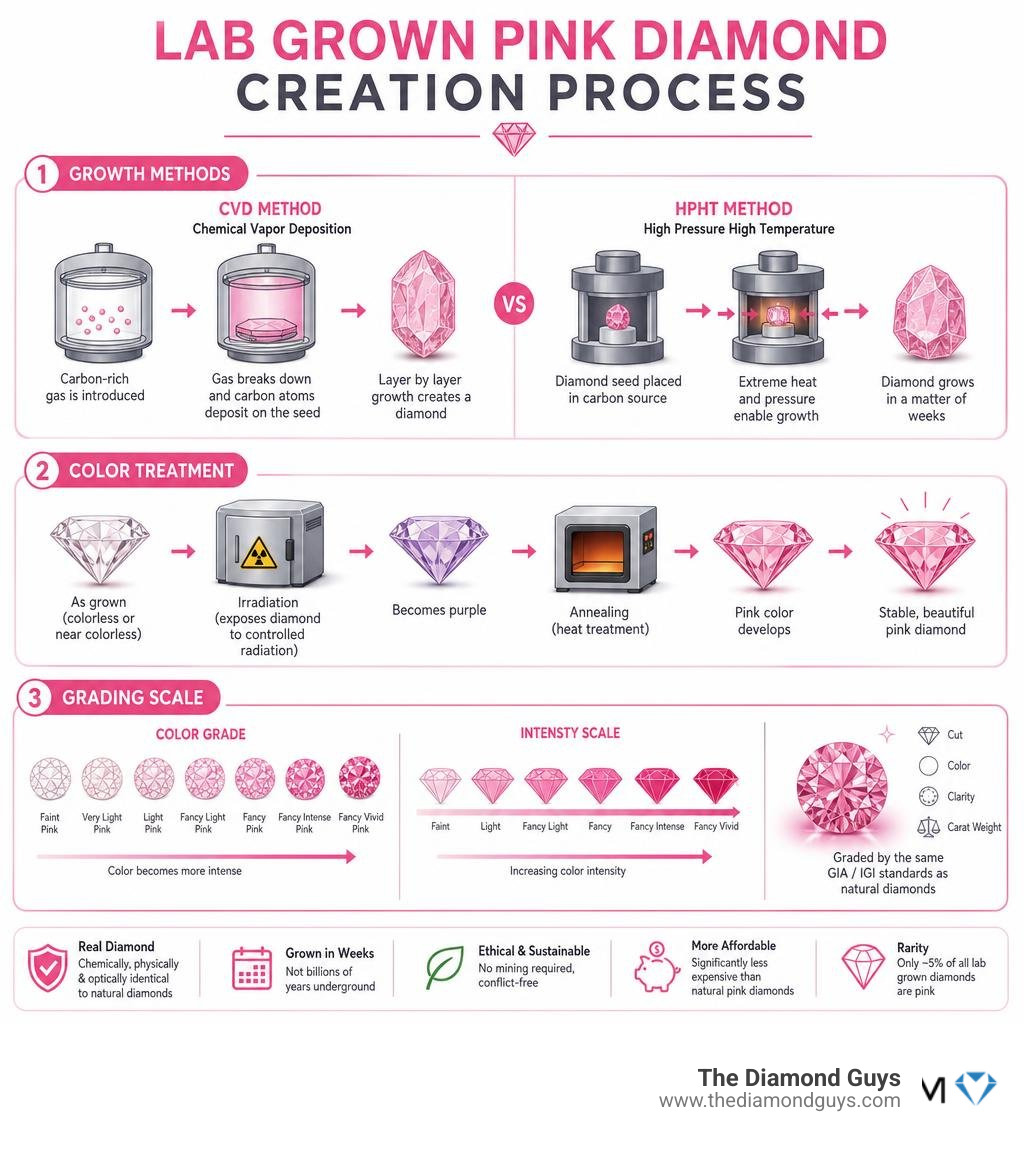
The Science and Appeal of Lab Grown Pink Diamonds

For centuries, colored diamonds—often called "fancy color diamonds"—were reserved exclusively for royalty and ultra-wealthy collectors. Today, advanced technology allows us to replicate the exact conditions that produce these breathtaking hues.
To understand why lab grown pink diamonds are so special, we have to look at their atomic structure. Diamonds are the only gemstones made of a single element: pure carbon (99.95% carbon, with only about 0.05% trace elements). Gemologists classify diamonds into different types based on the presence of these trace elements.
The most elite category is Type IIa. Only about 2% of all mined diamonds are classified as Type IIa, which includes famous historic stones like the Koh-i-Noor and the Elizabeth Taylor Diamond. These diamonds are virtually free of nitrogen impurities, making them exceptionally transparent and brilliant. Pink diamonds—both natural and lab-grown—belong to this rare Type IIa family.
When scientists grow these stones in a controlled environment, they use one of two primary techniques:
- Chemical Vapor Deposition (CVD): A method where carbon-rich gas is ionized in a vacuum chamber, causing pure carbon atoms to rain down onto a diamond seed crystal, growing it layer by layer.
- High Pressure High Temperature (HPHT): A process that mimics the earth's mantle, subjecting carbon to extreme pressures and temperatures to crystallize a diamond.
While some colored diamonds get their hues directly during the initial growth phase, achieving a rich, romantic pink often requires specialized post-growth treatments. Because are lab grown diamonds real diamonds in every sense of the word, they respond to the exact same physical forces as mined stones. To bring out those coveted blush and rose tones, lab-grown rough stones undergo post-growth irradiation and annealing—a process where the diamond is exposed to controlled radiation and then heated to high temperatures to rearrange its crystal lattice without altering its chemical purity.

How Lab Grown Pink Diamonds Get Their Color
In most colored diamonds, the hue comes from trace elements trapped inside the carbon structure. For example, nitrogen creates sunny yellow diamonds, while boron yields deep ocean-blue diamonds.
Pink diamonds, however, are a beautiful scientific mystery.
In nature, the pink hue is not caused by trace elements. Instead, it is the result of plastic deformation. Billions of years ago, intense seismic shock and volcanic pressure warped the diamond's crystal lattice structure. This physical twisting causes the diamond to absorb green light and refract a stunning spectrum of pinks, ranging from soft baby pink to deep French rosé.
In the laboratory, scientists replicate this lattice distortion. By combining CVD or HPHT growth with precise post-growth treatments, technicians intentionally alter the crystal lattice. This allows us to offer customized shades of pink—from a subtle, elegant blush to a vivid, jaw-dropping magenta—with a level of control that nature simply cannot match.
The Rarity of Pink Hues in the Lab and Nature
While lab technology has advanced leaps and bounds by 2026, creating high-quality lab grown pink diamonds remains incredibly difficult. In fact, only 5% of all lab-grown diamonds are pink.
This scarcity is even more pronounced in the natural world. With the closure of the famous Argyle Diamond Mine in 2020, the global supply of mined pink diamonds has plummeted. Today, finding a natural pink diamond of significant carat weight is like finding a needle in a haystack—and the price tag reflects that.
By choosing a lab-grown alternative, you are tapping into the beauty of Type IIa diamonds without the extreme scarcity premium of the traditional mining market. You can explore a stunning curated selection of pink lab-grown diamonds to find the exact tone and shape that speaks to you.
Comparing Lab-Grown and Mined Pink Diamonds
When you place a lab-grown pink diamond next to a mined pink diamond, even an experienced jeweler cannot tell them apart with the naked eye. They share the exact same physical, chemical, and optical properties.
| Property | Mined Pink Diamond | Lab Grown Pink Diamond |
|---|---|---|
| Chemical Composition | Pure Carbon (C) | Pure Carbon (C) |
| Crystal Structure | Cubic | Cubic |
| Refractive Index | 2.417 | 2.417 |
| Dispersion (Fire) | 0.044 | 0.044 |
| Mohs Hardness | 10 | 10 |
| Type Classification | Type I or Type IIa (Rare) | Type IIa (Ultra-Pure) |
To understand how identical these stones are, consider this: they both pass standard thermal and electrical diamond testers. If you are wondering, can a jeweler tell the difference between lab grown diamonds and natural ones, the answer is yes—but only by using highly specialized, advanced laboratory equipment like photoluminescence spectroscopy to detect minor growth patterns.
Grading the Quality of Lab Grown Pink Diamonds
Just like colorless stones, lab grown pink diamonds are graded using the classic "Four Cs": Color, Clarity, Cut, and Carat weight. However, for colored diamonds, color is king.
Major gemological laboratories, including the International Gemological Institute (IGI) and the Gemological Institute of America (GIA), grade pink diamonds based on three color dimensions:
- Hue: The primary color (pink) and any secondary modifiers (such as purplish-pink or orangey-pink).
- Tone: The lightness or darkness of the stone.
- Saturation: The strength or intensity of the color.
The color intensity scale ranges from Faint, Very Light, Light, and Fancy Light to Fancy, Fancy Intense, Fancy Vivid, and Fancy Deep. A "Fancy Vivid Pink" represents the pinnacle of color saturation—vibrant, rich, and incredibly eye-catching. You can see an example of this premium saturation in listings like this Fancy Vivid Pink Lab Grown Diamond Auction.
While color is the most important factor, do not overlook clarity. In nature, only about 7% of pink diamonds are Flawless or Internally Flawless (IF). Most contain heavy inclusions due to the immense pressure that created them. Lab-grown pinks offer much higher clarity grades, typically ranging from VS1 to VS2, meaning they are virtually eye-clean. Because they are grown under pristine conditions, you also do not have to worry about structural issues; if you have ever asked, do lab grown diamonds get cloudy, the answer is a resounding no—they will retain their brilliant, crystal-clear sparkle forever.
Additionally, keep an eye on fluorescence. More than 80% of natural pink diamonds display fluorescence (glowing under UV light). Lab-grown pinks can also display varying degrees of fluorescence, which is a completely natural optical characteristic.
Price and Value Comparison
The price difference between lab-grown and natural pink diamonds is where the magic happens. Lab-grown pink diamonds are about 80% to 90% more affordable than natural pink diamonds.
Because natural pink diamonds are incredibly rare, a high-quality, 1-carat natural pink diamond can easily cost upwards of $100,000. In contrast, a stunning 1-carat lab-grown pink diamond with excellent clarity and cut can be purchased for a fraction of that cost.
This massive price gap gives you incredible budget flexibility. Instead of compromising on a tiny, heavily included natural stone, you can choose a larger, higher-quality lab-grown diamond that truly makes a statement. If you are debating between the two for a milestone moment, our guide on should I buy a lab grown diamond engagement ring can help you weigh your options.
Top Design Styles for Pink and Yellow Lab Diamond Jewelry

Because lab grown pink diamonds are highly durable (scoring a perfect 10 on the Mohs hardness scale), they are ideal for everyday wear, including custom engagement rings, wedding bands, and statement necklaces.
When designing your jewelry, the choice of metal is crucial to bringing out the stone's natural beauty:
- Rose Gold: A popular choice that blends seamlessly with the diamond's pink hues, creating a soft, romantic, and vintage-inspired look.
- Platinum and White Gold: These bright white metals provide a high-contrast backdrop, making the pink diamond pop and appear even more vibrant.
- Yellow Gold: Perfect for multi-stone designs, especially when pairing pink and yellow lab-grown diamonds for a bold, modern, and cheerful contrast.
For those in the Arizona area looking to see these metals and stones in person, you can visit our premier showroom in Scottsdale to explore a stunning selection of certified lab-grown diamonds and custom jewelry designs.
Popular Shapes and Settings
The cut of a colored diamond behaves differently than a colorless one. While round brilliant cuts are designed to maximize white light return, fancy shapes are preferred for colored diamonds because they hold and intensify color.
- Oval and Cushion Cuts: These shapes have deeper pavilions that bounce light around the interior of the stone, beautifully concentrating and enhancing the pink saturation.
- Emerald and Princess Cuts: These geometric cuts offer a clean, modern aesthetic. An emerald cut highlights the clarity and step-like facets of the stone, while a princess cut offers modern brilliance, perfect for a custom engagement ring.
- Halo Settings: Surrounding your pink diamond with a delicate "halo" of small, colorless lab diamonds is a brilliant way to make the central pink stone appear larger and more vivid.
- Three-Stone Rings: A classic design featuring a central pink diamond flanked by two colorless side stones, symbolizing your past, present, and future.
If you want to create something completely unique, we specialize in helping you design a piece that tells your personal story. Learn more about the creative process in Crafting Your Legacy: The Art of Designing a Custom Lab Diamond Ring.
Caring for Your Colored Lab Diamonds
To keep your pink diamond sparkling like the day you bought it, follow these simple care tips:
- Clean regularly: Soak your jewelry in a bowl of warm water mixed with a few drops of mild dish soap. Use a soft-bristled toothbrush to gently clean behind the setting where oils and lotion can accumulate.
- Rinse and dry: Rinse thoroughly under warm running water and pat dry with a soft, lint-free microfiber cloth.
- Avoid harsh chemicals: Remove your jewelry before swimming in chlorinated pools, using household cleaning agents, or applying heavy lotions and perfumes.
- Store safely: When you are not wearing your jewelry, store it in a soft cloth bag or a lined jewelry box, separate from other pieces, to prevent scratches.
Frequently Asked Questions about Colored Lab Diamonds
Are lab-grown pink diamonds real diamonds?
Yes! Lab grown pink diamonds are 100% real diamonds. They feature the exact same carbon lattice structure, physical hardness, refractive index, and optical beauty as mined diamonds. The only difference is their origin—grown in a state-of-the-art laboratory rather than extracted from the earth.
Do lab-grown pink diamonds fade or change color over time?
No. The pink color in lab-grown diamonds is completely stable and permanent. Because they share the same physical properties as natural stones, they are highly resistant to heat, UV radiation, and daily wear. Their beautiful blush tones will remain vibrant for a lifetime.
How can you tell if a pink diamond is lab-grown or natural?
To the naked eye, it is completely impossible to tell the difference. A professional gemologist must use specialized laboratory equipment, such as photoluminescence spectroscopy, to identify the microscopic growth structures of a lab-grown stone. Additionally, reputable lab-grown diamonds are laser-inscribed on the girdle with a microscopic report number and the words "Lab Grown" to ensure full transparency.
Conclusion
Shopping for a diamond should be an exciting, joyful, and deeply personal experience. Whether you are drawn to the romantic blush of lab grown pink diamonds or the sunny warmth of yellow diamonds, these lab-grown treasures offer an ethical, stunning, and highly affordable way to own a piece of luxury.
At The Diamond Guys, we pride ourselves on providing a boutique, five-star experience that stands in stark contrast to big-box retail chains. With convenient showrooms in Scottsdale, AZ, and Los Angeles, CA, we combine expert guidance with custom-designed jewelry to help you find or create the perfect piece.
If you are ready to take the next step on your diamond journey, we invite you to explore The Diamond Guys Blog for more expert tips, or schedule a personalized consultation with us today. Let’s bring your dream jewelry to life!


