

Why Lab Made Diamond Rings Are Stealing the Spotlight
Lab Made Diamond Rings Are Changing the Way People Buy Diamonds

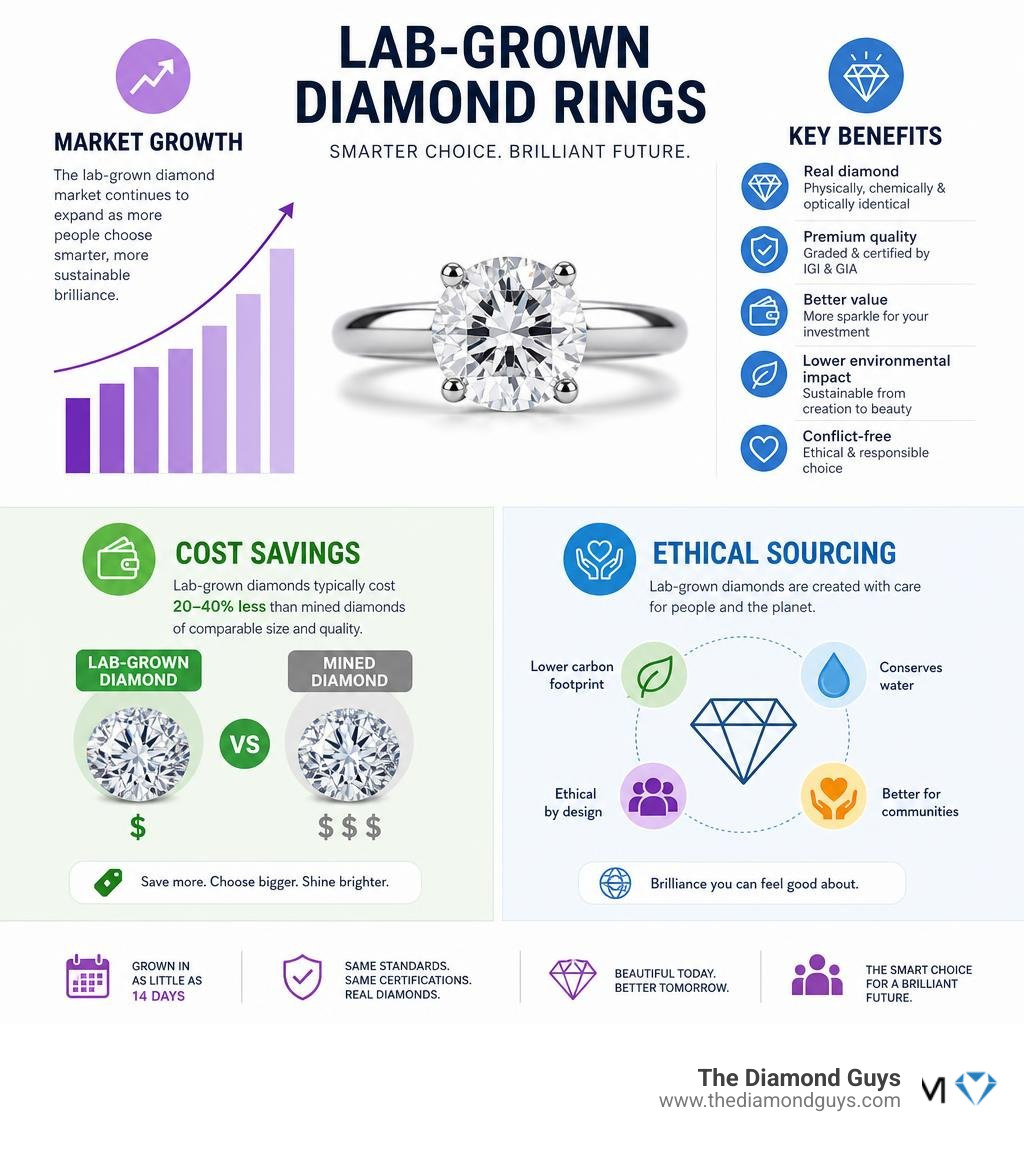
Lab made diamond rings are real diamond rings — physically, chemically, and optically identical to rings set with mined diamonds, but created in a controlled laboratory environment rather than extracted from the earth.
Here's a quick snapshot of what you need to know:
- What they are: Real diamonds grown in a lab using advanced technology that replicates natural diamond formation
- How long they take to grow: As little as 14 days, versus billions of years for mined diamonds
- Cost: Typically 20–40% less expensive than natural diamonds of comparable size and quality
- Quality: Graded by the same standards (cut, clarity, color, carat) and certified by IGI and GIA
- Ethics: Conflict-free origin and lower environmental impact than traditional mining
- Who they're for: Anyone who wants a stunning, certified diamond ring without overpaying or compromising on values
In 2026, more couples than ever are choosing lab-grown diamonds — not as a compromise, but as a deliberate, informed upgrade. The appeal is straightforward: you get a bigger, better diamond for less money, with a cleaner conscience.
I'm Morgan Price, a backlink outreach and content specialist with deep experience researching the lab made diamond rings market and the jewelers, certifications, and consumer trends that shape it. In the sections below, I'll walk you through everything you need to make a confident, well-informed decision.
What Are Lab Made Diamond Rings and How Are They Created?
To understand Lab Made Diamond Rings, we first have to bust a very common myth: these are not "fake" diamonds, nor are they glass, cubic zirconia, or crystal. They are pure carbon, organized in a beautiful, isometric-tetrahedral crystal lattice.
So, how does science accomplish in a matter of weeks what the Earth took billions of years to cook up?
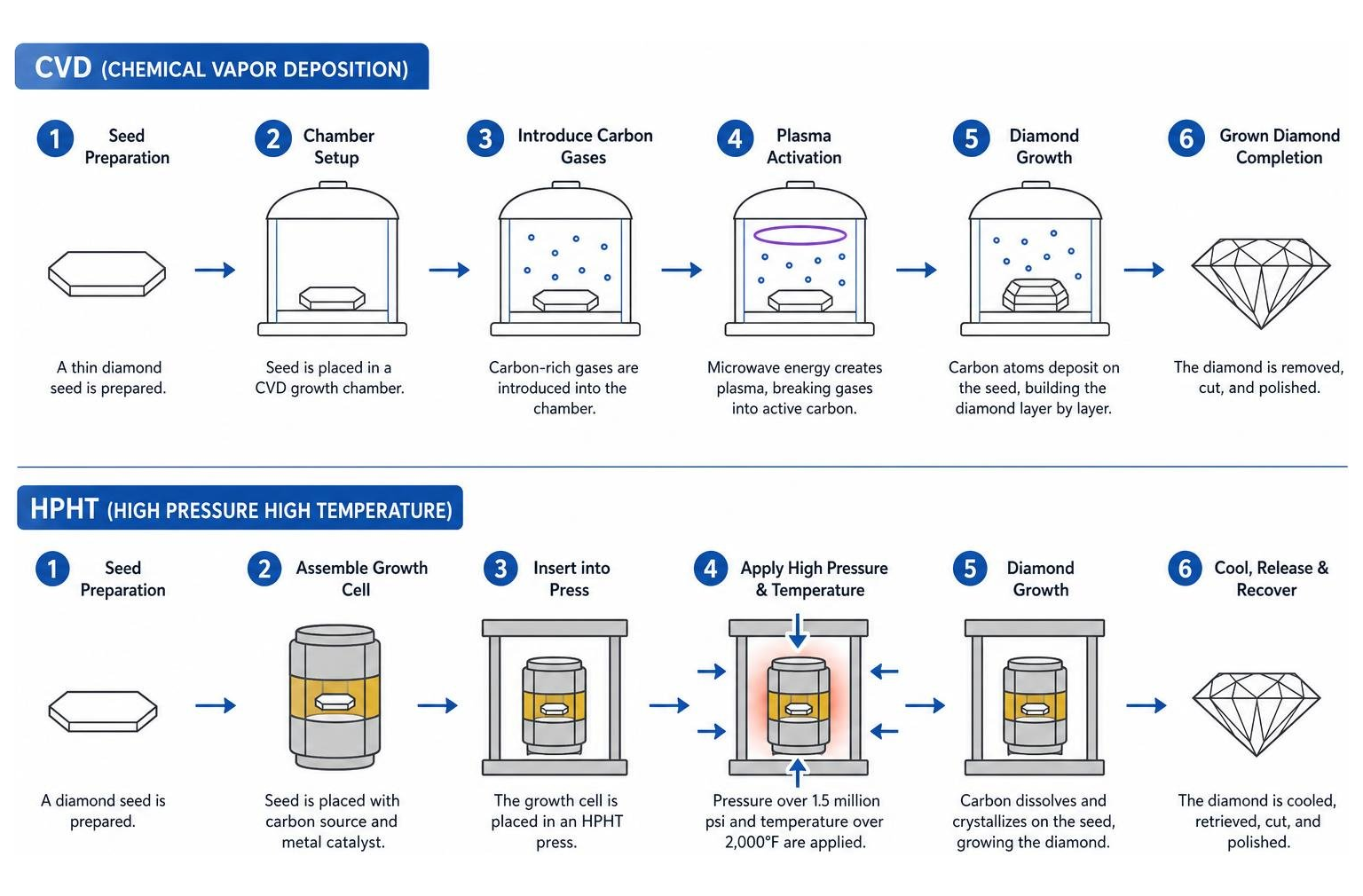
Scientists utilize two primary methods to grow gem-quality diamonds in controlled laboratory environments. Both processes start with a microscopic slice of a pre-existing diamond, known as a carbon seed.
1. High Pressure High Temperature (HPHT)
The HPHT method is the older of the two techniques, designed to mimic the extreme conditions found deep within the Earth's mantle.
- A carbon seed is placed in a specialized press.
- The chamber is heated to temperatures exceeding 2,000 degrees Fahrenheit.
- It is subjected to pressures of over 1.5 million pounds per square inch.
- Under these intense conditions, pure carbon melts and begins to crystallize around the seed, layer by layer, forming a rough diamond.
2. Chemical Vapor Deposition (CVD)
The CVD method is a highly precise, newer technology that has taken the jewelry world by storm.
- The carbon seed is placed in a vacuum chamber filled with carbon-rich gases, such as methane.
- Microwave beam technology is used to heat the chamber, ionizing the gas into a plasma state.
- This process breaks the molecular bonds of the gas, causing pure carbon to rain down and deposit onto the diamond seed.
- The diamond grows atom-by-atom, resulting in incredibly high-clarity crystals.
Using these advanced technologies, a beautiful, rough diamond can be grown in as little as 14 days. Once the growing process is complete, the rough stone is cut, faceted, and polished by master diamond cutters using the exact same techniques applied to mined stones.
To dive deeper into the science of these incredible gems, read our detailed article: Are Lab Grown Diamonds Real Diamonds.
Comparing the Sparkle: Lab-Grown vs. Natural Diamonds
When you place a lab-grown diamond next to a mined diamond, can you tell the difference? The short answer is no. Even to a seasoned gemologist with decades of experience, they look absolutely identical.
This is because they share the exact same chemical composition, physical properties, and optical brilliance. Both register a perfect 10 on the Mohs hardness scale, making them the hardest known material on Earth. They both have a refractive index of 2.42, which is what gives a diamond its signature fire, scintillation, and breathtaking sparkle.
To illustrate just how closely they match, let's look at the physical and chemical breakdown:
| Property | Lab-Grown Diamonds | Natural (Mined) Diamonds |
|---|---|---|
| Chemical Composition | Pure Carbon (C) | Pure Carbon (C) |
| Crystal Structure | Isometric-Tetrahedral | Isometric-Tetrahedral |
| Refractive Index | 2.42 | 2.42 |
| Dispersion (Fire) | 0.044 | 0.044 |
| Hardness (Mohs Scale) | 10 out of 10 | 10 out of 10 |
| Durability | Extremely High (Lifetime Wear) | Extremely High (Lifetime Wear) |
| Common Certifications | IGI, GIA, GCAL | GIA, IGI |
For a head-to-head comparison of their visual and structural characteristics, check out our guide on Lab Diamonds vs Real Diamonds.
Can a Jeweler Tell the Difference?
This is one of the most common questions we get at our Scottsdale and Los Angeles showrooms. The answer is that a professional jeweler cannot tell the difference with their eyes alone, nor can they tell using standard loupes or traditional diamond testers.
Because lab-grown diamonds are made of pure carbon, they pass standard thermal and electrical conductivity diamond testers with flying colors.
To determine if a diamond is lab-grown, a jeweler must use highly specialized, advanced laboratory equipment. These machines look for microscopic growth patterns, trace elements, or specific types of ultraviolet fluorescence that reveal whether the diamond grew in a laboratory reactor or deep within the earth over billions of years. Additionally, almost all reputable lab-grown diamonds over 0.50 carats feature a microscopic laser inscription on the girdle that notes their lab-grown origin and report number.
If you are curious about the technical process behind this detection, you will find our article Can a Jeweler Tell the Difference Between Lab Grown Diamonds highly informative.
The Key Benefits of Choosing Lab-Grown Diamonds
Choosing a lab-grown diamond for your engagement ring or fine jewelry collection comes with an array of undeniable advantages.
Unmatched Affordability
The most immediate benefit is the price tag. Lab-grown diamonds typically cost 20–40% less than natural diamonds of identical size, cut, color, and clarity. In some cases, especially for larger stones (such as 2-carat or 3-carat options), the price difference can be as high as 70%.
Because the supply chain is shorter and the growing process is highly efficient, you can easily secure a significantly larger, higher-quality stone for the exact same budget. If you are debating whether this is the right path for your proposal, read our expert breakdown: Should I Buy a Lab Grown Diamond Engagement Ring.
Guaranteed Ethical and Socially Conscious Sourcing
Traditional diamond mining has historically been linked to complex ethical issues, including human rights violations, labor exploitation, and the funding of violent conflicts. Opting for a lab-grown diamond is a foolproof way to guarantee that your ring has a morally sound, conflict-free origin. You know exactly where your diamond came from: a clean, state-of-the-art laboratory.
Lower Environmental Impact
Mined diamonds require massive, large-scale open-pit or underground mining operations that disrupt local ecosystems, displace wildlife, and consume vast amounts of water and fossil fuels. Lab-grown diamonds, on the other hand, avoid traditional mining and large-scale land disruption entirely. While growing diamonds does require high amounts of electricity, many modern diamond foundries are transitioning to renewable energy sources, making them a much gentler option for our planet.
Designing Custom Lab Made Diamond Rings
One of the most exciting aspects of choosing a lab-grown diamond is the creative freedom it unlocks. Because you are saving money on the center stone, you can allocate more of your budget toward crafting a truly spectacular, bespoke setting.
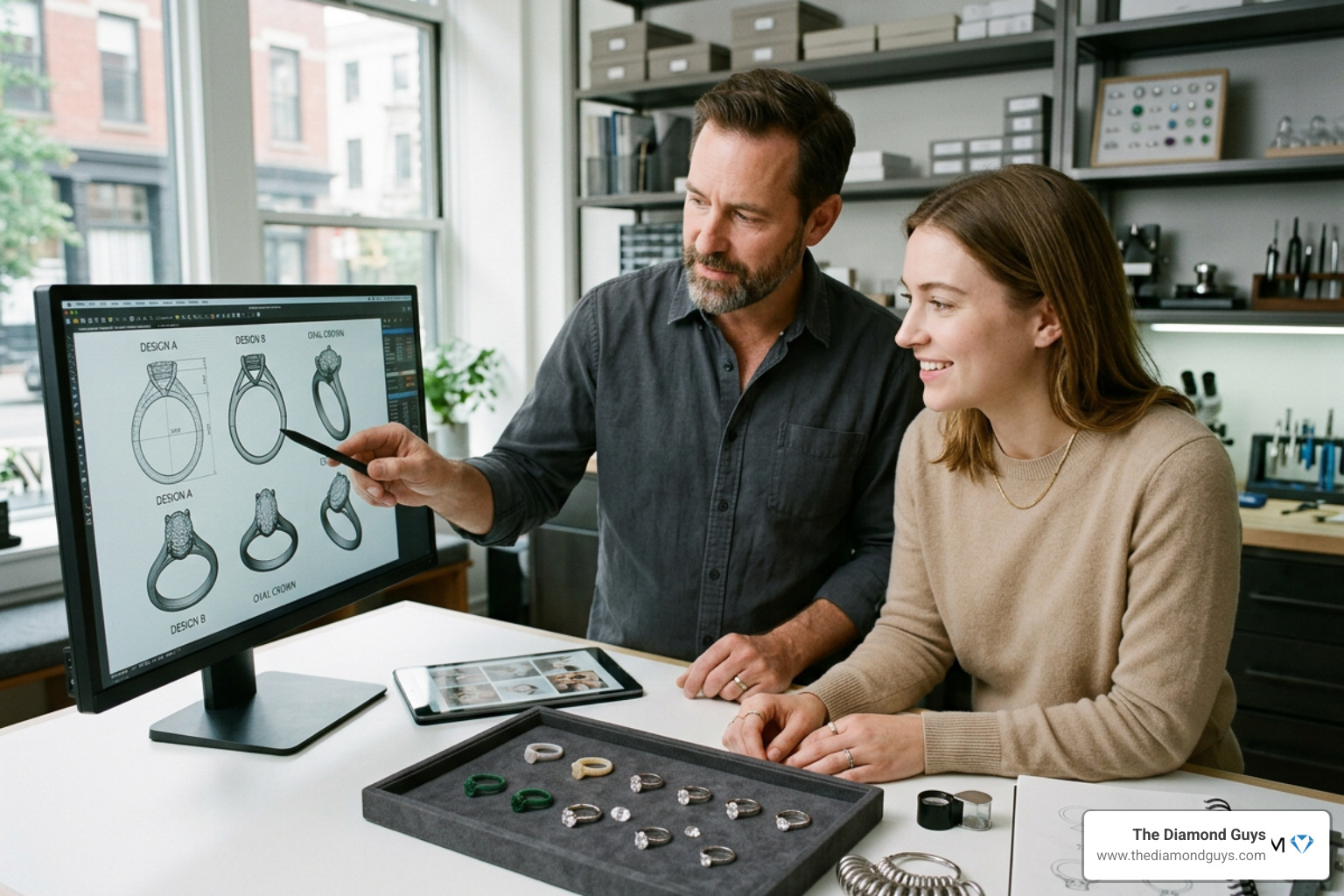
At The Diamond Guys, we specialize in bringing your dream jewelry to life. Whether you are looking for a classic solitaire, a vintage-inspired halo, a modern three-stone setting, or a romantic split-shank band, we work with you step-by-step to design a custom piece.
You can choose from a variety of premium, recycled metals, including:
- 14K or 18K White Gold
- 14K or 18K Yellow Gold
- 14K or 18K Rose Gold
- Platinum (for ultimate durability and hypoallergenic wear)
If you are ready to explore the endless design possibilities, start with our comprehensive Custom Lab Grown Diamond Ring Guide to learn how the customization process works.
Essential Considerations When Buying a Lab Diamond Ring
When shopping for Lab Made Diamond Rings, the buying process is virtually identical to shopping for natural diamonds. You will still want to focus on the industry-standard "4Cs":
- Cut: The most important factor for sparkle. Always prioritize an "Excellent" or "Ideal" cut grade.
- Clarity: Look for stones that are "eye-clean" (typically VS2 or higher), meaning any microscopic inclusions are invisible to the naked eye.
- Color: For a classic, icy-white look, stick to the colorless (D-F) or near-colorless (G-H) range.
- Carat Weight: Since lab diamonds are more affordable, you can easily explore larger carat weights that fit comfortably within your budget.
The Importance of Independent Certification
Never buy a lab-grown diamond without a grading report from a reputable, independent gemological laboratory. The International Gemological Institute (IGI) and the Gemological Institute of America (GIA) are the gold standards for grading lab-grown stones. These certificates verify the diamond's 4Cs and confirm its lab-grown origin, ensuring you get exactly what you pay for.
How to Care for Your Lab Made Diamond Rings
Because lab-grown diamonds are chemically identical to mined diamonds, they are incredibly durable and require the exact same care routine. They will not fade, degrade, or lose their sparkle over time.
To keep your ring looking as brilliant as the day you proposed, follow these simple best practices:
- Regular Cleaning: Mix a few drops of mild dish soap with warm water. Let your ring soak for 15 to 20 minutes, then gently scrub it with a soft-bristled toothbrush to remove everyday oils, lotions, and dirt. Rinse with clean water and pat dry with a lint-free cloth.
- Avoid Harsh Chemicals: Take your ring off when cleaning with bleach, chlorine, or abrasive household scrubbers.
- Safe Storage: Store your diamond ring in a soft fabric pouch or a separate compartment in your jewelry box. Because diamonds are the hardest material on Earth, they can easily scratch your other gold, silver, or platinum jewelry.
- Professional Maintenance: We recommend bringing your ring to a professional jeweler every 6 to 12 months. They can perform a deep ultrasonic cleaning and inspect the prongs to ensure your diamond remains securely in place.
You might wonder: do these stones change over time? We address this common concern in our article, Do Lab Grown Diamonds Get Cloudy.
Additionally, because these rings represent a significant emotional and financial investment, protecting them is vital. Learn how to secure peace of mind by reading our guide on Can You Insure Lab Grown Diamonds.
Frequently Asked Questions About Lab Diamonds
Do lab-grown diamonds hold their value over time?
Unlike natural diamonds, which have a well-established (though fluctuating) resale market, lab-grown diamonds do not hold a high resale value. Because technology continues to improve and production costs decrease, the retail price of lab-grown diamonds has dropped over the years.
When you buy a lab-grown diamond, you should view it as a beautiful piece of fine jewelry to be worn and cherished for a lifetime, rather than a financial investment. The "value" of a lab-grown diamond is realized upfront in the massive savings you enjoy at the time of purchase.
Do lab-grown diamonds pass a diamond tester?
Yes! Because they are made of pure carbon and have the exact same thermal and electrical conductivity as mined diamonds, they will pass any standard diamond tester. To learn more about how diamond testers interact with these stones, check out our article: Do Lab Diamonds Pass a Diamond Tester.
How do lab-grown diamonds compare to other diamond alternatives?
It is easy to confuse lab-grown diamonds with other popular diamond simulants, but they are entirely different.
- Moissanite: Moissanite is a distinct gemstone made of silicon carbide. While beautiful, it has a different refractive index, meaning it sparkles with a colorful, "rainbow" effect that looks different from a diamond. It is also slightly softer (9.25 on the Mohs scale).
- Cubic Zirconia (CZ): CZ is a synthetic material that is much softer, less durable, and prone to scratching or becoming cloudy over time.
Lab-grown diamonds are the only option that offers the authentic, lifetime durability and physical sparkle of a real diamond because they are real diamonds.
To compare these options in detail, read our helpful guides: Are Lab Grown Diamonds and Moissanite the Same and Is Moissanite a Lab Grown Diamond.
Conclusion
The spotlight is firmly on lab-grown diamonds in 2026, and it is easy to see why. They offer the exact same physical beauty, chemical purity, and lifetime durability as mined diamonds, but at a fraction of the cost and with a transparent, conflict-free origin.
At The Diamond Guys, we are proud to offer an exceptional selection of both certified lab-grown and natural diamonds. As a 5-star rated jewelry store with showrooms in Scottsdale, AZ and Los Angeles, CA, we bypass the aggressive sales tactics of big-box retailers to provide a warm, highly personalized shopping experience. Whether you want to design a custom engagement ring from scratch or select the perfect pre-set design, our team of experts is here to guide you every step of the way.
Ready to find the ring of your dreams? Explore our Lab Diamond Jewelry Store Guide to learn more, or book a personalized consultation with us today!


