

A Guide to Setting Your Loose Diamonds Without Losing Your Mind
What Is a Loose Diamond Setting — and How Does It Work?

Loose diamond setting is the process of taking an unmounted, cut diamond and securing it into a ring, pendant, or other jewelry piece of your choice. Here's a quick overview of how it works:
- Choose your diamond — Select a certified loose diamond based on the 4Cs: cut, color, clarity, and carat weight.
- Choose your setting — Pick a style (solitaire, halo, bezel, pavé, etc.) and metal (platinum, 14k or 18k gold).
- Confirm compatibility — Make sure the diamond shape, size, and girdle characteristics match the setting's specifications.
- Have it set professionally — A skilled jeweler secures the diamond into the setting using prongs, a bezel, or another mounting method.
- Inspect the finished piece — Verify the diamond is secure before wearing it regularly.
There's a reason so many couples go this route. Buying a loose diamond first — before choosing a setting — gives you complete control over quality, style, and budget. You're not locked into whatever a retailer decided to pair together. But it also comes with real decisions to make, and real risks if you skip the right steps.
As one jewelry professional put it: when you wear a piece of jewelry all day every day, it's exposed to a lot of banging, tugging, and twisting — which means how your diamond is set matters just as much as the diamond itself.
I'm Morgan Price, a backlink outreach and content specialist with deep experience researching the loose diamond setting process, from sourcing certified stones to understanding the nuances of prong styles and jeweler policies. In the sections ahead, I'll walk you through everything you need to know — so you can make a confident, informed choice.
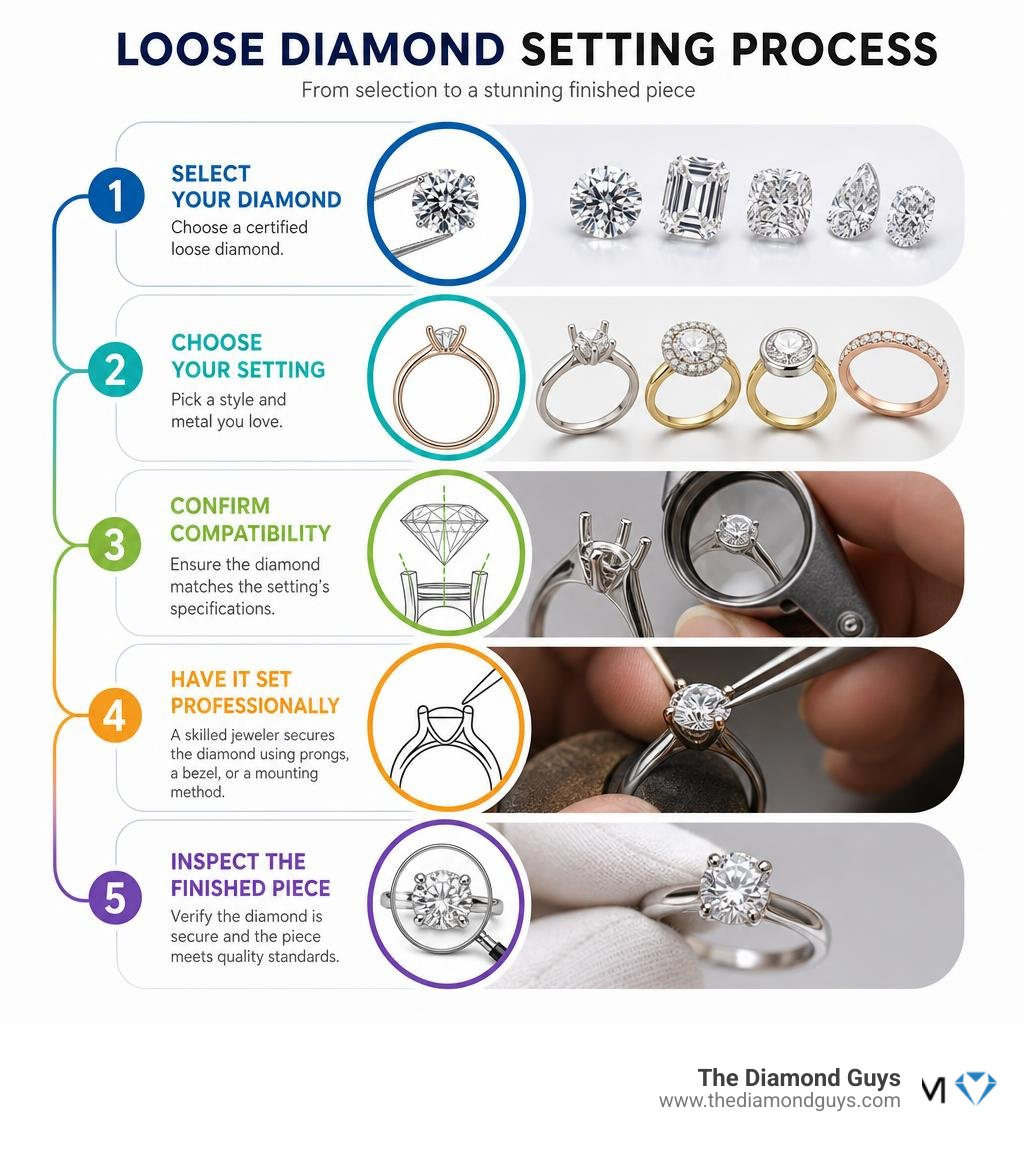
Simple Loose diamond setting word guide:
Why Choose a Loose Diamond Over a Pre-Set Ring?
When you walk into a traditional big-box jewelry store, most of the engagement rings you see are already complete. The diamond is already mounted, the price tag is unified, and what you see is what you get. However, purchasing a loose diamond and selecting the setting separately has become the preferred path for modern buyers.
Here is why opting for a loose diamond is often the smartest way to buy:
- Unmatched Customization: Buying loose allows you to act as the designer. You can pair a highly specific diamond shape with an architectural band that matches your partner's exact style, rather than settling for a pre-assembled combination.
- Total Control Over the 4Cs: When a diamond is already in a setting, the metal claws and bezel can hide flaws, inclusions, or yellowish tints. Buying a loose diamond allows you to inspect the stone from every angle under magnification. You can learn more about diamond quality and grading at GIA to understand exactly what you are paying for.
- Maximum Budget Flexibility: If you have a set budget, buying separately lets you allocate your funds strategically. If your partner values size over absolute clarity, you can spend 90% of your budget on a larger loose diamond and select a simple, elegant solitaire band. If they prefer intricate side-stone details, you can balance a slightly smaller center stone with a lavish pavé setting.
- Quality Assurance: Buying a loose stone ensures you can verify its laser inscription and certificate before it ever touches a piece of metal.
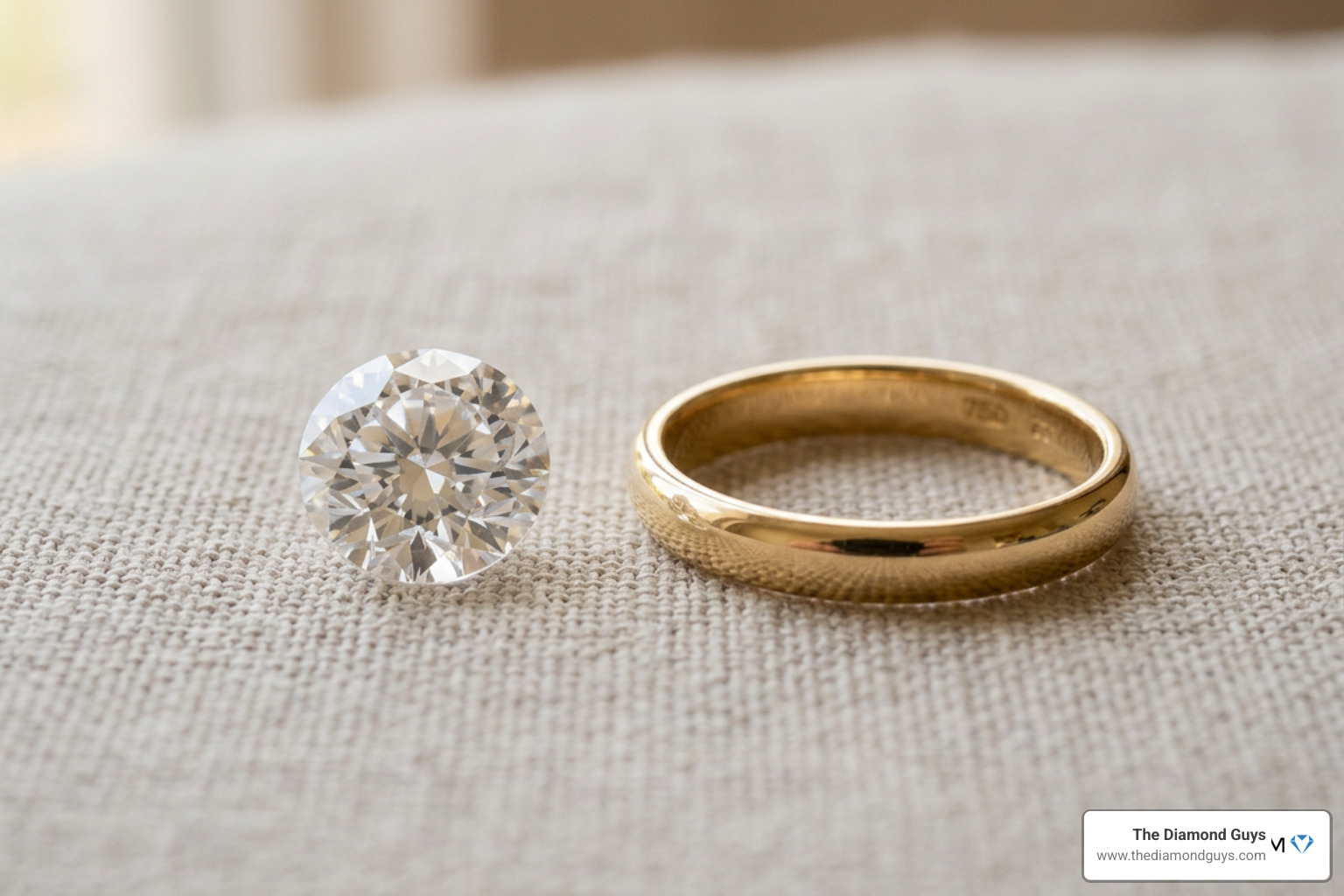
To help you weigh your choices, let us look at how these two buying methods compare:
| Feature | Loose Diamond + Separate Setting | Pre-Set Engagement Ring |
|---|---|---|
| Customization | Unlimited; mix and match any stone and band | Limited to what is in the display case |
| Flaw Visibility | 100% visible; easy to inspect before mounting | Metal prongs can hide inclusions or tint |
| Value Verification | Highly accurate; certified loose weight | Estimated weight once mounted in metal |
| Sourcing Control | High; select ethically sourced or lab-grown | Dependent on the manufacturer's pre-builds |
How to Choose the Perfect Loose Diamond Setting
Once you have secured your beautiful loose diamond, the next step is selecting its home. The setting is not just a frame; it is the structural support system that keeps your investment safe.
Metal Types and Durability
The metal you choose affects both the look of your ring and how much maintenance it will require over the years:
- Platinum: This is the heavyweight champion of durability. While platinum is a softer metal that will develop a lovely vintage patina over time from tiny scratches, it does not lose metal when scraped. It is naturally white and hypoallergenic, making it excellent for holding diamonds securely.
- 14k Gold (Yellow, White, Rose): Consisting of 58.3% pure gold mixed with stronger alloy metals, 14k gold is highly scratch-resistant and incredibly durable for daily wear. White gold is typically finished with a rhodium plating to give it a mirror-like shine, which may need to be reapplied every few years.
- 18k Gold (Yellow, White, Rose): Containing 75% pure gold, 18k gold offers a richer, warmer color (especially in yellow gold). However, because it contains more pure gold, it is slightly softer than 14k gold and can scratch more easily under heavy hand use.
Setting Styles
The setting style dictates the entire aesthetic of the ring:
- Solitaire: The classic. It features a plain metal band that directs all attention to the center stone, usually secured by four or six prongs.
- Halo: A circle of smaller accent diamonds surrounds the center stone. This is a brilliant way to make a smaller loose diamond look significantly larger.
- Bezel: Instead of prongs, a thin metal rim wraps entirely around the edge (girdle) of the diamond. This is the most secure setting style available, making it perfect for active individuals.
- Pavé: Small diamonds are set closely together along the band, held by tiny bead-like prongs, giving the illusion that the band is made entirely of sparkling diamonds.
If you are looking to bring your dream ring to life, you can explore custom setting options at The Diamond Guys to find the perfect pairing of metal and style.

Matching Diamond Shapes to Your Loose Diamond Setting
Not all diamond shapes behave the same way in a setting. Some shapes have delicate corners that are prone to chipping, while others need specific prong configurations to look balanced.
- Round Brilliant: The most forgiving shape. Because it has no sharp corners, it can be set safely in almost any style, from a delicate four-prong solitaire to a heavy bezel.
- Princess, Pear, and Marquise Cuts: These shapes have sharp, pointed corners. To protect these vulnerable areas from chipping during daily wear, they must be set with protective prongs. Princess cuts do best with V-prongs or flat prongs that hug the corners, while pear and marquise tips must be capped securely.
- Emerald and Asscher Cuts: These step-cut diamonds have large, flat tables. Because they do not have the heavy sparkle pattern of brilliant cuts, inclusions are much easier to see. If your emerald cut has clarity characteristics (like feathers) near the outer edges, a bezel setting or strategically placed flat prongs can protect these areas and hide minor inclusions near the girdle.
Lab-Grown vs. Natural Loose Diamonds
When choosing your loose diamond, you will undoubtedly face the choice between natural and lab-grown stones.
From a technical setting perspective, there is absolutely no difference. Both natural and lab-grown diamonds share the exact same chemical properties, physical structure, and optical brilliance. They are both a 10 on the Mohs hardness scale, meaning they are equally durable and can be set using the exact same tools and techniques by a jeweler.
- Lab-Grown Diamonds: Created using advanced technological processes like Chemical Vapor Deposition (CVD) or High Pressure High Temperature (HPHT), lab-grown diamonds offer incredible value. They are 100% real diamonds but cost a fraction of the price of natural stones, allowing you to buy a much larger center stone for your budget.
- Natural Diamonds: Formed deep within the Earth over billions of years, natural diamonds carry a sense of rarity and history. While they represent a higher financial investment, they tend to retain a higher percentage of their long-term resale value compared to lab-grown diamonds.
Navigating the Risks and Costs of Setting a Diamond Separately
While buying your stone and setting separately offers incredible customization, it does introduce a few logistical hurdles that you should prepare for.
The primary risk is liability. If you purchase a loose diamond from one online vendor and bring it to a local jeweler to mount in a setting you bought elsewhere, you are introducing multiple points of contact. If the diamond chips during the setting process—which can happen even to highly experienced jewelers if the stone has hidden internal stress points—determining who is responsible can become a nightmare.
Most jewelers will charge a setting fee (typically ranging from $100 to $500 depending on the stone's size and complexity) to cover the labor and risk of working with an outside stone. They may also require you to sign a liability waiver.
To eliminate this stress, some couples choose a placeholder ring—a simple, low-cost temporary band—to propose with first, allowing them to design the final custom ring together with a single trusted jeweler who handles both the stone sourcing and the setting.
Finding a Trusted Jeweler for Your Loose Diamond Setting
To minimize risk, you must choose a highly experienced jeweler to set your stone. Do not simply go to the closest mall kiosk.
Look for a jeweler with:
- In-house Gemologists: Ensure they have staff certified by respected institutions like the GIA or the American Gem Society (AGS). You can find certified gemologists through the American Gem Society (AGS) to verify their credentials.
- Clear Policies and Warranties: Ask upfront: "What happens if the diamond is damaged during setting?" A reputable jeweler should have clear insurance policies to cover rare accidents.
- Local Expertise: If you are in the Phoenix metro area—whether in Scottsdale, Phoenix, Tempe, or Mesa—working with an established local jeweler is always safer than shipping your precious heirloom back and forth across the country. Working with a trusted local specialist ensures you can speak directly with the jeweler who will be handling your stone.
Verifying Diamond Authenticity and Quality
Before you hand your loose diamond over to be mounted, you must verify that the stone matches the paperwork you received.
- Check the Laser Inscription: Most GIA-certified loose diamonds have a microscopic report number laser-inscribed on the girdle. A jeweler should show you this number under a gemological microscope before taking possession of your stone.
- Verify the Certificate: You can verify diamond certificates directly on the GIA Report Check website to ensure the paperwork is authentic and matches the physical dimensions of your stone.
- Map the Inclusions: Every diamond has a unique "fingerprint" of internal inclusions. A professional jeweler will plot these inclusions on a map with you before setting the stone, and show them to you again after the setting is complete to prove you received the exact same diamond back.
Post-Setting Maintenance and Care
Once your custom ring is safely on your finger, your job is not quite done. To ensure your diamond stays put for decades to come, follow these maintenance best practices:
- Perform the Fingernail Test: Once a month, gently tap your diamond with your fingernail or try to nudge it side-to-side. If you hear a tiny rattling sound or feel the stone shift even a fraction of a millimeter, take it off immediately.
- Get Annual Inspections: Just like a car needs an oil change, your ring needs a professional checkup. A jeweler will inspect the prongs under a microscope to ensure they haven't bent, thinned, or pulled away from the stone.
- Clean Safely at Home: Keep your ring sparkling by soaking it in warm water with a few drops of mild dish soap, then gently scrubbing it with a soft-bristled baby toothbrush. Avoid harsh chemicals that can weaken gold alloys.
Frequently Asked Questions
Can any jeweler set a loose diamond purchased online?
While most independent jewelers have the technical skill to set an outside diamond, some may decline to do so due to liability risks. Always call ahead to confirm their policy on setting customer-owned loose diamonds and ask about their setting fees.
How much does it cost to set a loose diamond?
The cost generally ranges from $100 to $500. The exact price depends on the carat weight of the diamond (larger stones carry higher setting risk and require more labor), the metal of the setting (platinum is harder to work with than gold), and the complexity of the design.
What should I do if my diamond feels loose in its setting?
Remove the ring immediately and place it in a secure container. Do not continue to wear it, and do not attempt a DIY fix with pliers, as you risk chipping the diamond or snapping the metal prong. Take it to a professional jeweler as soon as possible for a prong tightening.
Conclusion
Navigating loose diamond setting does not have to be stressful. By purchasing a loose diamond, you unlock the ability to inspect your stone with complete transparency and design a piece of jewelry that is truly unique to your love story.
If you are ready to take the next step in your jewelry journey, we are here to help. At The Diamond Guys, we specialize in offering a highly personalized, pressure-free custom design experience. Whether you are looking to source the perfect lab-grown diamond, find an ethically mined natural stone, or reset a cherished family heirloom, our expert team in Scottsdale is ready to guide you.
Schedule a professional jewelry repair or setting consultation with The Diamond Guys today, and let us help you build a ring that will last a lifetime.


