

The Real Deal on Natural Diamond Jewelry and Why It Never Goes Out of Style
What Makes Natural Diamond Jewelry Worth Your Attention

Natural diamond jewelry is one of the most meaningful purchases you'll ever make — and for good reason.
Here's a quick overview of what you need to know:
| Topic | Key Facts |
|---|---|
| What it is | Jewelry set with diamonds formed naturally in the Earth over billions of years |
| Why it's special | Rare, unique, and impossible to replicate — no two natural diamonds are identical |
| Quality grading | Evaluated using the 4Cs: Cut, Color, Clarity, and Carat weight |
| Certification | Graded by independent labs like GIA for verified quality and authenticity |
| Ethical sourcing | Conflict-free diamonds traceable through the Kimberley Process and certified sightholders |
| Price range | From under $1,000 for smaller stones to $50,000+ for premium luxury pieces |
| Best for | Engagement rings, heirloom pieces, and any jewelry meant to last a lifetime |
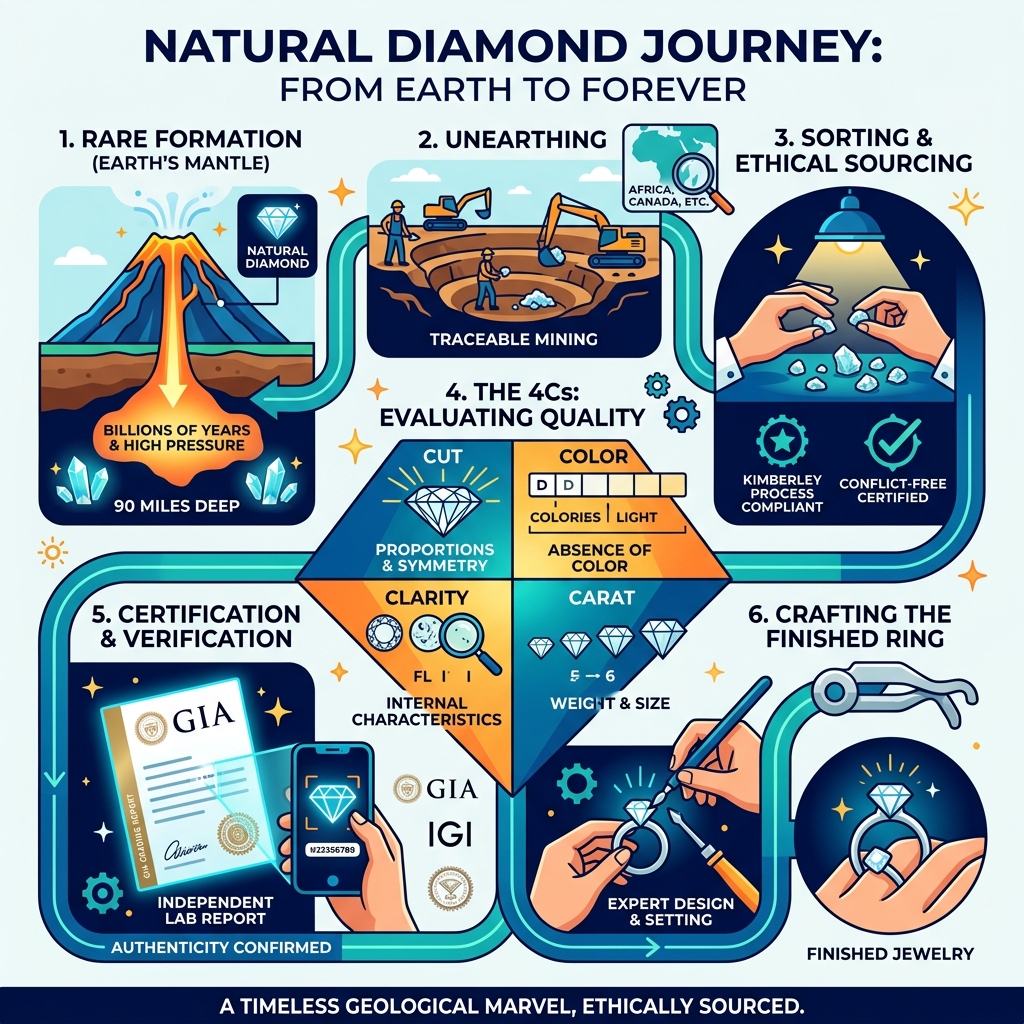
Natural diamonds take billions of years to form deep inside the Earth's mantle — making every single one a geological marvel before it ever becomes a piece of jewelry. That rarity is part of what gives them lasting emotional and financial value that alternatives simply can't match.
But with so many options — shapes, grades, retailers, and certifications — knowing where to start can feel overwhelming. That's exactly why this guide exists.
I'm Morgan Price, a backlink outreach and content specialist with deep experience researching and writing about natural diamond jewelry, from understanding the 4Cs to navigating ethical sourcing standards. I'll walk you through everything you need to feel confident before you buy.
The Timeless Appeal of Natural Diamond Jewelry

When we talk about Natural Diamond Jewelry, we aren't just talking about carbon and light. We are talking about a piece of the Earth’s history that you can wear. Unlike almost any other luxury item, a natural diamond carries an inherent emotional weight. It is a symbol of endurance—after all, it survived billions of years of heat and pressure just to reach the surface.
One of the most significant reasons many of our clients in Scottsdale and Phoenix prefer natural stones is their heirloom quality. A natural diamond is a finite resource. Because the Earth isn't making any more of them (at least not on a human timeline), they possess a rarity that translates into long-term value. While fashion trends come and go, the classic appeal of a natural stone remains constant.
Beyond the financial aspect, there is the question of preference. Many people find a deeper connection to a stone that was created by nature rather than in a laboratory. If you're curious about the specific reasons behind these choices, you can read more about do women prefer natural diamonds vs lab grown.
Popular Shapes for Natural Diamond Jewelry
The "shape" of a diamond is often the first thing people notice, and it plays a massive role in the overall vibe of the jewelry. Whether you are looking for a ring, a necklace, or studs, here are the most popular silhouettes:
- Round Brilliant: The undisputed heavyweight champion. It is designed to maximize "fire" and "brilliance."
- Princess Cut: A modern classic with sharp, square corners. You can find beautiful Princess cuts starting around $879 for a 0.71 ct stone, making them a great entry point for high-quality Natural Diamond Jewelry.
- Oval: This shape has exploded in popularity recently because it elongates the finger and often looks larger than a round diamond of the same carat weight.
- Pear and Marquise: These "fancy" shapes offer a unique, asymmetrical look. For instance, a 0.71 ct Pear E VS1 might be priced around $2,970 depending on the specific dimensions.
- Cushion: With rounded corners and larger facets, this shape has a romantic, vintage feel.
- Emerald Cut: Known for its "hall of mirrors" effect, this step-cut emphasizes clarity over sparkle.
While most people think of "white" diamonds, nature also produces stunning colors. If you want something truly standout, you might want to look into what is a yellow diamond to see how these "fancy" colors add a whole new dimension to your collection.
The 4Cs: Determining Quality and Value
If you’ve spent five minutes looking at diamonds, you’ve heard of the 4Cs. But what do they actually mean for your wallet and the look of your jewelry? At The Diamond Guys, we believe in transparency, so let’s break down how these factors interact.
Cut
This is arguably the most important "C." The cut isn't the shape; it's how well the diamond's facets interact with light. A poorly cut diamond will look dull even if it has perfect color and clarity. Only round diamonds receive an official GIA cut grade (Excellent, Very Good, etc.), while other shapes are evaluated on their symmetry and polish.
Color
The GIA grades diamond color on a scale from D (colorless) to Z (light yellow or brown). Most high-end Natural Diamond Jewelry uses stones in the D-J range. If you're wondering where the "sweet spot" is for value, you should learn what is diamond color to understand how different metals can hide or highlight these subtle hues.
Clarity
This measures the "purity" of the stone. Natural diamonds often have tiny internal "inclusions" or external "blemishes." These are like the diamond's DNA—no two patterns are the same. To help you navigate the technical jargon, we’ve put together a guide on what are inclusions in diamonds.
Carat Weight
Carat refers to the diamond's weight, not its physical size. One carat equals 200 milligrams. While "bigger is better" is a common sentiment, the "spread" or dimensions of the diamond can make a smaller carat weight look larger. Check out our breakdown of what is diamond carat size to see how to get the most visual "pop" for your budget.
Pricing Factors for Natural Diamonds
Pricing for Natural Diamond Jewelry is a delicate balance of rarity and demand. For example, a 1.01 ct Round diamond with H color and SI2 clarity might be priced around $3,119, whereas a 1.0 ct Pear with D color and VVS2 clarity could jump to nearly $7,000.
The most significant price jumps usually occur at the "full carat" marks (0.50, 1.0, 1.5, 2.0). Buying just shy of these marks—say a 0.90 ct stone—can often save you a significant amount without a noticeable difference in size. To find the best balance for your budget, it helps to know what diamond clarity is best for your specific needs.
Natural vs. Lab-Grown: Understanding the Differences
This is the most common question we get at our Scottsdale and Los Angeles locations. While both are "real" diamonds in terms of chemistry (pure carbon), they occupy very different spaces in the market.
| Feature | Natural Diamonds | Lab-Grown Diamonds |
|---|---|---|
| Origin | Earth's mantle (billions of years) | Laboratory (weeks) |
| Rarity | Finite resource | Mass-produced |
| Resale Value | Higher retention of value | Generally lower/minimal |
| Price | Premium | 60-80% less than natural |
| Chemistry | Carbon (C) | Carbon (C) |
While they look identical to the naked eye, the choice often comes down to what you value more: the size of the stone for the price, or the rarity and history of a natural gem. For a deeper dive into this debate, explore our articles on lab diamonds vs real diamonds and are lab grown diamonds real diamonds. If you are leaning toward the lab-created route for budget reasons, we also have advice on should you buy a lab grown diamond.
Ethical Sourcing and Certification Standards
When you invest in Natural Diamond Jewelry, you want to know that your stone's journey was as beautiful as the finished product. Ethical sourcing is no longer just a "nice to have"—it’s a requirement.
Most reputable jewelers today adhere to the Kimberley Process, an international certification scheme that prevents "conflict diamonds" from entering the mainstream market. Furthermore, many luxury brands now offer full traceability, allowing you to know exactly which mine your diamond came from. We prioritize working with sightholders who meet strict social and environmental standards, ensuring that the communities where these diamonds are found actually benefit from the industry.
How to Verify the Authenticity of Natural Diamond Jewelry
Don't just take a jeweler's word for it. Here is how you protect your investment:
- GIA Reports: The Gemological Institute of America is the gold standard. A GIA report provides an unbiased blueprint of your diamond's 4Cs.
- Laser Inscriptions: Most GIA-certified diamonds have a microscopic serial number laser-etched onto the girdle. This number matches your certificate, ensuring the stone in your hand is the one on the paper.
- Professional Appraisal: A third-party appraisal is essential for insurance purposes and to verify the retail replacement value.
- Verification Tools: Expert jewelers use "diamond testers" that measure thermal and electrical conductivity to confirm the stone is indeed a diamond.
Frequently Asked Questions about Natural Diamond Jewelry
Is I color diamond too yellow for a white gold setting?
This is a great question! An "I" color diamond sits in the "Near Colorless" range. While it has a very slight warm tint, it often looks perfectly white to the naked eye, especially when set in white gold or platinum. However, if you are very sensitive to color, you might notice a difference. Read our full take on is i color diamond too yellow.
Are emeralds rarer than diamonds?
It might surprise you, but high-quality emeralds can actually be rarer than diamonds. While diamonds are found in many parts of the world, top-tier emeralds are found in very few locations. For a comparison of these two stunning gems, check out are emeralds rarer than diamonds.
What are the best warranties and services for diamond buyers?
When buying Natural Diamond Jewelry, the sale shouldn't end when you walk out the door. Look for retailers that offer:
- Lifetime Warranties: Covering manufacturing defects and stone tightening.
- Complimentary Resizing: Because fingers change over time!
- Cleaning and Polishing: To keep that billion-year-old stone looking brand new.
- Insured Shipping: Essential for online orders to ensure your piece arrives safely.
- Return Policies: Usually ranging from 30 to 60 days for non-custom items.
Conclusion
Choosing the perfect piece of Natural Diamond Jewelry is a journey that combines science, art, and emotion. Whether you are looking for a 3-carat showstopper or a delicate pair of everyday studs, the key is finding a partner you can trust.
At The Diamond Guys, we pride ourselves on providing expert guidance that goes beyond the sales pitch. We specialize in custom engagement rings and ethically sourced natural diamonds, ensuring that your jewelry is as unique as your story. From our locations in Scottsdale, AZ, and Los Angeles, CA, we offer a personalized shopping experience designed to help you find "the real deal."
Ready to find your forever piece? Shop Natural Diamond Jewelry with us today and experience the difference that expert craftsmanship and ethical sourcing make.


