

Elegant Wedding Bands for Women Who Want to Sparkle Effortlessly
The Timeless Appeal of Elegant Wedding Bands for Women
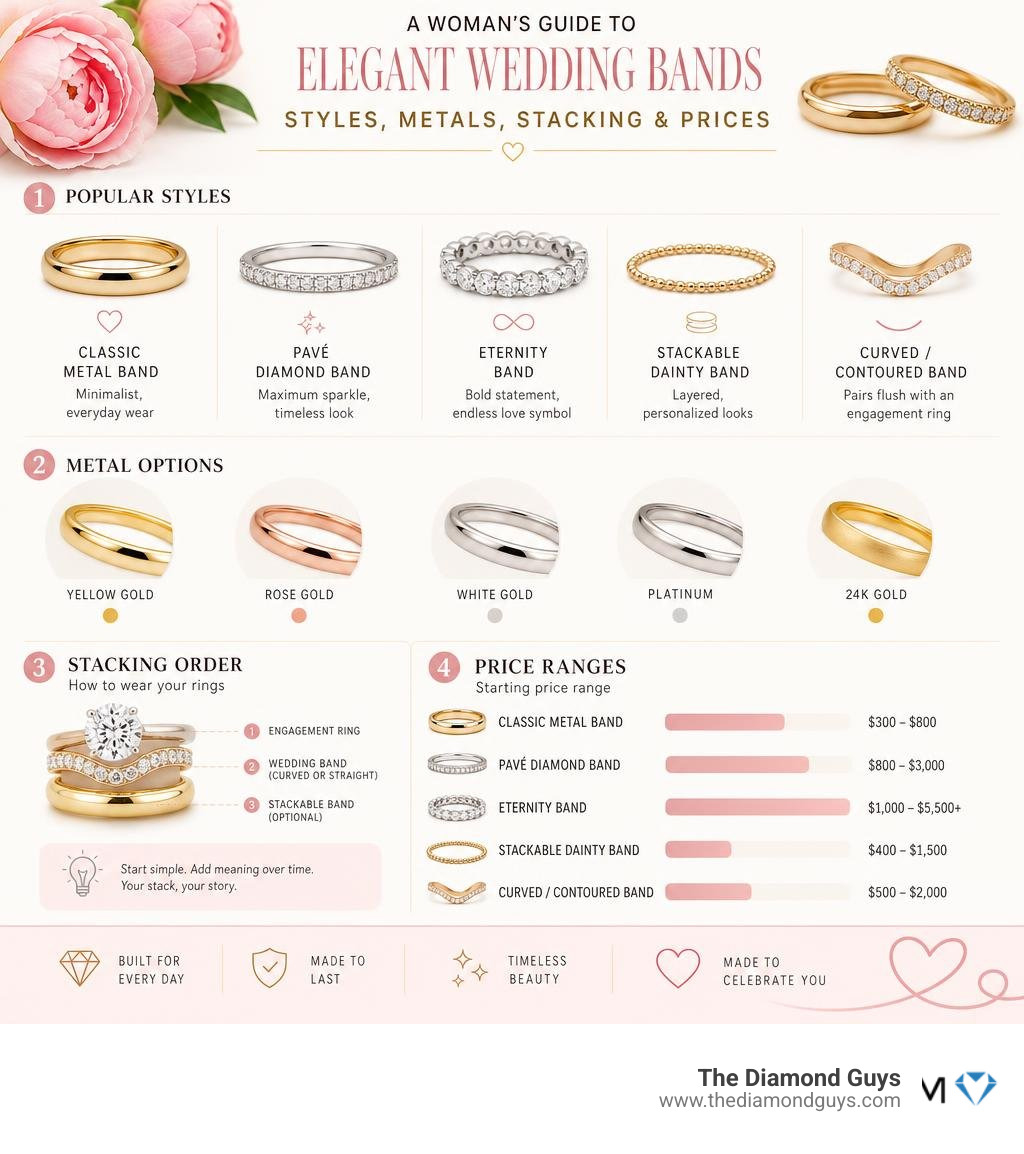
Finding elegant wedding bands for women doesn't have to be overwhelming. Here's a quick look at the most popular styles to help you decide fast:
| Style | Best For | Starting Price Range |
|---|---|---|
| Classic metal band | Minimalist, everyday wear | $300–$800 |
| Pavé diamond band | Maximum sparkle, timeless look | $800–$3,000 |
| Eternity band | Bold statement, endless love symbol | $1,000–$5,500+ |
| Stackable dainty band | Layered, personalized looks | $400–$1,500 |
| Curved/contoured band | Pairing flush with an engagement ring | $500–$2,000 |
A wedding band is more than jewelry. It's the one piece most women wear every single day — through morning routines, workouts, and everything in between. Unlike an engagement ring, which often features a prominent center stone, a wedding band is typically more understated and built for real life. That means comfort, durability, and personal style all matter just as much as sparkle.
In 2026, brides are leaning into styles that feel both personal and timeless — from ultra-slim dainty bands to bold diamond eternity rings that signal commitment from across the room.
I'm Morgan Price, and my work researching and evaluating fine jewelry — including elegant wedding bands for women — has given me a deep understanding of what separates a beautiful band from the right one. In the sections below, I'll walk you through everything you need to know to choose with confidence.
Elegant wedding bands for women definitions:
Understanding the Styles of Elegant Wedding Bands for Women
When embarking on the journey to find the perfect ring, you will quickly discover that style diversity is incredibly rich. Every bride has unique aesthetic preferences, and the jewelry industry has evolved to offer design variations that cater to every taste. Whether you prefer a quiet, understated ring or a brilliant showstopper, the right band acts as an enduring symbol of your shared journey.
To explore a wide variety of beautifully curated designs, you can browse our collection of Women's Wedding Rings | The Diamond Guys. If you are shopping in the local Arizona market, comparing different styles in person is highly recommended to get a sense of how different widths and stone patterns look on your hand.
Statistically, diamonds remain the reigning favorite for bridal elegance. Over 85% of women's wedding bands on the market feature diamonds, blending traditional sentiment with modern radiance. Furthermore, there is a massive shift toward accessible luxury: over 75% of high-quality women's wedding bands are priced between $500 and $3,000. This sweet spot allows couples to prioritize both exceptional craftsmanship and realistic budget planning.
Classic Metal Bands vs. Diamond Wedding Bands for Women
The decision between a classic all-metal band and a diamond-accented band often comes down to your lifestyle and how much sparkle you want on a daily basis.
Classic metal bands feature a high-polish finish and represent the ultimate minimalist style. They are incredibly comfortable, require very little maintenance, and never compete with your engagement ring. If you work with your hands, enjoy outdoor adventures, or simply prefer an understated, traditional look, a solid precious metal band is a beautiful and practical choice.
On the other hand, diamond wedding bands are designed for those who want to maximize their sparkle factor. The most popular style is the pavé diamond band, where tiny, brilliant-cut diamonds are set closely together, secured by micro-prongs that make the metal virtually disappear. This creates a continuous line of light that brilliantly complements an engagement ring. Choosing elegant wedding bands for women with diamond accents ensures your bridal set catches the light from every single angle.
Eternity Bands and Stackable Elegant Wedding Bands for Women
Eternity bands are the ultimate symbol of endless love, featuring an uninterrupted loop of diamonds encircling the entire finger. Because there is no "front" or "back" to the ring, it sparkles constantly, even as it spins during daily wear. Eternity styles range from delicate, low-profile bands to bold statement pieces featuring emerald, oval, or marquise-cut diamonds.
Stackable bands have become incredibly popular for brides who love a layered, highly personalized look. Instead of wearing just one matching band, many women choose to build a custom stack over time, adding new rings to commemorate anniversaries, the birth of children, or major personal milestones.
Dainty, ultra-lightweight bands (typically between 1.1mm and 1.5mm in width) are ideal for stacking because they allow you to layer multiple rings comfortably. Many of these dainty designs feature a feminine "bubble" side profile created by minimal prongs. This structural design minimizes the metal visible from the side, allowing the diamonds to look like delicate, floating droplets of light on your finger.
Choosing the Perfect Precious Metal for Your Band
The metal you select for your wedding band serves as the foundation for its entire look, weight, and longevity. The most popular choices for elegant wedding bands for women are platinum, white gold, yellow gold, and rose gold. Each metal has distinct physical properties, durability profiles, and maintenance needs.
For those with sensitive skin, hypoallergenic properties are a major consideration. Platinum is naturally hypoallergenic, making it an excellent choice for anyone prone to metal allergies. To compare different precious metals and find your perfect match, you can explore our curated Women's Wedding Bands Collection – Gold, Platinum & Diamond | The Diamond Guys.
To help you visualize how these metals compare, we have put together this handy reference table:
| Metal Type | Purity | Hypoallergenic | Maintenance Required | Color Profile |
|---|---|---|---|---|
| Platinum | 95% Pure | Yes | Low (develops patina) | Cool, bright white |
| White Gold | 58% (14K) or 75% (18K) | No (may contain nickel) | Medium (rhodium replating) | Cool, reflective white |
| Yellow Gold | 58% (14K) or 75% (18K) | Yes (generally) | Low (occasional polishing) | Warm, traditional gold |
| Rose Gold | 58% (14K) or 75% (18K) | No (contains copper) | Low (occasional polishing) | Soft, romantic pink |
Platinum vs. Gold Durability and Maintenance
While platinum and gold are both luxury metals, they behave very differently over years of daily wear. Platinum is a dense, heavy metal that commands a premium of $300 to $400 over gold due to its rarity and purity. When platinum is scratched, the metal is not lost; instead, it merely shifts, developing a soft, velvety finish known as an "antique patina." Many brides love this classic look, but if you prefer a mirror-like shine, it will require occasional professional polishing.
Gold, on the other hand, is alloyed with other metals to make it strong enough for daily wear. Pure gold is too soft for fine jewelry, so jewelers use 14K gold (which is approximately 58% pure gold) or 18K gold (75% pure gold). 14K gold is actually more scratch-resistant than 18K gold because it contains a higher percentage of stronger alloy metals, making it highly practical for active lifestyles.
If you choose white gold, keep in mind that it achieves its bright, icy finish from a protective layer of rhodium plating. Over time, this plating will wear away, revealing the naturally warm, slightly yellow undertones of the gold underneath. To keep white gold looking brand new, you will need to have it replated every 6 months to 2 years, depending on your skin chemistry and daily activities.
How to Pair and Stack Your Wedding Band with an Engagement Ring
Achieving the perfect ring pairing is an art form. Your wedding band and engagement ring should work together in aesthetic harmony, balancing each other's proportions without competing for attention. Some brides prefer a perfectly flush fit where the two rings sit together like a puzzle, while others love the contrast of mixing different metal colors or stacking multiple textures.
When designing your bridal set, it is helpful to see how different shapes nestle together.

To learn more about creating a cohesive look, check out our guide on Pairing Your Wedding Bands | The Diamond Guys.
Contoured, Curved, and Notched Designs
If your engagement ring features a low-profile setting or a large center stone (such as a classic oval, pear, or marquise cut), a traditional straight wedding band may not sit flush against it. This creates a gap between the two rings, which some brides love, but others prefer a seamless, nested look.
This is where contoured, curved, and notched designs come into play. A curved wedding band is designed with a gentle, graceful dip that perfectly hugs the contours of your engagement ring's center stone. A notched band features a small indentation designed to let the basket of your engagement ring slide right in. These low-profile, nesting bands ensure a secure, flush alignment that protects both rings from rubbing against each other, preserving their beauty for decades to come.
Lab-Grown vs. Natural Diamonds and Customization Options
As you shop for elegant wedding bands for women, you will have the choice between natural and lab-grown diamonds. Both options are physically, chemically, and optically identical, but they offer different advantages depending on your personal values and budget.
At our stores, we prioritize ethical sourcing and a personalized shopping experience, ensuring that every stone we offer is conflict-free and of the highest quality. To begin designing a ring that is uniquely yours, you can explore our options for Custom Wedding Bands for Women & Men | The Diamond Guys. If you are located in the Phoenix metro area and want to collaborate with local master jewelers, we invite you to visit our showroom to discuss your custom design.
The Rise of Lab-Grown Diamonds in 2026
The popularity of lab-grown diamonds has skyrocketed, and in 2026, they represent a major trend in fine jewelry. In fact, over 60% of modern diamond wedding bands feature lab-grown diamonds.
The primary driver of this trend is price accessibility. Lab-grown diamonds offer incredible value, often costing significantly less than natural diamonds of the same quality. This allows couples to maximize their budget, choosing wider bands, higher total carat weights, or full eternity styles that might have otherwise been out of reach. Additionally, lab-grown diamonds appeal to environmentally conscious brides who appreciate the modern, high-tech origin of these beautiful stones.
Personalizing Your Band with Custom Engravings
One of the most meaningful ways to personalize a wedding band is through custom engraving. Whether you want to engrave a significant date, your partner's initials, a secret phrase, or even a custom fingerprint engraving on the inside of the band, these hidden details add a beautiful layer of sentiment.
However, there are a few practical considerations to keep in mind. If you choose a full eternity band or a ring with intricate engraving patterns that wrap all the way around the metal, future resizing can be incredibly difficult. Resizing these styles often requires cutting into the design, which can leave a small, visible seam or disrupt the pattern. If you think you may need to resize your ring in the future, it is best to leave a small, solid metal sizing bar at the back of the band.
Frequently Asked Questions about Elegant Wedding Bands
What is the difference between an engagement ring and a wedding band?
An engagement ring is traditionally given during a marriage proposal and typically features a prominent center diamond or gemstone. A wedding band is exchanged during the wedding ceremony and represents the official union. While engagement rings are often bold and highly ornate, wedding bands are typically designed for streamlined, daily wear comfort and are worn stacked underneath the engagement ring.
How do I determine my correct ring size at home?
To measure your ring size at home, wrap a thin strip of paper or string around the base of your left ring finger. Mark the exact spot where the paper overlaps, and measure the length in millimeters using a ruler.
That your finger size fluctuates based on temperature, humidity, and the time of day. For the most accurate, snug fit, measure your finger at the end of the day when your hands are warm, and ensure the ring will be tight enough not to slip off easily but comfortable enough to slide over your knuckle.
Does the wedding band go on the top or bottom of the engagement ring?
Traditionally, the wedding band is worn on the bottom of the stack, closest to the hand. This placement stems from the romantic sentiment of wearing the wedding band "closer to the heart." During the wedding ceremony, the bride will often temporarily move her engagement ring to her right hand so the groom can slide the wedding band onto her left ring finger first. Afterward, she stacks the engagement ring back on top.
Conclusion
Your wedding band is a beautiful, daily reminder of your love story, making the selection process incredibly special. Whether you fall in love with a classic, high-polish platinum band, a sparkling pavé diamond ring, or a custom contoured stack, the key is finding a piece that feels authentic to your personal style and comfortable enough for everyday wear.
Avoid the impersonal atmosphere of big-box retailers and enjoy a personalized shopping experience instead. Our team of experts is dedicated to providing honest, ethical guidance to help you find or design the perfect ring.
Ready to find a band that sparkles as effortlessly as you do? If you are in Southern California, we invite you to Explore LA Wedding Bands or visit our Scottsdale, AZ showroom to experience our 5-star service in person. Let us help you create a symbol of commitment that you will cherish forever!


