

Suited and Booted: Top Vintage Dress Watches for Every Collector
Essential Defining Characteristics of Vintage Dress Watches

When we look at vintage dress watches, the first thing that strikes us is design restraint. While modern tool watches are built to withstand high ocean pressures or track lap times with multi-subdial layouts, traditional dress timepieces are built around simplicity, elegance, and low-profile dimensions.
Historically, a dress watch had one main job: to slip effortlessly under a tailored shirt cuff without catching on the fabric. To achieve this, watchmakers relied on ultra-thin profiles, minimal dial typography, and precious metals like solid 18k yellow gold, rose gold, or high-grade stainless steel. Mid-century manufacturers also mastered gold-capping—a technique where a thick layer of gold was permanently bonded over a sturdy steel core, giving buyers the warmth of solid gold at an accessible price point.
Unlike standard modern watches that feature bold luminescence and heavy metal bracelets, classic dress models typically opt for polished dauphine hands, delicate applied baton indices, and fine leather straps. Non-round geometry also plays a massive role in dress watch history. Shaped cases, such as the iconic rectangular tank, square cases, and soft tonneau silhouettes, offer an artistic flair that feels distinctively refined. For those exploring mens refurbished watches, these mid-century timepieces offer unmatched horological character.
How Mid-Century Case Size and Lug Proportions Impact Wearability
A common concern for modern collectors is case size. Between the 1940s and 1970s, the standard diameter for a gentleman’s dress watch ranged from 33mm to 36mm. On paper, this might sound small compared to today's modern 40mm+ sports watches. However, case diameter is only part of the equation—lug geometry and proportions heavily influence how a watch sits on the wrist.
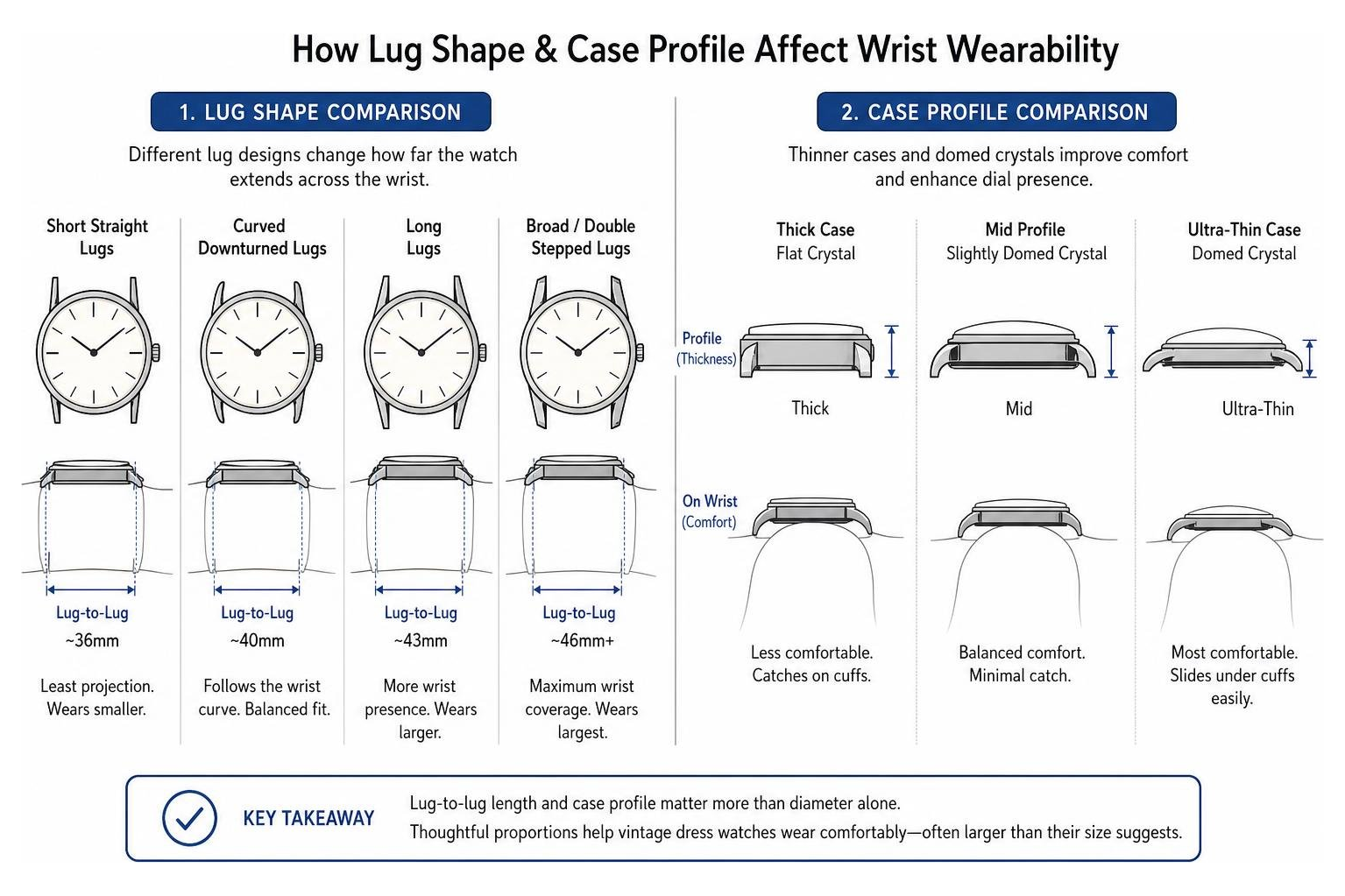
Long, curved, or double-stepped lugs project further across the wrist, creating an illusion of larger size. For instance, a 34mm vintage piece with extended 43mm lug-to-lug proportions often wears remarkably like a modern 37mm watch. Furthermore, vintage acrylic crystals feature domed profiles that catch ambient light, drawing attention to the dial and expanding its visual footprint. When evaluating 1940s broad-lug styles against sleek 1960s minimalist geometry, understanding these proportions ensures you select a timepiece that complements your modern wardrobe perfectly.
Standout Vintage Watch Models Across Eras
Navigating the vintage market becomes far simpler when you understand how design trends and movement technologies shifted across different eras. The 1940s brought utility-driven elegance, the 1950s introduced legendary manual-wind workhorses, the 1960s ushered in ultra-sharp Japanese and Swiss competition, and the 1970s experimented with bold shapes and textured dials.
If you are following iconic lines like the IWC Portugieser complete guide 2026, you already appreciate the historical weight of classic Swiss movement design. Models powered by legendary calibers—such as the manual-wind IWC Caliber 89—remain benchmarks of 20th-century horology.
| Era | Notable Model | Case Size Range | Typical Movement | Budget Guidance (Steel / Gold) |
|---|---|---|---|---|
| 1940s-1950s | IWC Caliber 89 (e.g., Ref. 810) | 34mm – 36mm | Manual-Wind Cal. 89 | €1,500 – €2,000 (Steel) / Up to €3,000 (Gold) |
| 1950s | Zenith Stellina Series | 34mm – 35mm | Manual-Wind / Auto | €500 – €1,500 (Steel) / Up to €2,500 (Gold) |
| 1950s-1960s | Longines Flagship (e.g., Ref. 3407) | 34mm – 36mm | Cal. 30L / Cal. 340 | €500 – €1,500 (Steel) / Up to €4,500 (Solid Gold) |
| 1950s-1960s | Omega Seamaster / DeVille | 33mm – 36mm | Manual Cal. 620 / Auto Cal. 565 | €500 – €2,000 (Steel) / Up to €2,500 (Gold) |
| 1960s | King Seiko (44KS / 45KS) | 35mm – 37mm | Hi-Beat Manual / Auto | Under €1,000 (Steel) |
Best Affordable Vintage Dress Watches Under €2,500
Finding exceptional value in vintage dress watches does not require spending five figures. In fact, some of the finest historical designs remain available for under €2,500.
- Omega De Ville Ribbon Dial (Ref. 111.077): Debuting originally within the Seamaster collection in 1960 before launching as a standalone dress line in 1967, the De Ville highlights ultra-slim profiles. Models featuring champagne ribbon dials and manual-wind Calibre 620 movements offer sophisticated 1970s texture.
- King Seiko 45-7001 / 4420-9990: During the 1960s, internal competition between Seiko's Daini and Suwa factories birthed the "Grammar of Design." King Seiko delivered mirror-polished cases, angular lugs, and high-beat movements that rivaled top Swiss chronometers, making them unmatched values under €1,000. Collectors interested in Japanese watchmaking heritage often pair these with a used Grand Seiko to build a historic collection.
- 1937 Dress Chronograph Reissues & Sector Dials: For those who adore 1930s Art Deco architecture, sector dials with telemetre scales capture the spirit of mid-century urban style without sacrificing daily practical wear.
When buying in this price segment, smart budget allocation is critical. We always advise clients to reserve approximately 20% of their total purchase budget for immediate servicing, replacing gaskets, or securing period-correct straps.
Luxury Milestones and Rare Complications in Vintage Horology
For collectors seeking rare, high-grade vintage timepieces, mid-century watchmaking offered fascinating mechanical complications housed within slim precious metal cases.
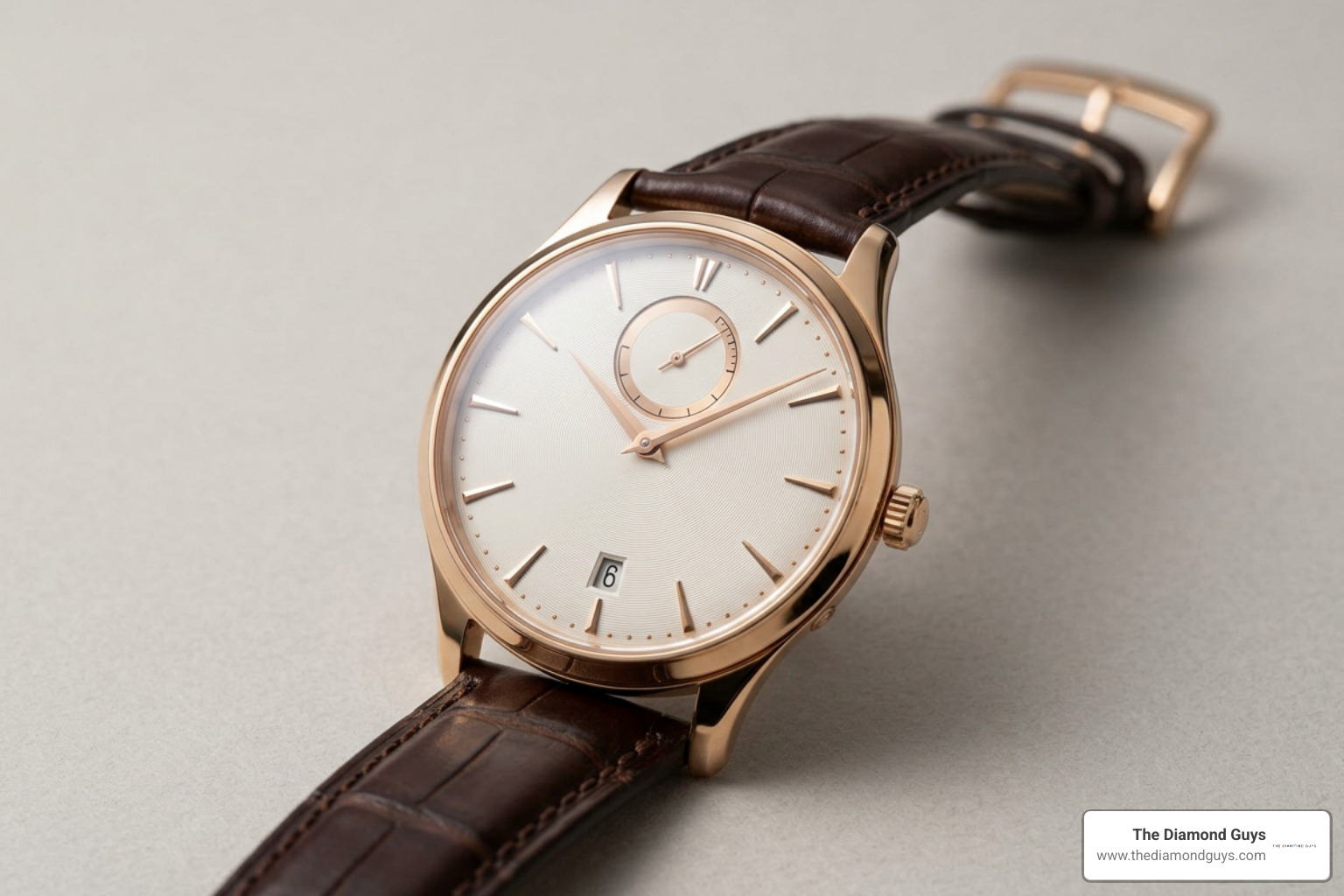
A prime example is the 1950s Vetta Power Reserve in 18k rose gold. Produced for the Italian market by Wyler's subsidiary, it featured an automatic caliber 82 movement with a subdial power-reserve indicator tucked neatly below 12 o'clock. Inner casebacks stamped "Fab. Suisse" confirm Swiss manufacture tailored for fine European market distribution.
Other high-end milestones include mid-century perpetual calendars, jump-hour complications, and early 1940s oversized chronographs. Brands like Patek Philippe, Vacheron Constantin, and early Rolex reference lines set benchmark standards for precious metal finishing. If you're building a premier collection, examining historic piece profiles alongside curated vintage Rolex watches reveals how luxury styling evolved over decades.
Buyer’s Checklist: Movements, Condition, and Authentication
Choosing between movement types comes down to personal ritual versus daily convenience:
- Manual-Wind Movements: Ultra-thin cases (often under 9mm thick) made possible by removing the automatic winding rotor. Requires daily winding, establishing a mechanical connection with your timepiece.
- Automatic Movements: Uses an internal rotor (such as IWC's famous Pellaton winding system found in Caliber 853 or Omega’s Caliber 565) to wind the mainspring through natural wrist motion. Offers effortless daily operation with slightly thicker case geometry.
When building your collection around used automatic watches, authenticating originality is paramount.
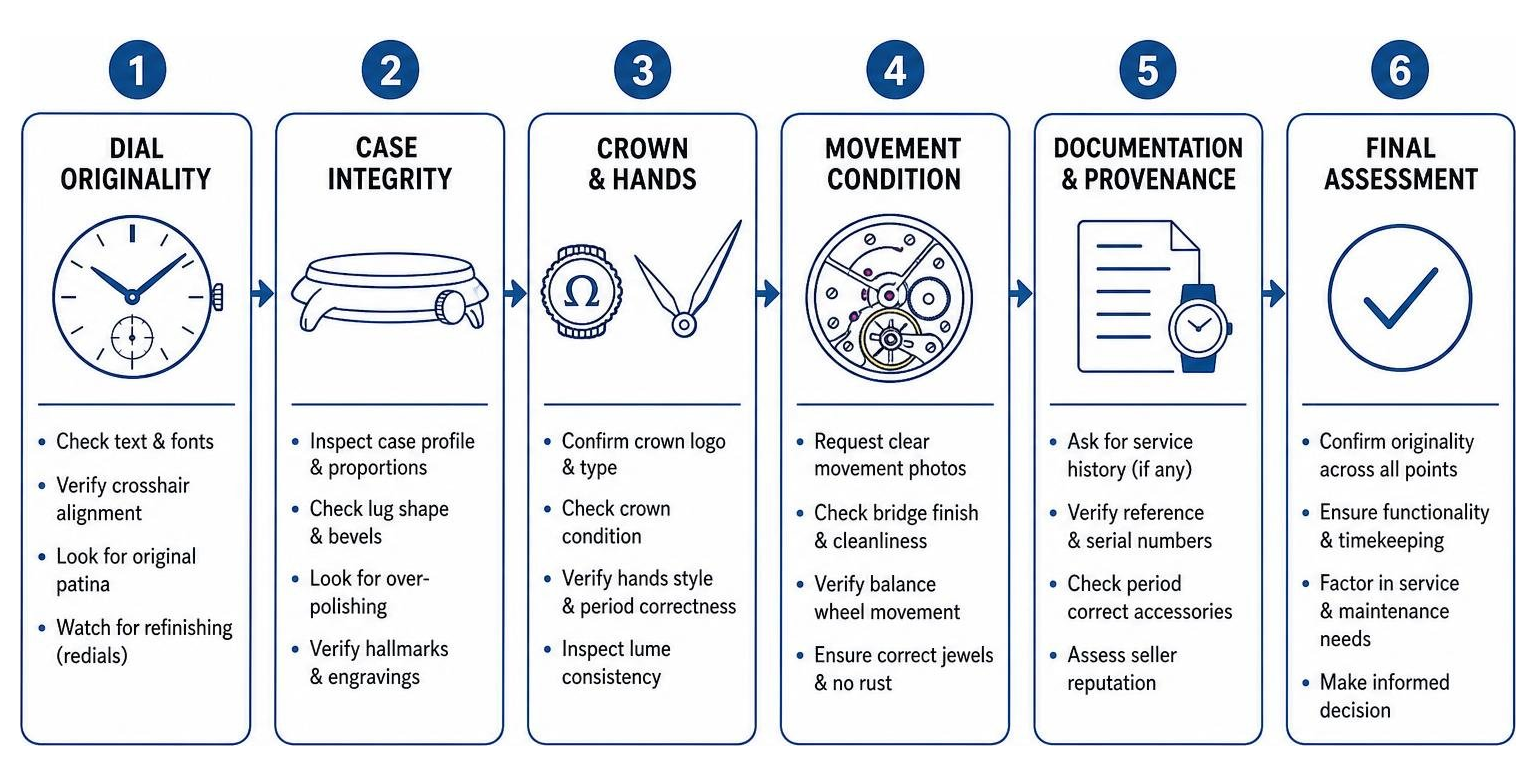
The Vintage Watch Inspection Checklist
- Dial Originality: Inspect under magnification for dial refinishing (often called "redials" or "franken dials"). Look for crisp text, proper brand fonts, correct crosshair alignment, and authentic period patina.
- Case Integrity: Check whether the case profile maintains sharp factory bevels or if aggressive polishing has rounded off signature lug lines.
- Crown & Hands: Confirm that the winding crown features the correct manufacturer logo (e.g., Omega's Greek letter or IWC's fish/probus logo) and that hands match period specifications (such as dauphine or baton hands).
- Movement Condition: Request movement photos to verify clean bridges, free movement of the balance wheel, original jewel settings, and lack of rust or improper tool marks.
- Service Records: Always ask for dated invoice documentation of recent mechanical overhauls rather than relying solely on verbal seller assurances.
Essential Storage and Maintenance for Vintage Dress Watches
Proper care guarantees your mechanical timepiece runs reliably for generations.

- Respect Water Resistance Limits: Standard vintage dress watches carry zero water resistance guarantees (or at best 3ATM / 30 meters when new). Keep them away from sinks, heavy rain, and swimming pools.
- Dedicated Storage: Store delicate timepieces in multi-slot padded watch rolls or dedicated travel cases to prevent scratches and safeguard delicate balance springs from drop impacts.
- Strap & Metal Care: Pair vintage heads with quality leather straps (such as calfskin or alligator). Use soft microfiber cloths to gently wipe down gold-plated, gold-capped, or solid gold cases after wear to remove skin oils.
- Regular Servicing: Plan for professional watchmaker overhauls every 4 to 5 years to clean aged lubricants, check mainspring tension, and preserve internal gears.
Frequently Asked Questions
What makes a vintage dress watch different from modern sports timepieces?
Vintage dress watches prioritize slim profiles, minimal dial typography, elegant case geometry, and leather strap pairings. Modern sports timepieces emphasize larger case diameters, heavy stainless steel bracelets, high water resistance, and bold luminous hands.
Should I choose a manual-wind or automatic vintage movement?
If you prefer the thinnest possible case that fits under formal cuffs, choose a manual-wind caliber. If you plan to wear the watch frequently and prefer the convenience of self-winding mechanisms, opt for an automatic movement.
How do I budget for servicing when buying a vintage watch?
We recommend reserving roughly 20% of your total budget for potential servicing. If a watch lacks documented service history from a certified watchmaker, assume it will need a movement cleaning and re-lubrication upon purchase.
Conclusion
The enduring appeal of vintage dress watches lies in their quiet elegance, historic craftsmanship, and remarkable versatility. Whether paired with a custom tuxedo for a black-tie gala or worn casually with dark denim and a sweater, a classic mid-century timepiece adds instant sophistication to any wardrobe.
If you are looking to curate your collection with exceptional pre-owned timepieces, explore The Diamond Guys pre-owned luxury watch collection. From our stores in Scottsdale, AZ, and Los Angeles, CA, our team provides expert guidance and authenticated luxury watches to help you find the perfect piece for your wrist.


