

How to buy 24k gold without getting fooled
Why Buying a 24K Gold Coin Takes More Than a Quick Search

If you're ready to purchase a 24k gold coin, here's what you need to know right now:
Quick Answer: Top Things to Know Before You Buy
| Question | Quick Answer |
|---|---|
| What purity is 24K gold? | 99.9% pure gold (hallmark: 999 or 9999) |
| Current spot price (May 2026) | $145.98/gram - $4,540.61/troy oz |
| Typical sticker price vs. spot | Higher - dealers add a premium of 5-15%+ |
| Best sources | US Mint, reputable local jewelers, authorized bullion dealers |
| Biggest risk | Buying gold-plated coins marketed as solid 24K |
| Good for investing? | Yes - liquid, divisible, globally recognized |
| Good for gifting? | Yes - especially 1g to 10g coins with motif designs |
Pure gold is one of the most trusted stores of value on the planet. But the market is full of traps - gold-plated coins, vague purity claims, and sellers with no buyback policy. Right now in May 2026, with gold trading above $4,540 per troy ounce, the stakes of getting it wrong are higher than ever.
Whether you're buying your first gram or stacking ounces, the difference between a smart purchase and a costly mistake often comes down to three things: knowing what you're buying, who you're buying from, and what you'll pay beyond the spot price.
I'm Morgan Price, a strategic research and content specialist with deep experience helping buyers navigate the gold bullion market - including how to evaluate a 24k gold coin for authenticity, fair pricing, and long-term value. In the sections below, I'll walk you through everything you need to buy confidently and avoid the most common pitfalls.
Relevant articles related to 24k gold coin:
What a 24k gold coin really is
When we talk about a 24k gold coin, we are talking about the "gold standard" of purity. In precious metals, 24-karat represents 99.9% pure gold, often referred to as "three-nines fine." Some ultra-pure investment coins, like the American Buffalo or the Canadian Maple Leaf, are even refined to 99.99% purity (four-nines fine).
Unlike jewelry, which is often mixed with other metals to make it stronger, a 24k gold coin is essentially pure elemental gold. These coins fall into two main categories:
- Bullion Coins: These are minted by sovereign governments (like the U.S. Mint) and are intended primarily for investment. They carry a face value (legal tender status), though their actual gold value is vastly higher.
- Proof Coins: These are high-quality collector versions of bullion coins. They are struck multiple times to create a mirror-like finish and often come in limited mintages with specialized packaging.
One major trap to watch out for is the "gold-plated" coin. These are often official-looking coins that have been layered with a microscopic coating of 24k gold. While they look pretty and make for nice gifts, they have almost zero investment value compared to a solid 24k gold coin.
24k gold coin vs 22k coin vs jewelry
The main difference between 24k and 22k is durability. 24k gold is incredibly soft—you could literally dent it with your fingernail. This is why it is rarely used for intricate jewelry that needs to withstand daily wear. 22k gold (91.6% purity) is mixed with a small amount of copper or silver to make it harder.
| Feature | 24K Gold Coin | 22K Gold Coin | Gold Jewelry (14k/18k) |
|---|---|---|---|
| Purity | 99.9% - 99.99% | 91.6% | 58.3% - 75% |
| Durability | Very Soft (scratches easily) | Durable | Very Durable |
| Best Use | Investment / Wealth Storage | Investment / Gifting | Daily Wear / Fashion |
| Resale Value | Highest (linked to spot) | High | Moderate (includes labor) |
How to read purity marks before you buy
Before you hand over your hard-earned money, you need to check the "hallmarks." A genuine 24k gold coin will almost always feature a "999" or "999.9" stamp. If you see "14k" or "585," that is not pure gold.
Look for the weight—usually measured in 1 ounce of gold (troy ounces) or grams. Most sovereign coins will also come in a sealed "assay card" from the refinery, which acts as a birth certificate for the coin, listing its weight, purity, and a unique serial number.
How 24k gold coin prices work in 2026
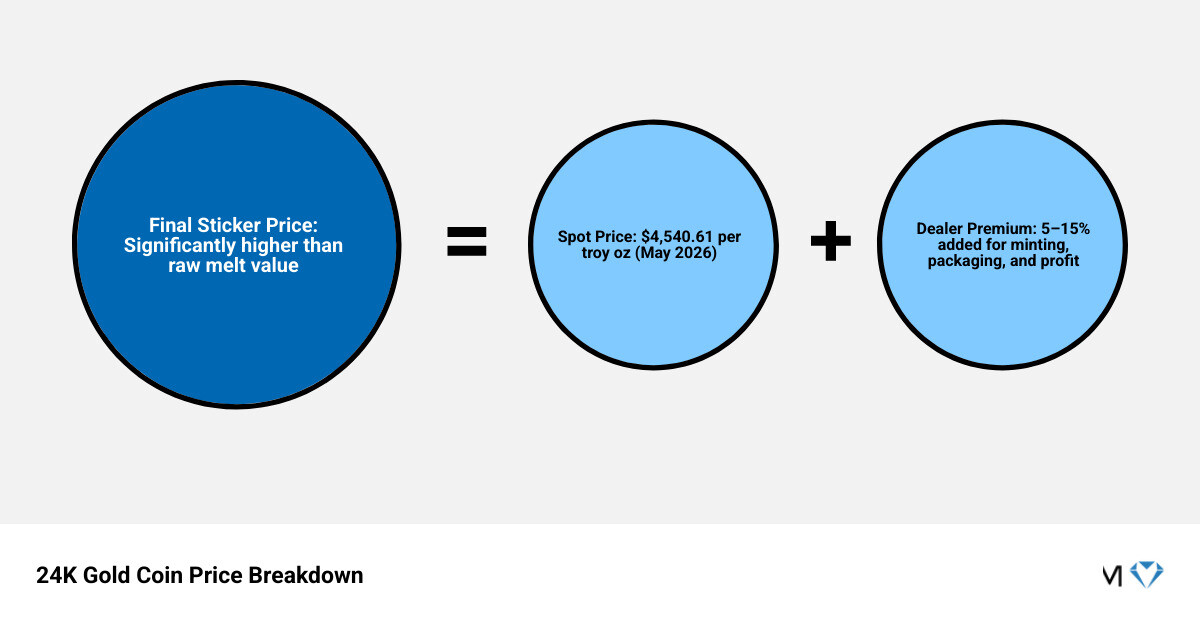
As of May 2026, the gold market is moving fast. To avoid getting "fooled," you must understand that you will never buy gold exactly at the "spot price." The spot price is the wholesale rate for raw gold on the global market.
Current Market Benchmarks (May 2026):
- Per Gram: $145.98
- Per Troy Ounce: $4,540.61
- Per Kilo: $145,983.87
When you buy a 24k gold coin, the dealer adds a "premium." This covers the cost of minting, shipping, insurance, and the dealer's profit. For a live look at how these rates fluctuate, you can check 24K gold spot rates and calculator.
Spot price, premiums, and why the sticker price is higher
Why does a 1-ounce coin cost more than the spot price? Think of it as the "fabrication fee." A government mint has to refine the gold, strike the coin with high-pressure dies, package it, and ship it securely.
Proof coins, like the American Eagle 2025 One Ounce Gold Proof Coin, carry much higher premiums - sometimes priced as high as $5,650.00 - because of their limited mintage and collector appeal. If you are just "stacking" gold for investment, you usually want the lowest premium possible, which often means buying standard bullion coins or larger bars.
24k gold coin sizes and what each usually costs
You don't need $4,500 to start. Gold coins come in various sizes to fit different budgets.
- 1 Gram: The entry point. Perfect for gifting (e.g., a 1g minted gold coin with a religious or decorative motif).
- 1/10 oz to 1/4 oz: Great for "fractional" stacking.
- 1 Ounce: The industry standard for serious investors.
- 30 Gram / 1 Kilo: For high-net-worth portfolio allocation.

Best ways to buy a 24k gold coin safely
Safety is paramount. You aren't just buying metal; you're buying trust. We always recommend buying from sovereign mints or highly reputable authorized dealers. In the US, the gold standard is the US Mint. Globally, names like the Royal Canadian Mint and Perth Mint are equally respected.
Where to buy authentic coins without getting fooled
If you are in the Scottsdale or Phoenix area, visiting a reputable local jeweler like us at The Diamond Guys can provide the peace of mind that online shopping sometimes lacks. We pride ourselves on expert guidance and ethical sourcing.
If buying online, look for:
- Sovereign Mint Status: Are they an authorized purchaser for the US Mint?
- Tamper-Evident Packaging: The coin should arrive in a sealed plastic "slab" or assay card.
- Invoice Detail: Your receipt should clearly state the weight, purity, and brand of the coin.

Red flags that signal a bad seller
If a deal seems too good to be true, it is. If someone is offering a 24k gold coin at or below the current spot price of $145.98 per gram, run the other way. No legitimate dealer sells gold for less than it's worth on the open market.
Other red flags include:
- Pressure Tactics: "Buy now before the dollar collapses tomorrow!"
- Vague Purity: Terms like "gold clad," "gold layered," or "gold finish" all mean "not solid gold."
- No Buyback Policy: Reputable dealers are always happy to buy back the gold they sold you.
Questions to ask before paying
- "Is this coin solid 24k gold or gold-plated?"
- "What is the total premium over the spot price?"
- "Do you provide a gold appraisal service or certificate of authenticity?"
- "What is your buyback price if I want to sell this back to you in five years?"
24k gold coin investment guide: coins vs bars, and jewelry
Why choose a 24k gold coin over other forms of gold? It comes down to liquidity and portability. A gold coin is recognized globally. You could take an American Buffalo coin to a dealer in London, Tokyo, or Dubai, and they would know exactly what it is and what it's worth.
Why many buyers prefer a 24k gold coin for first-time bullion purchases
For the first-time buyer, coins are less intimidating than large bars. They offer "divisibility" - if you need $500, you can sell a small coin. If you own one giant gold bar, you have to sell the whole thing to get any cash. Plus, sovereign coins are legal tender, which adds a layer of government-backed trust that private bars sometimes lack.
When bars may be better than coins
If you are looking to move significant capital into gold, coins might not be the only option.
- Gold Bars: Usually have lower premiums because they are easier to manufacture. While bars are efficient for large-scale storage, they lack the "emergency" divisibility and legal tender status of sovereign coins.
Best uses for 24k gold coin beyond investing
Gold coins aren't just for bunkers and vaults; they are a cornerstone of many cultures.
- Weddings: A 10g or 1 tola coin is a traditional gift in many cultures.
- Religious Milestones: Coins featuring motifs like Ganesha or Om are popular for festivals.
- Heirlooms: Unlike a gold chain repair that might be needed for jewelry, a coin in a capsule stays pristine for generations.
Storage, care, and authentication that protect resale value
Once you have your 24k gold coin, don't just toss it in a drawer. Because 24k gold is so soft, even a small scratch can reduce its "numismatic" or collector value.
How to store and handle coins the right way
- Use Capsules: Hard plastic capsules protect the edges and faces of the coin.
- Cotton Gloves: Your skin oils can actually cause slight discoloration over decades. If you must handle the coin, wear lint-free cotton gloves.
- Climate Control: Keep them in a dry, cool place. Humidity won't hurt the gold (gold doesn't rust), but it can damage the packaging or the copper in 22k coins.
How to verify a coin is genuine before and after purchase
If you've bought a coin and want to be sure, there are non-destructive tests you can do:
- The Magnet Test: Gold is not magnetic. If your coin sticks to a magnet, it's a fake.
- The Weight Check: Use a digital scale that measures to 0.01g. A 1oz coin should weigh exactly 31.1 grams.
- XRF Testing: Professional jewelers use X-Ray Fluorescence (XRF) machines to "see" the elemental makeup of the metal without scratching it. You can find more about this through a professional gold appraisal service.
Frequently asked questions about 24k gold coin
Is a 24k gold coin better for investment than gold jewelry?
Generally, yes. When you buy jewelry, you pay for the craftsmanship, the brand, and the retail markup. When you sell it, you usually only get the "melt value." A 24k gold coin has a much lower markup and is specifically designed for resale. For more on how gold and diamonds work together, check out Gold and Diamonds: A Match Made in Jewelry Heaven.
What taxes, premiums, and fees should buyers expect?
In many states (like Arizona), investment-grade bullion is exempt from sales tax if you buy over a certain amount, but you should always check local regulations. Expect to pay a dealer premium (usually 3%–10% for coins) and potentially shipping and insurance fees if buying online.
Can a 24k gold coin be a good gift and still hold value?
Absolutely. Unlike a toy or an electronic gadget, a gold coin is a gift that grows (or at least preserves) its value. It teaches the recipient about wealth and saving. Popular options include the 1g Ganesha motif or the 1/10 oz American Eagle.
Conclusion
Buying a 24k gold coin is one of the most rewarding ways to diversify your wealth. By focusing on purity (999+), buying from reputable sources like The Diamond Guys or official mints, and understanding the May 2026 market prices, you can build a collection that lasts a lifetime.
Remember the smart buyer's checklist:
- Verify the hallmark (999).
- Check the daily spot price ($145.98/g).
- Ensure the coin is in an assay card or capsule.
- Buy for the long term.
If you're looking for more guidance on precious metals, from 1 ounce of gold to custom jewelry, we are here to help you make a choice you’ll be proud of for years to come.


