

The 4 Prong Tennis Bracelet Buying Guide
Why the 4 Prong Tennis Bracelet Is the Gold Standard for Security and Sparkle

A 4 prong tennis bracelet is one of the most secure and brilliant ways to wear diamonds on your wrist — and it's the setting style most jewelers recommend for everyday wear.
Quick answer: Is a 4-prong tennis bracelet secure enough for daily wear?
- Yes. Four prongs grip each diamond from four sides, holding it firmly in place
- The setting balances security and light exposure better than 2- or 3-prong alternatives
- 14k gold is the most durable metal choice for daily wear
- Prong tightening every 1-2 years keeps diamonds safe long-term
- Box clasps with safety latches add an extra layer of protection
The 4-prong setting has become the benchmark in tennis bracelet design — not by accident, but because it solves the two biggest concerns buyers have: will my diamonds stay put, and will they still shine? Each diamond sits in its own four-prong basket, held securely while still allowing maximum light to pass through and reflect back. The result is a bracelet that looks stunning and holds up to real life.
Whether you're buying your first fine jewelry piece or adding to a collection, choosing the right setting matters more than most buyers realize. Getting it wrong can mean loose stones, dull sparkle, or a bracelet that just doesn't feel right on the wrist.
I'm Morgan Price, a backlink and content specialist with deep expertise in fine jewelry topics including the 4 prong tennis bracelet market, having researched and analyzed dozens of retailers, settings, and diamond configurations. In this guide, I'll walk you through everything you need to make a confident, informed purchase.
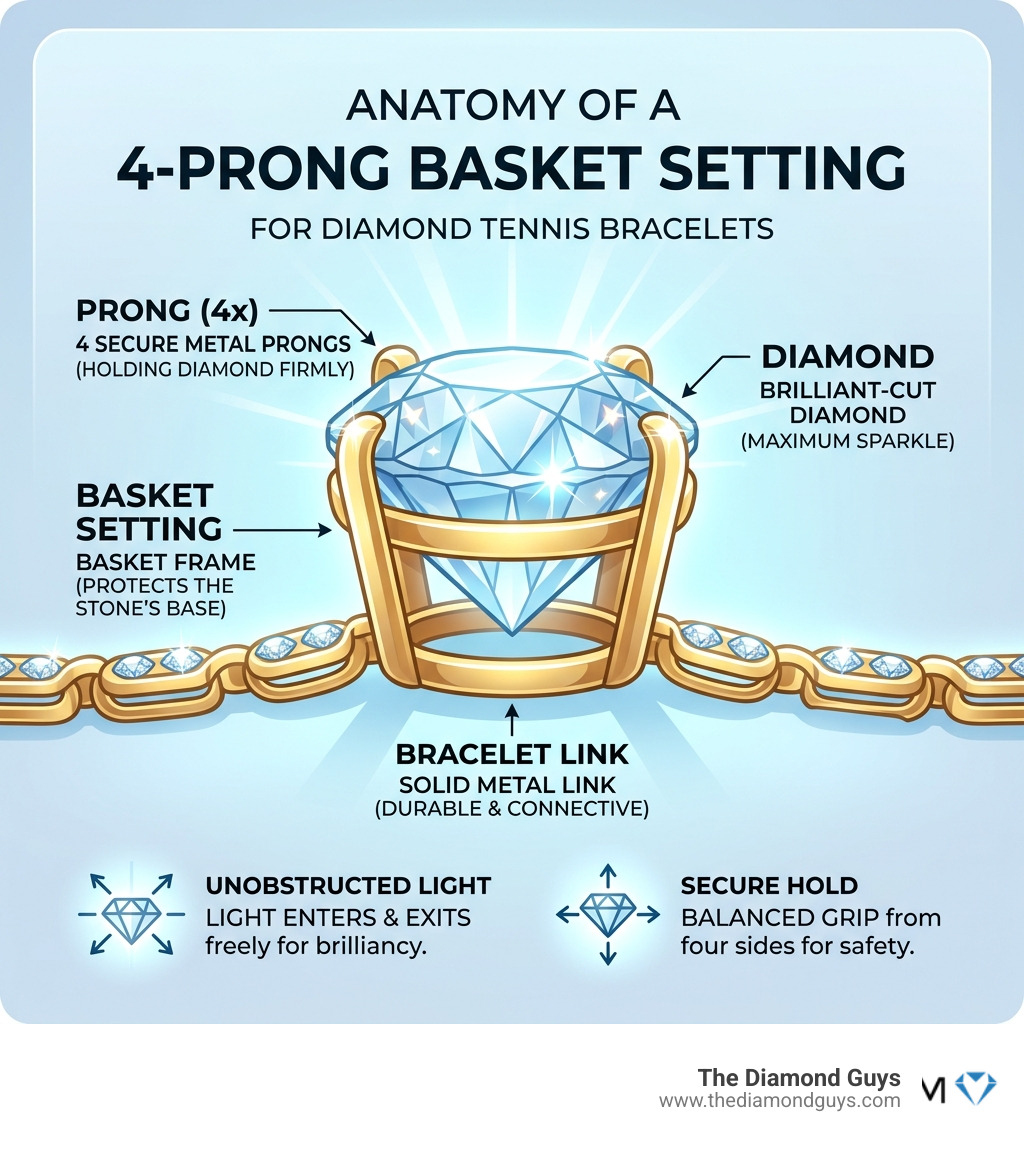
Essential 4 prong tennis bracelet terms:
Understanding the 4 Prong Tennis Bracelet Setting
When we talk about a 4-prong setting, we are referring to the "basket" that holds each individual diamond. In a 4 prong tennis bracelet, every stone is cradled by four small metal posts (prongs) that overlap the edge of the diamond. This creates a square or box-like silhouette around a round diamond, which provides a balanced, symmetrical look that many of our clients in Scottsdale and Phoenix find incredibly appealing.
Compared to other styles, such as the 3-prong (which creates a more triangular look) or the bezel setting (which wraps the diamond in a solid rim of metal), the 4-prong basket is the "Goldilocks" of jewelry. It offers more metal visibility than a 3-prong, giving the bracelet a substantial, high-end feel, but it allows for significantly better light performance than a bezel. Because the sides of the basket are often open, light can enter the diamond from multiple angles, resulting in that signature "fire" we all love.
For a deeper dive into how this compares to other styles like the channel or halo, check out our diamond tennis bracelets complete guide.
Security and Durability of the 4 Prong Tennis Bracelet
If you are the type of person who plans to wear your jewelry to brunch, the office, and maybe even a quick stop at the gym (though we usually suggest taking it off for heavy lifting!), security is your top priority. The 4 prong tennis bracelet excels here. With four points of contact, even if one prong were to snag and pull back slightly, the other three usually provide enough tension to keep the diamond from falling out immediately.
However, durability isn't just about the number of prongs; it’s about the metal they are made of. At our Scottsdale showroom, we often discuss the merits of 14k vs. 18k gold.
- 14k Gold: Contains 58.3% gold. It is harder and more resistant to scratching or bending, making it the ideal choice for the thin prongs of a tennis bracelet.
- 18k Gold: Contains 75% gold. It has a richer color but is softer. While luxurious, it may require more frequent "prong checks" to ensure the stones remain tight.
If you're looking for an entry-level option that still offers great durability, you might even consider a 10k white gold tennis bracelet, though 14k remains the industry standard for high-quality bridal and fine jewelry.
Aesthetic Advantages of the Four Prong Design
Beyond the safety specs, the four-prong design is simply a classic. It creates a continuous "line of light" on the wrist. Because round brilliant diamonds are the most common stone used in these bracelets, the four prongs help define the shape while adding a bit of architectural structure.
The symmetry of the four prongs makes the bracelet look "organized" and intentional. It doesn't lean or tilt as easily as some minimalist settings might. Whether you are choosing a dainty 2-carat piece or a show-stopping 10-carat version, the four-prong basket ensures that each diamond is presented at its maximum brilliance.
Choosing Your Diamonds: Carat Weight and Quality
When shopping for a 4 prong tennis bracelet, you’ll see the term "CTW" (Carat Total Weight). This represents the combined weight of all diamonds in the bracelet. It is important to remember that as the CTW increases, the individual size of each diamond also grows, which changes the width of the bracelet and the number of stones required.
Based on industry standards and common configurations, here is how the physical appearance shifts as you go up in weight:
| Total Carat Weight (CTW) | Approx. Number of Diamonds | Approx. Bracelet Width | Gold Weight (Approx.) |
|---|---|---|---|
| 3.00 CTW | 60–65 | 2.3mm | 5.3g |
| 5.00 CTW | 50–55 | 3.0mm | 7.5g |
| 7.00 CTW | 45–50 | 3.4mm | 8.2g |
| 10.00 CTW | 40–45 | 4.0mm | 9.0g |
For those looking for a balanced, everyday look, a 3ct diamond tennis bracelet complete guide can help you decide if that size fits your lifestyle. If you're aiming for a red-carpet statement, you’ll want to look at our 10 carat tennis bracelet price guide.
When it comes to quality, we recommend focusing on the "eye-clean" standard. For a tennis bracelet, you don't necessarily need "Flawless" diamonds.
- Color: G-H is the "sweet spot." These diamonds look white to the naked eye but cost significantly less than D-F (Colorless) stones.
- Clarity: VS2 to SI1 is ideal. At these grades, any inclusions are invisible without a jeweler's loupe, meaning your bracelet will sparkle brilliantly without the premium price tag of VVS stones.
Lab-Grown vs. Natural Diamonds in a 4 Prong Tennis Bracelet
One of the biggest decisions our clients face today is choosing between lab-grown and natural diamonds.
Lab-Grown Diamonds:
- Cost-Effectiveness: You can often get a much larger CTW for the same budget. For example, a 5ct lab-grown bracelet might be priced similarly to a 2ct natural diamond bracelet.
- Ethics: They are conflict-free and have a smaller environmental footprint.
- Quality: Chemically, physically, and optically, they are identical to natural diamonds. Even a trained gemologist needs specialized equipment to tell the difference.
Natural Diamonds:
- Rarity and Value: Natural diamonds hold their value better over time and carry the prestige of being billions of years old.
- Investment: For those looking for a legacy piece or an heirloom, natural is often the preferred route.
Whether you choose a lab-grown option or a massive 15 ct tennis bracelet made of earth-mined stones, the 4-prong setting will ensure they stay protected.
Sizing and Customization Options
Nothing ruins the feeling of a new 4 prong tennis bracelet like it sliding off your hand or being so tight it leaves a mark. Getting the size right is a science.
How to Measure Your Wrist:
- Use a flexible measuring tape or a piece of string.
- Wrap it just above the wrist bone (where you would normally wear a watch).
- The "Two Finger" Rule: For a comfortable fit, add about 0.5 to 1 inch (1.25 to 2.5 cm) to your measurement. You want enough room to fit one or two fingers between the bracelet and your skin so it can move gracefully.

Standard Lengths:
- 6.5 inches: Small/Petite
- 7.0 inches: Most common size for women
- 7.5 to 8.0 inches: Large/Men's sizes
Clasp Security: In a 4 prong tennis bracelet, the clasp is the most common point of failure. We always recommend a box clasp with a safety latch (sometimes called a "figure-eight" safety). This ensures that even if the main lock clicks open, the side safety bar keeps the bracelet on your wrist.
For more on metal choices and how they affect the fit and feel, see our 18k gold tennis bracelet ultimate guide.
Care, Maintenance, and Styling Tips
A 4 prong tennis bracelet is designed for life, but it does need a little love to keep it shining.
Cleaning at Home: You don't need fancy chemicals. A bowl of warm water with a few drops of mild dish soap is perfect. Let the bracelet soak for 10-15 minutes, then gently scrub the diamonds with a soft-bristled toothbrush. Pay extra attention to the back of the baskets, where lotions and oils tend to build up.
Professional Maintenance: We recommend bringing your bracelet in for a professional inspection once a year. We check for:
- Prong Tightness: Ensuring no stones are loose.
- Clasp Tension: Making sure the safety latches haven't become "mushy."
- Rhodium Plating: If your bracelet is white gold, a fresh dip in rhodium will restore that "brand new" mirror finish.
Styling Your Bracelet: The beauty of the 4-prong style is its versatility.
- Everyday: Wear it alone as a signature piece. It’s subtle enough for a t-shirt and jeans but elevated enough for the boardroom.
- The "Stack": Combine it with a luxury watch or a gold bangle. The 4-prong setting provides a nice structural contrast to smooth metal bands.
- Special Occasions: For weddings or galas, don't be afraid to go big. A high-carat 4-prong bracelet is a "showstopper" that doesn't need any help from other jewelry.
Discover more about finding your perfect look in our article, game set match discovering the best tennis bracelets.
Frequently Asked Questions about 4 Prong Tennis Bracelets
Is a 4-prong setting more secure than a 3-prong setting?
Generally, yes. While a 3-prong setting is beautiful and allows for a more "minimalist" look, a 4 prong tennis bracelet offers an extra point of contact. If one prong is damaged, the diamond is much more likely to stay in a 4-prong basket than a 3-prong one.
How do I measure my wrist for the perfect bracelet fit?
Measure your wrist circumference with a soft tape and add 0.5 to 1 inch. Most women find that a 7-inch bracelet is the "standard" comfortable fit. If you're in the Scottsdale or Phoenix area, stop by our showroom, and we’ll measure you professionally to ensure a perfect drape.
Can I wear a 4-prong tennis bracelet every day?
Absolutely. In fact, that is what it’s built for! The 4-prong basket is one of the most durable designs available. Just remember to remove it before heavy cleaning, swimming in chlorinated pools, or intense physical activity to prevent the gold from wearing down prematurely.
Conclusion
Choosing a 4 prong tennis bracelet is an investment in both style and peace of mind. By balancing the classic beauty of round brilliant diamonds with the structural integrity of a four-point basket, you’re getting a piece of jewelry that will truly stand the test of time.
At The Diamond Guys, we pride ourselves on providing more than just jewelry; we provide expert guidance. Whether you are looking for a custom-designed natural diamond piece or a high-carat lab-grown stunner, our team in Scottsdale and Los Angeles is here to ensure you find exactly what you're looking for. We believe in ethical sourcing, transparent pricing, and a personalized shopping experience that you just won't find at a big-box retailer.
Ready to find your sparkle? Find your perfect tennis bracelet or book a consultation with us today. We can’t wait to help you find a piece you’ll love for a lifetime.
External Resources for Further Reading:


