

Understanding 5 Carat Diamond Earrings Price Points and Value
What Do 5 Carat Diamond Earrings Cost?
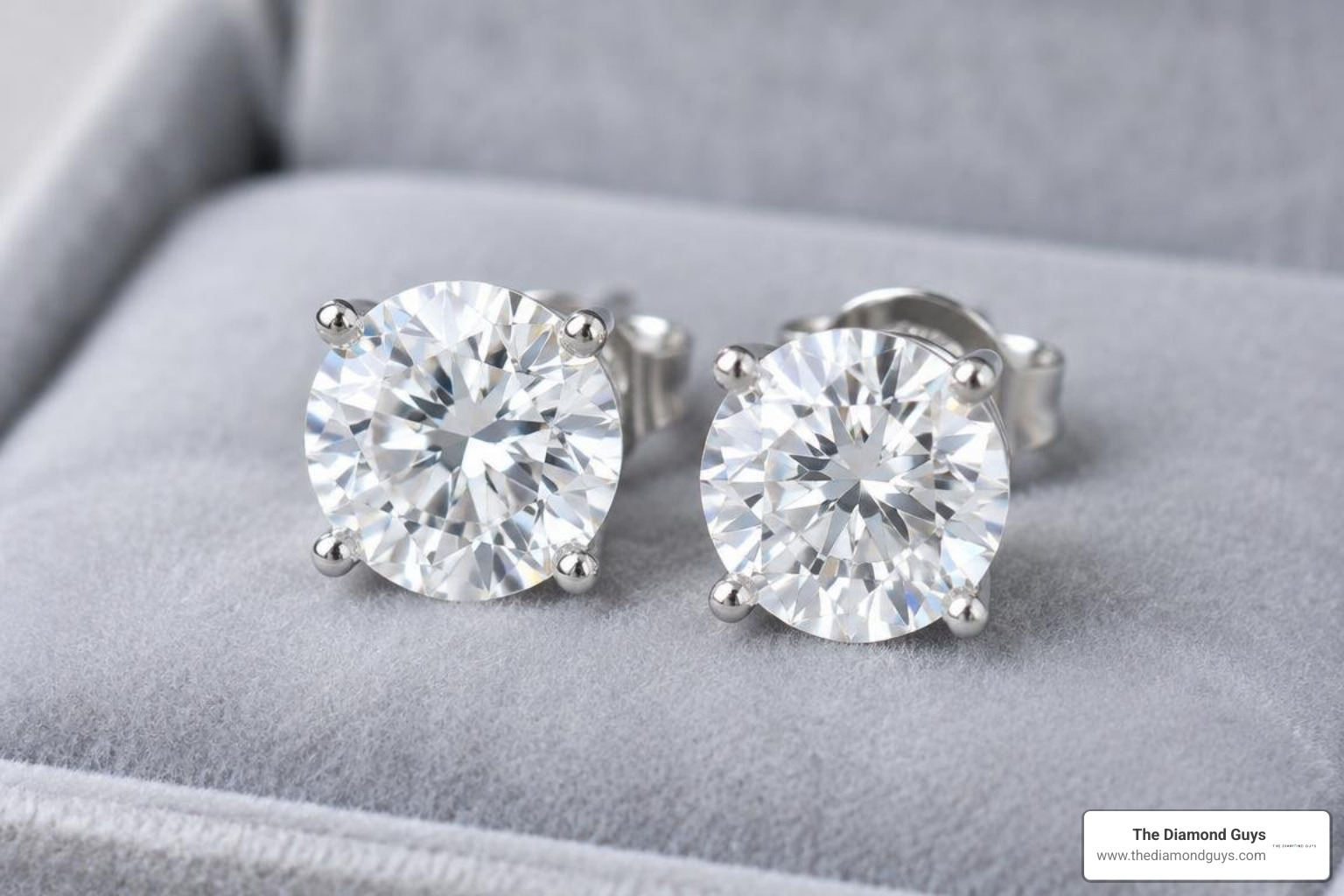
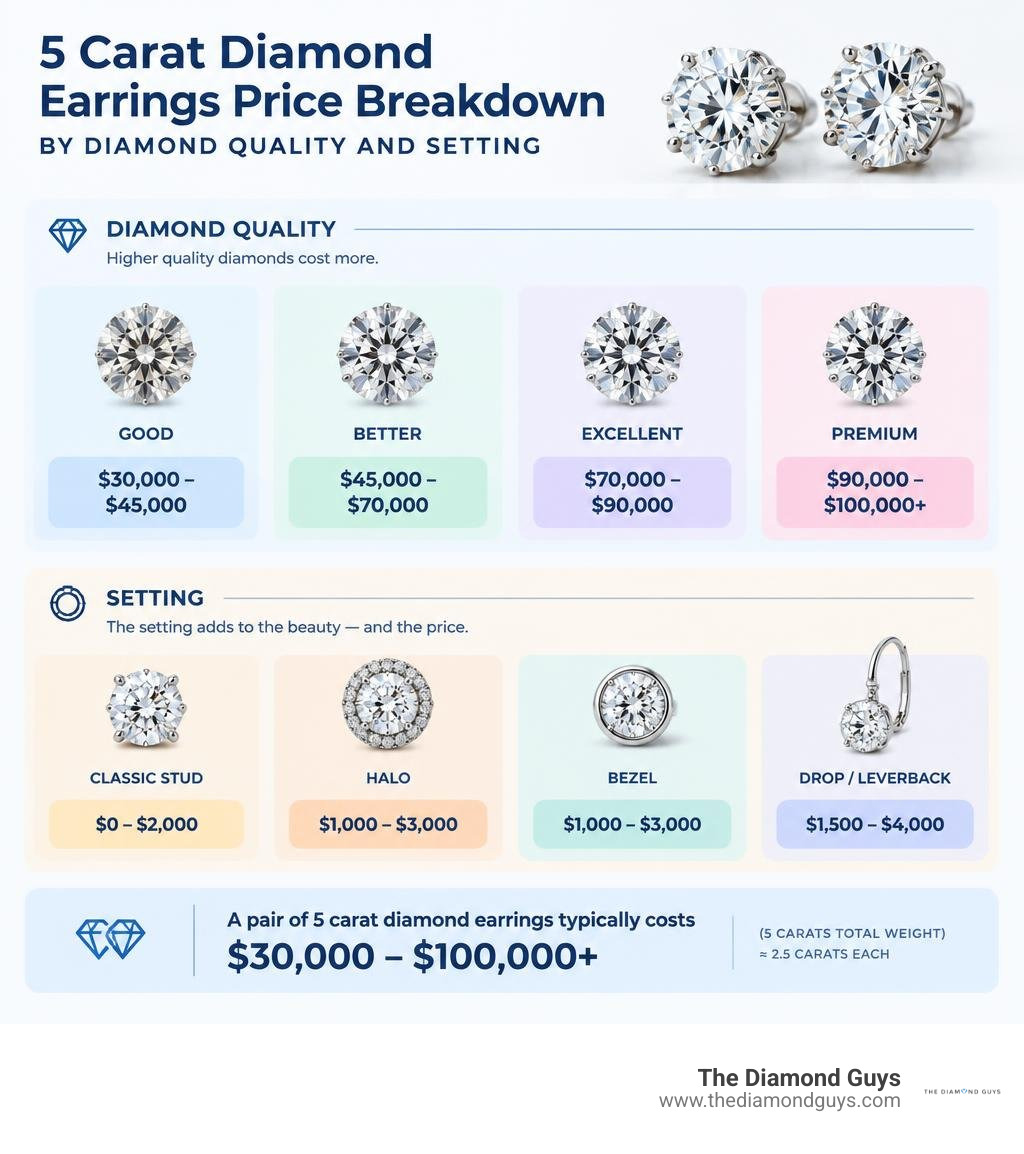
A pair of 5 carat natural diamond earrings often costs $30,000 to $100,000 or more. That usually means 5 carats total weight: about 2.5 carats in each ear. The price can shift sharply with the diamonds' cut, color, clarity, and grading reports. The setting matters, too, but the diamonds usually drive the largest share of the cost. Lab-grown diamonds need a separate price comparison.
The key is to compare pairs with the same total weight and similar quality, not just the same "5 carat" label.
I'm Morgan Price, a research and outreach specialist who helps content teams check sources and explain topics like 5 carat diamond earrings price. I'll start with what makes one pair cost more than another.
Easy 5 carat diamond earrings price word list:
Typical Price Ranges for 5 Carat Diamond Earrings
Navigating the market for substantial fine jewelry requires an understanding of how diamond valuation scales. When evaluating a natural diamond, pricing does not increase in a direct, straight line as carat weight goes up. Instead, larger stones command an exponential premium because finding rough material large enough and pure enough to yield gem-quality individual stones of 2.5 carats or more is exceptionally rare.
In almost all retail environments, the phrase "5 carat diamond earrings" denotes 5 carats total weight (CTW). This means the pair consists of two matching diamonds weighing roughly 2.5 carats each. If you are shopping for earrings where each individual center stone weighs 5 carats (for a staggering 10 carats total weight), the price brackets jump into hundreds of thousands of dollars.
To provide a clear baseline for 5 carats total weight (approx. 2.50 ct per ear), natural diamond pairs typically fall across three main quality tiers:
| Quality Tier | Color & Clarity Profiles | Average Natural Price Range (Pair) |
|---|---|---|
| Commercial / Good Value | I–J Color, SI1–SI2 Clarity | $30,000 – $48,000 |
| Fine Quality / Premium Balance | F–H Color, VS1–VS2 Clarity | $50,000 – $85,000 |
| Collector / Investment Grade | D–E Color, VVS2–Flawless Clarity | $90,000 – $150,000+ |
At our showrooms in Scottsdale and Phoenix, Arizona, as well as Los Angeles, we work closely with clients to source diamonds that hit the visual "sweet spot," maximizing fire and brilliant brilliance without paying for microscopic perfection that cannot be seen once the earrings are worn.
Key Factors Driving the 5 Carat Diamond Earrings Price
When selecting a pair of Diamond Stud Earrings, the total price is predominantly dictated by the rarity and quality of the two center stones. Because two diamonds are needed to make a pair, finding an identical match in millimeter dimensions, table spread, color tone, and optical performance requires curated sourcing.
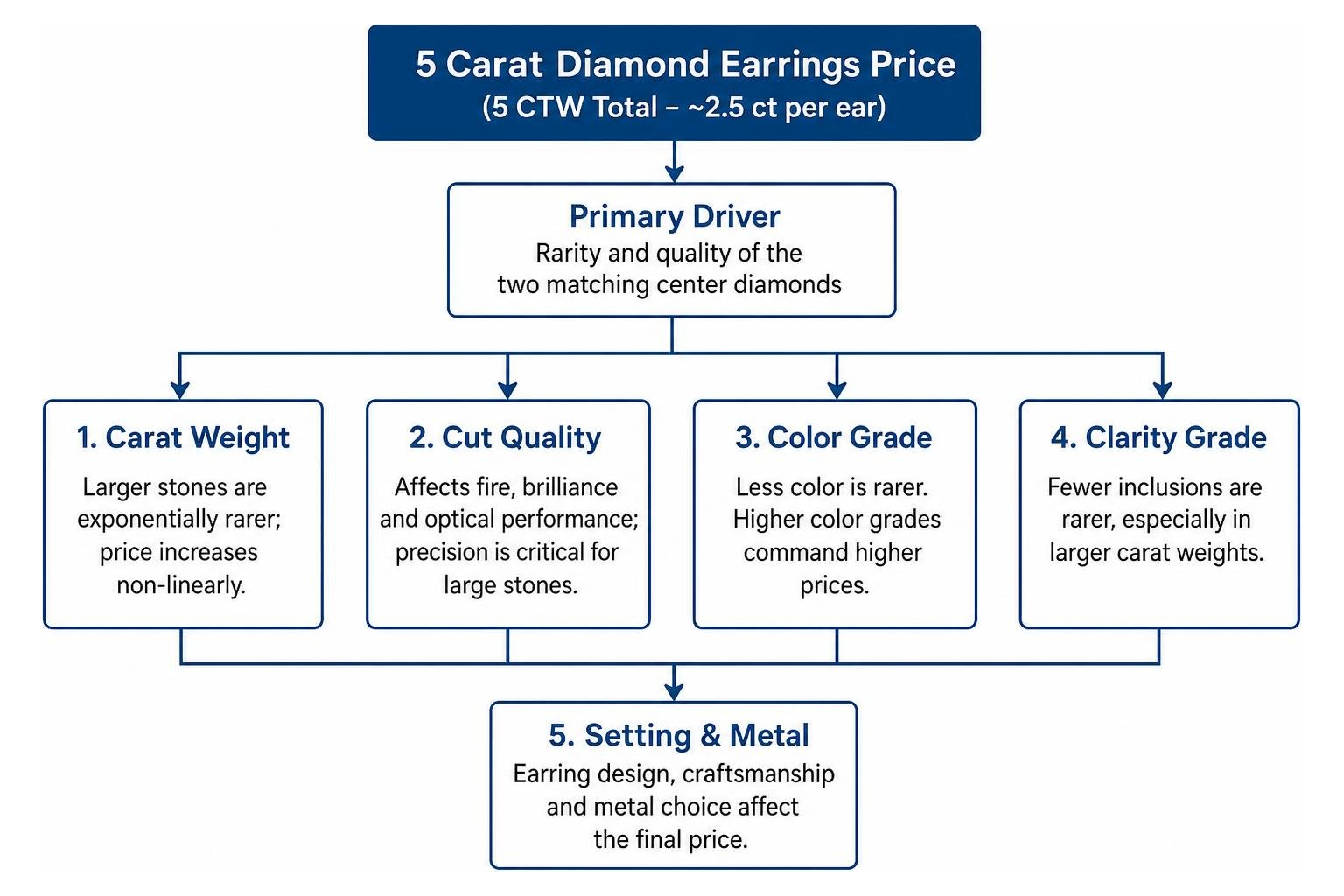
The rarity curve explains why two 2.5-carat diamonds cost significantly more than ten 0.50-carat diamonds. In nature, massive crystal formations are scarce. When you assemble a balanced pair of 2.5-carat natural diamonds, you are acquiring two distinct rarities that must mirror each other seamlessly in cut precision and optical life.
How the 4Cs Influence the 5 Carat Diamond Earrings Price
The Gemological Institute of America (GIA) established the standardized grading criteria known globally as the 4Cs: Cut, Color, Clarity, and Carat Weight. In large stones, these factors behave with distinct nuances:
- Cut: Cut is the single most important factor determining a diamond's beauty. An "Excellent" or "Ideal" cut ensures proper light refraction, maximum brightness, and dynamic sparkle. Even in a 5-carat pair, a poor cut will make the stones look dull and smaller than their true weight.
- Color: Because larger diamond facets show body color more clearly than small accent stones, color retention becomes prominent above 2 carats. While an I or J color stone can look white when set in yellow gold, those who prefer crisp icy brilliance in platinum or white gold generally opt for the D through G color spectrum.
- Clarity: Clarity measures internal inclusions and surface blemishes. At 2.5 carats per ear, large facet windows make inclusions easier to spot under magnification. Selecting "eye-clean" stones—typically within the VS1 to SI1 range—allows you to avoid paying the steep premium of VVS or Flawless grades while ensuring zero visible imperfections to the naked eye.
- Carat Weight & Millimeter Spread: A standard 2.50 ct round brilliant diamond measures approximately 8.8 to 9.0 millimeters in diameter. Precision-cut diamonds distribute their carat weight across the top face rather than hiding excess depth at the bottom of the stone.
Setting Styles and Metal Choices
While center gems represent the vast majority of your investment, the metal structure and craftsmanship secure your diamonds and complete the aesthetic.
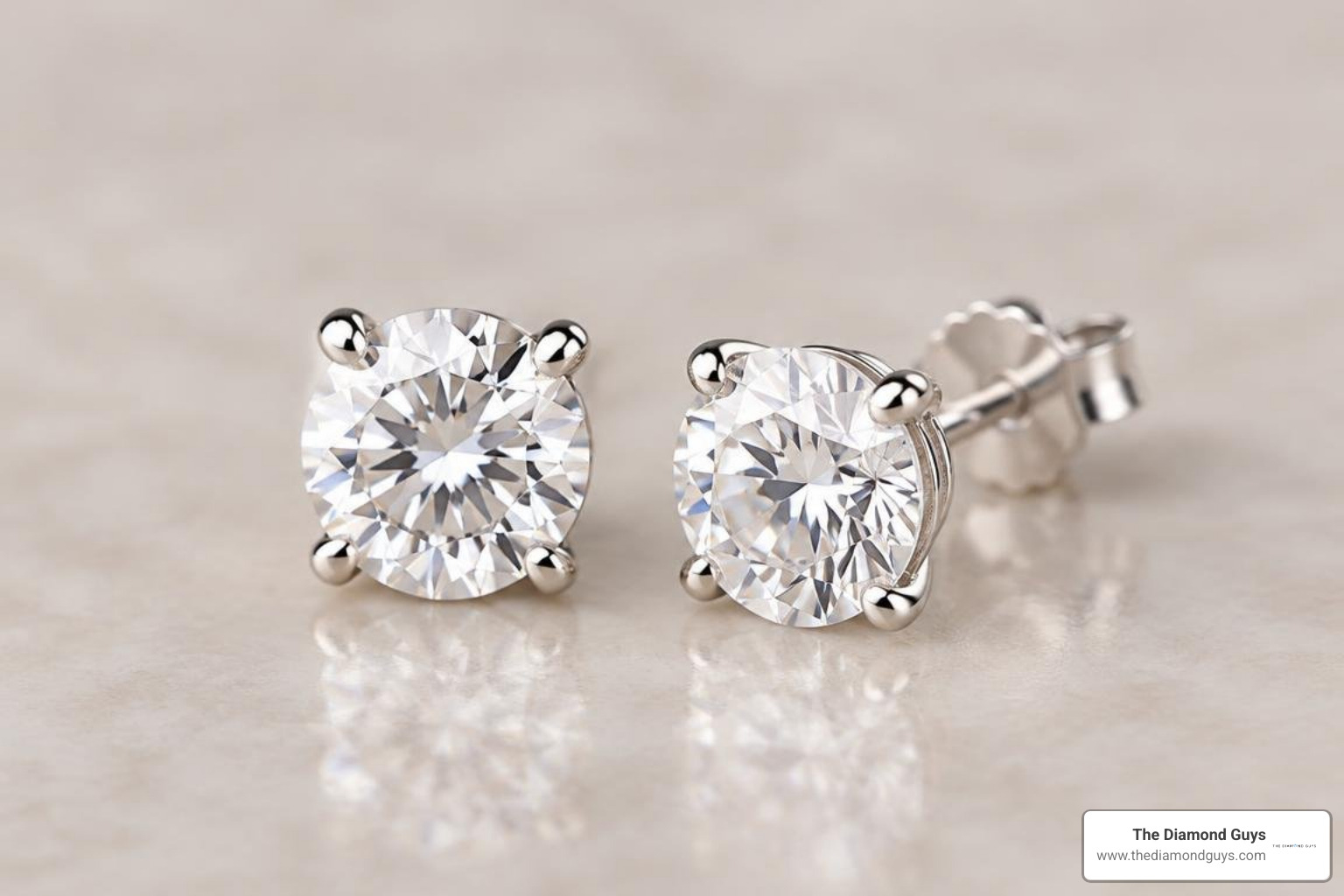
Precious metal choices introduce distinct pricing and functional considerations:
- Platinum: Platinum is naturally hypoallergenic, exceptionally dense, and provides unmatched prong durability. It costs roughly 20% to 30% more than gold due to metal purity and the specialized bench work required.
- 18k and 14k Gold: Available in white, yellow, and rose alloys, gold provides timeless warmth and structural resilience at a slightly lower entry cost.
Setting styles also impact the final presentation:
- Martini 3-Prong Settings: Hug the earlobe tightly, preventing the heavy 2.5-carat stones from drooping forward.
- Classic 4-Prong Basket: Offers a square silhouette with sturdy retention.
- Bezel Mounts: Encase the stone perimeter in solid metal, adding protective rimming while visually expanding the diameter.
- Halo Accents: Surround the center diamonds with smaller micro-pavé accents.
For dynamic movement, some clients choose drop designs or combine studs with accent pieces such as Diamond Hoop Earrings for versatile styling.
Market Channels and Value Considerations
Where you purchase high-carat jewelry impacts the overall financial equation. Traditional brick-and-mortar storefronts with massive corporate retail footprints often apply high overhead markups to cover inventory holding costs. In contrast, working directly with specialized diamond purveyors or wholesale-direct custom jewelers provides access to global stone inventories at significantly closer margins to primary market value.
Certification is the essential pillar of value verification. Independent, third-party grading from premier laboratories—principally the GIA—guarantees that you receive the exact carat weight, cut proportions, color grade, and clarity characteristics stated on paper. Uncertified diamonds carry substantial financial risk, as a single grade discrepancy in color or clarity on a 2.5-carat stone can alter its fair value by thousands of dollars.
Following purchase, obtaining a formal jewelry appraisal for insurance coverage protects your assets against loss, theft, or physical damage based on current replacement valuations.
Natural vs. Lab-Grown 5 Carat Diamond Earrings Price Comparison
For buyers exploring alternative options, laboratory-grown diamonds have emerged as an accessible modern choice. Lab-grown diamonds share identical chemical, physical, and optical properties with mined diamonds, created using advanced High Pressure High Temperature (HPHT) or Chemical Vapor Deposition (CVD) processes.
The primary difference lies in rarity and manufacturing scalability, which leads to substantial cost variances. You can evaluate modern lab collections, such as Lab Grown Diamond Stud Earrings, to understand how different production methods correlate with pricing.
| Attribute | Natural 5 Carat Pair (2.5 ct each) | Lab-Grown 5 Carat Pair (2.5 ct each) |
|---|---|---|
| Typical Price Range | $30,000 – $100,000+ | $3,500 – $7,500 |
| Origin & Formation | Mined from Earth over billions of years | Grown in controlled laboratory environments |
| Rarity Factor | High natural geological scarcity | Technologically reproducible |
| Long-Term Value | Established secondary market and resale track record | Decreasing production costs affect secondary retention |
Resale Potential and Investment Outlook

High-carat natural diamonds occupy a distinct segment within luxury assets. While diamond jewelry should primarily be acquired for personal enjoyment and sentimental significance, stones weighing 2.5 carats and above demonstrate better secondary market stability than smaller commercial goods.
Natural diamonds maintain intrinsic value through established diamond exchanges, auction houses, and estate jewelry markets. However, retail buyers should expect a margin differential when reselling, as secondary acquisitions occur at wholesale pricing levels. Selecting GIA-certified natural diamonds with Excellent cut grades and desirable color-clarity balances ensures the highest liquidity and asset retention across generations.
Financing and Smart Buying Strategies
Acquiring a significant jewelry piece can be managed flexibly through structured financing strategies:
- Deferred Interest & Installment Plans: Many buyers utilize 0% APR promotional financing over 6 to 12 months or extended low-interest installment terms to spread capital outlay smoothly.
- Prioritizing Cut over Clarity: You can save thousands by selecting an eye-clean VS2 or SI1 clarity grade rather than paying for microscopic purity (VVS/FL), putting those funds into an Excellent cut grade to maximize physical sparkle.
- Custom Fabrication: Designing custom settings allows you to choose low-profile backings, such as custom screw backs or secure La Pousette locking mechanisms, ensuring heavy carat studs sit securely and flush on the earlobe without tilting.
Frequently Asked Questions About 5 Carat Diamond Earrings
How much should I expect to pay for a high-quality pair of 5 carat diamond earrings?
For a high-quality, GIA-certified pair of natural diamond earrings with F–G color, VS clarity, and Excellent cut grades, expect to invest between $50,000 and $85,000. Exceptional collector-grade pairs with top-tier D color and VVS+ clarity exceed $100,000.
Does 5 carat diamond earrings mean 5 carats each or total weight?
In jewelry industry terminology, a 5-carat earring specification universally indicates 5 Carats Total Weight (5.00 CTW) for the pair. This translates to two individual diamonds weighing approximately 2.50 carats each.
Why is GIA certification essential when buying 5 carat diamond earrings?
Independent GIA grading protects your investment by verifying the exact physical and optical standards of the gems without conflict of interest. Because slight grading variances in large diamonds represent thousands of dollars in value, certification ensures you receive the precise quality you pay for.
Conclusion
Purchasing a pair of 5 carat diamond earrings represents an extraordinary milestone of style, craftsmanship, and enduring value. By balancing the 4Cs, selecting secure, proportionate settings, and verifying diamond authenticity with GIA documentation, you can select an exceptional pair suited to your aesthetic and investment goals.
At The Diamond Guys, our master jewelers and diamond specialists in Scottsdale, Phoenix, and Los Angeles are dedicated to providing ethical sourcing, transparent market pricing, and bespoke custom design. When you are ready to view curated stones in person or begin a custom build, explore our diamond stud earring options to schedule your private consultation.


