

Local Sparkle: Your Go-To Guide for Finding Lab Grown Diamonds in Your Area
The Smartest Way to Find Lab Created Diamonds Nearby in 2026
If you're searching for lab created diamonds nearby, here are the fastest ways to find a trusted local retailer:
- Search Google Maps for "lab grown diamond jeweler" + your city
- Visit a local showroom in Scottsdale or Los Angeles — like The Diamond Guys — for hands-on, expert guidance
- Look for IGI or GIA certified inventory at any retailer you consider
- Book a private consultation to compare stones in person under proper lighting
- Ask about custom design options to get exactly the shape, size, and setting you want
Finding the right diamond locally isn't just about convenience. It's about seeing the stone in person, getting honest advice, and walking away with full confidence in what you bought.
Lab-grown diamonds have gone from a niche option to a mainstream choice for couples and individuals who want real diamond quality without the inflated price tag. In July 2026, they're widely available — but not all local retailers offer the same level of expertise, certification, or transparency.
That's exactly why knowing where to look and what to ask matters so much.
My name is Morgan Price, and I've spent years researching the lab-grown diamond market — helping buyers navigate the growing landscape of local retailers offering lab created diamonds nearby with confidence and clarity. In this guide, I'll walk you through everything you need to find the right stone, from the right jeweler, at the right price.
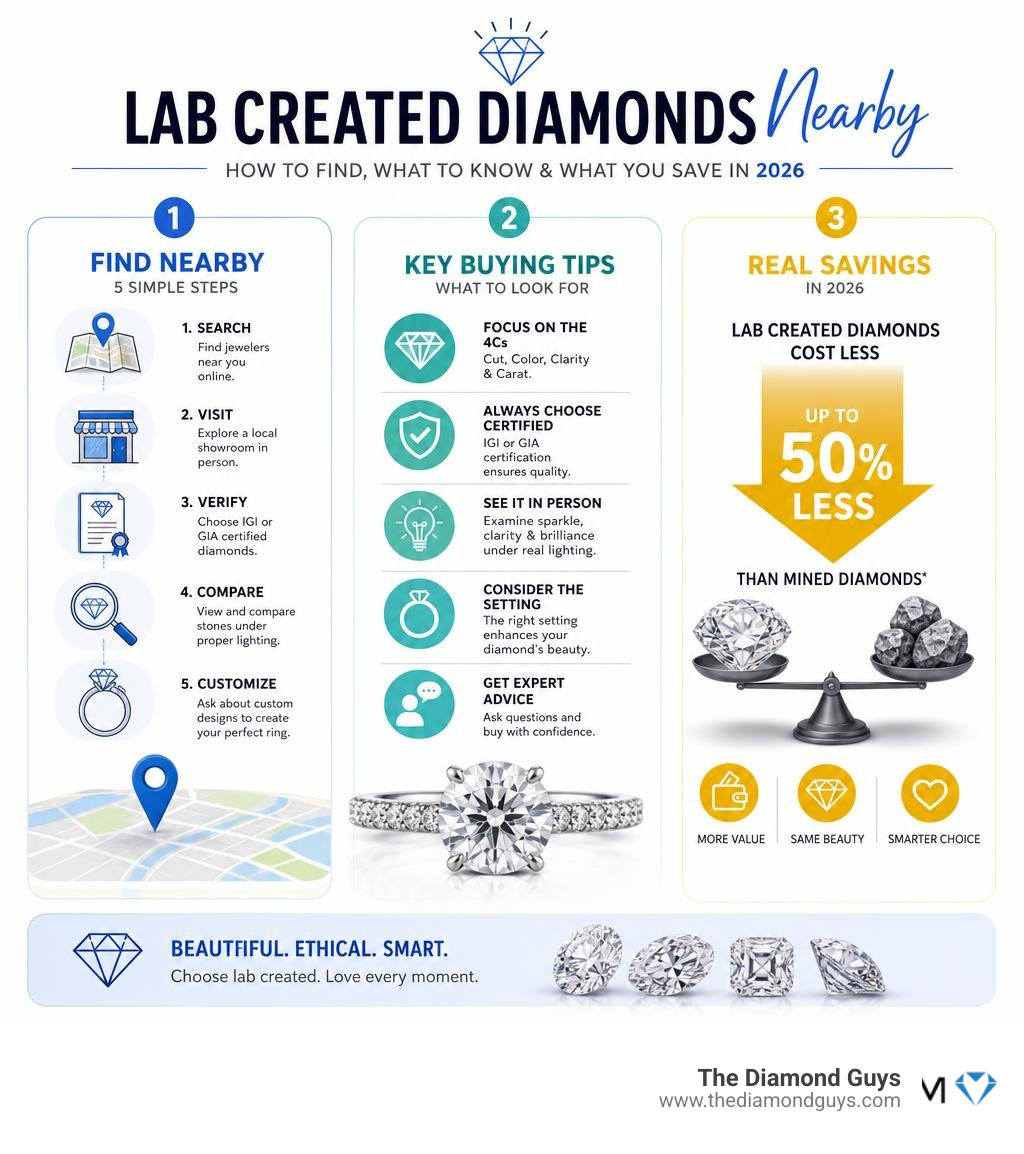
Simple guide to lab created diamonds nearby:
What Are Lab-Grown Diamonds and How Are They Created?
To understand why so many people are searching for lab created diamonds nearby, we first need to pull back the curtain on the science. These stones are not "fake" diamonds, nor are they cheap imitations like cubic zirconia or moissanite. They are genuine diamonds grown in highly controlled laboratory environments that replicate the intense heat and pressure found deep within the earth’s mantle.
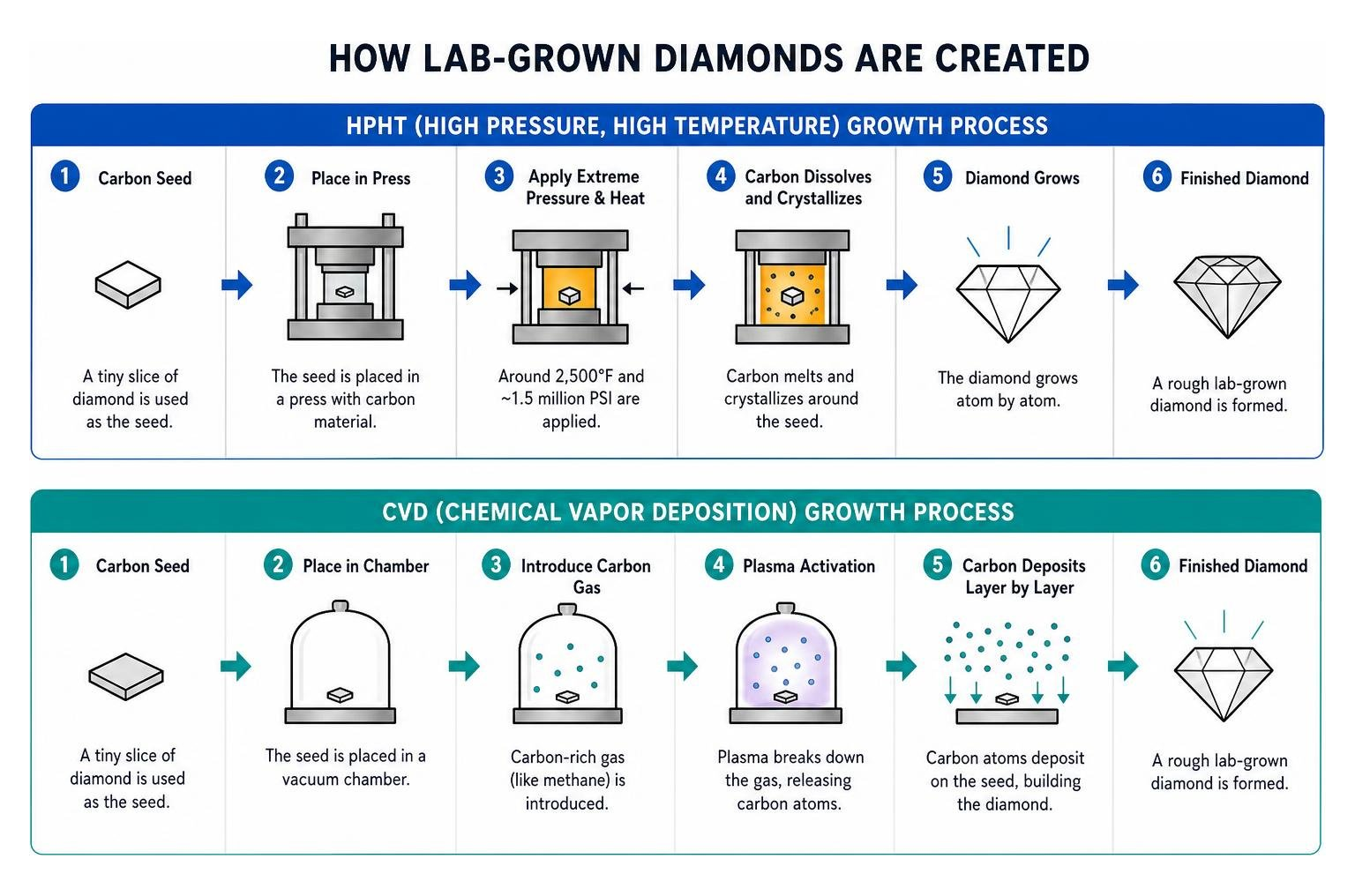
The creation process is essentially "Mother Nature, but with a PhD." It starts with a tiny carbon seed—a microscopic slice of a pre-existing diamond. Scientists then use one of two primary methods to grow the diamond crystal over a period of weeks:
- High Pressure, High Temperature (HPHT): This method mimics the extreme geological conditions of the earth. The carbon seed is placed in a press and subjected to temperatures of around 2,500°F and immense pressure (roughly 1.5 million pounds per square inch). Under these conditions, pure carbon melts and crystallizes around the seed, growing atom by atom into a beautiful diamond structure.
- Chemical Vapor Deposition (CVD): In this method, the carbon seed is placed in a vacuum chamber filled with carbon-rich gas (like methane). When the chamber is heated and supercharged with plasma, the gas molecules break down, causing pure carbon atoms to rain down and deposit onto the seed layer by layer.
Interestingly, a 1-carat white diamond typically takes about 2 to 3 weeks to grow in a lab, while colored lab-grown diamonds can be produced in as little as 5 to 7 days. Because they are made of pure carbon, these gemstones achieve a perfect 10/10 on the Mohs hardness scale, making them physically identical in durability and scratch-resistance to natural mined diamonds.
If you want to dive deeper into how these modern marvels stack up against traditional stones, read our guide on Are Lab-Grown Diamonds Real Diamonds.
Are Lab Created Diamonds Nearby Real Diamonds?
Yes, absolutely. To the naked eye, a trained jeweler's loupe, and even standard thermal testing pens, lab-grown diamonds are indistinguishable from earth-mined diamonds. They share the exact same chemical composition, physical properties, and optical brilliance.
The Federal Trade Commission (FTC) officially ruled that a diamond is a diamond, regardless of whether it was grown in a laboratory or dug out of the ground. The only difference is their origin. Think of it like ice: whether you get an ice cube from your kitchen freezer or from a glacier in Antarctica, it is still chemically $H_2O$.
Because they are real diamonds, they are graded on the exact same parameters (the 4Cs: Cut, Color, Clarity, and Carat weight) by major independent gemological organizations. You can learn more about this physical equivalence by reading our detailed breakdown of Lab Diamonds vs Real Diamonds.
Popular Shapes, Sizes, and Colors Available
When searching for lab created diamonds nearby, you aren't limited to basic cuts or small carat sizes. In fact, because the growth process is highly controlled, manufacturers can produce an incredibly diverse range of options.
All of the classic diamond shapes are widely available in local showrooms:
- Round Brilliant: The gold standard for maximum sparkle and light performance.
- Oval and Pear Cuts: Highly popular for their elongating effect on the finger.
- Emerald and Asscher Cuts: Elegant, step-cut styles that highlight the diamond's clarity.
- Radiant and Cushion Cuts: Modern, fiery shapes with brilliant faceting patterns.
- Princess and Marquise Cuts: Bold, geometric choices that stand out.
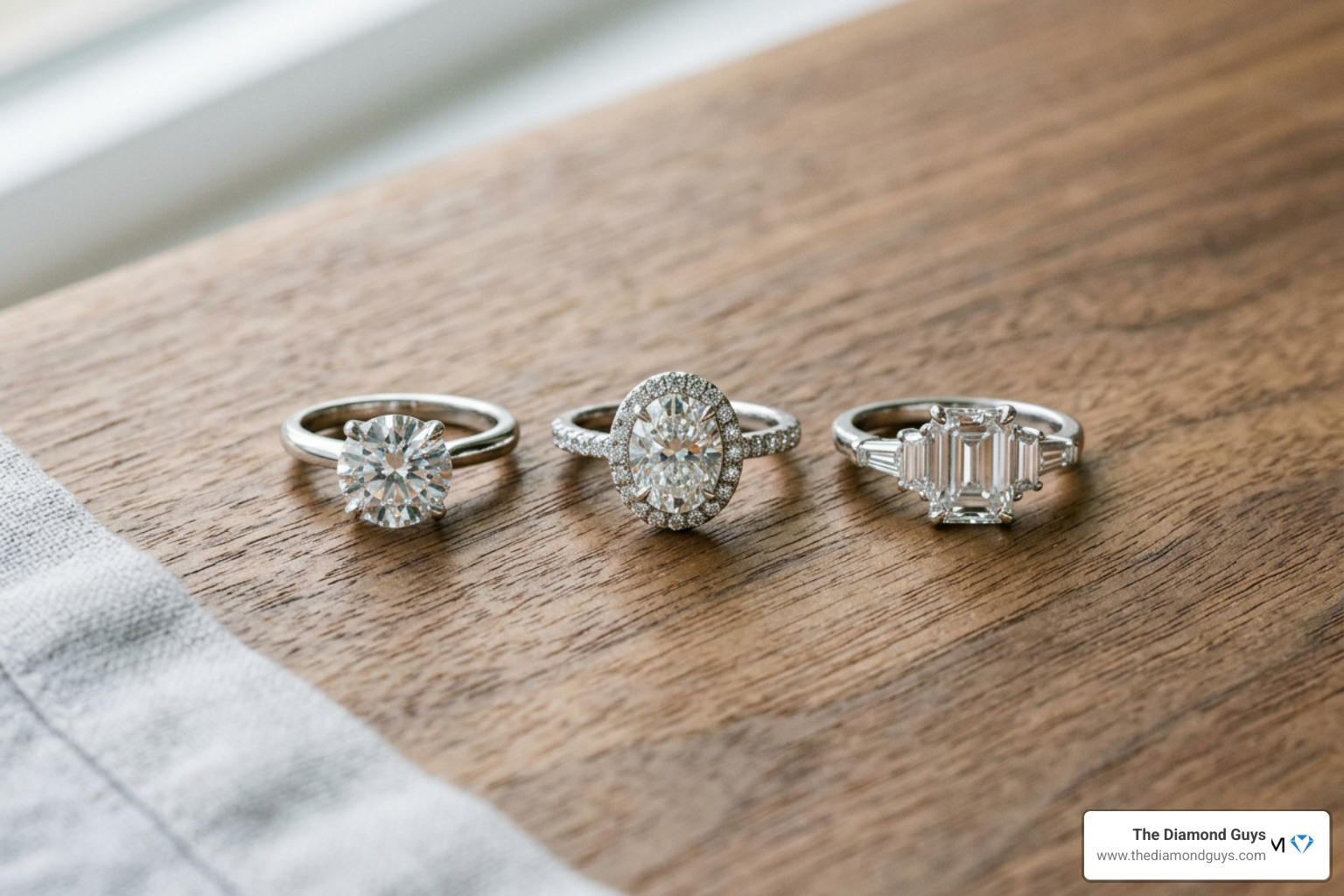
Furthermore, you can find lab-grown diamonds in exceptionally large carat weights (from 1.00 carat up to 5.00+ carats) that would be cost-prohibitive in the earth-mined market. Fancy colored lab-grown diamonds—such as pink, blue, yellow, and green—are also highly accessible, offering vibrant options for custom creations.
To explore how these shapes can be integrated into your dream ring, check out our Custom Lab Grown Diamond Ring Guide and our comprehensive Lab Created Engagement Rings Guide 2026.
Lab-Grown vs. Earth-Mined Diamonds: Quality, Price, and Ethics
Choosing between a lab-grown and an earth-mined diamond is a highly personal decision. To help you weigh your options, we've broken down the key differences in the table below:
| Feature | Lab-Grown Diamonds | Earth-Mined Diamonds |
|---|---|---|
| Chemical Composition | 100% Carbon | 100% Carbon |
| Hardness (Mohs Scale) | 10 out of 10 | 10 out of 10 |
| Brilliance & Fire | Identical | Identical |
| Price Point | 30% to 60% more affordable | Premium pricing |
| Grading & Certification | Certified by IGI, GIA, and GCAL | Certified by GIA, IGI, and others |
| Environmental Impact | Minimal habitat disruption; lower carbon footprint | High land excavation; significant habitat disruption |
| Sourcing Ethics | 100% Conflict-free | Subject to complex tracking (Kimberley Process) |
Both types of diamonds are evaluated using the same 4Cs standards. When shopping locally, you should always look for stones certified by the Gemological Institute of America (GIA) or the International Gemological Institute (IGI). For a deeper look into which choice aligns with your lifestyle and values, check out our article: Should You Buy a Lab-Grown Diamond.
Financial Benefits of Choosing Lab Created Diamonds Nearby
The most immediate and dramatic advantage of choosing a lab-grown diamond is the cost savings. On average, lab-grown diamonds are 30% to 40% more affordable than their mined counterparts, with some high-quality stones priced up to 50% to 60% less than equivalent earth-mined diamonds.
This massive price delta exists because the supply chain for lab-grown diamonds is significantly shorter. There are no expensive mining operations, heavy machinery, or complex international transport routes involved. We pass these supply-chain efficiencies directly to you.
For example, a buyer with a $5,000 budget might only be able to purchase a 1.00-carat mined diamond of average color and clarity. With that same budget, they could easily secure a stunning, near-flawless 2.00 or even 2.50-carat lab-grown diamond. This allows you to stretch your jewelry budget further, especially at a time when gold and platinum prices are rising.
Opting for loose lab-grown diamonds and pairing them with a custom-designed setting is a highly effective way to maximize your purchasing power. To learn more about this smart financial strategy, read our blog post: Should I Buy a Lab-Grown Diamond Engagement Ring.
Environmental and Ethical Impact
In 2026, modern luxury is defined by intentionality and values. Many eco-conscious buyers are searching for lab created diamonds nearby because they want a conflict-free, sustainable alternative to traditional mining.
Earth mining requires massive excavation, moving thousands of tons of dirt to find a single carat of diamond. This process can lead to deforestation, soil erosion, and the displacement of local wildlife. In contrast, lab-grown diamonds require zero land excavation.
Additionally, many leading diamond laboratories utilize carbon-neutral growing processes and power their facilities with renewable energy. When paired with recycled metals—like 96% recycled gold—for the setting, lab-grown diamond jewelry represents a beautiful step forward for sustainable luxury.
Why Choose a Local Jeweler for Lab Created Diamonds Nearby?
With so many online inventory feeds available, you might wonder why you should bother visiting a physical showroom. The answer is simple: diamonds must be seen in person to be truly understood.
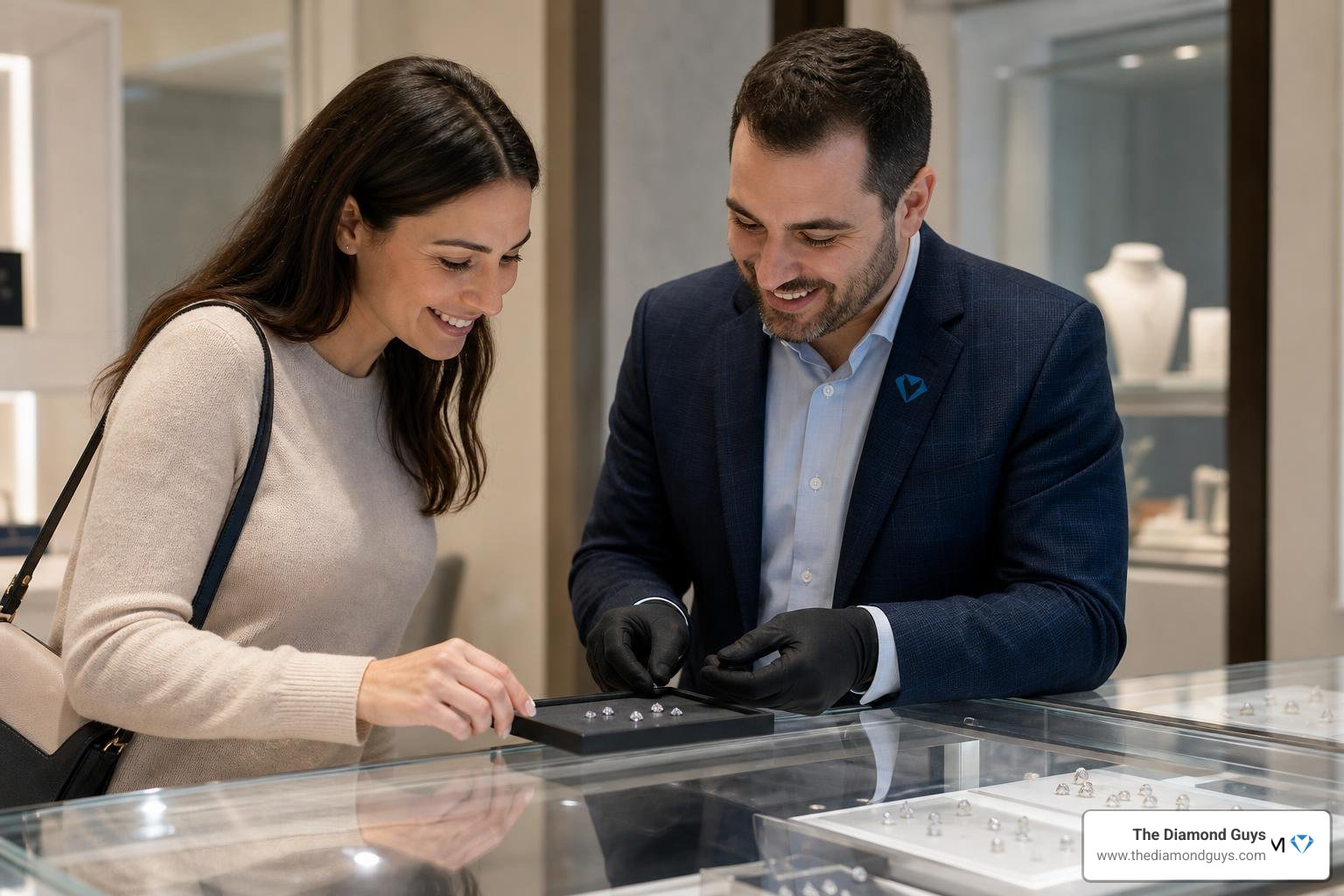
A diamond's beauty is highly dependent on its light performance, which cannot be fully captured by a static image or a grading report on a screen. Two diamonds with the exact same 4Cs grades can look completely different in real life due to subtle differences in cut proportions, symmetry, and polish.
By choosing a local jeweler, you get:
- Hands-On Inspection: You can view loose stones under a jeweler’s loupe and compare different shapes side-by-side.
- Expert Guidance: A professional gemologist can explain the nuances of color and clarity, helping you find the "sweet spot" (like an F-color, VS2-clarity stone) that looks flawless to the naked eye but saves you money.
- Customization: You can collaborate directly with a designer to create a setting that perfectly matches your vision.
- Lifetime Support: Local jewelers provide essential post-purchase services like resizing, professional cleaning, and regular prong inspections.
To understand how to navigate your local options, check out our Lab Diamond Jewelry Store Guide.
Finding the Best Showrooms in Scottsdale and Los Angeles
If you are located in Arizona or Southern California, you have access to some of the finest lab-grown diamond selections in the country. At The Diamond Guys, we pride ourselves on offering a curated, education-first shopping experience at our showrooms in Scottsdale, AZ and Los Angeles, CA.
Rather than pressuring you into a quick sale, we focus on teaching you how to evaluate diamonds so you can make a decision with absolute confidence. We maintain a robust inventory of certified lab-grown diamonds, allowing local buyers to view exquisite stones in person.
Whether you are looking for a classic round brilliant solitaire or a stunning emerald cut engagement ring, we can help you source or custom-build the perfect piece.
Explore our local resources to plan your visit:
- Learn about our Arizona team: Scottsdale Lab Grown Specialists
- Discover our local collections: Lab Diamond Rings Scottsdale
- Read our regional guide: Lab Grown Diamonds LA Ultimate Guide
Frequently Asked Questions About Lab-Grown Diamonds
To help you shop with peace of mind, we’ve compiled answers to the most common questions our clients ask during local consultations.
Do lab-grown diamonds hold their value over time?
Because lab-grown diamonds are a relatively modern innovation, their long-term resale market is still developing compared to the historical market for natural diamonds. As manufacturing technology has become more efficient and widespread, the cost of producing lab-grown diamonds has decreased.
While they may not hold substantial financial resale value over time, they offer incredible upfront value. They allow you to buy a larger, higher-quality stone for your budget today. The primary value of an engagement ring or fine jewelry piece is sentimental and emotional—which is always priceless.
How do I care for and clean lab-grown diamond jewelry?
Caring for a lab-grown diamond is incredibly simple because they are just as durable as mined diamonds. To keep your jewelry sparkling like new:
- Mix a few drops of mild dish soap in a bowl of warm water.
- Soak your diamond jewelry for 10 to 20 minutes.
- Gently scrub the stone and the setting with a soft-bristled toothbrush, paying close attention to the space underneath the diamond where dirt accumulates.
- Rinse thoroughly under warm running water and pat dry with a lint-free cloth.
We also recommend bringing your jewelry to a local showroom twice a year for a professional steam cleaning and a quick safety check on the prongs.
Do lab-grown diamonds get cloudy or yellow?
No, lab-grown diamonds will never naturally get cloudy, fade, or turn yellow over time. They are physically and chemically identical to natural diamonds and possess permanent color and clarity stability.
If your diamond ever appears dull or cloudy, it is simply due to a buildup of daily residue—such as hand lotion, soap, makeup, or skin oils. A quick cleaning using the method outlined above will instantly restore its original brilliance and fire.
Conclusion
Finding lab created diamonds nearby is the smartest way to experience modern luxury. By choosing a lab-grown stone, you get the exact same physical beauty, durability, and brilliance of an earth-mined diamond—while saving up to 60% of the cost and supporting more sustainable jewelry practices.
However, the key to a successful purchase is working with a local, trusted jeweler who prioritizes education over high-pressure sales tactics. At The Diamond Guys, we invite you to visit our showrooms in Scottsdale and Los Angeles to view these magnificent stones in person and design a custom piece that tells your unique story.
Ready to take the next step? Compare Lab Diamonds vs Real Diamonds or book a private consultation with our specialists today!


