

Rocking the Lab: Why Lab Created Engagement Rings Are the New Classic
The Rise of Lab Created Engagement Rings in 2026

If you're shopping for engagement rings lab created in a controlled laboratory setting, here's what you need to know right away:
Quick Answer: Best Reasons to Choose a Lab-Created Engagement Ring
| Factor | What to Know |
|---|---|
| Price | 50–60% less than natural diamonds of comparable size and quality |
| Quality | Chemically, physically, and optically identical to mined diamonds |
| Durability | Ranks 10 on the Mohs hardness scale — built for daily wear |
| Ethics | Conflict-free and produced without mining |
| Certification | Graded by IGI or GIA, just like natural diamonds |
| Customization | Available in all major shapes, settings, and metal types |
Something has quietly shifted in the engagement ring world. More couples in 2026 are choosing lab-grown diamonds — not as a compromise, but as a deliberate upgrade. You get the same sparkle, the same hardness, the same brilliance — at a fraction of the price.
And the options have never been better. From classic solitaires to hidden halo designs, the lab-grown market now rivals anything you'd find in the mined diamond space.
I'm Morgan Price, and I've spent years helping buyers navigate the fine jewelry market — including the fast-growing world of engagement rings lab created. In this guide for The Diamond Guys, I'll walk you through everything you need to make a confident, informed choice.
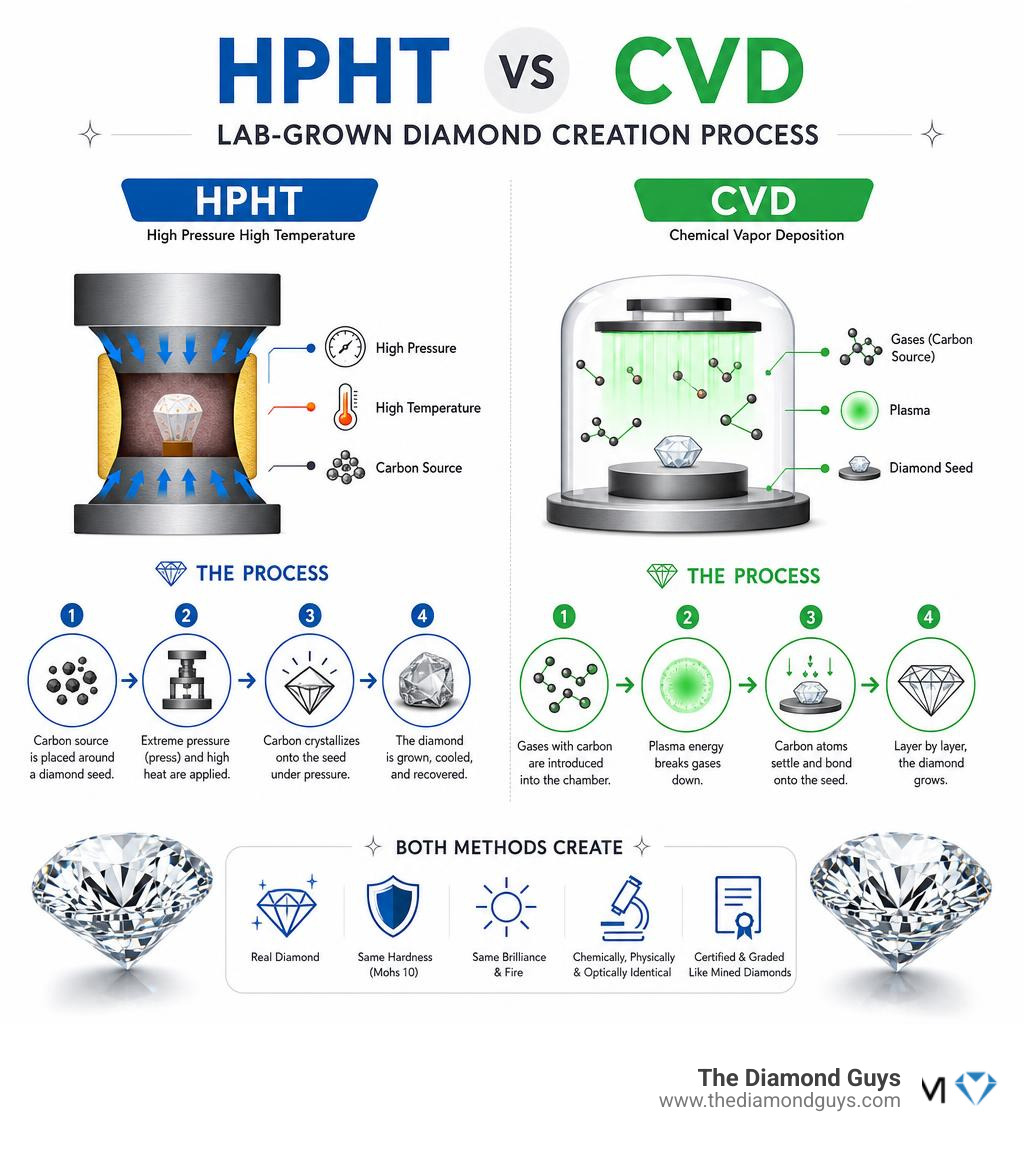
Engagement rings lab created terms to learn:
Why Engagement Rings Lab Created Are Dominating the Market
To understand why engagement rings lab created have taken over jewelry store displays from Scottsdale to Phoenix, we first have to bust a major myth. Lab-grown diamonds are not "fake" diamonds. They are not cubic zirconia, nor are they moissanite.
When you look at a lab-grown diamond, you are looking at a 100% real diamond. They possess the exact same chemical identity, physical properties, and optical brilliance as diamonds pulled from deep within the Earth. Both are made of pure carbon atoms arranged in a tight crystal lattice structure.
In fact, even professional gemologists cannot tell the difference with a jewelry loupe or the naked eye. It requires highly specialized, advanced laboratory equipment that tests for trace elements and growth patterns to distinguish them. When asking Are Lab Grown Diamonds Real Diamonds, the scientific and gemological answer is a resounding yes.
So, why are they so incredibly popular today? In 2026, consumer priorities have shifted toward transparency, value, and design freedom. Because of this, Are Lab Grown Diamonds Popular is no longer a question of "if," but "by how much." They have become the definitive modern classic. If you are shopping locally, working with Scottsdale Lab Grown Specialists ensures you get a hand-selected stone that bypasses the lower-quality options that sometimes flood the online market.
To help visualize how these two options stack up, let's look at a direct comparison:
| Feature | Lab-Grown Diamonds | Natural (Mined) Diamonds |
|---|---|---|
| Chemical Composition | Pure Carbon (C) | Pure Carbon (C) |
| Crystal Structure | Cubic | Cubic |
| Refractive Index (Brilliance) | 2.42 | 2.42 |
| Mohs Hardness Scale | 10 out of 10 | 10 out of 10 |
| Origin | Controlled Laboratory (CVD or HPHT) | Earth's Mantle (Mined) |
| Resale Value | Low to moderate | Moderate to stable |
| Average Cost (1 Carat) | $1,000 - $2,000 (Highly accessible) | $4,000 - $8,000+ |
The Cost Advantage of Engagement Rings Lab Created
Let’s talk about the most obvious benefit: your budget. The pricing difference between lab-grown and mined diamonds is staggering. On average, lab-created diamonds are 50% to 60% less expensive than natural diamonds of comparable size, cut, color, and clarity.
This massive price gap is not due to a difference in quality. Rather, it is a direct result of supply chain efficiency. Natural diamonds require massive mining operations, heavy machinery, global transport, and multiple middlemen. Lab-grown diamonds are grown in controlled environments using advanced technological reactors, meaning the supply chain is shorter, faster, and far more cost-effective.
For anyone preparing to propose, this cost advantage translates directly into budget flexibility. You can choose to:
- Maximize the Carat Weight: Buy a visually breathtaking 2-carat or 3-carat center stone for the same price you would pay for a modest 1-carat natural diamond.
- Upgrade the Setting: Allocate your savings toward an intricate, custom-designed platinum setting or a diamond-encrusted band.
- Keep the Savings: Put those hard-earned dollars toward a memorable honeymoon, a down payment on a home, or wedding planning.
When debating Should You Buy A Lab Grown Diamond, the financial peace of mind is often the deciding factor. Furthermore, we believe that luxury should be accessible, which is why we offer flexible options like Jewelry Financing to help you secure the perfect ring without financial stress.
Ethical and Environmental Benefits
For many modern couples, the decision to buy an engagement ring is as much about values as it is about aesthetics. Traditional diamond mining has historically been linked to environmental disruption, habitat destruction, and complex human rights issues in developing nations.
Choosing Lab Grown Diamond Jewelry offers a transparent, conflict-free alternative. Because these gems are grown in laboratories using electricity and carbon gas, they require zero open-pit mining. This significantly reduces the physical footprint and avoids the destruction of local ecosystems.
While lab-grown diamond production does require a significant amount of energy to replicate the heat and pressure of the Earth, many modern growers are transitioning to renewable energy sources like solar and wind power to minimize their carbon footprint. By opting for a lab-created diamond, you can wear your ring with pride, knowing its origin story is clean, ethical, and fully traceable.
How to Choose the Perfect Lab-Grown Diamond
Buying a lab-grown diamond requires the exact same level of care and education as buying a mined stone. You shouldn't just buy the first diamond you see online. To get the best value and the most beautiful sparkle, you need to understand how they are graded.
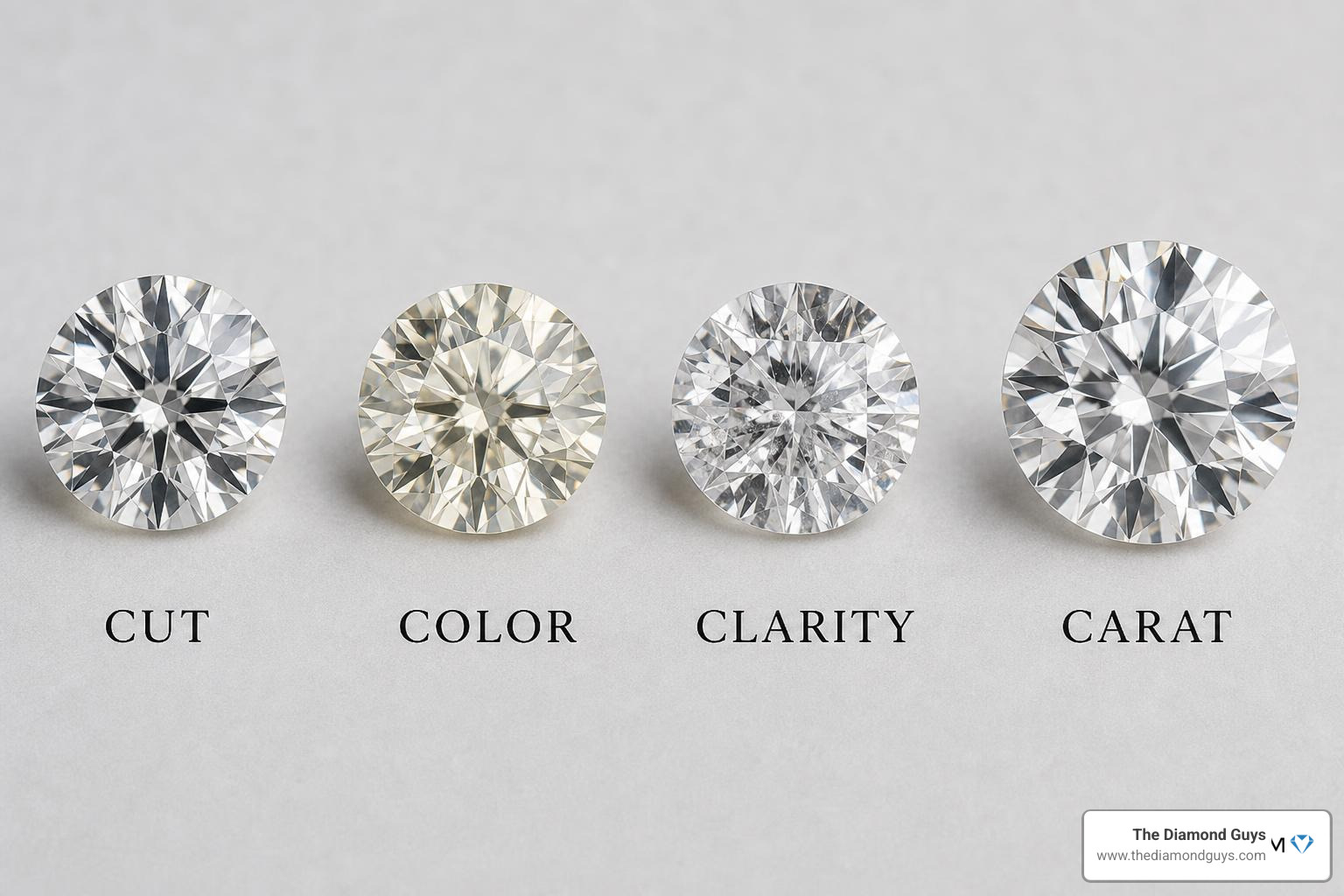
The ultimate roadmap for this journey is the famous 4Cs of Diamond Quality:
- Cut: This is the most critical of the 4Cs. The cut determines how light enters the diamond and bounces back to your eye. A poorly cut diamond will look dull and lifeless, even if it has perfect color and clarity. Always prioritize an "Excellent" or "Ideal" cut grade.
- Color: Diamonds are graded on a scale from D (completely colorless) to Z (noticeable yellow or brown tint). For a bright, icy-white look, aim for the colorless (D-F) or near-colorless (G-H) ranges.
- Clarity: Because lab diamonds are grown under intense heat and pressure, they can develop tiny internal characteristics called inclusions. The clarity scale ranges from Flawless (FL) to Included (I). We recommend looking for "eye-clean" diamonds in the VS1, VS2, or VVS2 ranges, where inclusions are invisible to the naked eye.
- Carat Weight: This measures the diamond's physical weight, not its physical size. Because lab diamonds are so cost-effective, you can easily explore larger carat weights without blowing past your budget limit.
If you are feeling overwhelmed, don't worry. Reading up on How To Start Engagement Ring Shopping is a fantastic way to build your confidence. Asking yourself Should I Buy A Lab Grown Diamond Engagement Ring comes down to balancing your personal style, values, and budget.
Certification and Grading Standards
Never buy a lab-grown diamond that does not come with an independent grading report from a reputable gemological laboratory. The two most trusted authorities in the industry are the International Gemological Institute (IGI) and the Gemological Institute of America (GIA).
These laboratories evaluate each diamond using strict scientific standards, verifying its exact 4Cs metrics and confirming its origin as laboratory-grown. When you purchase a certified diamond, it will feature a microscopic laser inscription on the girdle. This tiny serial number matches the physical certificate, ensuring you get exactly what you paid for.
When comparing Lab Diamonds Vs Real Diamonds, you will find that both undergo the exact same rigorous certification processes, proving that the jewelry industry treats lab-grown stones with the same level of professional respect as their mined counterparts.
Durability and Long-Term Sparkle
A common question we hear in our Scottsdale showroom is: Will my lab-grown diamond last, or will it lose its sparkle over time?
The answer is simple: Yes, it will last forever.
Because lab-grown diamonds are chemically identical to natural diamonds, they rank a perfect 10 on the Mohs hardness scale. This makes them the hardest known substance on Earth. They are incredibly scratch-resistant, impervious to daily wear and tear, and highly durable.
To answer some common buyer anxieties:
- When exploring Are Lab Grown Diamonds As Strong As Real Diamonds, the answer is a scientific yes. They can easily handle everyday bumps, knocks, and cleaning.
- If you're wondering Do Lab Grown Diamonds Get Cloudy, sleep easy. Unlike cheap diamond simulants like cubic zirconia, real lab-grown diamonds will never fade, change color, or get cloudy over time. Any temporary dullness is simply surface dirt, lotion, or oil, which can be easily washed away with warm water, mild dish soap, and a soft toothbrush.
Designing Your Dream Ring
One of the greatest joys of choosing a lab-grown diamond is the freedom it gives you to design a truly custom piece of art. Because you are saving significantly on the center stone, you can invest in a high-quality, custom-engineered setting that perfectly reflects your partner's personality.

When designing a ring, your first choice is selecting the precious metal for the band:
- Platinum: The ultimate choice for durability. Platinum is naturally hypoallergenic and has a cool, white sheen that beautifully accentuates a colorless diamond.
- Yellow Gold (14k or 18k): A classic, warm choice that is currently experiencing a massive resurgence in popularity. Yellow gold offers a stunning, high-contrast look when paired with a bright white center diamond.
- Rose Gold (14k): Romantic and whimsical, rose gold is alloyed with copper to create a soft, pinkish hue that looks beautiful on all skin tones.
To get started on your custom journey, you can research how to Design Your Own Ring Setting or explore the endless possibilities of Lab Diamond Custom Jewelry to see how other couples have brought their visions to life.
Popular Styles for Engagement Rings Lab Created
When it comes to the overall design, several stunning styles stand out as modern favorites for engagement rings lab created:
- Classic Solitaire: The quintessential engagement ring. A single, magnificent lab-grown diamond sits atop a polished metal band, secured by four or six prongs. This style maximizes light entry, letting the diamond do all the talking.
- Hidden Halo: A brilliant modern twist. While a traditional halo surrounds the top of the diamond, a hidden halo features a delicate collar of tiny diamonds wrapped around the base of the center stone's prongs. It adds a subtle, secret sparkle that is visible from the side profile.
- Three-Stone (Toi et Moi / Trilogy): Representing your past, present, and future, this style pairs a larger center diamond with two complementary side stones (such as pear, baguette, or round shapes).
- Vintage-Inspired: Featuring intricate milgrain detailing, delicate engraving, and art-deco geometry, these settings offer timeless, heirloom-quality romance.
For a comprehensive look at these settings and more, check out our curated Custom Engagement Rings Guide.
Custom Engagement Rings in Arizona
If you live in the Phoenix metro area, you don't have to rely on faceless online retailers or high-markup mall jewelry chains to find your dream ring. We specialize in bringing local, hands-on expertise to the custom design process right here in the Valley of the Sun.
By choosing a local design experience, you get to sit down with a master jeweler, view loose lab-grown diamonds under a microscope, and collaborate on 3D CAD models of your ring before it ever goes to production.
To learn more about how to design a ring locally, check out our comprehensive Custom Engagement Rings Az Guide and our hyper-local Custom Engagement Rings Phoenix Guide to find out why Arizona couples trust us to craft their forever rings.
Frequently Asked Questions about Lab-Grown Diamonds
Do lab-grown diamonds pass a diamond tester?
Yes, absolutely. Because lab-grown diamonds have the exact same chemical composition (pure carbon structure), thermal conductivity, and electrical conductivity as natural diamonds, they will easily pass any standard diamond tester. The only way to differentiate them is through advanced laboratory testing.
Can you insure lab-grown diamonds?
Yes, you can easily insure lab-grown diamond engagement rings. Just like natural diamond jewelry, you will receive a professional appraisal detailing the quality of the diamond and the metal setting. You can submit this appraisal to any major jewelry insurance provider to protect your investment against loss, theft, or damage. For a deeper dive into how this works, read our guide on Can You Insure Lab Grown Diamonds.
When did lab-grown diamonds start becoming popular?
While scientists have been growing industrial-grade diamonds since the mid-20th century, gem-quality lab diamonds only became widely accessible and popular over the last decade. Massive technological breakthroughs in Chemical Vapor Deposition (CVD) have allowed growers to produce large, flawless, and completely colorless crystals that rival the finest natural diamonds. To learn more about this fascinating journey, check out our history guide on When Did Lab Grown Diamonds Start.
Conclusion
Choosing an engagement ring is one of the most significant emotional and financial decisions of your life. By choosing a lab-created diamond, you are embracing a modern classic that combines breathtaking beauty, unmatched durability, and incredible value without compromise.
At The Diamond Guys, we pride ourselves on steering clear of high-pressure sales tactics. Whether you visit our comfortable Scottsdale showroom or work with us online, our mission is to provide expert guidance, transparent pricing, and a personalized shopping experience that you simply won't find at big-box retailers.
Ready to start your journey? Read our Lab Diamond Jewelry Store Guide for expert shopping tips, or book a consultation with our local Scottsdale Lab Grown Specialists today.
Let's build something beautiful together. Visit The Diamond Guys to explore our loose lab-grown diamond inventory and start designing your dream ring today!


