

From Peak to Tumble: What 10 Years of Natural Diamond Prices Reveal
Introduction

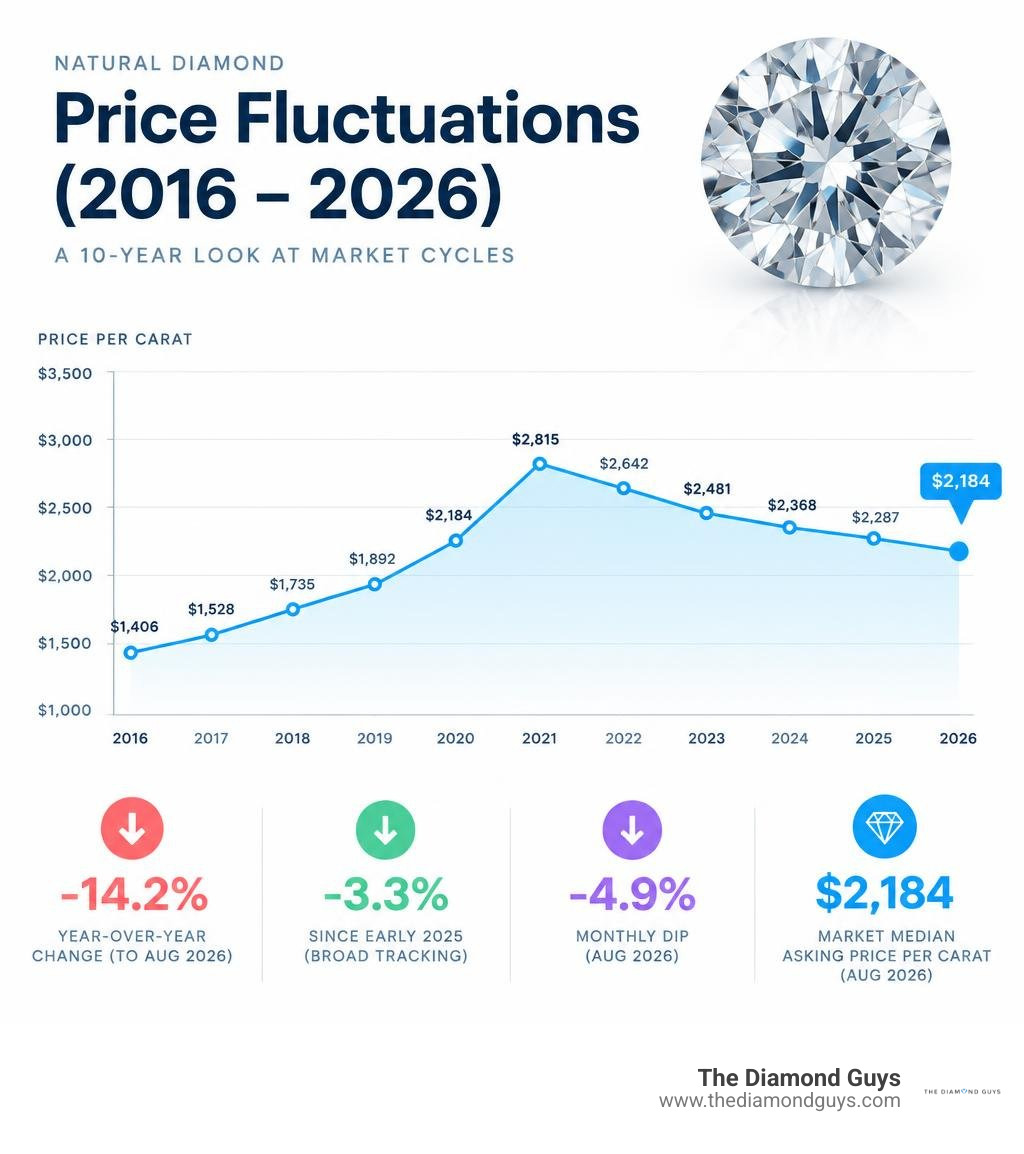
Current natural diamond price benchmarks show a broad market median asking price of $2,184 per carat as of August 2026, with a 1.00-carat natural round diamond in G color, VS2 clarity, and Excellent cut priced near $5,350 per carat. Over the past ten years, diamond valuations have traversed historic highs, pandemic surges, and post-boom corrections, with natural diamond asking prices moving down 14.2% year-over-year leading into August 2026. Whether you are searching for an engagement ring or monitoring heirloom value, tracking price per carat metrics gives you the leverage needed to negotiate confidently.
Market sentiment in September 2026 shows buyers prioritizing transparent grading, ethical provenance, and authentic value over inflated retail markups. To make sense of where the industry stands today, we must explore how historical cycles shaped current valuations.
Understanding the 2026 Natural Diamonds Price Chart and Historical Trends
Diamond pricing does not happen in a vacuum. Industry trackers like The Diamond Price Index reveal that natural diamond asking prices moved down 14.2% over the past year leading into August 2026. While natural stones have slipped 3.3% since broad tracking began in early 2025, August 2026 recorded a monthly dip of 4.9%, settling the broad market median asking price at $2,184 per carat.
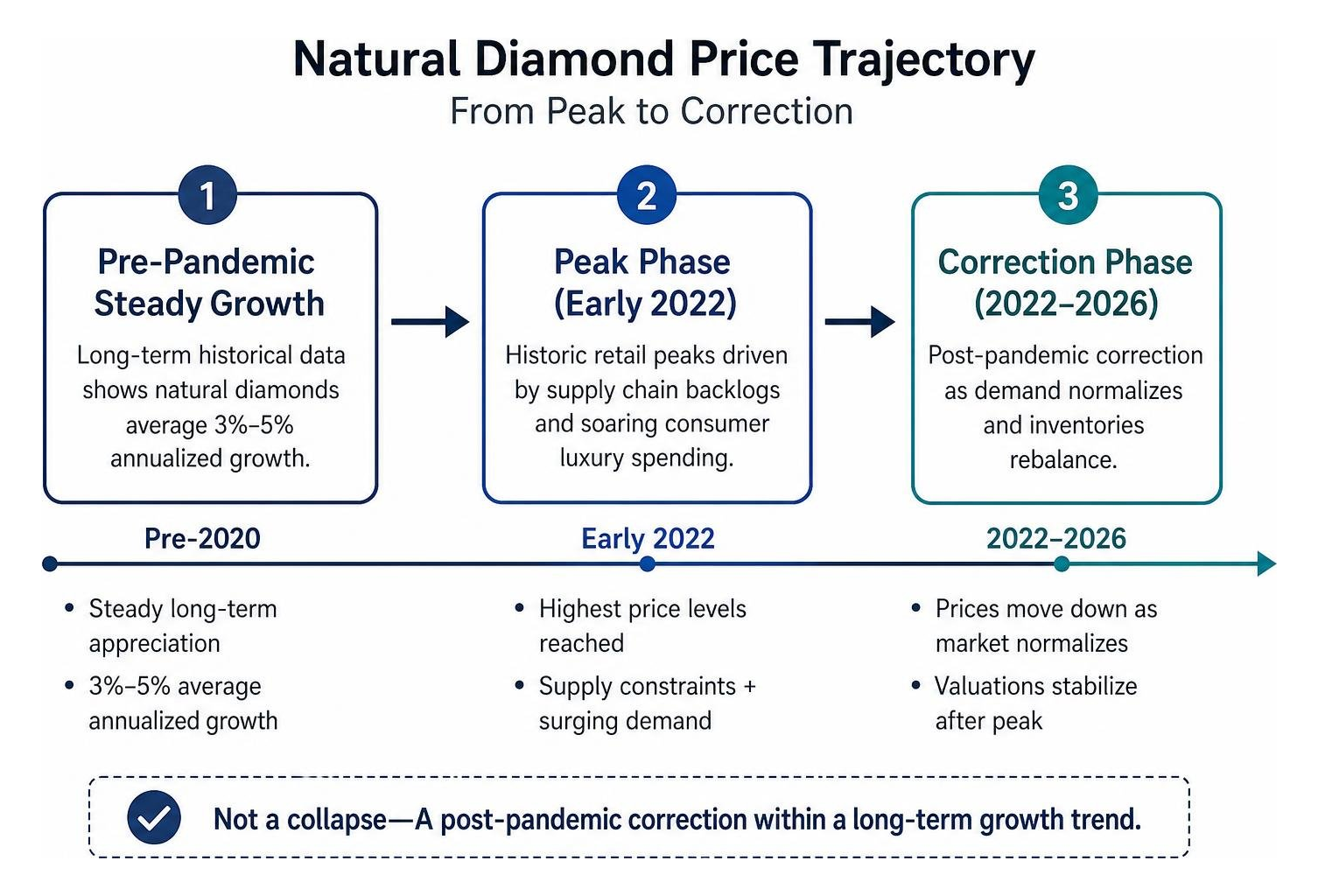
This movement represents a post-pandemic correction rather than a collapse. Following historic retail peaks in early 2022—driven by supply chain backlogs and soaring consumer luxury spending—the wholesale and retail segments have normalized. When evaluating diamonds as an investment asset, it is essential to view these stones as durable luxury assets rather than volatile trading commodities. Long-term historical data reveals that natural diamonds average a steady 3% to 5% annualized growth over multi-decade spans, despite interim cyclical dips.
Decade-Long Market Drivers: Geopolitics, Supply Chains, and Lab-Grown Disruption
Three major factors have reshaped natural diamond valuations over the last decade:
- Supply Chain Constraints & Sanctions: Geopolitical shifts disrupted rough diamond exports from major mining regions, temporarily reducing rough stone supplies before alternative trade channels stabilized.
- Post-Pandemic Demand Normalization: As consumer spending shifted back toward travel and experiential luxury, jewelry retailers adjusted surplus inventories.
- The Rise of Manufactured Alternatives: The rapid expansion of factory-produced diamonds absorbed a significant portion of entry-level consumer interest, forcing natural diamonds to reclaim their positioning as rare, heritage luxury assets.
How to Read a Natural Diamonds Price Chart by Carat Weight
Natural diamond pricing is fundamentally non-linear. Because larger gem-quality rough crystals are exceptionally scarce in nature, prices scale exponentially rather than proportionally:
- 0.50 Carat: Entry-level benchmark stones carry lower price-per-carat rates due to steady rough availability.
- 1.00 Carat: The universal benchmark. A 1.00-carat natural diamond with VS2 clarity, G color, and an Excellent cut sits at a median price of $5,350 ($5,350/ct).
- 2.00 Carat: A comparable 2.00-carat stone does not merely double in price; it jumps roughly 3.6 times higher to around $19,500 ($9,750/ct).
- 3.00 Carat: Scarcity surges exponentially at this tier, pushing median valuations toward $42,500 ($14,166/ct)—over 6.7 times the total cost of a 1-carat stone.
Smart shoppers use this curve to their advantage by targeting sizes just below popular "magic size" thresholds (such as 0.90 to 0.95 carats), capturing identical visual spreads while saving 10% to 15%. For a deeper breakdown of diamond grading tiers, explore our detailed diamond education guide.
Analyzing the Natural Diamonds Price Chart Across Shapes and Cuts
Round brilliant diamonds command the highest price per carat across every market index. Cutting a round diamond from rough crystal results in significant gem loss—often over 50% to 60% of the raw material. In contrast, fancy shapes (such as oval, emerald, cushion, and radiant) preserve more rough stone during the cutting process.
Data from the Caratlytics Diamond Price Index underscores significant pricing spreads across different diamond geometries:
- Round Brilliant: The baseline standard commanding premium market pricing.
- Oval & Pear Shapes: Highly popular for their elongated appearance, offering finger-flattering surface area at a 15% to 25% lower cost per carat than round stones.
- Princess & Cushion Cuts: Historically popular square cuts that offer exceptional fire while costing 21% to 36% less than round diamonds of equal carat weight.
- Asscher & Emerald Cuts: Step cuts that emphasize optical purity, showing unique pricing stability in mid-2026 (Asscher stones recorded an 11.1% month-over-month price bump in August 2026).
To understand why geometric cut efficiency dictates retail tags, read our analysis on which diamond shapes cost the most.
The 4Cs Price Impact: Color, Clarity, and Certification Premiums
Every natural diamond valuation hinges on the 4Cs: Cut, Color, Clarity, and Carat weight. Understanding how each grade shifts the price curve allows you to maximize your budget without compromising optical beauty.
| Quality Metric | Premium Tier | Value Sweet Spot | Budget / Commercial Tier | Price Impact Factor |
|---|---|---|---|---|
| Color | D–F (Colorless) | G–H (Near Colorless) | I–J (Faint Color) | D color costs ~46% more than G color |
| Clarity | FL–VVS2 (Flawless/Near) | VS2–SI1 (Eye-Clean) | SI2–I1 (Included) | Flawless costs ~72% more than VS2 |
| Cut Quality | Ideal / Super Ideal | Excellent | Very Good / Good | Top cut grades command 10%–15% premiums |
| Certification | GIA / AGS | GIA | Non-standard independent labs | Strict grading carries standard trade valuation |
Choosing a D color or Flawless clarity diamond provides gemological perfection on paper, but when set in a ring, a G color, VS2 clarity stone looks completely identical to the naked eye. Selecting the VS2/G sweet spot eliminates unnecessary premiums, keeping your purchase grounded in visible beauty.
Grading laboratory consistency also plays a massive role in diamond pricing. Stones evaluated by strict institutions maintain clear market values, which is why sourcing GIA certified diamonds remains the gold standard for verifying authentic cut, color, and clarity metrics.
Natural vs. Lab-Grown Diamond Price Divergence in 2026
The pricing dynamic between natural and lab-grown diamonds has decoupled entirely. In August 2026, natural diamonds listed at a median of $2,184 per carat, whereas lab-grown diamonds averaged just $464 per carat across retail datasets.
Natural diamonds currently command a 371% premium over lab-grown stones—costing roughly 4.7 times as much per carat. While natural asking prices saw steady corrections (-14.2% year-over-year), lab-grown diamond prices fell 28.3% over the same period as industrial factory production scaled worldwide.
Furthermore, retail price dispersion for natural diamonds averages 55.5% (median 39.7%), compared to a massive 138.9% dispersion for lab-grown alternatives. Natural diamonds maintain residual asset characteristics rooted in geological scarcity, mining overhead, and global wholesale trade support.
Strategic Diamond Buying: Maximizing Value on a $3,000 to $5,000 Budget
A $3,000 to $5,000 budget offers exceptional flexibility when shopping for natural diamond jewelry if you apply strategic buying rules:
- Target Sub-Carat Weights: Instead of paying a premium for a 1.00-carat milestone, look at 0.90 to 0.92-carat natural stones. A 0.90-carat round diamond with SI1 clarity and I color trades between $1,190 and $1,279 per carat, delivering the visual spread of a full carat at a fraction of the cost.
- Prioritize Cut Over Color: An Excellent cut ensures maximum light refraction and brilliance, masking subtle body color in G-H-I color diamonds.
- Choose Fancy Shapes for Larger Footprints: An oval, radiant, or pear cut of 0.85 carats often possesses a larger millimeter surface footprint than a 0.90-carat round diamond, maximizing face-up size.
- Partner with Local Custom Jewelers: Independent custom jewelers help you avoid the inflated 22% to 50% retail markups common in corporate mall chains by sourcing stones directly from wholesale networks.
If you are beginning your search, navigating diamond purchases with expert guidance ensures you secure a stunning certified natural diamond tailored exactly to your budget.
Frequently Asked Questions About Diamond Pricing Trends
What is the average price per carat for a 1-carat natural diamond in 2026?
As of September 2026, the median market benchmark for a 1.00-carat natural round diamond with G color, VS2 clarity, and an Excellent cut is approximately $5,350 per carat. Lower color/clarity combinations (such as I color, SI1 clarity) range between $3,200 and $4,100, while premium colorless, flawless tiers exceed $12,000 to $20,000 per carat.
Why are natural diamond prices falling while demand remains steady?
Natural diamond asking prices adjusted downward throughout 2025 and 2026 as global inventory levels normalized following the post-pandemic luxury peak. This correction re-established historical pricing trajectories, balancing wholesale availability with sustainable consumer demand.
How much money can you save by choosing a fancy shape over a round diamond?
Choosing a fancy diamond shape—such as an oval, princess, cushion, emerald, or radiant cut—can save you between 21% and 36% compared to a round brilliant stone of identical carat weight, color, and clarity. Fancy cuts retain more rough crystal during the cutting process, resulting in lower manufacturing costs that translate to lower retail pricing.
Conclusion
The 10-year diamond price trajectory proves that natural diamonds remain resilient, enduring luxury assets when purchased at fair market benchmarks. By understanding the 4Cs, avoiding "magic size" markup traps, and paying attention to shape premiums, you can navigate current market conditions with complete clarity.
At The Diamond Guys, our goal is to simplify your buying journey. As a 5-star rated custom jewelry team serving Scottsdale and Phoenix, Arizona, we combine ethical sourcing, direct market pricing, and personalized guidance to help you craft timeless custom engagement rings and fine jewelry.
Ready to find your ideal natural stone? Explore the complete natural diamond jewelry collection or visit our Scottsdale showroom to view certified natural diamonds in person today.


