

Why an Oval Lab Engagement Ring is the Ultimate Modern Choice
The Rise of Oval Lab Grown Diamond Rings: What Every Buyer Should Know in 2026

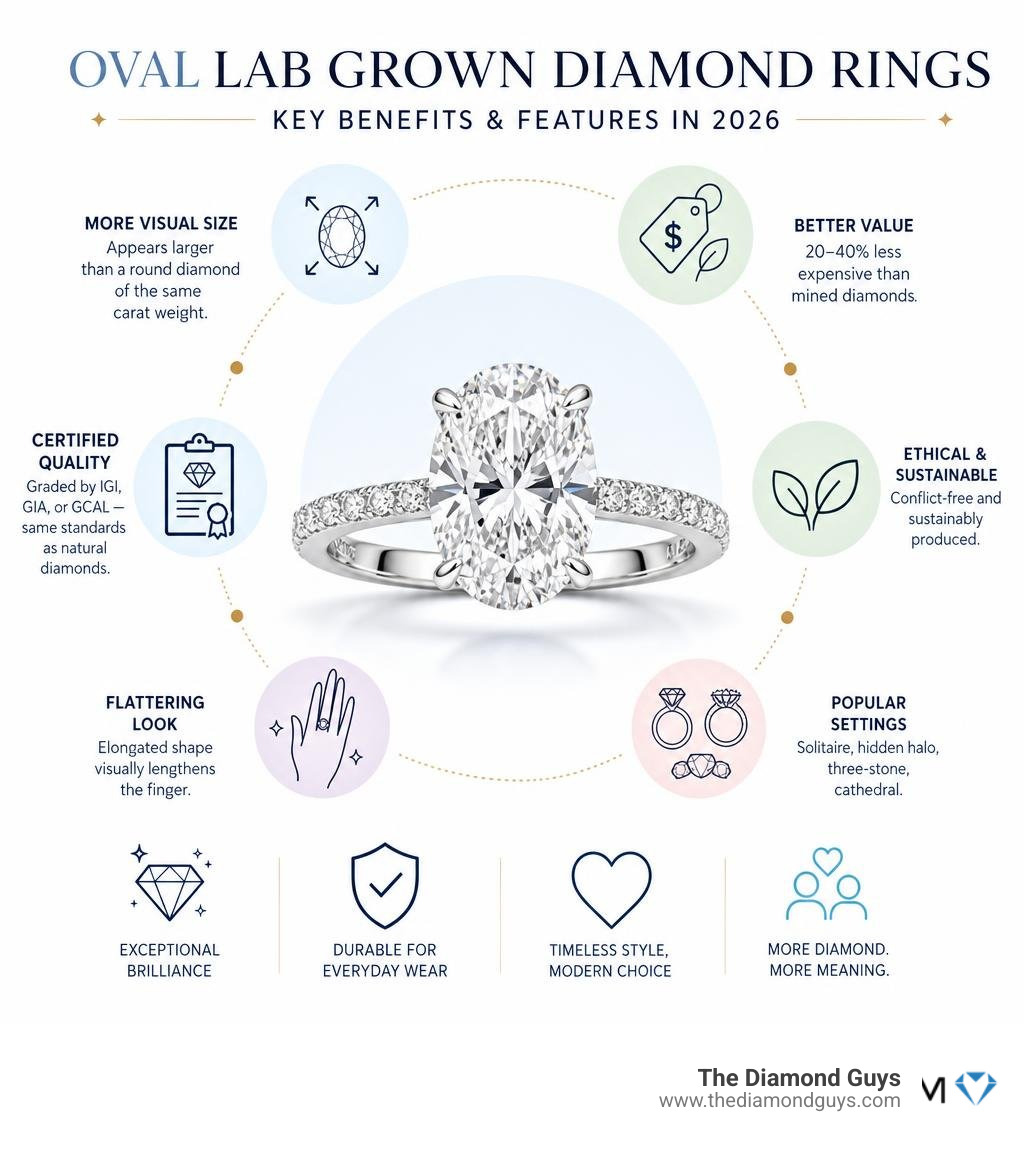
Oval lab grown diamond rings are one of the most sought-after engagement ring choices in 2026 — and for good reason.
Here is a quick snapshot of what makes them stand out:
| Feature | What You Get |
|---|---|
| Visual size | Appears larger than a round diamond of the same carat weight |
| Cost | 20–40% less expensive than mined diamonds |
| Ethics | Conflict-free and sustainably produced |
| Certification | Graded by IGI, GIA, or GCAL — same standards as natural diamonds |
| Finger effect | Elongated shape visually lengthens the finger |
| Popular settings | Solitaire, hidden halo, three-stone, cathedral |
More couples are choosing lab-grown ovals because they offer more diamond for the money — without compromising on brilliance, durability, or beauty.
The oval cut has a fascinating origin. Diamond cutter Lazare Kaplan invented it in 1957, and it quickly became associated with the clean, minimalist aesthetic of the 1960s. Today, it is described by many in the industry as the "Audrey Hepburn of ring shapes" — bold, timeless, and effortlessly elegant.
But with so many options across carat weights, settings, certifications, and retailers, knowing where to start can feel overwhelming. This guide breaks it all down in plain language.
I'm Morgan Price, and I've spent years researching the fine jewelry and lab-grown diamond market — including helping buyers navigate the nuances of oval lab grown diamond rings — to make sure every purchase decision is backed by solid, trustworthy information. Let's walk through everything you need to know to find the perfect ring with confidence.
Oval lab grown diamond rings terminology:
- Lab Made Diamond Rings
- Price of synthetic diamonds
The Allure of Oval Lab Grown Diamond Rings
There is something undeniably magnetic about an oval-cut diamond. While round brilliant diamonds have long been the traditional default, modern jewelry buyers are increasingly drawn to fancy shapes. Among these, the oval cut reigns supreme.
An oval diamond offers the best of both worlds: it delivers the incredible fire and scintillation of a round brilliant cut, but packages it in a modern, elongated silhouette. This unique geometry creates an optical illusion that flatters almost any hand. By drawing the eye along the vertical axis of the hand, the elongated shape visually lengthens and slenders the wearer's finger.
When you pair this classic aesthetic with the modern technology of lab-grown diamonds, the appeal multiplies. Choosing a lab-grown center stone means you can secure a visually flawless, high-carat diamond for a fraction of the cost of a mined stone. If you are debating between a natural and lab-created center stone, reading our guide on Should I Buy a Lab Grown Diamond Engagement Ring can help clarify your priorities.
To see how the oval cut stacks up against the classic round brilliant, let's look at the key differences:
| Feature | Oval Cut | Round Brilliant Cut |
|---|---|---|
| Brilliance & Fire | Very High (Modified Brilliant) | Maximum (Standard for Brilliance) |
| Visual Face-Up Size | Appears larger due to elongated shape | Appears true to its carat weight |
| Finger-Flattering Effect | Yes (Lengthens and slenders) | Neutral |
| Average Cost | Lower price per carat | Highest price per carat |
| Bow-Tie Effect | Present (Requires careful selection) | None |
Maximizing Carat Weight and Visual Presence
One of the most compelling reasons to choose an oval cut is its generous "spread." Because of their elongated shape and larger table (the flat top facet of the diamond), oval diamonds distribute their physical weight differently than round or cushion cuts.
A significant portion of an oval diamond's carat weight is concentrated on its surface area rather than deep in its pavilion (the bottom portion). This means that a 1.5-carat oval diamond will physically look larger from the top down than a 1.5-carat round diamond.
This visual advantage gives you incredible budget flexibility. Instead of stretching your budget to buy a 2-carat round diamond, you can choose a 1.5-carat to 1.7-carat oval and achieve a nearly identical visual impact. When you combine this structural benefit with the pricing of lab-grown diamonds—which typically cost 20% to 40% less than mined stones—you can easily afford a show-stopping center stone without breaking the bank.
Ethical and Environmental Advantages of Lab-Grown Diamonds
Modern couples place a high priority on the origin of their jewelry. Traditional diamond mining is a resource-intensive process that can carry significant environmental footprints and complex ethical histories.
Lab-grown diamonds, on the other hand, offer a transparent, modern alternative. Grown in controlled laboratory environments using advanced scientific methods like Chemical Vapor Deposition (CVD) or High Pressure High Temperature (HPHT), these stones are chemically, physically, and optically identical to mined diamonds. They are real diamonds in every sense of the word, composed of pure carbon arranged in a crystalline structure.
By opting for lab-grown stones, you bypass the ecological impact of heavy open-pit mining. Furthermore, lab-grown diamonds are guaranteed conflict-free, offering complete peace of mind. For those looking to maximize their eco-friendly impact, pairing a lab-grown diamond with recycled precious metals creates a beautiful symbol of love that respects the earth. You can explore a curated selection of certified lab-grown diamonds and find exquisite lab-grown diamond jewelry that aligns perfectly with these values.
Anatomy of a Perfect Oval Cut Diamond
Buying an oval diamond requires a slightly different approach than buying a round brilliant. Because ovals are "fancy shapes," major gemological laboratories like the GIA and IGI do not assign an official, single "Cut" grade (such as Excellent or Very Good) to them. Instead, evaluating the beauty of an oval diamond relies on looking at its proportions, symmetry, and visual performance.
An oval diamond's anatomy consists of its length, width, table percentage, depth percentage, and facet alignment. To ensure the stone has maximum sparkle, look for a depth percentage between 58% and 63% and a table percentage between 53% and 63%. Excellent symmetry and polish are also critical; they ensure that light bounces cleanly within the stone rather than leaking out the sides.
Understanding the Bow-Tie Effect in Oval Lab Grown Diamond Rings
Any discussion of oval diamonds must address the "bow-tie effect." Because of the way oval diamonds are faceted, they all exhibit some degree of a dark, bow-tie-shaped shadow running horizontally across the center of the stone. This shadow is caused by a blockage of light; when you look directly at the diamond, your head and shoulders block light from entering the center facets, creating a dark reflection.
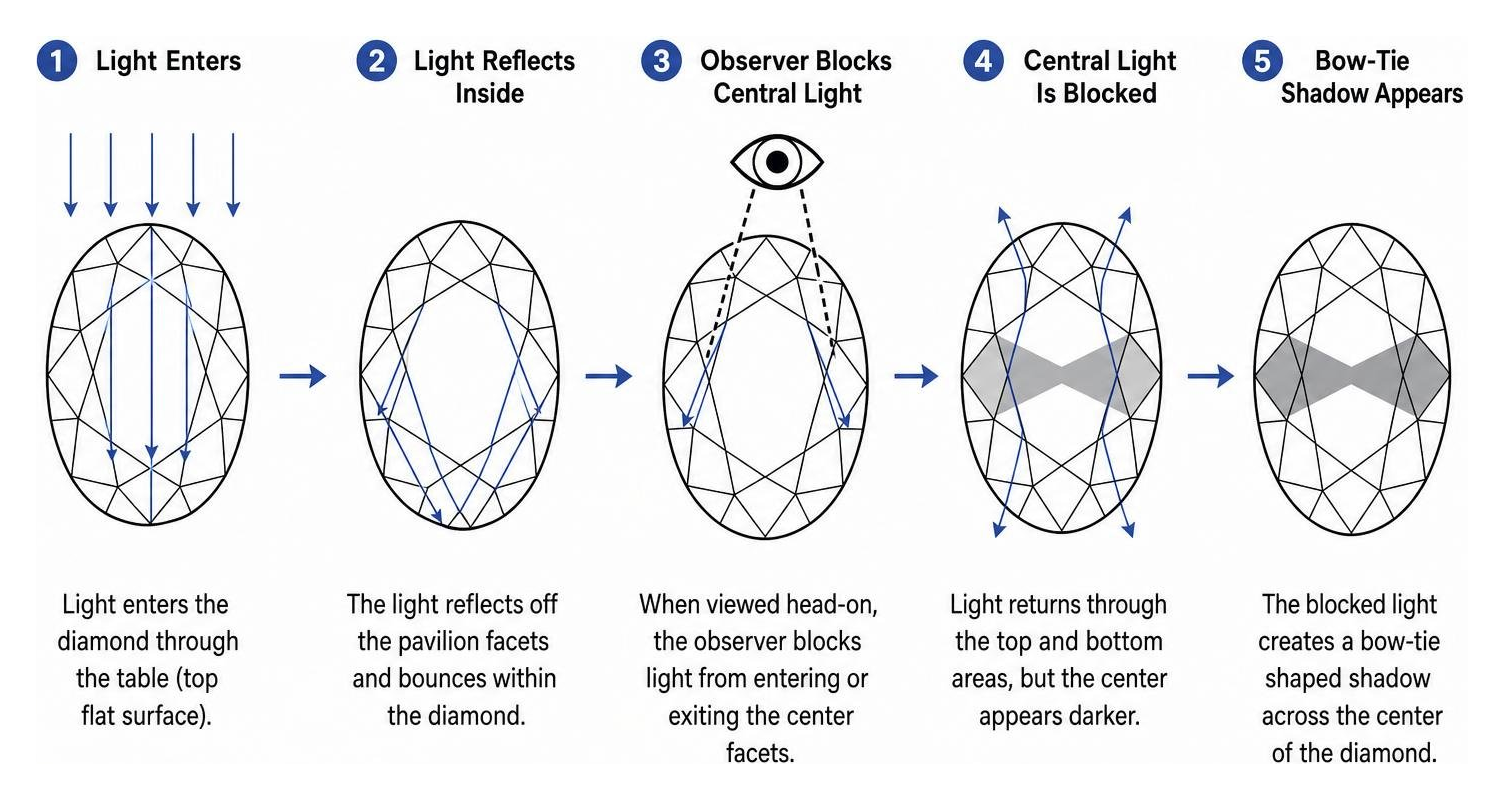
While every oval diamond has a bow-tie, the key is to find a stone where the effect is minimized. A well-cut oval will distribute light evenly, making the bow-tie look faint or nearly invisible when the stone moves. A poorly cut stone will have a harsh, stark black bow-tie that dulls the center of the diamond. To understand the physics behind this phenomenon and learn how to spot a good cut, read our detailed article on What Causes the Bow-Tie Effect in Oval Diamonds.
Balancing the 4Cs for Oval Lab Grown Diamond Rings
When shopping for oval lab grown diamond rings, you can use the 4Cs (Cut, Color, Clarity, and Carat weight) strategically to get the most beautiful diamond for your budget.
First, let's talk about Clarity. Oval diamonds are exceptionally good at hiding inclusions. The intricate, brilliant facet pattern of an oval scatters light in a way that masks small internal characteristics. Because of this, you do not need to pay a premium for a Flawless (FL) or Very Very Slightly Included (VVS1) grade. Opting for a Very Slightly Included (VS2) or even an eye-clean Slightly Included (SI1) diamond will save you money while looking completely perfect to the naked eye.
However, you should be more conservative with Color. Because of their elongated ends, oval diamonds tend to retain and show body color more easily than round diamonds. If you set an oval diamond in a white metal band like platinum or white gold, we recommend staying within the colorless to near-colorless range (D, E, or F). If you plan to set your diamond in a warm 14K yellow gold or rose gold band, you can safely drop to a G or H color, as the metal's warmth will naturally mask any slight yellow tint in the stone.
To help visualize how these factors come together in different sizes, you can consult our comprehensive 1 Carat Oval Diamond Ring Guide 2026 or read our broader Lab Created Diamond Engagement Ring Guide 2026.
Popular Settings and Styles for Oval Engagement Rings
Selecting the right setting is just as important as choosing the diamond itself. The setting not only secures the stone but also defines the overall design aesthetic of the ring.
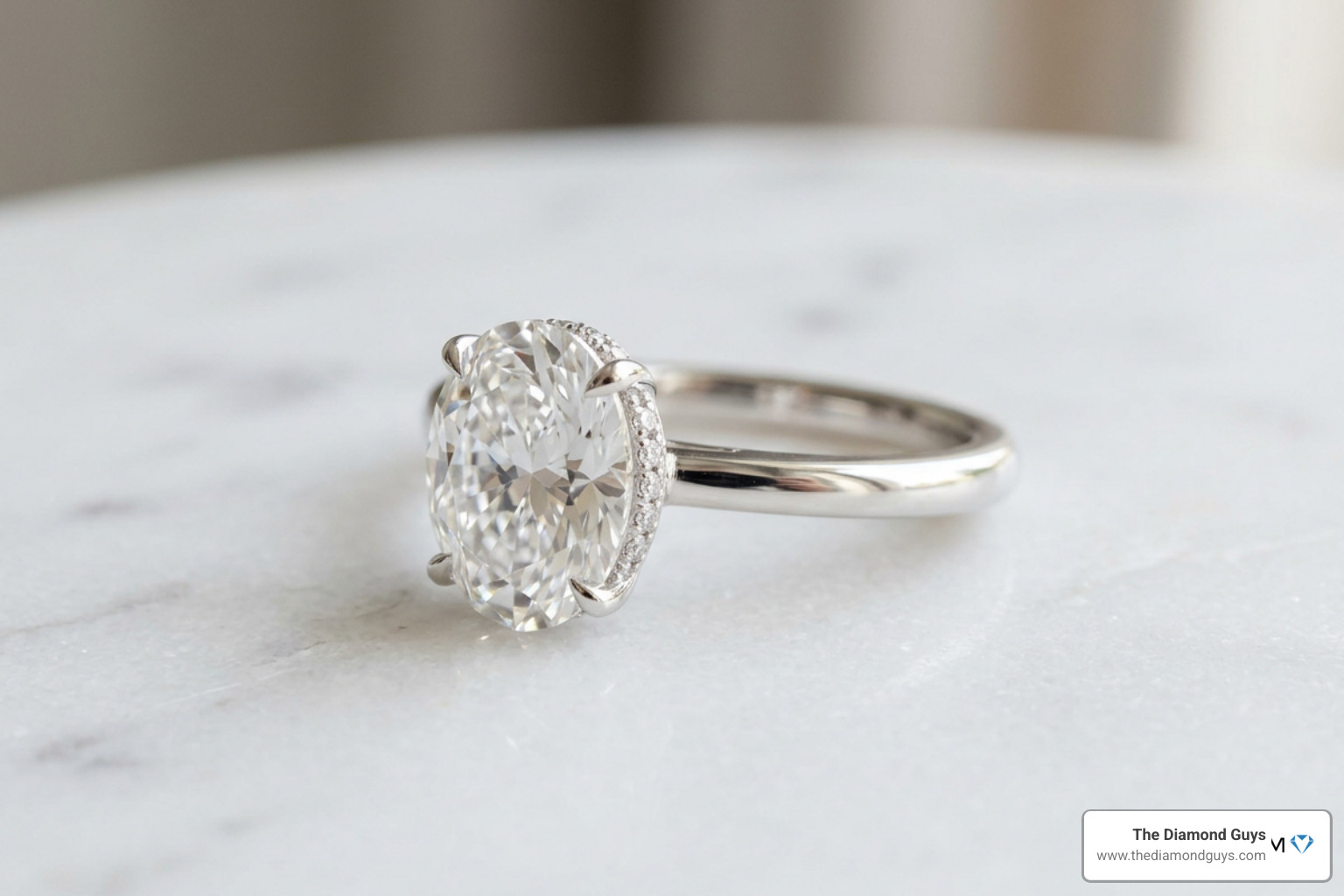
Oval diamonds are incredibly versatile and look beautiful in a wide variety of metals. Platinum and white gold offer a sleek, contemporary look that highlights the icy brilliance of colorless diamonds. Yellow gold provides a classic, high-contrast warmth, while rose gold lends a romantic, vintage-inspired charm.
Classic Solitaire and Cathedral Settings
For those who love minimalist elegance, a classic solitaire setting is hard to beat. A solitaire keeps the focus entirely on the oval center stone. Because ovals have curved, delicate ends, we highly recommend securing them with at least a four-prong setting—or even a six-prong setting—to protect the tips of the stone from accidental chips.
A cathedral setting is another popular choice that adds structural drama to a solitaire design. In a cathedral setting, sweeping arches of metal rise from the band to support the basket holding the diamond. This elevates the stone higher off the finger, giving it a prominent, regal profile and allowing more light to enter the pavilion for enhanced sparkle.
Multi-Stone and Three-Stone Designs
If you want to maximize sparkle across the entire width of your finger, a multi-stone setting is a fantastic option. Three-stone engagement rings are deeply symbolic, traditionally representing a couple's past, present, and future.
When designing a three-stone ring with an oval center, choosing the right side stones is key. Half-moon side stones curve flush against the sides of the oval, creating a seamless, high-brilliance silhouette. Alternatively, pairing an oval with tapered baguette or epaulette side stones adds a touch of clean, geometric Art Deco contrast. To explore these stunning layouts, check out our guide on the 3-Stone Oval Engagement Ring.
Another modern favorite is the hidden halo. Unlike a traditional halo that surrounds the perimeter of the stone, a hidden halo features a delicate collar of tiny diamonds set just below the center stone's girdle. This adds a subtle, sparkling surprise that is visible primarily from the side profile. This design element elevates the center stone beautifully, creating a stunning profile that catches the light from every angle.
Frequently Asked Questions About Oval Lab Diamonds
Are oval lab-grown diamonds certified by major gemological labs?
Yes! High-quality lab-grown diamonds are fully certified by the same independent gemological laboratories that grade natural diamonds. The International Gemological Institute (IGI) is the most common certifying body for lab-grown diamonds, providing highly detailed grading reports. The Gemological Institute of America (GIA) and the Gem Certification & Assurance Lab (GCAL) also regularly certify lab-grown stones. Always ensure your diamond comes with a grading report to verify its exact 4Cs specifications. For additional consumer education, the GIA offers a helpful overview of laboratory-grown diamonds.
How do I choose the right length-to-width ratio for an oval diamond?
The length-to-width (L/W) ratio determines how elongated or rounded your oval diamond will look. To find the ratio, divide the length of the diamond by its width.
According to GIA standards, the classic, most popular ratio for an oval diamond ranges from 1.3:1 to 1.4:1. A ratio within this range provides that perfect, iconic oval silhouette. If you prefer a wider, more rounded look, look for a ratio between 1.2:1 and 1.28:1. If you love a very sleek, elongated, and modern look, look for a ratio of 1.45:1 or higher.
How should I care for and clean my oval lab-grown diamond ring?
Keeping your ring clean is essential to maintaining its fire and brilliance. Over time, everyday lotions, oils, and dirt will build up on the underside of the stone, dulling its sparkle.
To clean your ring at home:
- Soak the ring in a bowl of warm water mixed with a few drops of mild dish soap for 10 to 15 minutes.
- Gently brush the stone-especially underneath the setting-using a soft-bristled baby toothbrush.
- Rinse thoroughly under warm running water.
- Pat dry with a lint-free microfiber cloth.
We also recommend bringing your ring to a professional jeweler once or twice a year to inspect the setting and ensure the prongs remain tight and secure.
Designing Your Custom Oval Engagement Ring
There is nothing quite like creating a piece of jewelry that is uniquely yours. Designing a custom engagement ring allows you to hand-select your loose oval lab-grown diamond and pair it with a setting designed specifically for your lifestyle and taste.
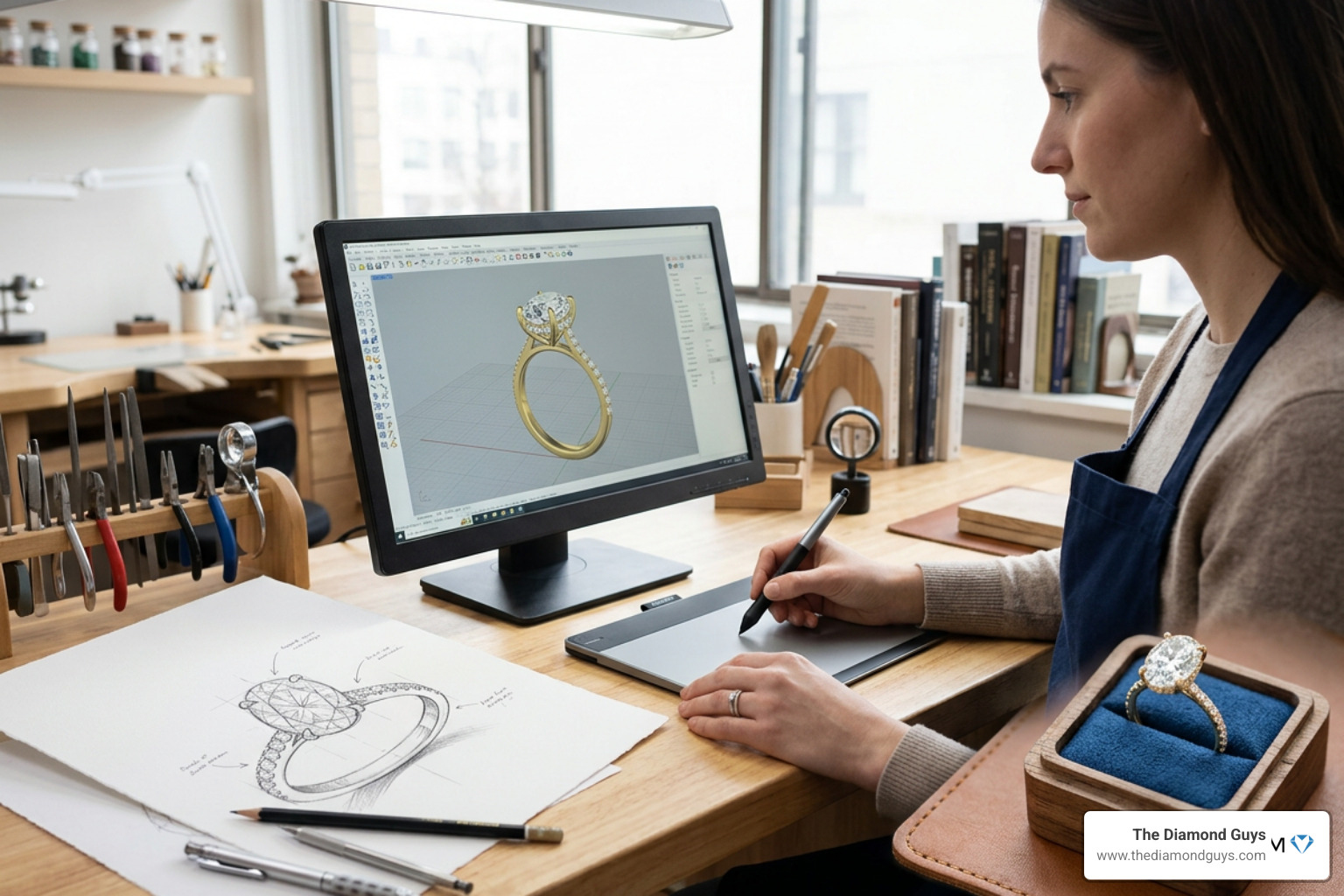
At The Diamond Guys, we make the custom design process collaborative, transparent, and exciting. We begin by helping you source the perfect loose oval diamond, focusing on eye-clean clarity, bright color, and a minimal bow-tie. From there, we sketch your ideas and translate them into photo-realistic 3D renderings. This allows you to preview your ring from every angle and make adjustments before our master craftsmen handcraft the final piece.
To learn more about how we bring your dream ring to life, dive into our Custom Lab Grown Diamond Ring Guide.
Conclusion
Choosing an engagement ring is a deeply personal milestone. Oval lab grown diamond rings offer an incredible blend of timeless elegance, finger-flattering proportions, and modern, sustainable luxury. By opting for a lab-grown stone, you can maximize your budget to secure a larger, brighter, and more brilliant diamond that represents your shared future.
At The Diamond Guys, we bypass the high-pressure sales tactics of big-box retailers to offer a personalized, expert-guided shopping experience. Whether you visit our 5-star rated jewelry store in Scottsdale, AZ, or stop by our showroom in Los Angeles, CA, we are here to help you navigate the details and craft a custom ring you will cherish forever.
Ready to begin your search? Read our Lab Diamond Jewelry Store Guide or contact us today to schedule your personalized consultation!


