

The Ultimate Guide to Pearl Necklace Repair and Restringing
Why Pearl Strands Fail and When to Restring
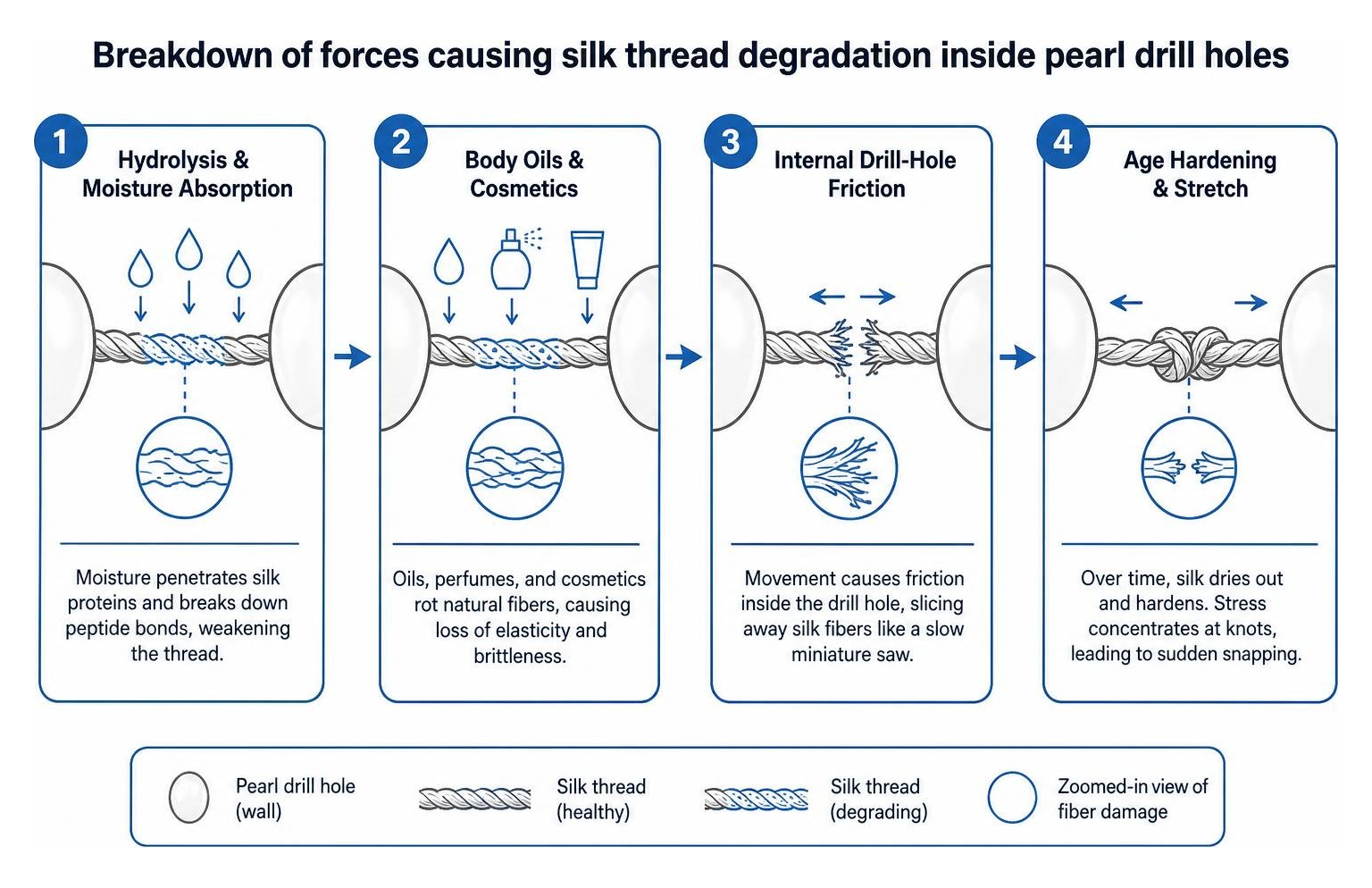
Unlike hard gemstones set in solid precious metal mountings, pearls rest on soft, flexible cords. The vast majority—approximately 90%—of fine pearl necklaces are hand-strung on pure silk cord. While natural silk gives fine cultured pearls their elegant, liquid-like drape, it is an organic protein fiber that inevitably degrades over time.
Several invisible chemical and mechanical forces act on the thread every time you wear your necklace:
- Hydrolysis and Moisture Absorption: Silk fibers are sensitive to moisture. Sweat, atmospheric humidity, lotions, and perfumes penetrate the silk cord. Through hydrolysis, water molecules break down the peptide bonds holding the silk proteins together, causing the thread to weaken from the inside out.
- Body Oils and Cosmetics: Natural skin oils, alcohol-based perfumes, hairsprays, and cosmetics collect along the cord. Over months and years, these substances rot the natural fibers, causing the silk to lose elasticity and turn brittle.
- Internal Drill-Hole Friction: Every time you move, the tiny sharp edges inside a pearl's drill hole slice away at the individual strands of silk cord. This friction acts like a slow miniature saw operating silently inside each gem.
- Age Hardening and Stretch: Even if kept inside a dark safe for decades, unworn silk cord gradually dries out, loses its natural oils, and hardens. When worn again, the stiff thread concentrates mechanical stress right at the knots, leading to sudden snapping.
How often should you bring your pearls in for maintenance? Industry standard guidelines recommend that a strand worn regularly (two to three times a week) should be restrung every 1 to 3 years. If you wear your strand only for special occasions, restringing every 3 to 5 years is sufficient. However, if a strand has sat unworn in a jewelry box for over ten years, always have a professional jeweler examine and restring it before wearing it out. For broader advice on maintaining delicate heirloom pieces, check out our Engagement Ring Maintenance Guide 2026 and our detailed Heirloom Pearl Restringing Guide.
Spotting the Signs of Wear
You do not have to wait for your strand to break across a crowded room to know it needs attention. Performing a quick home inspection every few months can save you from losing irreplaceable pearls. Look for these four critical warning signs:
- Visible Thread Sagging: Hold the center of your necklace and let it dangle. If you see noticeable gaps of bare thread between individual pearls, the silk has stretched. Stretched thread allows pearls to shift back and forth, accelerating drill-hole abrasion.
- Frayed Cord Near the Clasp: Inspect the thread ends closest to the clasp. Because this area bears the most strain during fastening, individual silk filaments often break first here, appearing fuzzy or frayed.
- Discolored French Wire (Gimp): High-end pearl strands feature French wire—a tiny, tightly coiled wire sleeve fitted over the thread where it connects to the clasp ring. If this wire turns green or dark grey, it indicates that sweat and oils have oxidized the metal and rotted the silk hidden directly underneath.
- Loose or Wobbling Pearls: Gently wiggle individual pearls along the strand. If pearls easily twist or slide between the hand-tied knots, the internal knots have flattened and worn thin.
Knotted vs Unknotted Pearl Strands
When evaluating a pearl necklace repair, understanding strand construction is critical. Pearl strands generally fall into two categories: knotted and unknotted.
In a knotted strand, a small, tight knot is hand-tied in the thread between every single pearl. Unknotted strands simply string pearls sequentially along a cord or metal wire without intervening knots, allowing the pearls to sit flush against one another.
| Feature | Knotted Pearl Strands | Unknotted Pearl Strands |
|---|---|---|
| Security | Superior. If the strand snaps, only 1 or 2 pearls fall off. | Poor. If the strand breaks, all pearls slide off and scatter. |
| Pearl Protection | High. Knots keep gems separated so nacre does not scratch. | Low. Pearls rub directly together, wearing down surface nacre. |
| Drape & Flexibility | Fluid, soft, and natural drape along the neckline. | Stiff or rigid, especially on heavier bead wires. |
| Industry Standard | Used in 90% of fine jewelry (Akoya, South Sea, Tahitian). | Used mainly for costume pieces or low-cost commercial beads. |
| Labor Requirement | High. Requires skilled hand-knotting between each bead. | Low. Fast stringing process with no hand knotting required. |
For fine cultured pearls, hand-knotting is mandatory. The individual knots act as miniature shock absorbers, protecting delicate outer nacre from friction scratches while guaranteeing that an unexpected break won't send your precious gems rolling across the floor.
The Complete Pearl Necklace Repair Process
Restoring a fine pearl strand requires precision craftsmanship and specialized bench tools. It is an intricate art where patience and consistent knotting tension make all the difference between an uneven strand and a beautifully finished heirloom.
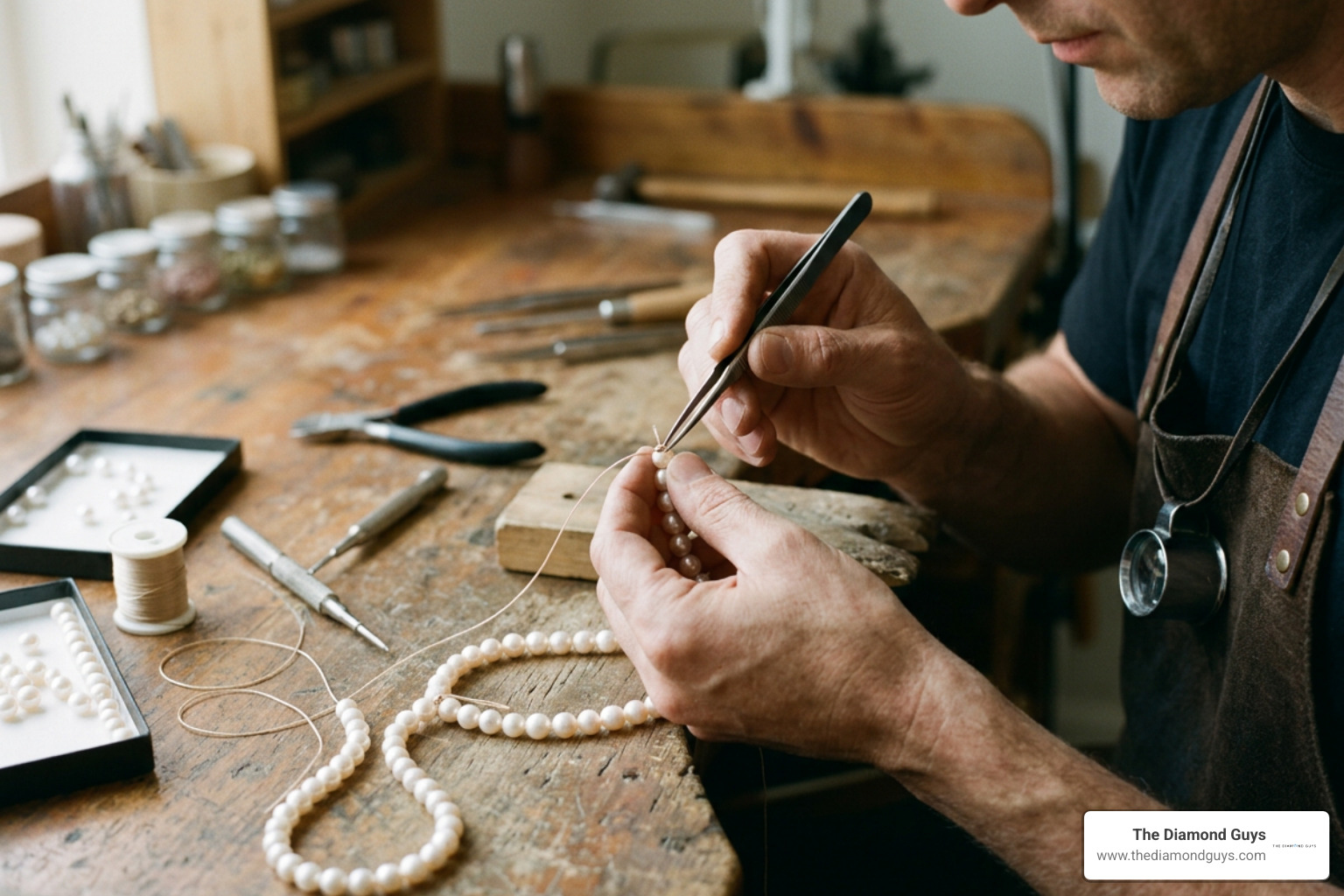
When we handle a pearl necklace repair at our shops, the process follows strict, deliberate steps:
- Inspection and Documentation: The necklace is photographed, measured, and every pearl is counted and logged into our system.
- Safe Disassembly: Old, brittle thread is carefully snipped. If a stubborn knot refuses to give way, we cut the cord rather than pulling forcefully, which could crack the delicate nacre around the drill hole.
- Ultrasonic Deep Cleaning: Loose pearls are given a gentle, specialized bath to dissolve accumulated body oils, cosmetics, and debris inside the drill holes without stripping the pearls' delicate organic luster.
- Thread and Needle Preparation: We select high-grade filament silk or high-strength synthetic cord matched specifically to the drill-hole diameter. The cord is pre-stretched under tension to eliminate sagging after the repair.
- Precision Hand Knotting: Working pearl by pearl, the craftsman slides each gem into place and ties an overhand knot using specialized fine-point tweezers or an awl. Consistent tension is applied to ensure every knot sits flush against the pearl entry point without pinching.
- Securing the Terminations: At the clasp connections, French wire (gimp) is threaded onto the silk to protect against metal wear. The cord is woven back through the last three pearls on each end and locked using a specialized double-knot finish combined with flexible bead cord adhesive.
For items requiring additional clasp work or metal repairs alongside restringing, take a look at our specialized Chain Repair Near Me guide.
Materials and Thread Gauge Selection
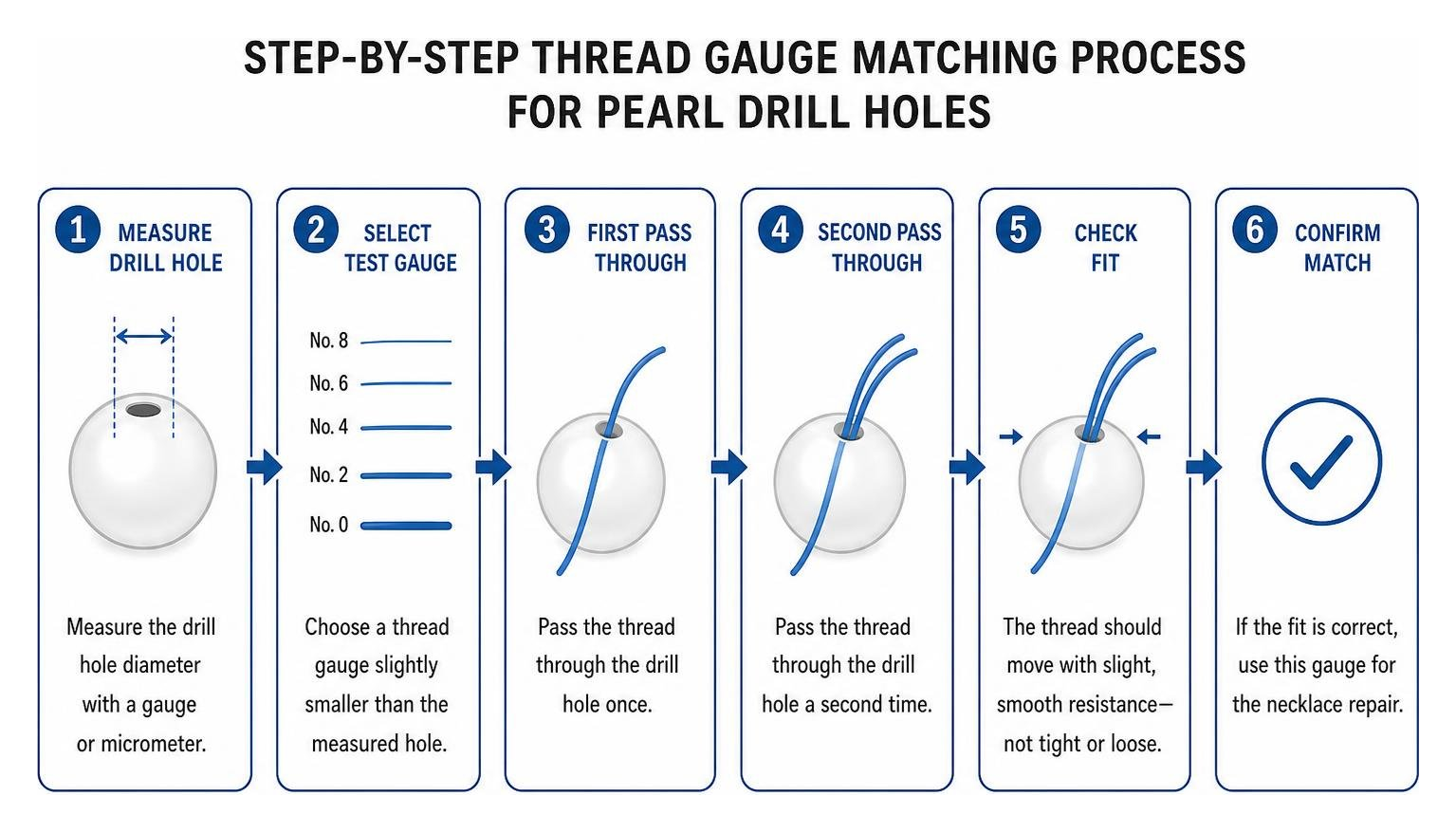
Selecting the proper cord material and thread size is crucial for longevity. Thread that is too thin will cut through under strand weight, while thread that is too thick will jam inside drill holes and split the pearls.
- 100% Natural Silk Cord: The gold standard for luxury pearl jewelry since 1866. Silk offers incredible strength-to-thickness ratios and an unmatched liquid drape. Brands like GRIFFIN supply silk with pre-attached stainless steel wire needles, eliminating double-threading bulk.
- Braided Synthetic Cords (NylonPower / High-Tech Polyethylene): Modern synthetic threads offer higher tensile strength and resistance to water degradation. They are ideal for daily wear, heavier Tahitian or South Sea strands, or clients who prefer vegan, non-silk alternatives.
- Matching Gauge Sizes: Silk cords come in standardized gauge sizes ranging from No. 0 (0.30 mm) up to No. 16 (1.05 mm). The ideal thread size passes through a sample pearl's drill hole twice with slight, smooth resistance.
DIY vs Professional Pearl Necklace Repair
With DIY video tutorials easily accessible today, many clients wonder if they can repair a broken pearl necklace at home using craft materials. While stringing basic glass beads is a fun pastime, repairing fine cultured pearls yourself carries substantial risks:
- Nacre Splitting: Forcing a thick needle or improper wire through an Akoya pearl can chip or shatter the outer nacre layer permanently.
- Inconsistent Knotting: Professional knotting requires years of practice. Amateurs often end up with uneven gaps, bunching, or crooked strands that refuse to lay flat against the collarbone.
- Chemical Damage: Using commercial superglue or hardware adhesives to secure clasp knots can rot silk fibers instantly or render end pearls permanently unusable for future restringing.
- Lack of Specialized Tools: Bench jewelers use knotting awls, precision tweezers, caliper gauges, and gold-plated bullion wire to ensure structural integrity.
Leaving your pearls to experienced bench jewelers protects both their monetary value and their deep sentimental worth.
Understanding Pearl Restringing Costs and Additional Services
What should you expect to pay when bringing your strand in for service? Pearl necklace repair pricing in today's market is calculated primarily based on strand length, pearl size, and structural complexity.
Most reputable jewelers calculate labor charges using a standard per-inch rate structure. Here is a breakdown of typical industry pricing in 2026:
- Knotted Restringing (5mm pearls or larger): $3.00 to $5.00 per inch
- Knotted Restringing (small pearls under 5mm): $5.00 to $7.00 per inch (or $0.75 per individual knot)
- Unknotted Restringing: $1.50 to $3.00 per inch
- Material & Findings Fee: $8.00 to $15.00 (covers high-grade silk thread and gold/silver French wire)
- Standard Bracelet (7–8 inches, knotted): $35.00 to $60.00
- Princess Strand (18 inches, knotted): $65.00 to $125.00
- Opera Strand (30–36 inches, knotted): $150.00 to $220.00
What Affects the Cost of Pearl Necklace Repair?
Beyond strand length, several key technical variables influence your total final estimate:
- Pearl Size and Hole Diameter: Pearls smaller than 5mm require finer needles and significantly higher knot density per inch. A 18-inch strand of tiny seed pearls requires almost double the labor time of an 18-inch strand of large South Sea pearls.
- Knot Density: Multi-strand arrangements (such as double or triple strand chokers) require precise alignment so all strands drape symmetrically without twisting.
- Clasp Repair or Replacement: Upgrading an outdated clasp to a modern 14K gold fishhook, safety ball, or diamond-accented plunger clasp adds component costs ranging from $45 for sterling silver up to $250+ for solid gold.
- Pearl Matching and Gemstone Replacement: If loose pearls were lost during a break, sourcing matching cultured pearls with identical luster, overtone, body color, and millimeter size requires specialized gemological inventory. If you need replacement stones for other jewelry pieces, review our Gemstone Replacement Service.
Additional Pearl Maintenance and Restoration
While your strand is disassembled on the bench, it is the perfect time to perform comprehensive restyling or restoration work:
- Pearl Re-Gluing & Post Repair: Loose pearls on rings, pendants, or stud earrings are detached using non-damaging epoxy solvents, cleaned, and reset using specialized jeweler's epoxy ($15–$40 per pearl).
- Multi-Strand Conversions: Long, unworn opera strands can be split and converted into a matching classic 18-inch necklace and bracelet set.
- Pearl Redrilling: If drill holes have clogged with broken thread or old glue, bench craftsmen can redrill the channels using diamond-tipped micro-drills ($10 per pearl).
For additional insights on repairing gold fastenings or clasps, see our comprehensive Gold Jewelry Repair Guide 2026.
How to Care for Restrung Pearls and Ship Them Safely
Whether you are bringing your pearls directly to our physical stores in Scottsdale, AZ or Phoenix, AZ, or preparing them to send through a secure mail service, taking proper intake precautions is essential.
Safe Mail-In and In-Store Intake Procedures
Before handing your pearls over for service, always follow these four protective rules:
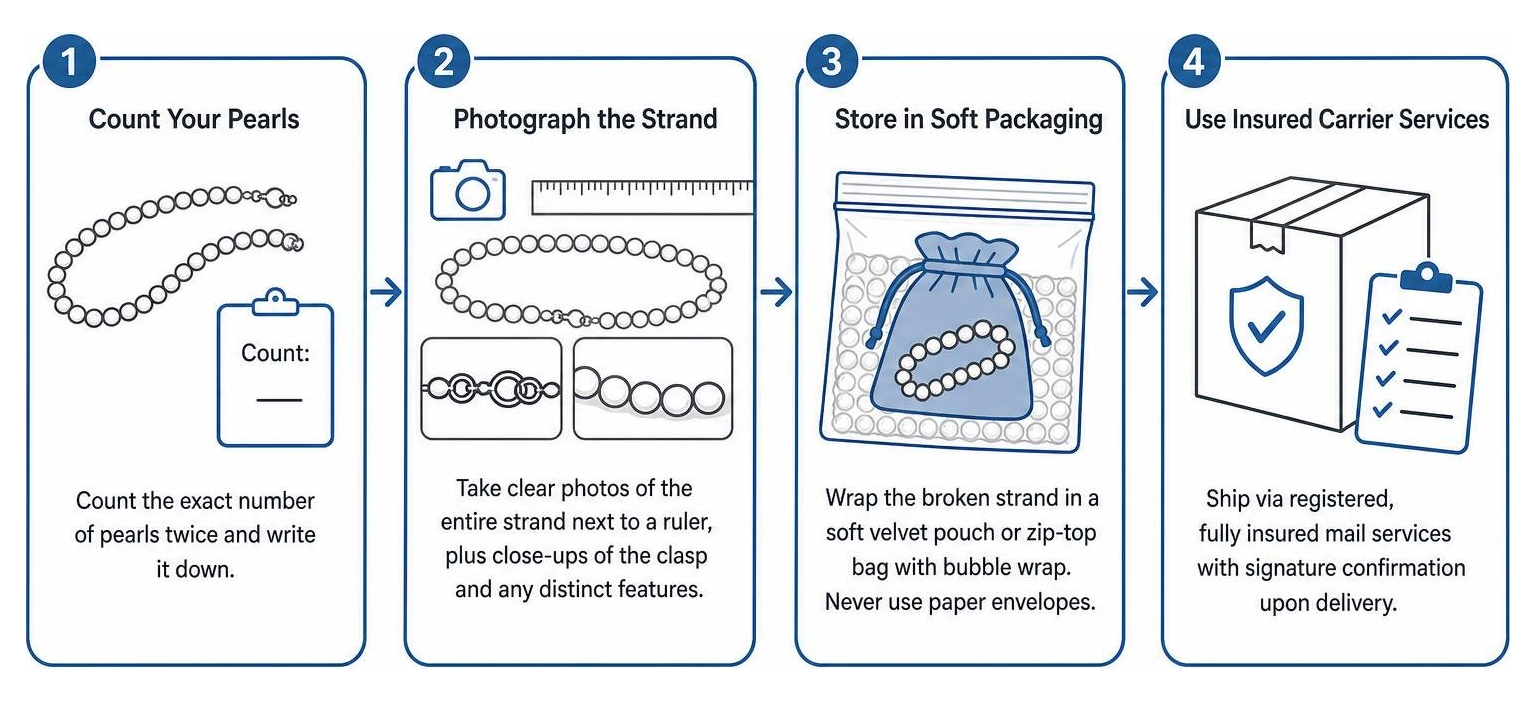
- Count Your Pearls: Count the exact number of pearls on your strand twice and write down the final number on your intake sheet.
- Photograph the Strand: Take clear high-resolution photos of the entire strand laid flat next to a ruler, taking close-ups of the clasp and any distinctive markings or color variations.
- Store in Soft Packaging: Wrap the broken strand inside a soft velvet pouch or zip-top bag surrounded by bubble wrap. Never pack loose pearls in paper envelopes where they can get crushed.
- Use Insured Carrier Services: Always ship via registered, fully insured mail services requiring signature confirmation upon delivery.
If you are looking for localized drop-off options, visit our Jewelry Repair Near Me resource center.
Long-Term Post-Repair Pearl Care
Restringing gives your necklace a brand-new lease on life, but daily habits determine how many years that fresh silk cord will survive. Keep your restored pearls glowing with these foundational care tips:
- The "Last On, First Off" Rule: Always put your pearls on after applying hairspray, perfumes, cosmetics, and body lotions. Take them off first when returning home. The alcohol and chemicals in beauty products dull nacre and rot silk.
- Store Them Flat: Never hang pearl necklaces on jewelry trees or wall hooks. Gravity places continuous tension on the silk cord, causing it to stretch prematurely. Store your strand laying flat inside a velvet-lined box or soft cloth roll.
- Gentle Wiping: After every wearing, wipe your pearls gently with a soft, microfiber cloth dampened slightly with clean water. This removes residual skin oils before they soak into the drill holes.
- Keep Out of Water: Never shower, swim, or wash dishes while wearing pearl strands. Prolonged water immersion causes rapid thread hydrolysis and will dissolve the specialized glue securing your end knots.
Frequently Asked Questions About Pearl Restringing
How long does it take to get a pearl necklace restrung?
In-store restringing turnarounds at professional jewelry shops typically take 1 to 3 business days for standard single strands. Mail-in repair services or complex multi-strand redesigns generally take 1 to 2 weeks. Be aware that turnaround times across the jewelry industry often double during peak holiday seasons (such as April-May for graduations/weddings and November-December for holidays).
Can a broken pearl necklace be repaired if pearls are missing?
Yes, absolutely. An experienced bench jeweler can match missing pearls by evaluating the remaining gems' millimeter diameter, body color, overtone, and surface quality. Replacement cultured pearls (Freshwater, Akoya, or Tahitian) are sourced and integrated seamlessly into the strand during restringing.
Why does a newly restrung pearl necklace feel tight or kinked?
Do not be alarmed if your freshly restrung strand feels slightly stiff, tight, or kinked straight out of the repair shop. Bench jewelers tie knots firmly so the necklace does not stretch out too quickly. Within a few wearings, the natural weight of the pearls combined with gentle body warmth will cause the silk to stretch slightly, resulting in a smooth, elegant drape.
Preserving Your Family Heirlooms
Pearl necklaces hold a unique position in fine jewelry. They capture life’s most cherished milestones—from weddings and graduations to treasured family hand-me-downs passed down across generations. Because pearls are born from living organisms, maintaining their beauty requires thoughtful, periodic care.
Regular inspection, timely restringing on high-grade silk, and gentle daily habits ensure that your pearls remain as radiant today as the day they were first worn.
At The Diamond Guys, we bring expert guidance, meticulous craftsmanship, and ethical standards to every piece brought through our doors. Whether you need a quick thread inspection, custom clasp replacement, or a complete heirloom restringing, our team in Scottsdale and Phoenix is here to help.
For complete local service details, explore our Jewelry Repair Scottsdale AZ Complete Guide, or stop by our showroom to speak directly with our team.


