

The Hole Truth: How Much Does It Cost to Re-Shank a Ring?
When Your Ring Band Wears Thin: What Re-Shanking Actually Costs

Re-shanking a ring is one of the most common jewelry repairs — and one of the most misunderstood when it comes to cost.
Here's the short answer:
| Repair Type | Metal | Typical Cost (USD) |
|---|---|---|
| Half-shank | 14k/9k gold | ~$150–$400 |
| Half-shank | 18k gold / platinum | ~$300–$600 |
| Full-shank | 14k/9k gold | ~$300–$600 |
| Full-shank | 18k gold / platinum | ~$500–$900+ |
| Stone resetting (pave/eternity) | Any | Add $150–$500 |
Prices vary by jeweler, location, and ring complexity.
Re-shanking means cutting away the worn-down bottom portion of your ring's band and replacing it with new metal. It restores the ring's strength, shape, and safety — without touching the stone or setting.
Rings wear down at the bottom because that's where friction happens every single day. Once the band thins below about 1mm, it can bend, crack, or cause stones to fall out. Re-shanking fixes that before it becomes a much bigger problem.
This guide covers everything you need to know: what the process involves, how much it costs, how long it takes, and what to watch out for.
I'm Morgan Price, a content specialist with deep experience researching jewelry repair topics — including re-shanking a ring — to help buyers make confident, informed decisions. In the sections below, I'll walk you through everything clearly so you know exactly what to expect before you walk into a jeweler.
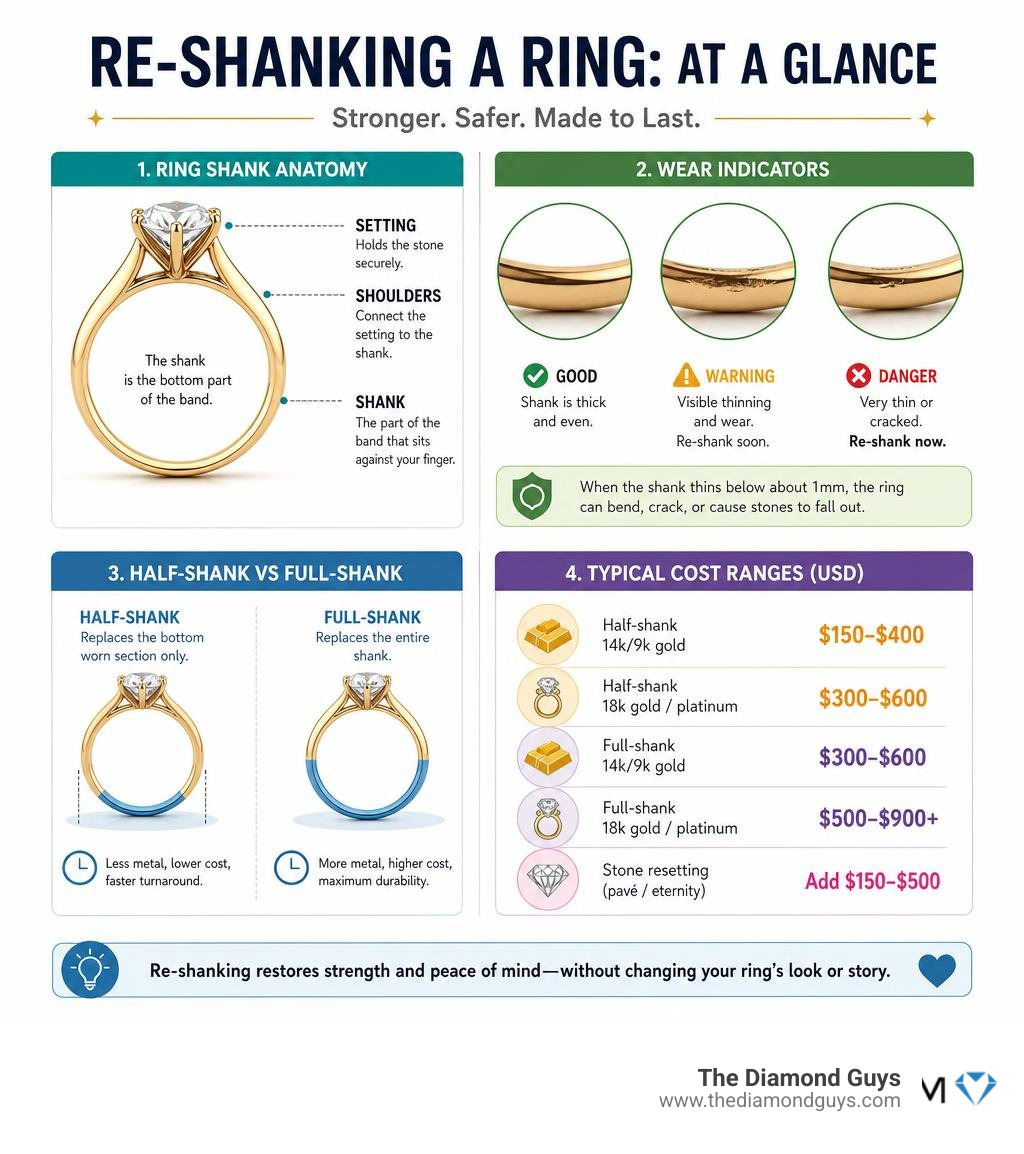
Re-shanking a ring terms made easy:
What Does Re-shanking a Ring Mean?
When we talk about re-shanking a ring, we are talking about a structural saving grace for well-loved jewelry. To understand what this repair actually is, we first have to look at the anatomy of a ring.
The "shank" is the jeweler’s term for the band of the ring that wraps around your finger. While the top portion (often called the crown or head) holds the center diamond or gemstones, the shank does the heavy lifting of keeping the ring secure on your hand.
Over years of continuous wear, the shank naturally loses metal. As the band thickness decreases, the structural integrity of the entire piece is compromised. Re-shanking is the process of removing that weak, thinned-out portion of the band and replacing it with a brand-new, durable piece of matching metal. This process restores the ring to its original thickness, strength, and circular shape without altering the beautiful top setting that holds your precious gems.
Why Your Ring Band Wears Down Over Time
It might seem surprising that hard metals like gold and platinum can wear away simply by sitting against your skin, but daily life is incredibly abrasive. Every time you grip a steering wheel, hold metal grocery cart handles, carry heavy keys, lift weights at the gym, or clap your hands, your ring rubs against other hard surfaces.
This constant friction acts like ultra-fine sandpaper. Over decades, microscopic layers of metal are shaved off.
The rate of this wear depends heavily on the metal alloy:
- Gold: Yellow gold, white gold, and rose gold are mixed with alloy metals to make them durable, but they still wear down over time. White gold rings also lose their protective rhodium plating, exposing the softer gold beneath to direct friction.
- Platinum: Platinum is highly dense. Instead of flaking away, platinum tends to displace or "flow" when bumped (creating a beautiful patina), but even platinum bands eventually thin out and warp after thirty or forty years of daily wear.
If you are noticing your favorite piece looking a little worse for wear, you can learn more about restoration options in our comprehensive guide to ring repair in Scottsdale, AZ.
Signs Your Ring Needs a Re-Shank
How do you know when your ring has crossed the line from "well-loved" to "dangerously thin"?
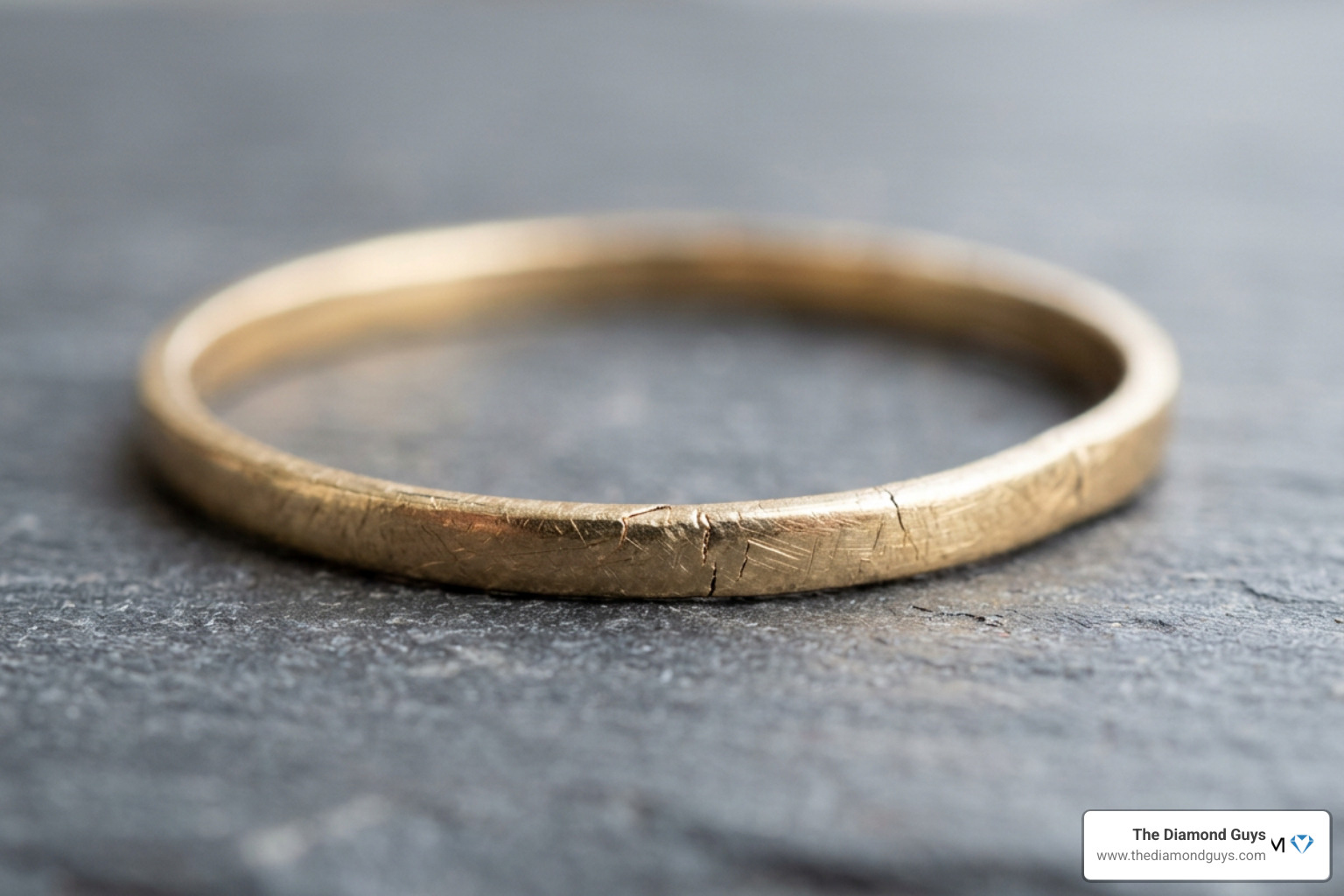
Keep an eye out for these classic warning signs:
- The 1mm Rule: If the back of your band wears down to under 1mm in thickness, it is highly vulnerable to bending and warping. A safe, durable daily-wear band should ideally measure between 1.8mm and 2.5mm.
- Warping and Bending: If your perfectly round ring is starting to look like an oval or a pretzel, the metal has become too thin to support the structure.
- Visible Cracks or Grooves: Small hairline fractures along the bottom of the band are clear indicators that the metal is fatigued and about to snap.
- Loose Stones: This is the most dangerous symptom. When a thin shank bends out of shape, it pulls on the shoulders of the ring. This structural shifting can open up the prongs or pave settings at the top, causing your diamonds to fall out.
The Step-by-Step Re-Shanking Process
Re-shanking is a highly precise job that requires the skilled hands of a master bench jeweler. It is not a simple "band-aid" fix; it is a structural reconstruction of your jewelry.
Here is how a professional jeweler performs the repair:
- Assessment and Measurement: The jeweler inspects the ring under magnification to check the security of all stones and measure the exact thickness and width of the existing band.
- Cutting Away the Worn Metal: Using a precise jewelry saw, the jeweler cuts out the thin, damaged portion of the shank. This is typically done at the 3 o'clock and 9 o'clock positions, leaving the top half of the ring entirely intact.
- Fabricating the New Shank Stock: The jeweler selects a piece of new metal wire (called stock) that perfectly matches the original ring's alloy, color, karat, and width.
- Shaping and Fitting: The new metal is annealed (heated to make it workable), curved on a mandrel, and filed down until it fits flush against the cut edges of the original ring.
- Laser Welding or Soldering: Using a high-precision laser welder or a traditional torch, the jeweler joins the new shank to the original setting. Laser welding is often preferred because it allows the jeweler to target heat directly at the joint without risking damage to nearby gemstones.
- Blending and Polishing: The jeweler uses abrasive wheels and polishing compounds to smooth out the joints. The goal is to make the seam completely invisible, leaving a smooth, continuous band.
For a deeply technical look at how jewelers execute this bench repair, you can review this step-by-step guide on how to re-shank a ring.
Half-Shank vs. Full-Shank Replacement
Depending on how far the wear extends up the sides of your ring, your jeweler will recommend either a half-shank or a full-shank replacement.
| Feature | Half-Shank Replacement | Full-Shank Replacement |
|---|---|---|
| What is replaced | Only the bottom half of the band (approx. 3 o'clock to 9 o'clock). | The entire band, starting right below the main setting shoulders. |
| When to use it | Best when the wear is isolated to the very bottom of the ring. | Best when the band is thin all the way up, or for upgrading the overall band thickness. |
| Cost | More economical (uses less metal and labor). | Higher cost (requires more metal and extensive blending). |
| Sizing impact | Great opportunity for minor size adjustments. | Allows for complete reshaping and significant size changes. |
Metal Matching and Selection
Matching the metal alloy of the new shank to your original ring is absolutely critical. If you have an 18k yellow gold ring, the new shank must be fabricated from 18k yellow gold.
If a jeweler attempts to use 14k gold on an 18k band to save on costs, it will create a visible color seam within a few years due to the different metal mixtures. Furthermore, different karats wear down at different rates, which can cause structural issues down the road.
If you have a white gold ring, the entire piece must be rhodium-plated after the soldering process to ensure a uniform, brilliant white finish. For platinum rings, matching the dense, pure metal is essential to maintain the heavy, luxurious feel of the original piece.
Re-shanking a Ring with Stones or Eternity Bands
Can you re-shank a ring that has diamonds running down the band? Yes, but it is a much more delicate operation.
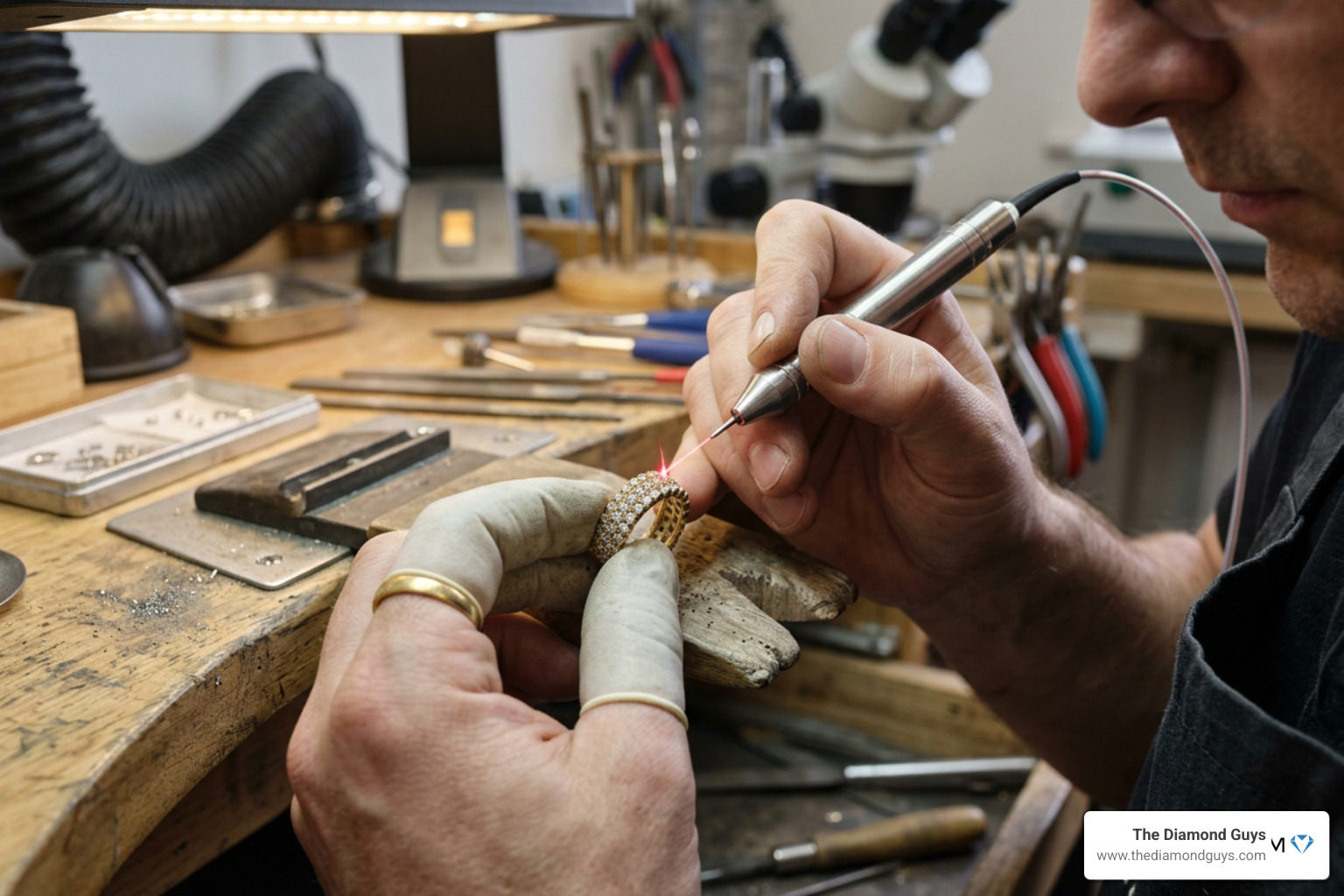
Rings with pave settings, channel-set accent stones, or full eternity bands present unique challenges. Because the metal holding these small stones is incredibly thin, the heat from traditional soldering can cause the settings to warp, dropping the stones.
In these cases, a master jeweler must use a focused laser welder to complete the repair without heating the rest of the ring. If the wear is too severe, some of the accent stones may need to be carefully removed before the repair and reset afterward, which adds to the overall labor cost.
How Much Does It Cost to Re-Shank a Ring?
The cost of re-shanking a ring is determined by three main factors: the type of metal used, the amount of metal required (half vs. full shank), and the labor involved in protecting or resetting any accent stones.
Because precious metal prices fluctuate daily, and different ring designs require varying levels of bench experience, getting a personalized assessment is always the best path forward. For high-value metals like platinum, you can read more about what goes into these specialized repairs in our guide to platinum ring repair.
Cost Breakdown by Metal and Shank Type
To help you budget for this essential repair, here is a breakdown of typical pricing you can expect to see in the United States:
- 14k Yellow or White Gold Half-Shank: $150 to $400. This is the most common repair and covers standard daily-wear engagement rings that have thinned out at the very bottom.
- 18k Gold or Platinum Half-Shank: $300 to $600. The higher cost reflects the density of platinum and the higher pure gold content of 18k gold.
- 14k Gold Full-Shank: $300 to $600. Replacing the entire band requires more raw material and extra labor to blend the seams near the shoulders of the ring.
- 18k Gold or Platinum Full-Shank: $500 to $900+. This is a premium repair suited for heavy, luxurious bands or complex designer mountings.
- Design and Engraving Duplication: If your original band had custom hand-engraving, millgrain, or a unique pattern, duplicating this on the new section of the shank will typically add $100 to $300 in artisan labor.
How Long Does the Re-Shanking Process Take?
Because re-shanking is a structural reconstruction rather than a quick polish, it is not a repair that can be completed while you wait.
The typical turnaround time for a professional re-shank ranges between two to four weeks. This timeframe allows the jeweler to source the exact matching metal stock, execute the precise cutting and welding, reset any stones that may have shifted, and perform rigorous quality control checks to ensure the ring is structurally sound.
Sizing, Antique Value, and Alternatives
Will Re-shanking a Ring Affect Its Size?
Yes, making a ring band thicker will change how it feels on your hand.
When you increase the thickness of a band, the metal fills up more of the inner circumference against your skin. As a result, a newly re-shanked ring will sit more snugly on your finger.
If you are upgrading from an ultra-thin 1.2mm band to a durable 2.0mm band, we often recommend sizing the ring up by about a quarter-size to maintain the exact same comfortable fit. If you want to dive deeper into how band dimensions impact sizing, check out our guide to resizing wedding bands.
Preserving the Value of Vintage and Heirloom Rings
If you have inherited a beautiful Art Deco or Victorian heirloom, you might worry that cutting the original band will ruin its antique value.
The jewelry conservation consensus is quite the opposite: a dangerously thin, cracked shank that risks losing its original antique diamonds is worth far less than a professionally restored, wearable piece of history.
As long as the jeweler only replaces the worn bottom portion of the band and leaves the original face, filigree, and setting completely untouched, a re-shank is viewed as necessary maintenance. It preserves the ring's wearability for the next generation.
Alternatives to Re-Shanking
If your ring is only slightly thin, or if you aren't ready to commit to a full re-shank, there are a few alternative options:
- Adding Metal (Solder Overlay): If the band is only slightly thin in one spot, a jeweler can sometimes melt a small amount of matching gold over the area to build it back up. This is a temporary "band-aid" fix and is not recommended for severely worn rings.
- Sizing Ribbons or Beads: If your ring is too loose but the shank is still in decent shape, adding small metal beads or a sizing ribbon inside the band can improve the fit without cutting the ring.
- CLIQ Adjustable Shank: For individuals with larger knuckles or arthritis, a hinged shank system like the CLIQ adjustable shank can be installed. This allows the ring to open and close directly around the base of the finger. You can watch a demonstration of this system in this video on how to install a CLIQ adjustable shank.
How to Prevent Future Shank Wear
Once your ring has been beautifully restored, you can extend the lifespan of your new shank by practicing good jewelry habits:
- Take It Off at the Gym: Metal-on-metal friction from weightlifting bars is one of the fastest ways to flatten a ring band.
- Remove It During Heavy Labor: Gardening, cleaning with abrasive chemicals, and DIY home projects can scratch and wear down the metal.
- Schedule Regular Inspections: Bring your ring to a trusted jeweler once or twice a year to check the prongs and measure the band thickness.
For residents in the Valley, you can read our localized maintenance tips in our guide to jewelry repair in Phoenix.
What to Ask Your Jeweler Before the Repair
Before you hand over your precious ring, make sure you ask these key questions:
- "Can I get a detailed, written quote?" Ensure the quote covers the cost of the metal, labor, any stone resetting, and rhodium plating (if white gold).
- "Where will the seams be, and will they be visible?" A skilled jeweler should be able to hide the seams completely.
- "Will you check the security of all the side stones after the welding is complete?" The heat from the repair can cause slight metal shifts, so a final stone-tightening check is crucial.
- "Do you offer a warranty on the repair work?"
Frequently Asked Questions About Re-Shanking
Can you make a ring band thicker without replacing it?
Not successfully if the band is already severely thinned out. While a jeweler can add a small amount of gold solder to a minor low spot, attempting to build up a paper-thin band by melting gold over it creates a weak, multi-layered metal structure that is prone to cracking. Cutting out the old section and replacing it with a solid piece of new metal stock is the only durable, long-term solution.
Can engagement rings be resized during a re-shank?
Absolutely! In fact, a re-shank is the perfect time to adjust the size of your ring. Because the jeweler is already cutting the band and fabricating a new piece of metal, they can easily adjust the length of the new shank to make the ring larger or smaller. You can read more about how this works in our guide to resizing engagement rings.
How do I find a qualified jeweler for this repair?
Re-shanking requires advanced bench jewelry skills, precision laser welding, and an eye for seamless finishing. Avoid mall chain stores that ship repairs out to massive, anonymous processing facilities. Instead, look for an independent, highly-rated jeweler with an in-house master jeweler. You can find tips on selecting the right partner in our resource on jewelry repair near me.
Conclusion
Your jewelry is meant to be worn, enjoyed, and passed down through generations. While a worn-down, thin band can feel like the end of the road for a beloved ring, re-shanking a ring is a beautiful, highly effective way to breathe new, durable life into your most treasured pieces.
At The Diamond Guys, we specialize in custom engagement rings, ethical natural and lab-grown diamonds, and expert jewelry restoration. Our 5-star rated showrooms in Scottsdale, AZ, and Los Angeles, CA, provide a warm, personalized, and educational environment where you can trust that your jewelry is in the safest hands.
If your favorite ring is looking thin, warped, or ready for an upgrade, don't wait for a stone to fall out. Schedule a jewelry repair consultation in Scottsdale with our master jewelers today, and let us restore your ring to pristine, lifetime-wearable condition.


