

Upgrade Your Wrist Game with a Classic Vintage Omega Seamaster
Why a Vintage Omega Seamaster Still Stands Out

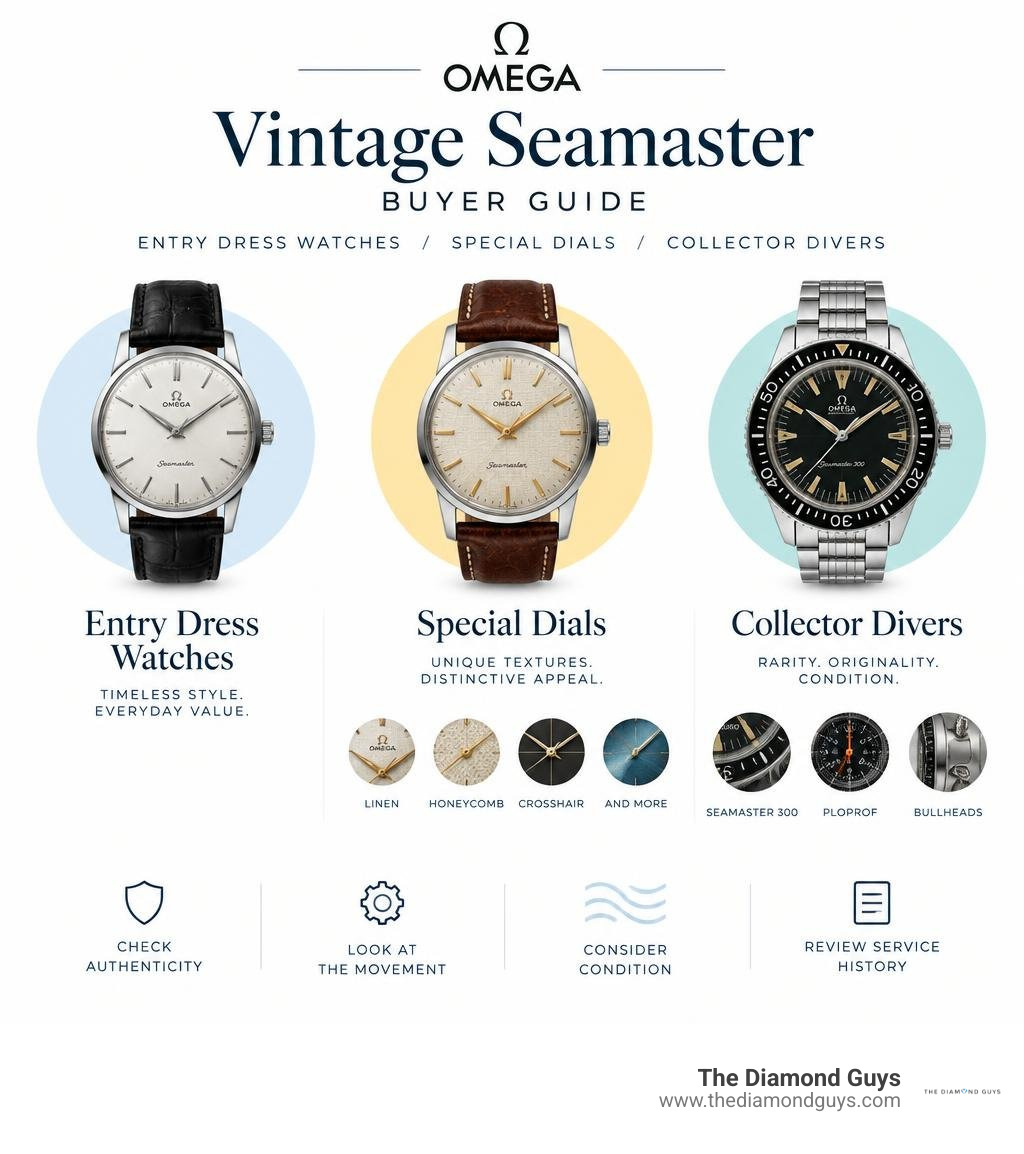
A Vintage Omega Seamaster can be an excellent first collectible watch or a serious long-term addition to a collection. The best choice depends on what you value most:
- Everyday value: 1950s to 1970s steel dress Seamasters, often from about $500 to $1,500.
- Distinctive style: linen, honeycomb, crosshair, and other original special dials, which can command a premium.
- High-end collecting: Seamaster 300 divers, Ploprofs, Bullheads, and chronographs, where rarity, originality, and condition matter far more than age alone.
First introduced in 1948, the Seamaster began as a water-resistant civilian watch shaped by Omega's military-era experience. It later grew into a broad family: slim dress watches, capable professional divers, and bold 1960s and 1970s tool watches. That range is what makes the line rewarding, but also tricky to buy. A clean original dial, correct movement, sharp case, and documented service history can make a meaningful difference in both enjoyment and value.
I am Morgan Price, a white-hat research and outreach specialist who helps content teams turn detailed watch research into clear, useful buying guidance, including the Vintage Omega Seamaster market. In the sections ahead, we will compare the references, dials, price tiers, and authenticity details that deserve your attention.
Quick Vintage Omega Seamaster terms:
The Evolution and Heritage of the Vintage Omega Seamaster
To truly understand why collectors hold this lineage in such high regard, we have to look back at the late 1940s. Omega celebrated its centenary in 1948, marking 100 years of Swiss precision watchmaking. Rather than releasing a delicate presentation timepiece, Omega introduced the Seamaster. Built upon the rugged specifications developed for the British Ministry of Defence during World War II, this new creation married military-grade utility with refined civilian styling.
Prior to 1948, most water-resistant watches relied on lead, shellac, or compressed paper gaskets that degraded rapidly. Omega revolutionized the industry by adapting submarine rubber O-ring gasket technology into a commercial wristwatch. This ensured the Seamaster maintained structural integrity against moisture, dust, and temperature fluctuations without requiring a cumbersome case.
Adorning the caseback of these historic pieces, you will frequently spot the iconic Hippocampus (seahorse) medallion. Engraved or stamped in relief, this mythical sea emblem became the official seal of the Seamaster line in 1958. For anyone curating a serious collection, learning about the structural fundamentals of early timepieces is as essential as reviewing our vintage dress watches ultimate guide.
From Dress Watch to Professional Diver: Seamaster 300 and Beyond
While early references like the CK 2576 and pie-pan dial ref. 2577 performed admirably against daily splashes, the recreational and commercial diving boom of the 1950s demanded greater depth performance. In 1957, Omega unveiled its legendary "Master Trilogy," consisting of the Railmaster, the Speedmaster, and the Seamaster 300 (Ref. CK 2913).
The CK 2913 set a new standard for underwater horology. Featuring a rotating external timing bezel, a bold black dial, luminous geometric markers, and iconic "Broad Arrow" hands, it was initially rated to 200 meters (tested to 300 meters, as Omega's testing equipment could not exceed 20 atmospheres at the time).
By 1962, the reference 14755 evolved the design with straight baton hands, followed by the mid-1960s references 165.024 (no-date) and 166.024 (date). The 165.024 introduced the prized "Big Triangle" luminous dial marker at 12 o'clock and lyre twisted lugs. For collectors examining mid-century dress references alongside dive tools, checking an Omega Seamaster 165.02 (1965) provides insight into how case profiles diverged during this era.
Specialized Cult Classics: Bullhead, Ploprof, and Chronographs
As the late 1960s and 1970s brought an explosion of avant-garde design, Omega expanded the Seamaster family into specialized, high-performance professional instruments:
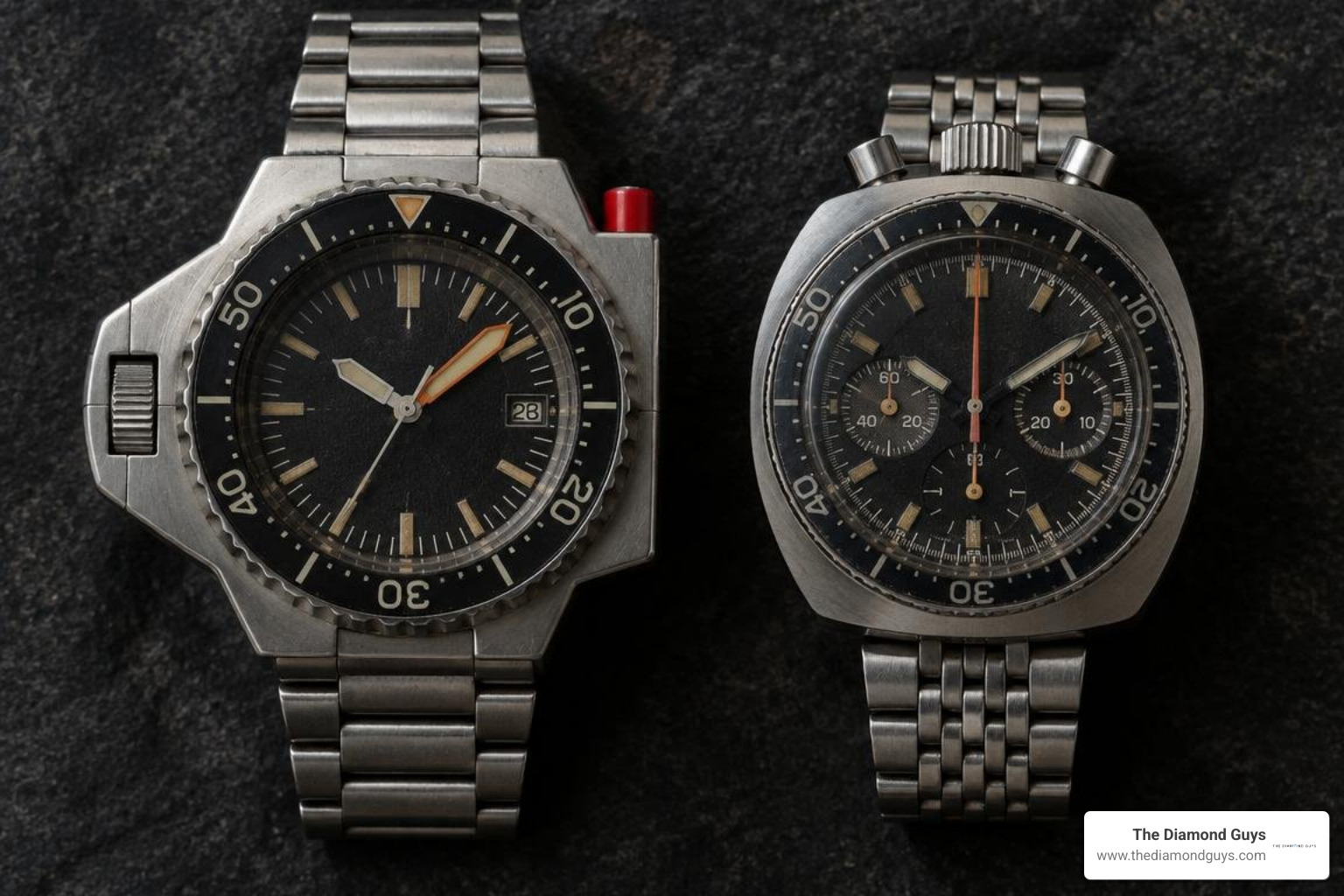
- The Ploprof 600 (Ref. 166.077): Developed in collaboration with COMEX and ocean explorer Jacques Cousteau, its name derives from plongeurs professionnels (professional divers). Featuring a massive monobloc steel case, a locking red bezel-release button, and an integrated crown-locking system, it completely prevented helium ingress.
- The "Bullhead" Chronograph (Ref. 146.011-69): Released in 1969, this uniquely shaped chronograph placed its crown and pushers at the top of the case (12 o'clock), flanked by an internal bezel crown at 6 o'clock, resembling a bull's horns.
- The Caliber 321 Chronographs: Prized chronographs like the 1959 solid 18k yellow gold Ref. 2872-62 used the legendary column-wheel Caliber 321—the exact mechanical caliber chosen by NASA for the Speedmaster.
- The "Soccer Timer" (Ref. 145.020): Tailored for sporting officials with a 45-minute sub-dial indicator.
- The "Darth Vader" & "Anakin Skywalker" (Ref. ST 145.023): Chunky 1970s chronographs housed in tungsted-carbide coated steel cases, featuring vibrant multi-colored dials.
Rare and Collectible Special Dial Variations
During the early 1960s, Omega recognized that the American market craved personal expression. To differentiate its watches from traditional flat dials, Omega introduced an array of textured, patterned, and geometric dial variations that remain coveted collector items today.
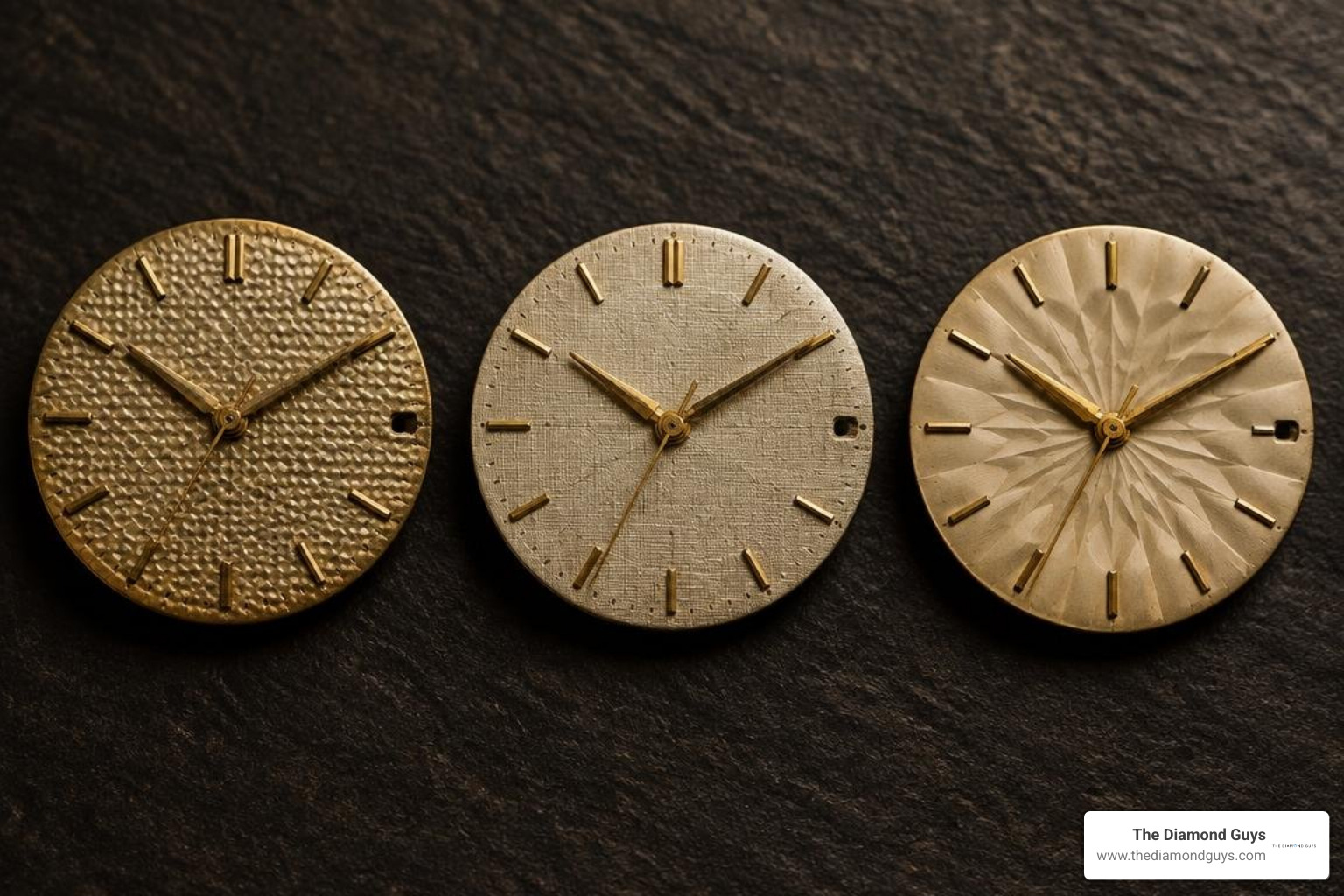
- Honeycomb / Waffle Dials: Found on early 1950s references such as the ref. 2577, ref. 2761, and bumper-wind ref. 2757. These feature a raised, multi-faceted grid texture that captures ambient light from sharp angles.
- Linen Dials: Identified on late 1950s and 1960s references such as the Ref. 14773-SC-61 and Seamaster De Ville dress pieces. The micro-hatched, woven texture offers a fabric-like appearance that masks minor age spots exceptionally well.
- Clamshell & Ribbon Motifs: Elegant Art Deco-inspired stamped geometric patterns that radiate across the dial surface.
- Technical & Companion Dials: Featured on models like the 1964 Seamaster 600 Ref. 135.011, incorporating high-contrast sector tracks and bold concentric minute divisions for rapid legibility.
- Stardust Patina Dials: Authentic aged lacquer dials featuring uniform micro-speckling across the dial surface, turning standard production models into unique one-of-a-kind art pieces.
The Coveted 'Don Draper' and Crosshair Vintage Omega Seamaster Dials
Few vintage watches have penetrated modern pop culture quite like the black-dial Seamaster worn by Jon Hamm's character in television's Mad Men. Known colloquially among horologists as the "Don Draper," this aesthetic is defined by a deep black crosshair dial, applied silver or gilt hour markers, and a sleek monocoque front-loading case.
Omega produced crosshair variations across standard Seamasters, the space-age Omega Seamaster Cosmic 166.023 (1960-1969), and the refined Omega Seamaster De Ville (1960-1969) line. The De Ville monocoque (unishell) case eliminated the traditional screw-in caseback entirely, loading the movement through the crystal bezel to minimize water ingress points.
When searching for verified luxury pieces, our curated selection of authentic pre-owned watches offers peace of mind against modified or poorly restored examples.
Identifying Original Dials vs. Redials and Refinishes
Due to the skyrocketing popularity of black dials and textured variants, the vintage market is flooded with refinished, repainted, or outright counterfeit dials ("redials"). A redial can strip 50% to 70% of a watch's market value.
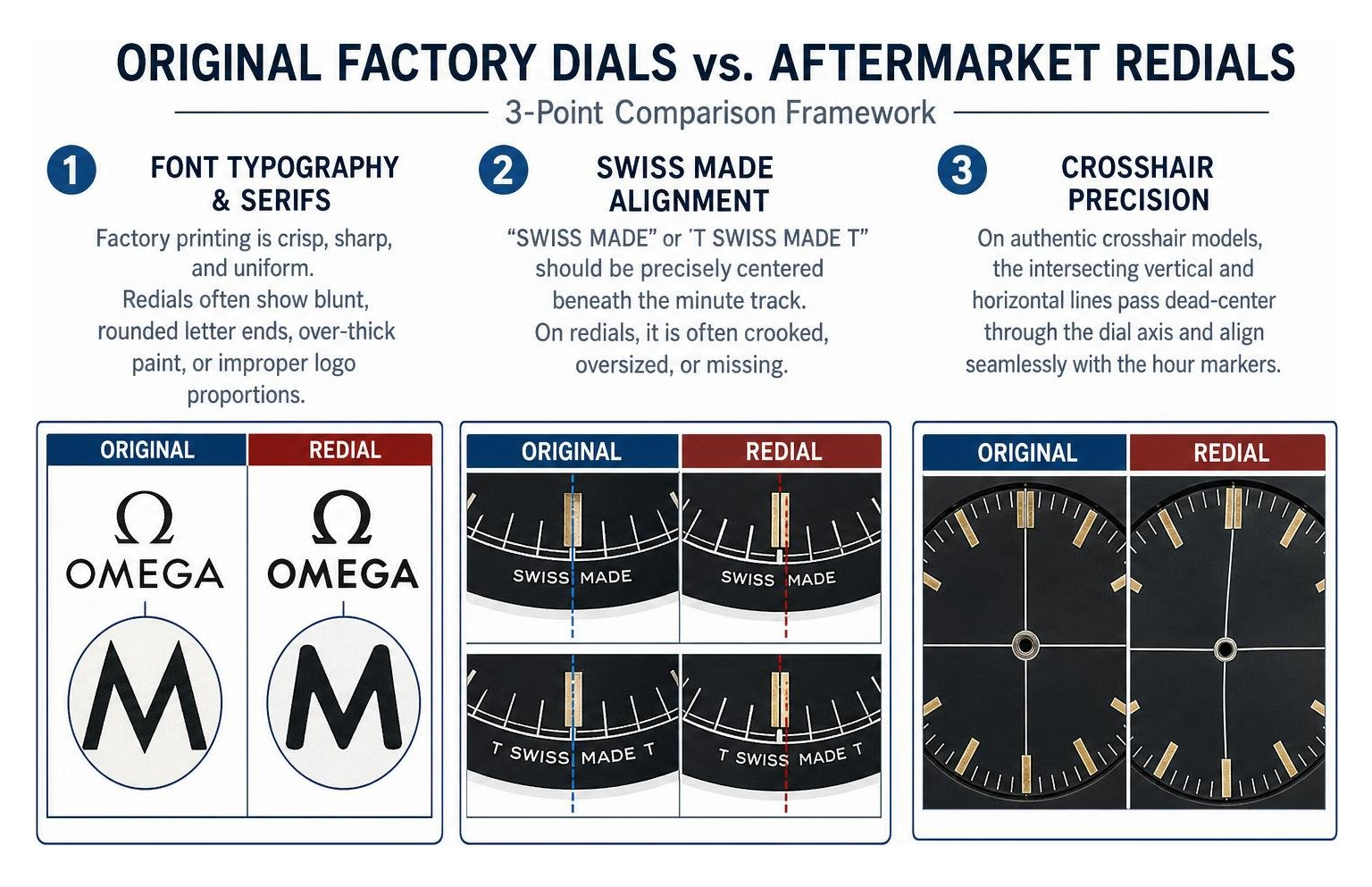
When assessing dial originality, we recommend examining four primary checkpoints:
- Font Typography and Serifs: Factory Omega printing is crisp, sharp, and uniform. Redials often show blunt, rounded letter ends on the "O-M-E-G-A" wordmark, an over-thick coat of paint, or an improperly proportioned Greek Omega letter logo.
- Swiss Made Alignment: Look closely at the 6 o'clock position. The text "SWISS MADE" or "T SWISS MADE T" (indicating tritium luminous paint) should sit precisely centered beneath the minute track. On repainted dials, this text is often crooked, oversized, or missing entirely.
- Crosshair Precision: On authentic crosshair models, the intersecting vertical and horizontal lines pass dead-center through the dial axis and align seamlessly with the hour markers.
- Dial Plate Reverse: Removing a dial during servicing reveals its bare brass or factory-coated backing. An authentic factory black dial will show consistent metal treatment on the reverse, whereas an aftermarket black redial often exhibits paint bleed or overspray along the dial edges.
Key Reference Numbers, Movements, and Materials
Vintage Seamaster cases were manufactured across three primary material configurations:
- Stainless Steel (ST): Durable, corrosion-resistant surgical steel cases manufactured by legendary Swiss case makers such as Huguenin Frères.
- Gold Cap / Gold Plated (CD / MD): A substantial sheet of 14k or 18k solid gold bonded over a robust steel core, offering the warmth of solid precious metal without the soft structural wear of hollow gold.
- Solid 14k & 18k Gold (BA / BB): Heavy precious metal executions found on dress references such as the ref. 2627 Calendar or the ref. 2872-62 chronograph.
Under the dial, Omega deployed mechanical movements that defined mid-century watchmaking:
- Bumper Automatics (Calibers 342, 351, 354): Used throughout the late 1940s and early 1950s, these early self-winding calibers utilized an oscillating weight that bounced between two spring-loaded shock bumpers rather than rotating 360 degrees.
- 500-Series Full-Rotor Automatics (Calibers 552, 562, 565): Considered by many watchmakers to be among the finest mass-produced mechanical calibers in history. The 24-jewel Caliber 552 (no-date) and Caliber 565 (date) feature swan-neck micro-regulators, copper-plated bridges, and an innovative quickset date mechanism activated by repeatedly pulling the crown into its outermost position.
- Manual Wind Calibers (Caliber 601): Slim, highly dependable hand-wound calibers powering classic 1960s references like the Seamaster 600.
| Reference | Production Era | Movement / Caliber | Case Material | Distinguishing Feature | Typical Price Range (USD) |
|---|---|---|---|---|---|
| Ref. CK 2577 | 1949–1954 | Cal. 351 / 354 Bumper Auto | Steel / Gold Cap | Pie-pan or Honeycomb dial, center seconds | $700 – $1,800 |
| Ref. CK 2913 | 1957–1961 | Cal. 501 Automatic | Stainless Steel | Seamaster 300 diver, Broad Arrow hands | $13,000 – $20,000 |
| Ref. 14755 | 1961–1963 | Cal. 552 Automatic | Stainless Steel | Seamaster 300 diver, straight baton hands | $8,500 – $11,000 |
| Ref. 165.024 | 1964–1969 | Cal. 552 Automatic | Stainless Steel | Seamaster 300 "Big Triangle", twisted lugs | $4,500 – $7,500 |
| Ref. 166.010 | 1962–1969 | Cal. 565 Automatic | Steel / Gold Cap | Classic 35mm date, quickset date | $750 – $1,400 |
| Ref. 166.067 | 1969–1975 | Cal. 565 Automatic | Stainless Steel | Tonneau C-shape case, chunky lugs | $650 – $1,200 |
| Ref. 146.011 | 1969–1972 | Cal. 930 Manual | Stainless Steel | Bullhead chronograph, 12 o'clock crown | $8,500 – $10,500 |
| Ref. 166.077 | 1970–1975 | Cal. 1002 Automatic | Stainless Steel | Ploprof 600, monobloc case, red lock | $7,500 – $9,000 |
As styles evolved into the early 1970s, traditional round cases gave way to tonneau profiles, such as the Omega Seamaster 166.067 (1971), reflecting the era's taste for bold wrist presence.
Evaluating Condition for an Entry-Level or Investment-Grade Vintage Omega Seamaster
Condition trumps everything in vintage horology. An unpolished case with honest micro-scratches is consistently more desirable than an over-polished case that has lost its sharp lug chamfers and factory satin brushing.
Check for the presence of an original signed stainless steel "beads-of-rice" bracelet (such as ref. 1502 or 1503 with correct end-links), as purchasing one separately can cost several hundred dollars. When reviewing mechanical health, a watch running on a modern timegrapher should display a strong balance amplitude (ideally 260° to 300°) and maintain an accuracy within +/- 15 seconds per day. Those interested in learning how restoration affects vintage integrity can read our overview on men's refurbished watches.
Essential Buying Guide: Pricing, Market Value, and Avoiding Scams
Navigating the vintage watch market requires a clear understanding of current market benchmarks. As of 2026, the market presents distinct entry, mid-tier, and high-end investment brackets:
- Entry-Level ($500 – $900): Clean stainless steel manual-wind models (Cal. 601), quartz models from the late 1970s and 1980s (like the Seamaster Mariner or Polaris), and entry-level bumper automatics like the Omega Seamaster 166.010 (1960-1969).
- Mid-Tier Collectibles ($1,200 – $3,500): Factory original textured dials, such as a 1958 Linen Dial Ref. 14773 ($1,500), specialized technical dials like the 1964 Seamaster 600 Ref. 135.011 ($3,400), or clean vintage Omega Seamaster 35mm stainless steel models featuring original beads-of-rice bracelets.
- Specialized & Cult Tool Watches ($6,500 – $10,000): The Seamaster Chronograph ST 145.023 "Darth Vader" (~$7,000), 1959 Caliber 321 Solid 18k Chronograph Ref. 2872-62 ($7,750), Seamaster 600 Ploprof Ref. 166.077 (~$7,900), and the 1969 Bullhead Ref. 146.011 (~$9,500).
- Blue-Chip Grails ($10,000 – $20,000+): The original 1957 Seamaster 300 CK 2913 ($13,000 to $20,000) and transitional Ref. 14755 dive watches (~$10,000).
The primary risk in vintage shopping is encountering "frankenwatches"—timepieces assembled from mismatched Omega parts. Common traps include non-waterproof Geneve movements dropped into Seamaster cases, incorrect service replacement hands, or modern aftermarket bezels on vintage Seamaster 300 divers. Always demand high-resolution movement photographs to cross-reference the 8-digit movement serial number with the reference number stamped inside the caseback.
Frequently Asked Questions About the Vintage Omega Seamaster
What is the current market price range for a vintage Omega Seamaster?
In 2026, market pricing spans from approximately $500 for entry-level dress references and 1970s quartz pieces up to $20,000 for rare first-generation 1957 Seamaster 300 divers (CK 2913). Most high-grade automatic dress references from the 1960s with clean, original dials trade comfortably between $900 and $2,500.
How do I verify if a vintage Seamaster dial is authentic or redialed?
Examine the dial under 10x magnification. Factory dials display sharp, even typography, thin and uniform minute track hashes, and precise alignment between the logo, crosshair lines, and hour indices. Paint bleeding near marker edges, missing "Swiss Made" designations, or an uneven glossy finish are telltale signs of an aftermarket redial.
What are the best vintage Seamaster references for beginner collectors?
The reference 166.010 and reference 165.002 from the 1960s are widely regarded as the best entry points. Powered by the legendary Caliber 552 or quickset Caliber 565 movements, they offer bulletproof reliability, classic 34mm–35mm proportions, easily sourced service parts, and approachable pricing under $1,200.
Conclusion
The vintage Omega Seamaster remains one of the most rewarding avenues in modern horology. It effortlessly bridges the gap between historical significance, daily mechanical reliability, and timeless mid-century aesthetic appeal. Whether your heart is set on an entry-level 1960s linen dial, a space-age Cosmic, or a grail-level Seamaster 300 diver, prioritizing dial originality and mechanical health guarantees a piece that will hold both sentimental and monetary value for decades to come.
At The Diamond Guys, we bring decades of jewelry and timepiece expertise to collectors across Scottsdale, Phoenix, and beyond. Whether you are searching for your next heirloom piece or seeking expert guidance on fine jewelry and watches, we invite you to browse our curated pre-owned luxury watch collection and discover the exceptional craftsmanship of authentic mechanical watchmaking.


