

Heart Shape Lab Diamonds That Steal the Spotlight
Choose a Heart Shape Lab Diamond With Confidence
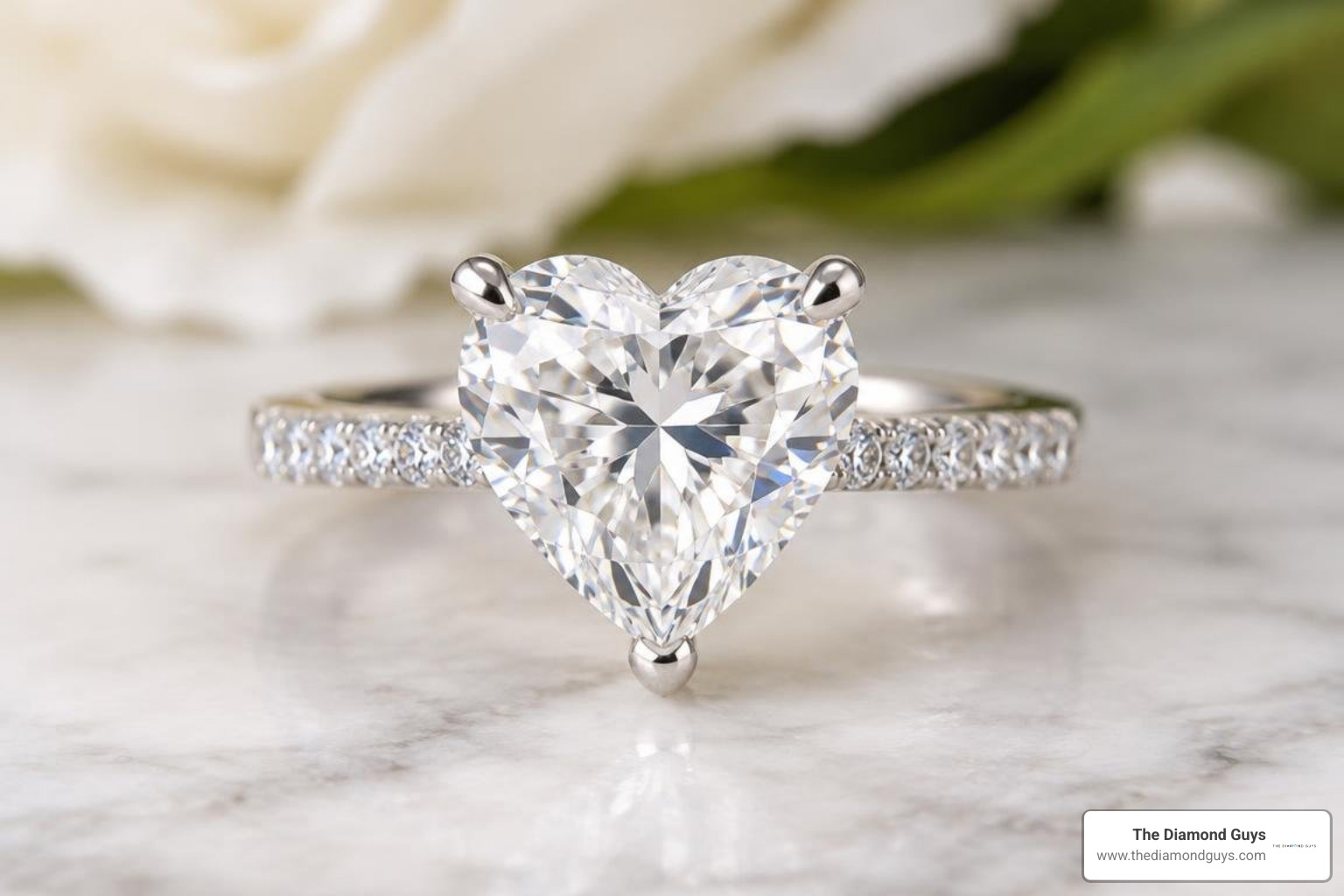
A heart shape lab diamond is a smart choice when you want a romantic, unmistakable design without giving up the beauty or durability of diamond. Choose one with balanced lobes, a crisp point, and a centered cleft; then prioritize an independent grading report, eye-clean clarity, and a setting that protects the pointed tip.
Heart cuts are among the most expressive fancy diamond shapes. Because lab-grown diamonds have the same chemical and physical makeup as mined diamonds, they offer the same sparkle and everyday strength. They also commonly cost less than a comparable mined heart diamond, which can leave more room in the budget for carat weight, a higher color grade, or a custom setting.
The details matter more in a heart cut than in many shapes. Small symmetry issues can be easy to spot, so this guide will help you compare stones beyond the basic 4Cs and find a diamond that looks beautiful from every angle.
I'm Morgan Price, a white-hat outreach specialist who researches fine-jewelry topics and helps create clear, useful resources for buyers. My work on heart shape lab diamond content focuses on transparent quality signals, trustworthy sourcing, and the details shoppers need before making a major purchase.
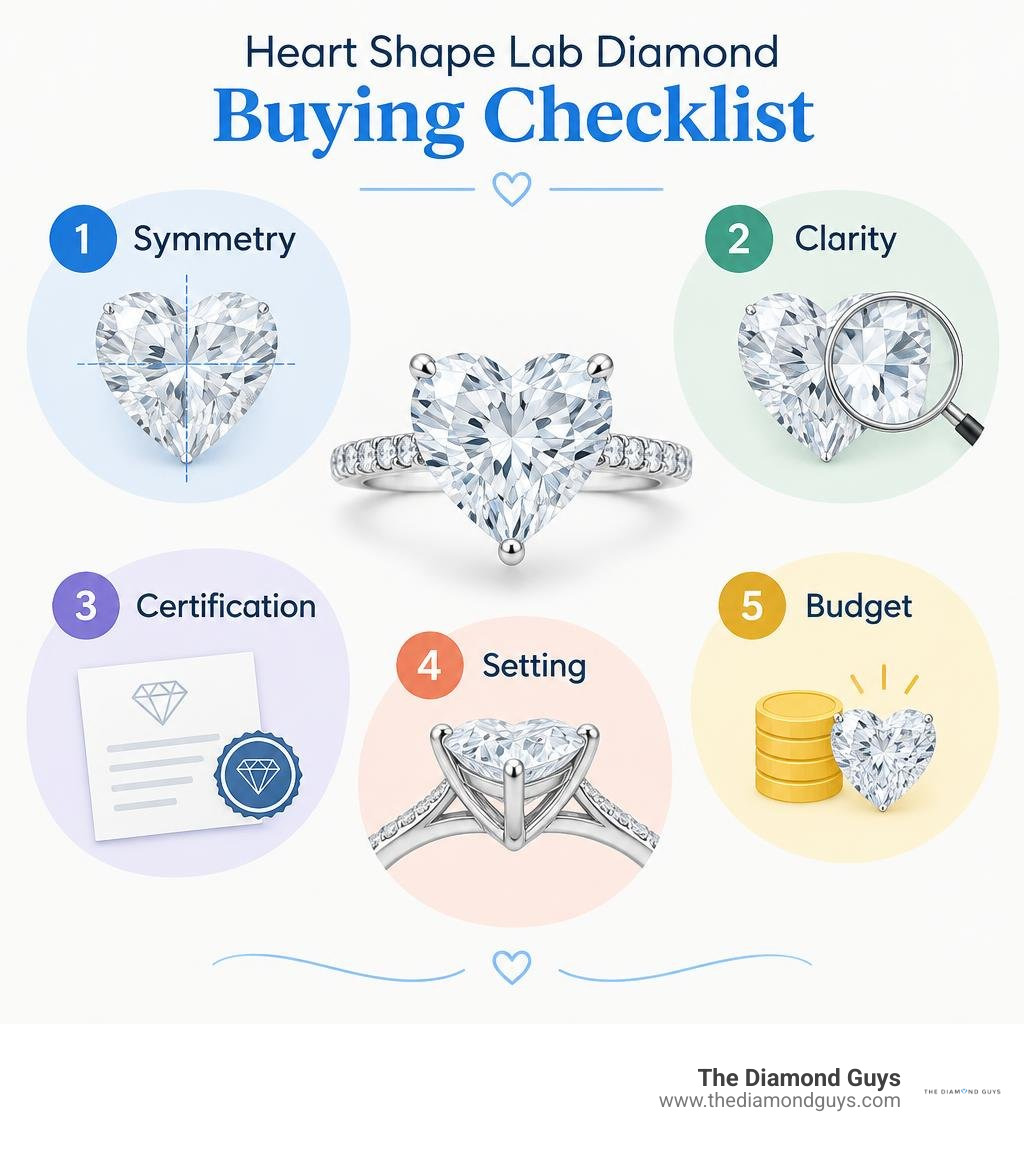
Easy heart shape lab diamond word list:
The Allure, Science, and Symbolism of Heart-Cut Diamonds
The heart cut holds a legendary place in jewelry history, with roots tracing back to royalty in the 15th and 16th centuries. Historically given as tokens of friendship, loyalty, and deep devotion, the shape remains one of the most unapologetically romantic choices available. Heart-shaped diamonds are consistently among the top five most popular fancy diamond cuts, representing roughly 5% of all diamond engagement ring purchases.
Modern laboratory diamond synthesis has transformed how these intricate stones are created. Today, master gemologists cultivate diamonds using two sophisticated methods:
- Chemical Vapor Deposition (CVD): A tiny diamond seed is placed in a vacuum chamber filled with carbon-rich gases. When heated, the gas molecules break down, allowing pure carbon atoms to layer upon the seed crystal lattice by lattice.
- High Pressure High Temperature (HPHT): This method replicates the extreme geological conditions beneath the Earth’s mantle, subjecting carbon to intense pressures (over 1.5 million pounds per square inch) and temperatures exceeding 2,000°F.
When comparing lab diamonds vs real diamonds, it is essential to understand that lab-created stones are real diamonds. They feature a 100% identical physical, optical, and chemical composition to mined diamonds. Both register a 10 on the Mohs hardness scale, contain identical refractive indices, and display the same fire, brilliance, and scintillation. For broader context on how these stones are classified, the diamond entry provides a useful scientific overview of carbon crystal structure and gemological properties.
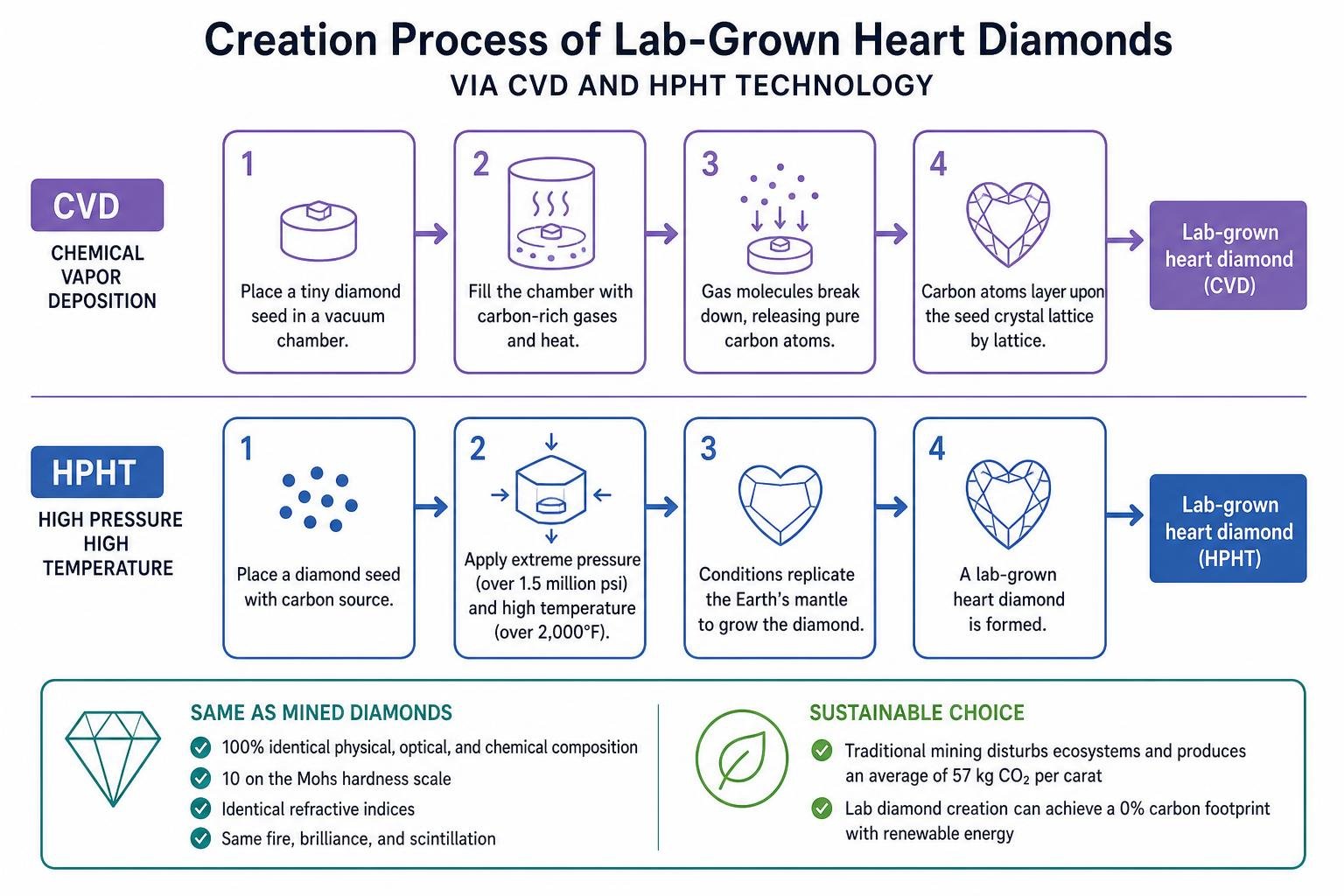
Beyond structural equality, lab-created gems offer distinct environmental benefits. While traditional diamond mining disturbs delicate ecosystems and produces an average of 57 kg of CO2 per carat, modern lab diamond creation can achieve a 0% carbon footprint when powered by renewable energy sources. Furthermore, the global lab-grown diamond market is on track to reach $49.9 billion by 2030, expanding at a compound annual growth rate (CAGR) of 9.4% as shoppers embrace modern innovation.
Comparing Lab-Grown vs. Mined Heart Diamonds
| Feature | Lab-Grown Heart Diamond | Mined Heart Diamond |
|---|---|---|
| Chemical Structure | 100% Pure Carbon Crystal | 100% Pure Carbon Crystal |
| Mohs Hardness | 10 (Maximum Durability) | 10 (Maximum Durability) |
| Optical Performance | Exceptional Brilliance & Fire | Exceptional Brilliance & Fire |
| Average Cost Difference | 30% to 40% Lower Cost | Premium Pricing |
| Carbon Footprint | Up to 0% (with renewable energy) | ~57 kg CO2 per carat |
| Grading Standards | Certified by IGI & GIA | Certified by GIA & IGI |
How to Choose a Quality Heart Shape Lab Diamond
Selecting a fancy cut requires a keener eye than shopping for a standard round brilliant. Because heart cuts feature complex facets and irregular contours, knowing how cut, color, clarity, and carat weight interact ensures your stone performs at its absolute best.
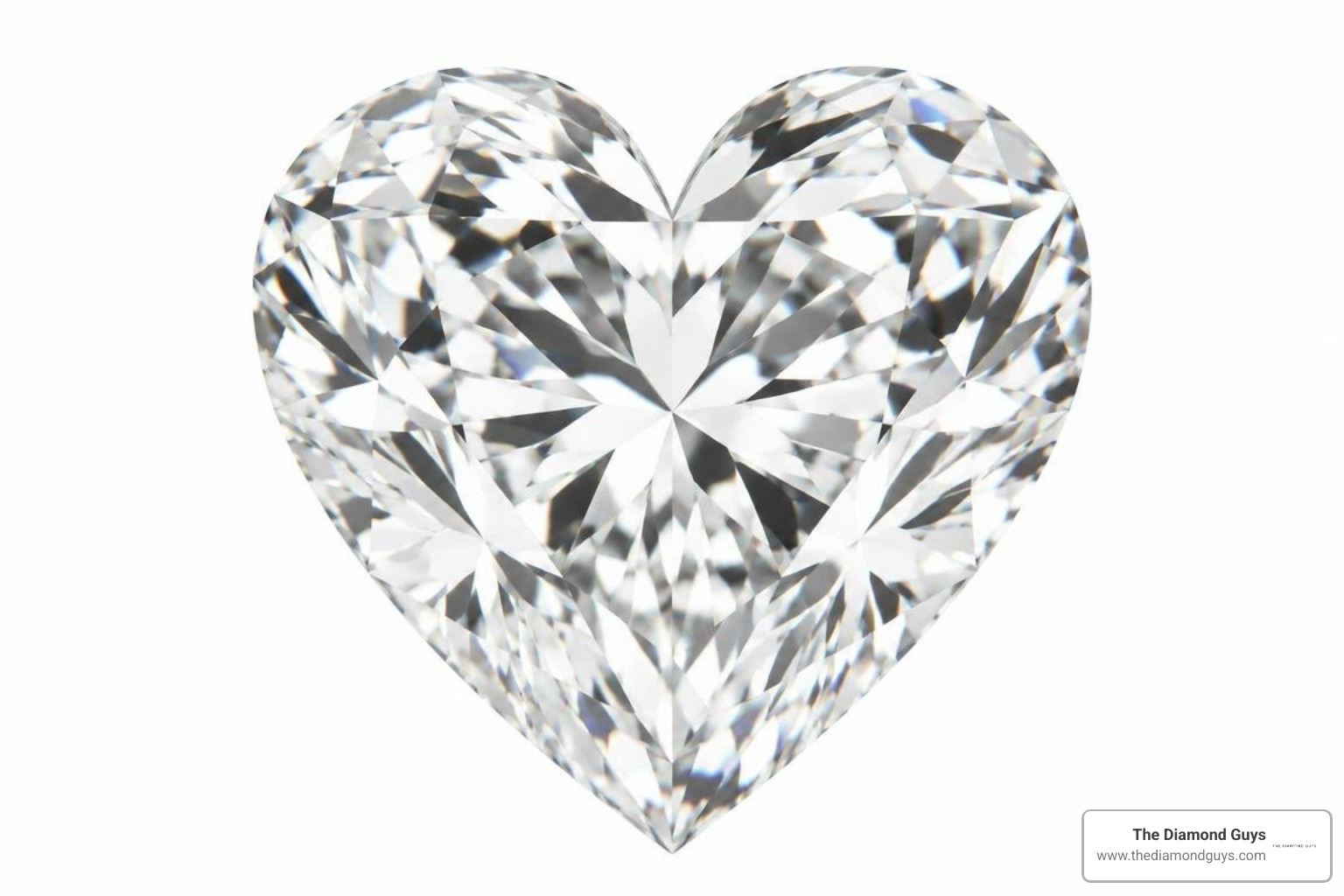
- Cut Quality: Cut determines how effectively a stone reflects light. In heart cuts, an expertly faceted pavilion ensures light does not leak through the bottom of the gem, keeping the center bright and lively.
- Color Grade: Fancy shapes tend to show body color toward the pointed tip and edges. For an icy white appearance in white gold or platinum, opt for a color grade of F, G, or H. When setting your stone in yellow or rose gold, I or J colors provide a warm, appealing glow without sacrificing brilliance.
- Clarity Considerations: Because heart shapes feature a modified brilliant facet pattern, they camouflage minor internal inclusions effectively. Selecting an eye-clean VS1, VS2, or SI1 clarity grade allows you to maximize your budget without visible imperfections.
- Carat Weight Impact: The intricate outline of a heart diamond is most distinct in larger carat sizes. Below 0.50 carats, the cleft and lobes can lose their defined shape from a distance. Stones of 1.00 carat or larger provide the surface area needed for the silhouette to stand out clearly.
Anatomy and Symmetry of a Heart Shape Lab Diamond
A masterfully cut heart diamond relies on exact geometric proportions. When inspecting a stone, evaluate its individual anatomical components:
- The Cleft: The sharp, inward indentation at the top. The cleft should be distinct, sharp, and centered directly above the point.
- The Lobes: The two rounded upper sections. Both lobes should be symmetrical in height, curvature, and volume.
- The Belly: The gentle outer curve of the sides. It should flow naturally from the lobes without bulging outward or appearing flat.
- The Wings: The tapering edges leading down to the bottom point. Straight or slightly rounded wings maintain an elegant contour.
- The Point: The sharp bottom tip. It must align precisely with the central cleft.
- Length-to-Width Ratio: The industry benchmark for a traditional, balanced heart shape is a 1.00:1 ratio (acceptable range: 0.95 to 1.05). Ratios below 0.90 create a wide, squat appearance, while ratios above 1.10 result in a narrow, elongated stone.
Certification and Quality Verification
Never buy a diamond without independent grading documentation. World-recognized institutions like the International Gemological Institute (IGI) and the Gemological Institute of America (GIA) grade lab-grown diamonds with the same scrutiny applied to mined gems.
Independent certificates detail the 4Cs, exact millimeter dimensions, symmetry ratings, and Polish grades. Reputable laboratories also use microscopic lasers to inscribe the unique certificate number directly onto the diamond's girdle. This micro-inscription ensures that the stone you purchase corresponds with its official grading dossier.
Top Ring Styles and Jewelry Designs for Heart Diamonds
Whether set in modern minimalist mountings or vintage-inspired halos, heart-cut diamonds pair well with a wide range of jewelry styles. At The Diamond Guys, we work closely with clients across our Scottsdale and Phoenix, AZ locations to design bespoke lab created diamond engagement rings that protect the diamond while accentuating its unique shape.
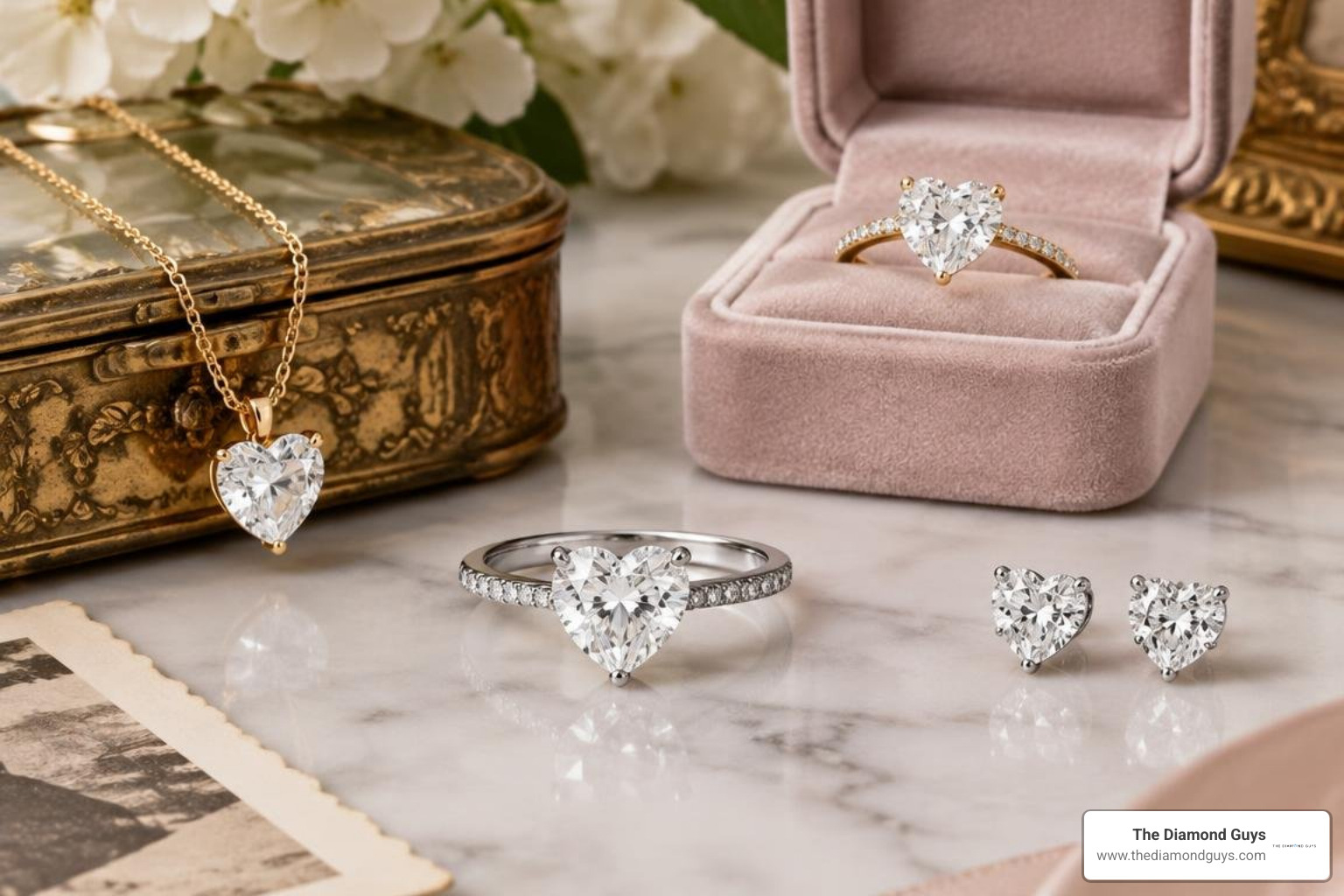
When selecting a setting, prong configuration is essential:
- V-Prong Protection: The vulnerable bottom tip of a heart cut should always be sheltered with a protective V-shaped prong or chevron claw to safeguard it against accidental strikes.
- Three-to-Five Prong Mountings: A three-prong setting (one V-prong at the point, two prongs on the lobes) keeps the profile airy, while a five-prong mounting offers maximum security for active lifestyles.
- Halo Settings: Encircling the center stone with small round pavé diamonds accentuates the heart silhouette and adds noticeable sparkle.
Popular Jewelry Settings for a Heart Shape Lab Diamond
Heart-cut lab diamonds shine across a variety of timeless fine jewelry designs:
- The Classic Solitaire: A 1 carat heart-shaped diamond solitaire ring showcases the diamond's silhouette on a plain, polished band, letting the shape take center stage.
- The Modern Bezel: For a sleek, contemporary look with optimal edge protection, a bezel set heart necklace encases the stone in a continuous rim of precious metal.
- The Classic Pendant: A 14k yellow gold laboratory grown heart shaped diamond pendant provides a warm contrast against the icy white diamond, making it an ideal gift for anniversaries or milestones.
- Three-Stone Mountings: Flanking a central heart diamond with tapered baguettes, pear shapes, or round brilliant side stones creates a balanced, multi-dimensional look.
Common Misconceptions About Lab-Grown Fancy Shapes
Despite the rising popularity of lab-created diamonds, a few common myths persist:
-
Myth 1: "Lab diamonds are synthetic imitations like cubic zirconia or moissanite."
Fact: Lab diamonds are not imitations. Cubic zirconia and moissanite are entirely different minerals with different optical and physical properties. Lab diamonds are 100% pure carbon crystals with the identical refractive index (2.42) and dispersion (0.044) of mined diamonds. -
Myth 2: "Lab-grown fancy cuts are more fragile."
Fact: Lab diamonds possess an identical crystal lattice, rating a 10 on the Mohs hardness scale. They are just as resistant to scratching and daily wear as mined gems. -
Myth 3: "You can tell a lab diamond by looking at it with a jeweler's loupe."
Fact: Even experienced gemologists cannot distinguish a lab diamond from a mined diamond using standard magnification. Advanced spectroscopic equipment is required to detect the specialized growth patterns of lab-created stones.
Frequently Asked Questions About Heart Shape Diamonds
Are heart shape lab diamonds as durable as mined diamonds?
Yes. Both lab-grown and mined heart diamonds share the exact same crystal structure, earning a top rating of 10 on the Mohs hardness scale. They are impervious to everyday scratches from items like keys, glass, or steel. Because the bottom point of any heart cut is narrow, we recommend using a protective V-prong or full bezel setting to keep the tip secure during daily activities.
What is the ideal length-to-width ratio for a heart diamond?
A classic length-to-width ratio of 1.00:1 produces a balanced heart shape that is neither too wide nor overly narrow. Ratios between 0.95:1 and 1.05:1 remain within the ideal aesthetic range, allowing personal preferences for slightly wider or slimmer silhouettes.
How much do heart shape lab diamonds cost compared to natural stones?
Heart-shaped lab diamonds are typically 30% to 40% less expensive than their mined counterparts of equivalent carat weight, color, and clarity. This price advantage allows buyers to invest in larger carat weights, higher clarity grades, or custom metalwork without exceeding their budget.
Conclusion
A heart-shaped diamond combines romance, precision cutting, and distinctive personal style. By choosing a lab-grown stone, you benefit from the same durability and brilliance as a mined diamond while taking advantage of modern pricing and sustainable creation methods. Focus on balanced symmetry, an eye-clean clarity grade, and a protective mounting to ensure your piece looks stunning for decades to come.
As a 5-star rated jeweler serving Scottsdale and Phoenix, AZ, The Diamond Guys specializes in personalized, pressure-free consultations and custom diamond creations. Whether you are searching for custom lab-grown diamond engagement rings in Scottsdale or want to browse fine diamond jewelry, our expert team is here to help. For more details on choosing the perfect stone, explore our complete lab diamond jewelry store guide.


