

Finding an Ethical Diamond Specialist for Your Next Fine Piece
Key Standards Defining Diamond Store Ethical Practices
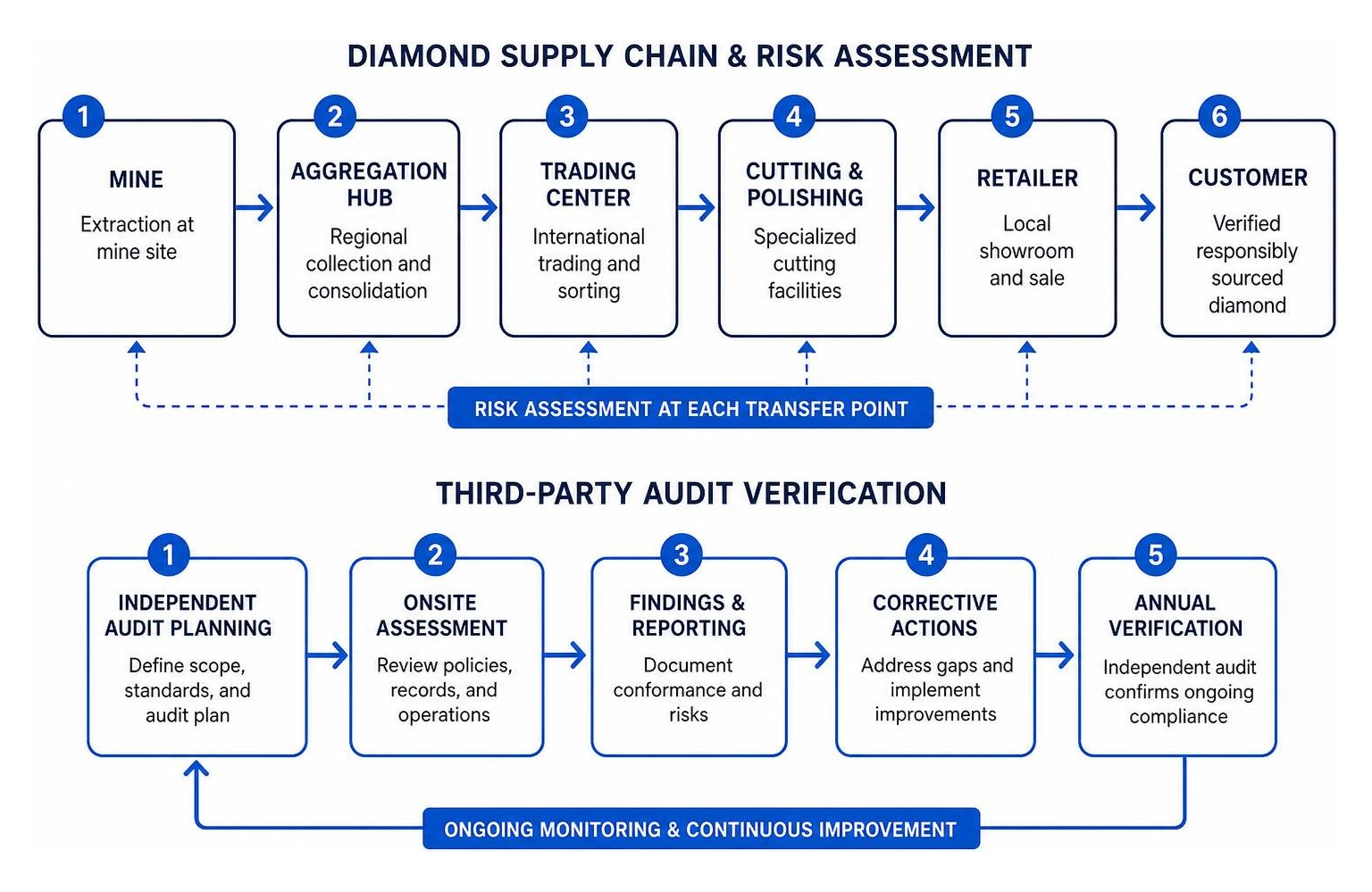
Evaluating diamond store ethical practices requires looking past clever marketing language and examining whether a jeweler strictly adheres to established international frameworks. Responsible sourcing is not an abstract feeling; it is grounded in concrete operational standards designed to track gemstones across a multi-stage global supply chain.
A standard diamond journey spans several international borders. It moves from initial extraction at a mine site to regional aggregation hubs, then through global trading centers, to specialized cutting facilities (over 70% of gem-quality diamonds are cut and polished in India), and finally to local retail showrooms. At every transfer point, stones from different origins risk being mixed together.
To prevent illicit or unethical stones from entering the market, reputable retailers align their operations with the OECD Due Diligence Guidance for Responsible Supply Chains of Minerals from Conflict-Affected and High-Risk Areas. This framework requires businesses to maintain a clear chain of custody, conduct risk assessments, and establish protocols for suspending non-compliant suppliers. Leading industry players also enforce robust corporate standards, such as the De Beers Responsible and Ethical Sourcing Policy for Diamonds, which mandates annual independent third-party audits to verify that suppliers respect human rights and environmental regulations.
Primary Human Rights Issues Addressed by Diamond Store Ethical Practices
The primary reason rigorous standards exist is the persistent human rights risk within unmonitored supply chains. Historically, the most severe abuses occur in artisanal and small-scale mining (ASM) environments, which account for roughly 20% of the world's gem-quality natural diamonds. Unlike large-scale industrial operations, artisanal mining relies on manual labor, where workers dig pits and wash gravel using hand tools.
Key human rights violations addressed by rigorous ethical sourcing protocols include:
- Child Labor: An estimated one million or more children work globally in artisanal mining, performing hazardous tasks like digging deep shafts or handling toxic chemicals instead of attending school.
- Forced Labor and Human Trafficking: Vulnerable workers in low-income or conflict-affected regions are often trapped in debt bondage or forced into dangerous labor under threat of violence.
- Hazardous Working Conditions: Unregulated artisanal mines frequently lack proper safety gear, pit stabilization, or clean water, leading to tunnel collapses and severe respiratory or physical injuries.
Retailers dedicated to ethical standards demand documented proof that their suppliers provide safe working environments, pay fair living wages, and maintain zero tolerance for forced or child labor. If you are exploring customized designs, reviewing our Custom Ethical Engagement Rings Guide 2026 offers deeper context on choosing verified materials.
Limitations of the Kimberley Process Certification
Many jewelers assure customers that their stones are ethical simply because they are "Kimberley Process certified." However, relying solely on the Kimberley Process (KP) is a major red flag when evaluating diamond store ethical practices.
Established in 2003, the Kimberley Process Certification Scheme was created to eliminate "blood diamonds"—specifically defined as rough diamonds used by violent rebel movements to finance conflict against legitimate governments. While the KP successfully curtailed these specific rebel group revenues, its narrow legal definition leaves massive loopholes:
- Ignores State and Security Violence: The KP definition of a conflict diamond only applies to non-state rebel groups. It does not cover human rights abuses committed by state governments, local police, or private security forces at mine sites.
- Excludes Polished Stones: The KP certificate only applies to rough diamond shipments entering or leaving a country. Once a diamond is cut and polished, KP tracking ends, making it impossible to trace the stone's original mine through KP paperwork alone.
- Omits Labor and Environmental Abuses: Issues such as child labor, wage exploitation, toxic land runoff, and land rights violations are completely outside the scope of the Kimberley Process mandate.
Because the Kimberley Process represents only a legal baseline rather than a complete ethical guarantee, trusted jewelers go far beyond it by enforcing independent auditing and comprehensive mine-to-market traceability.
Comparing Mined, Lab-Grown, and Recycled Diamonds
To make an informed purchase, shoppers must understand the ethical and environmental tradeoffs among natural mined diamonds, lab-grown diamonds, and recycled diamonds. Each option offers distinct features depending on your personal priorities.
| Feature / Criteria | Mined Natural Diamonds | Lab-Grown Diamonds | Recycled Diamonds |
|---|---|---|---|
| Origin Source | Deep earth mantle extraction | Technological synthesis (HPHT/CVD) | Upcycled vintage/estate pieces |
| Human Rights Risk | Moderate to high (requires strict auditing) | Zero risk of mining abuse | Zero risk of new mining abuse |
| Land Degradation | Significant excavational impact | Zero land excavation | Zero land excavation |
| Carbon Footprint | Variable based on mine fuel use | Dependent on local energy grid | Lowest overall environmental impact |
| Supply Chain Traceability | High if tracked; difficult if uncertified | 100% traceable to lab facility | Origin traced to secondary market |
| Relative Cost | Premium (natural scarcity value) | 60%–80% lower initial retail cost | Value-focused pre-owned pricing |
Ethical Impact of Mined Diamonds
Natural diamonds carry deep historical and cultural value. When responsibly extracted, large-scale industrial diamond mining generates substantial tax revenues, funds public healthcare, builds regional infrastructure, and provides employment in nations like Botswana and Canada.
However, the natural diamond sector also carries continuous ethical responsibilities. Open-pit mining alters large tracts of land, requiring environmental rehabilitation to protect local biodiversity. Furthermore, in regions dependent on artisanal mining, low pay and lack of worker protections remain persistent risks unless retailers proactively partner with audited mine sites that pay living wages. Jewelers who specialize in natural stones must demonstrate active oversight over their supply network to ensure their inventory supports local communities safely. For a deeper look into natural options, read our Natural Diamond Jewelry Complete Guide.
Sustainability of Lab-Grown and Recycled Diamonds
For buyers seeking to avoid geological extraction entirely, modern options provide sustainable alternatives:
- Lab-Grown Diamonds: Created using High Pressure High Temperature (HPHT) or Chemical Vapor Deposition (CVD) technologies, lab-grown diamonds possess the exact chemical, physical, and optical properties of mined diamonds. They completely eliminate land displacement and artisanal labor risks. However, prospective buyers should ask whether a lab facility utilizes clean, renewable energy, as diamond synthesis requires high electricity inputs. Learn more about these stones in our guide on Lab Grown Diamonds vs Real Diamonds.
- Recycled Diamonds: Recycled diamonds represent the ultimate circular economy choice. These are pre-owned natural stones that have been repurposed from vintage jewelry or estate collections. They require zero new mining, produce no new carbon emissions, and leave no fresh environmental footprint.
Local shoppers searching for sustainable options in the Southwest can explore our curated local insights on Ethical Diamonds Phoenix Area.
Essential Retailer Actions to Guarantee Supply Chain Integrity
A retail jewelry store cannot claim to practice ethical sourcing based on trust alone. Responsible businesses implement specific structural actions to guarantee supply chain integrity from origin to showroom.

To offer true transparency, jewelers must work closely with midstream cutting and polishing operations. Because over 70% of gem-quality diamonds are polished in specialized hubs in India, ethical jewelers require their polishing partners to submit to annual third-party labor and safety audits. Furthermore, individual polished diamonds receive microscopic laser inscriptions on their girdles, linking the finished stone directly to its physical grading certificate and origin batch.
Blockchain Traceability and Mine-to-Market Tracking
The modern gold standard for proving origin is digital mine-to-market tracking powered by blockchain technology. By recording every transaction on an unalterable digital ledger—from the moment a rough diamond leaves the mine head, through the cutting wheel in India, to its final custom setting—jewelers eliminate the possibility of untraced stones being secretly introduced into a parcel.
Retailers who prioritize transparency make these digital provenance passports available to their clients, allowing buyers to verify the exact path their center stone took. If you are looking for localized artisan crafting that values transparent sourcing, check out our guide on Phoenix Ethical Ring Makers.
Supporting Artisanal Mining Communities
Rather than completely boycotting natural diamonds from developing regions, forward-thinking retailers support responsible development initiatives in artisanal mining regions. Because artisanal mines supply nearly 20% of gem-quality diamonds and employ millions of low-income workers, simply walking away can harm vulnerable local economies.
Ethical stores support artisanal communities by:
- Sourcing from Fairtrade or Development Diamond Initiative (DDI) certified small-scale cooperatives.
- Ensuring miners receive direct, unexploited market access and fair cash payments.
- Investing in clean water projects, local schools, and safety training in regional mining districts.
How Consumers Can Evaluate Retail Integrity
When you walk into a jewelry showroom or browse online, evaluating diamond store ethical practices comes down to asking the right questions and demanding documented proof.
Always ask staff to explain their sourcing policies in detail. Reputable specialists welcome these questions and will readily present third-party compliance documents rather than giving vague, rehearsed responses.
Actionable Consumer Checklist for Verifying Diamond Store Ethical Practices
Use this quick verification checklist before purchasing your fine jewelry piece:
- Written Ethical Policy: Does the store publish a clear, accessible supply chain code of conduct?
- Third-Party Certifications: Is the jeweler certified by recognized independent bodies like the Responsible Jewellery Council (RJC), or do their stones come from facilities audited under De Beers Best Practice Principles (BPP)?
- Origin Documentation: Can the store provide origin documentation (such as a country-of-origin report or blockchain certificate) for natural center stones?
- Independent Lab Grading: Are lab-grown and natural diamonds graded by respected, objective laboratories like the Gemological Institute of America (GIA) or International Gemological Institute? Read our detailed guide on IGI Certified Lab Diamonds to understand these reports.
- Recycled Precious Metals: Does the store use 100% recycled gold or platinum for their ring settings to reduce new precious metal mining?
Balancing Affordability with Responsible Sourcing
A common misconception is that ethically sourced jewelry is cost-prohibitive. In reality, jewelers can maintain strict ethical standards across a wide variety of price points through efficient sourcing models.
By sourcing directly from primary suppliers and primary diamond growers rather than middleman dealers, independent specialists eliminate unnecessary markups. Additionally, choosing lab-grown diamonds allows budget-conscious buyers to maximize their ring's carat size and clarity while maintaining flawless ethical origin. To see how far your budget can go with lab-created options, explore our complete 2ct Lab Diamond Complete Guide.
Frequently Asked Questions About Responsible Diamond Sourcing
What does conflict-free mean when buying a diamond ring?
In standard industry terminology, "conflict-free" means a diamond was traded in compliance with the Kimberley Process, certifying that it did not fund non-state rebel armies attempting to overthrow a legitimate government. However, modern ethical jewelers define conflict-free far more broadly: to them, it means a gemstone is completely free from severe human rights abuses, direct state violence, forced child labor, and destructive environmental exploitation.
Are lab-grown diamonds more ethical than natural diamonds?
Lab-grown diamonds eliminate land excavation, physical open-pit mining, and the human rights risks historically associated with unmonitored artisanal mining. This makes their origin 100% traceable and conflict-free from day one. However, producing lab diamonds requires high amounts of thermal energy. To ensure maximum environmental sustainability, look for lab diamonds produced in facilities powered by renewable energy sources like solar or hydropower.
How can I verify that a local diamond store follows ethical sourcing practices?
To verify a local store's practices, ask to see their written supply chain policy and inquire whether their natural diamonds come with origin-tracing documentation or independent third-party audit credentials (such as RJC certification). Check if they offer lab-grown diamonds from verified renewable-energy facilities or utilize recycled precious metals for custom ring mountings. Clear, direct answers and full documentation demonstrate a store's genuine commitment to ethical standards.
Conclusion: Finding Your Trusted Ethical Fine Jewelry Specialist
Selecting an engagement ring or fine jewelry piece is one of the most personal purchases you will ever make. Knowing that your heirloom was crafted with respect for human rights and environmental care makes the piece even more meaningful.
At The Diamond Guys, we believe that luxury fine jewelry should never come at the expense of our global community. Operating as a trusted, 5-star rated jewelry specialist in Scottsdale, AZ, and Los Angeles, CA, we specialize in custom engagement rings, certified natural diamonds, and premium lab-grown options.
Our core difference lies in our hands-on expert guidance, total supply chain transparency, and personalized shopping environment—giving you complete confidence at every step. Whether you are seeking a rare natural diamond with verified provenance or designing a modern lab-grown masterpiece, we are here to help you select a piece you will feel proud to wear forever. Visit our showroom or connect with our specialists today to bring your custom fine jewelry vision to life.


