

Explore the Massive Gems That Dominate the Natural Diamond Record Books
The Largest Natural Diamonds, Ranked by Record and Rarity
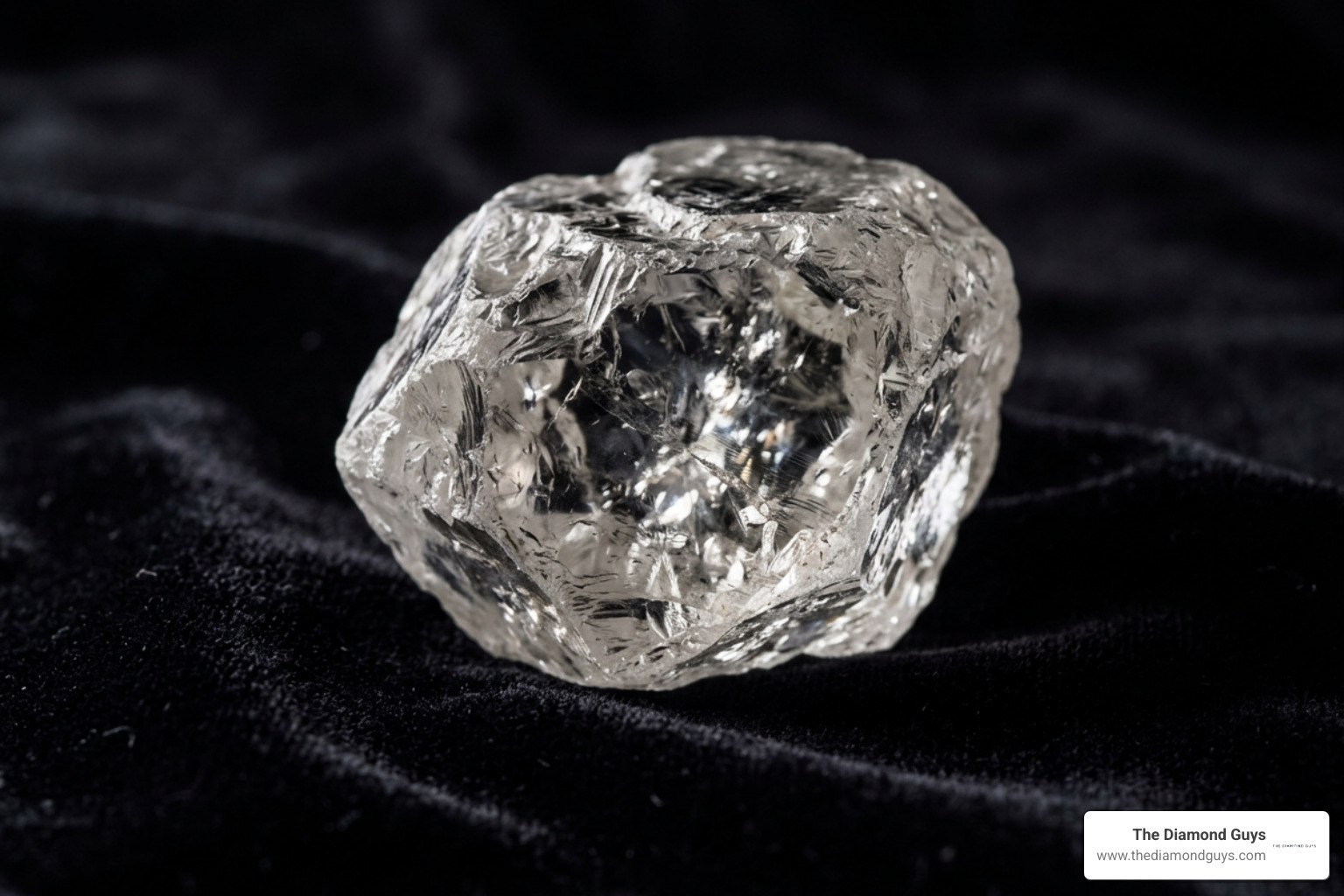
The Cullinan Diamond is the largest natural diamond in the world by gem-quality rough weight. Found in South Africa in 1905, it weighed 3,106 carats (621.2 grams) before cutting. Its two best-known polished stones now appear in the British Crown Jewels: Cullinan I, a 530.2-carat colorless diamond, and Cullinan II, at 317.4 carats.
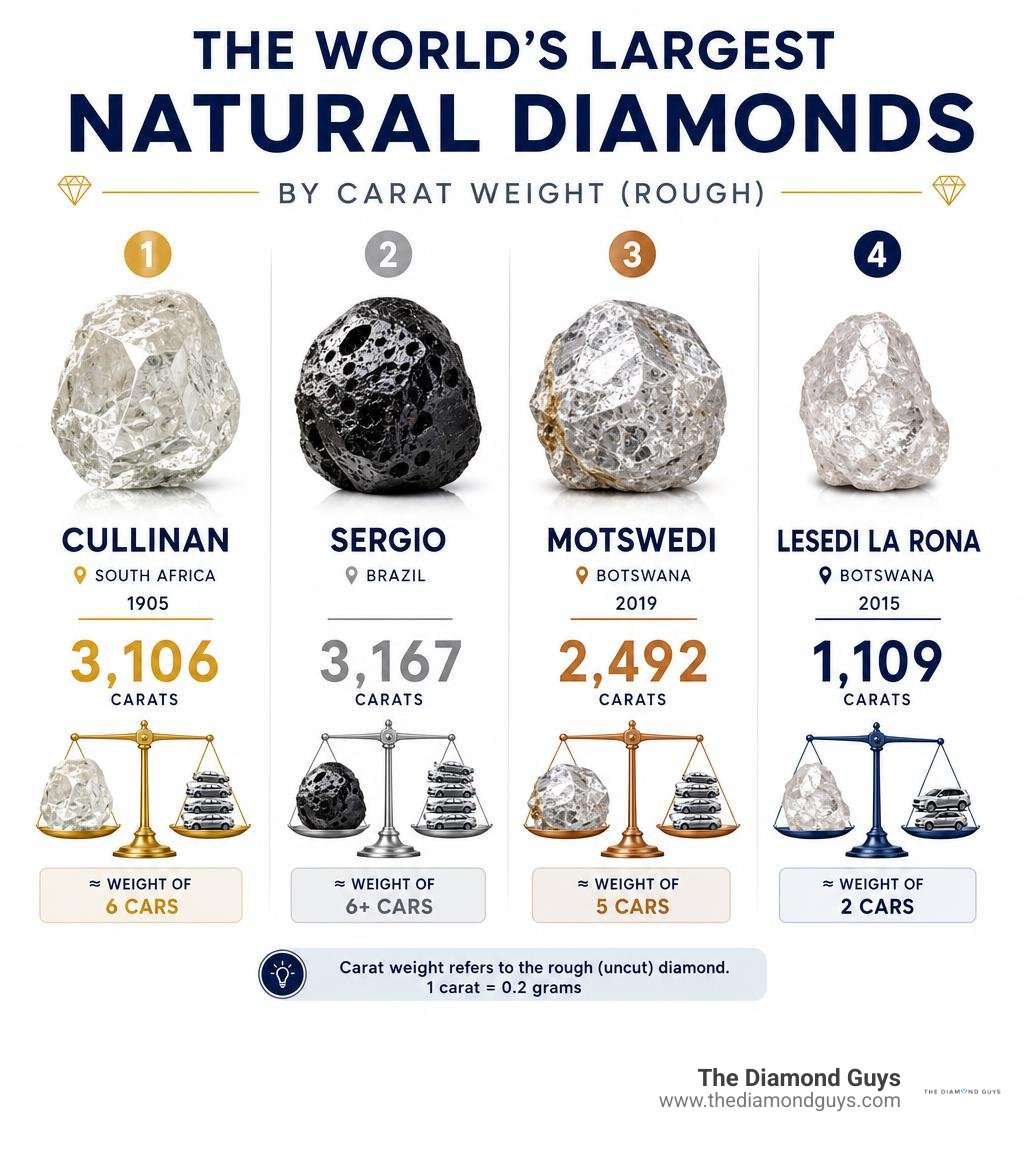
There is one important distinction: Brazil's 3,167-carat Sergio is heavier, but it is a black carbonado diamond with a porous, polycrystalline structure rather than a gem-quality crystal. Newer finds, including Botswana's 2,492-carat Motswedi, show just how rare stones of this scale remain.
This guide ranks the giant natural diamonds that shaped gem history, from rough stones recovered from deep-earth deposits to polished gems made for royal regalia.
I am Morgan Price, a white-hat SEO and research specialist who builds reliable, source-led content around topics such as the largest natural diamond in the world. I focus on clear comparisons, credible history, and the details that help buyers understand why provenance and rarity matter.
Largest natural diamond in the world terms to learn:
The Cullinan Diamond: The Largest Natural Diamond in the World
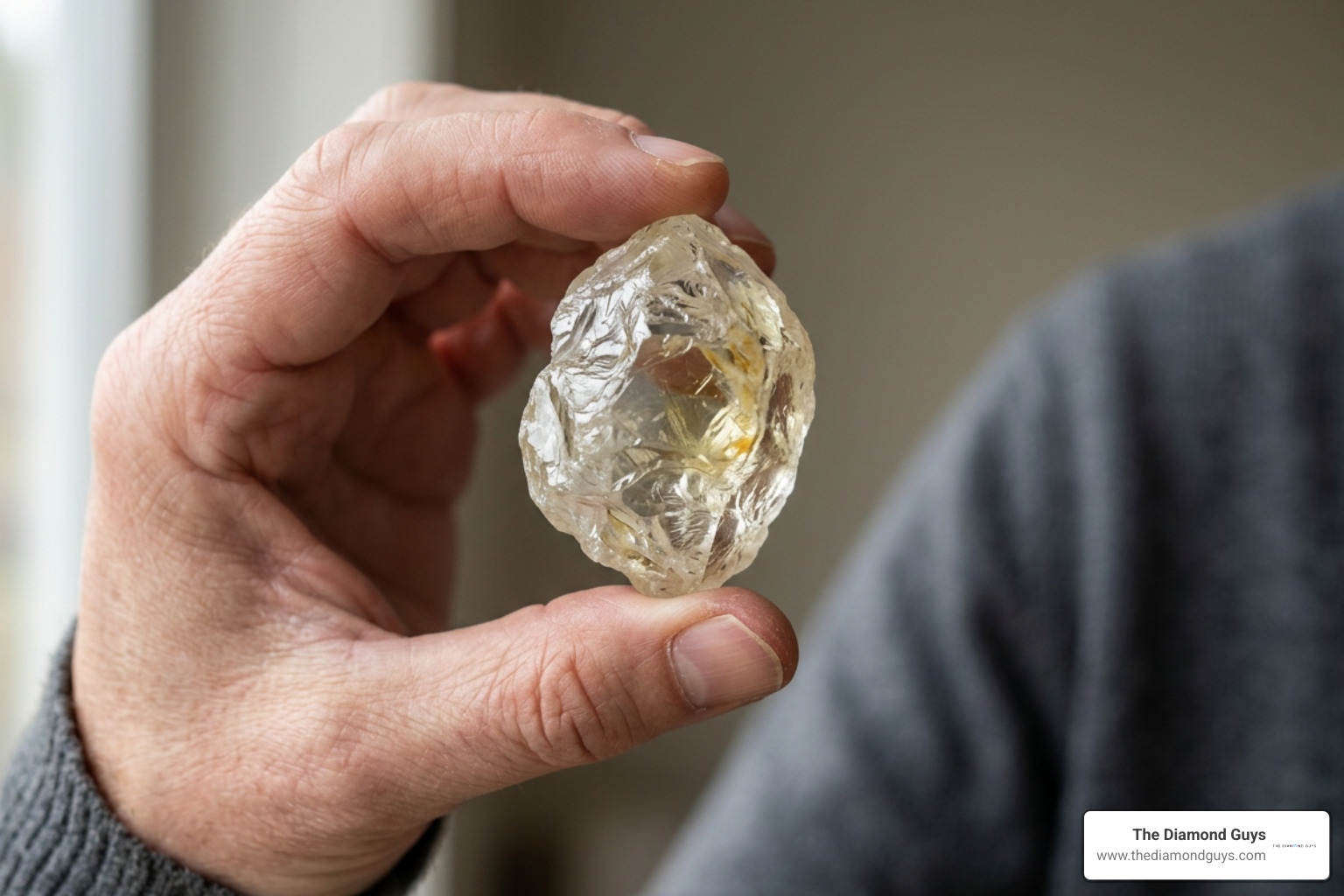
On January 26, 1905, during a routine afternoon inspection at the Premier No. 2 Mine in Cullinan, South Africa, mine superintendent Frederick Wells spotted an unusual flash of light in the sidewall of the open pit, roughly 5.5 meters below the surface. Digging into the earth, he extracted a massive crystalline crystal measuring roughly 10.1 cm long, 6.35 cm wide, and 5.9 cm deep.
Weighing in at an extraordinary 3,106 carats (1.37 pounds), the rough stone was initially suspected to be an industrial prank or a worthless piece of glass because of its sheer volume. However, thorough gemological inspection quickly revealed it was a Type IIa superdeep diamond of supreme transparency, characterized by an absence of measurable nitrogen impurities and pristine structural clarity. Scientists have since determined that it formed in the Earth's mantle transition zone at depths between 410 and 660 kilometers over a billion years ago, before being carried rapidly to the surface in a kimberlite eruption.
Named after Sir Thomas Cullinan, the owner and founder of the Premier Mine, the stone was put up for sale, but its breathtaking scale made finding an individual private buyer nearly impossible. Recognizing its unprecedented historic value, the Transvaal Colony government purchased the rough stone on October 17, 1907, for £150,000 (roughly equivalent to £21 million today). The government subsequently presented the stone to Britain's King Edward VII on his 66th birthday as a gesture of goodwill and colonial allegiance.
Transporting a gemstone of this immense worth posed unprecedented security hazards. To safeguard the treasure from international jewel thieves, authorities arranged a high-profile decoy package: an elaborate, heavily guarded locked box was placed aboard the steamship RMS Kenilworth Castle, complete with armed security details to draw public attention. Meanwhile, the authentic rough diamond was shipped discreetly to London inside a simple, plain parcel via standard registered post.
Once the diamond arrived safely in Europe, King Edward VII entrusted its cleavage and polishing to the celebrated Asscher Diamond Company in Amsterdam. Master cutter Joseph Asscher spent months studying the internal grain, cleaving planes, and internal optical characteristics of the stone—the foundational elements of what makes a diamond sparkle—before making an incision.
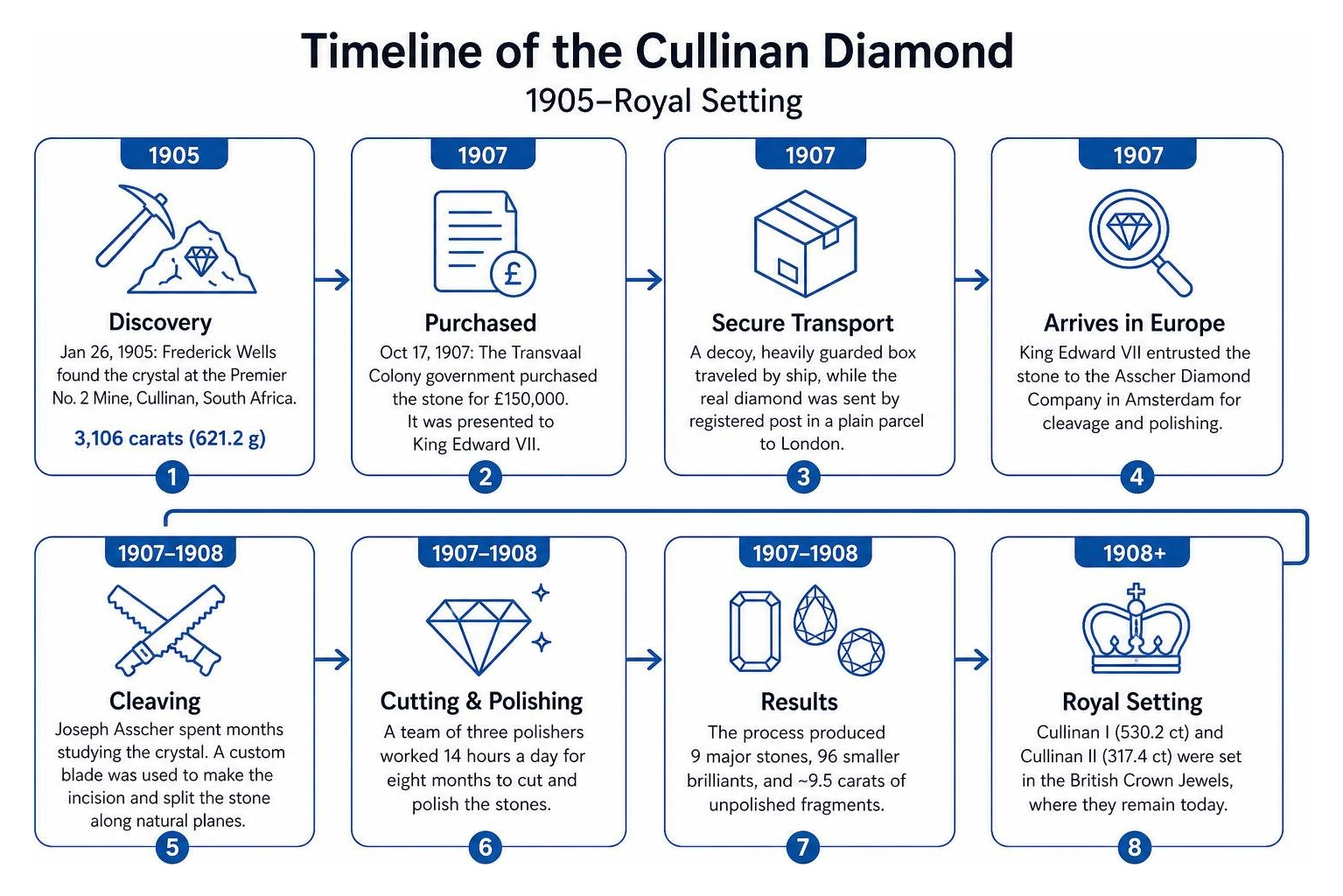
Asscher spent four days carving a precise 0.5-inch incision into the crystal. On his first attempt to split the diamond with a specialized steel blade, the tremendous structural density of the stone caused the blade to snap in two while the diamond remained entirely intact. Using a newly engineered blade, Asscher struck again, cleanly splitting the giant crystal into several principal sections along its natural cleavage planes. The extensive cutting and polishing endeavor required a dedicated team of three polishers working 14 hours a day for eight months to shape the gems. Learn more in this historical overview of the Cullinan.
The Major Cut Stones: Cullinan I Through IX
The master cutting process yielded nine major gem-quality stones, 96 smaller brilliant-cut gems, and approximately 9.5 carats of unpolished fragments. The principal stones represent some of the most famous polished diamonds in human history:
- Cullinan I (The Great Star of Africa): A majestic 530.2-carat pear-shaped diamond featuring 74 facets. It remains the largest cut colorless diamond in existence. It is mounted directly into the head of the Sovereign's Sceptre with Cross, held in trust as part of the British Crown Jewels.
- Cullinan II (The Second Star of Africa): A 317.4-carat cushion-cut gem with 66 facets, set prominently into the front band of the Imperial State Crown, directly beneath the Black Prince's Ruby.
- Cullinan III: A 94.4-carat pear-shaped drop stone originally crafted for Queen Mary's crown.
- Cullinan IV: A 63.6-carat square cushion-cut diamond. Queen Mary frequently wore Cullinan III and IV paired together as a magnificent brooch, affectionately dubbed "Granny's Chips" by Queen Elizabeth II.
- Cullinan V: An 18.8-carat heart-shaped diamond mounted into an elaborate platinum brooch.
- Cullinan VI: An 11.5-carat marquise-cut diamond, presented by King Edward VII to Queen Alexandra and later set into an emerald drop necklace.
- Cullinan VII: An 8.8-carat marquise-cut stone paired with Cullinan VIII (a 6.8-carat cushion-cut gem) into an ornate brooch.
- Cullinan IX: A 4.4-carat pear-shaped diamond mounted into a classic platinum ring setting.
Discover comprehensive details on the Cullinan Diamond cutting and cut stones and their historical record.
How the Cullinan Became the Largest Natural Diamond in the World Cut for Royalty
The transformation of the 3,106-carat rough crystal into the British Crown Jewels established an enduring standard for royal gemological artistry. Beyond its monumental carat weight, the Cullinan’s value lies in its historical transformation: turning a massive, raw geological anomaly into ceremonial symbols of state power.
Cullinan I and Cullinan II remain on permanent display in the Jewel House at the Tower of London, viewed by millions of global visitors every year and used during monarchical coronations. The remaining seven major stones (Cullinan III through IX) were retained as personal heirlooms by Queen Mary, eventually inherited by Queen Elizabeth II and passed to the contemporary British Royal Family. Together, these cut diamonds represent an unmatched gemological heritage that bridges raw natural wonder and master lapidary craft.
The Top Record-Breaking Natural Diamonds in History
While the Cullinan holds the historic crown for gem-quality rough weight, diamond exploration across the globe has revealed other breathtaking behemoths.
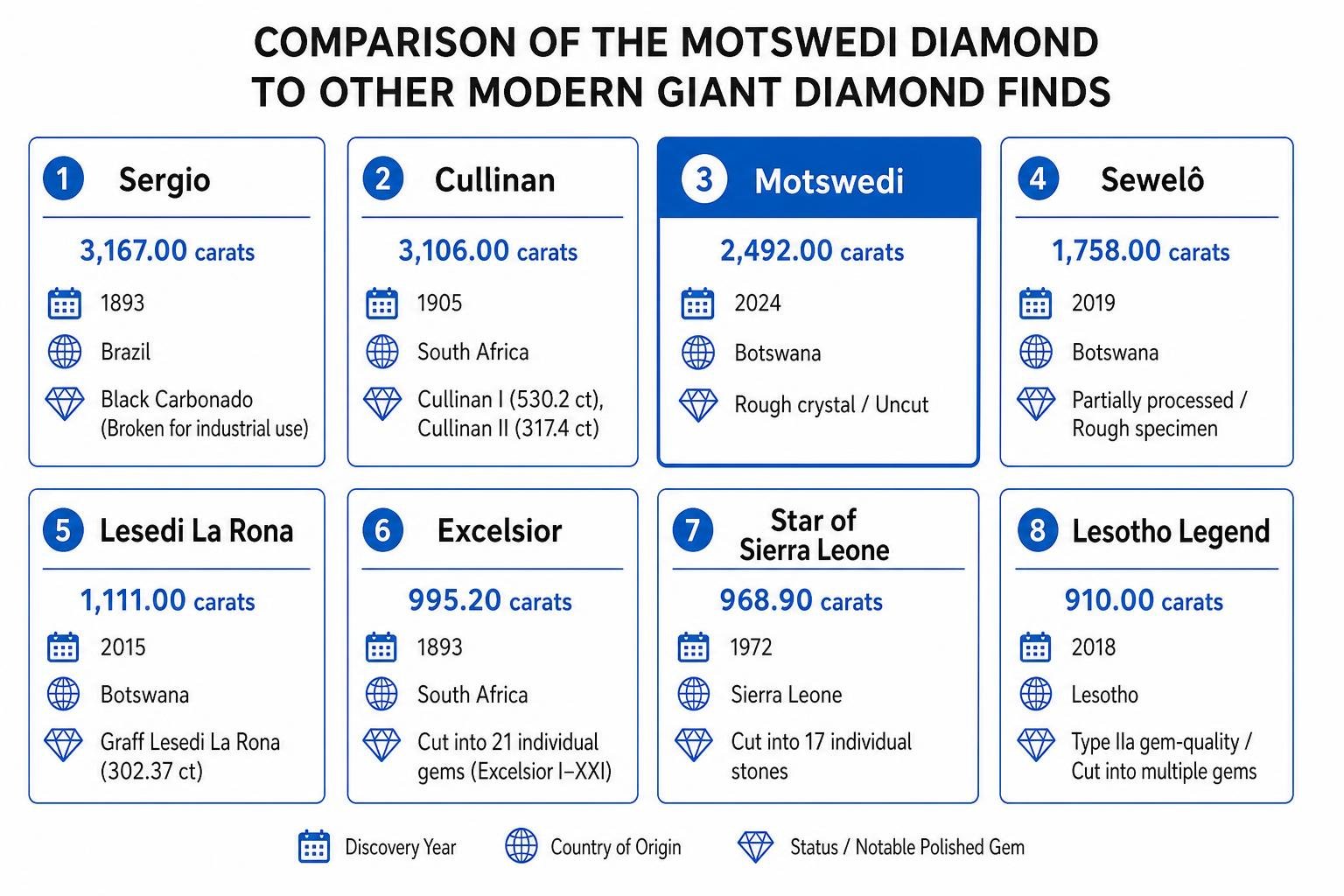
| Diamond Name | Rough Weight (Carats) | Discovery Year | Country of Origin | Status / Notable Polished Gem |
|---|---|---|---|---|
| Sergio | 3,167.00 | 1893 | Brazil | Black Carbonado (Broken for industrial use) |
| Cullinan | 3,106.00 | 1905 | South Africa | Cullinan I (530.2 ct), Cullinan II (317.4 ct) |
| Motswedi | 2,492.00 | 2024 | Botswana | Rough crystal / Uncut |
| Sewelô | 1,758.00 | 2019 | Botswana | Partially processed / Rough specimen |
| Lesedi La Rona | 1,111.00 | 2015 | Botswana | Graff Lesedi La Rona (302.37 ct) |
| Excelsior | 995.20 | 1893 | South Africa | Cut into 21 individual gems (Excelsior I-XXI) |
| Star of Sierra Leone | 968.90 | 1972 | Sierra Leone | Cut into 17 individual stones |
| Lesotho Legend | 910.00 | 2018 | Lesotho | Type IIa gem-quality / Cut into multiple gems |
To explore how these geological wonders are discovered across different terrains, read our finding natural diamonds ultimate guide.
The Sergio: The 3,167-Carat Carbonado Mystery
Discovered in the state of Bahia, Brazil, in 1893, the Sergio diamond is officially the heaviest natural diamond ever recorded, weighing a staggering 3,167 carats. Unlike the transparent, single-crystal structure of the Cullinan, the Sergio was a black carbonado.
Carbonados are polycrystalline aggregates formed from millions of microscopic diamond crystals bonded together with graphite and amorphous carbon. Because of its dark, porous composition and lack of optical transparency, the Sergio held no traditional gem-quality value. It was sold and eventually broken down into smaller pieces to be used on the tips of industrial drill bits. Geologists continue to debate carbonado origins, with leading hypotheses suggesting they formed in unique interstellar supernova environments or ultra-deep radiation-rich zones of Earth's mantle.
The Motswedi Diamond: Botswana’s 2,492-Carat Wonder
Recovered from the Karowe Diamond Mine in Botswana, the Motswedi Diamond weighs an incredible 2,492 carats, making it the second-largest diamond rough ever found and the largest discovery in over 120 years.
Named "Motswedi" (meaning "water spring" in Setswana to symbolize the flow of national prosperity), the stone represents a monumental modern milestone. Its intact extraction was made possible by advanced X-ray Transmission (XRT) mega-diamond recovery sorting technology, which detects large gem crystals without subjecting the ore to destructive mechanical crushing. Read the complete analysis on the Motswedi Diamond recovery.
Historic Giants: Sewelô, Lesedi La Rona, and the Excelsior
Before the recovery of the Motswedi, Botswana's Karowe mine produced two other record-setting gems: the Sewelô (1,758 carats, recovered in 2019), a carbon-coated rough diamond acquired by high-fashion houses for artisanal study, and the famous Lesedi La Rona (1,111 carats, discovered in 2015). The Lesedi La Rona was subsequently cut into 67 individual polished gems, the largest being a 302.37-carat Emerald cut diamond of exceptional D-color and flawless clarity.
Historically, the Excelsior Diamond, weighing 995.2 carats, was unearthed in 1893 at the Jagersfontein Mine in South Africa. Prior to the Cullinan discovery, the Excelsior was the largest known gem-quality rough diamond in the world, eventually cleaved into 21 distinct polished stones. Other legendary historical finds, such as the 968.9-carat Star of Sierra Leone and the pristine 777-carat Millennium Star, illustrate how Africa’s kimberlite pipes have defined global diamond heritage. Read more about these famous world diamonds.
Geological Formation and Modern Recovery of Giant Diamonds
The existence of massive natural diamonds is a remarkable feat of planetary geology. Unlike standard diamonds that crystallize in the lithospheric mantle at depths around 150 to 200 kilometers, mega-diamonds like the Cullinan, Lesotho Legend, and Lesedi La Rona are classified as CLIPPIR diamonds (Cullinan-like, Large, Inclusion-Poor, Pure, Irregular, and Resorbed) or superdeep Type IIa gems.
These stones crystallized deep within the mantle transition zone (410 to 660 kilometers beneath the crust) in environments rich in liquid metallic iron-nickel-carbon alloys. Because they lack nitrogen impurities, they exhibit extraordinary optical transparency and color neutrality.
Historically, many giant diamonds were inadvertently crushed or fragmented during early mechanical crushing extraction processes. Today, modern mining utilizes state-of-the-art X-ray Transmission (XRT) and laser luminescence sorting sensors. These machines scan raw ore feeds before crushing, identifying the distinct atomic density of large carbon crystals and ejecting giant stones intact. This technology has fueled a new era of discoveries across Botswana and South Africa.
Frequently Asked Questions About Record-Holding Diamonds
What Is the Largest Natural Diamond in the World Ever Discovered?
The Cullinan Diamond is the largest gem-quality rough diamond ever discovered, weighing 3,106 carats (621.2 grams). Discovered in South Africa's Premier Mine in 1905, it produced the world’s largest cut colorless diamond, the 530.2-carat Great Star of Africa (Cullinan I).
What Is the Difference Between Gem-Quality and Carbonado Diamonds?
Gem-quality diamonds are single monocrystalline carbon lattices exhibiting optical transparency, light dispersion, and structural purity, making them suitable for faceting into jewelry. Carbonado diamonds (like the 3,167-carat Sergio) are opaque, porous, polycrystalline structures composed of micro-diamonds and graphite, traditionally used for industrial cutting and drilling applications rather than fine jewelry.
Who Owns the Largest Polished Diamond Today?
The largest polished colorless diamond, Cullinan I (530.2 carats), is mounted in the British Sovereign’s Sceptre with Cross and is held in public trust as part of the British Crown Jewels by the ruling British monarch.
Conclusion
The natural world has created singular geological masterpieces, from the 3,106-carat Cullinan rough to the technological marvel of the 2,492-carat Motswedi. These legendary diamonds remind us that every natural gem holds billions of years of deep-Earth history, enduring optical brilliance, and peerless rarity.
Whether you are inspired by the royal legacy of historic gems or searching for the perfect certified stone for a bespoke heirloom, exploring natural diamond craftsmanship connects you to the earth's greatest wonders. Discover the nuances of fine diamond jewelry in our complete guide to natural diamond jewelry.


