

Finding Natural Diamonds Without Getting Rough Around the Edges
Where Finding Natural Diamonds Starts: Know the Few Places You Can Keep One

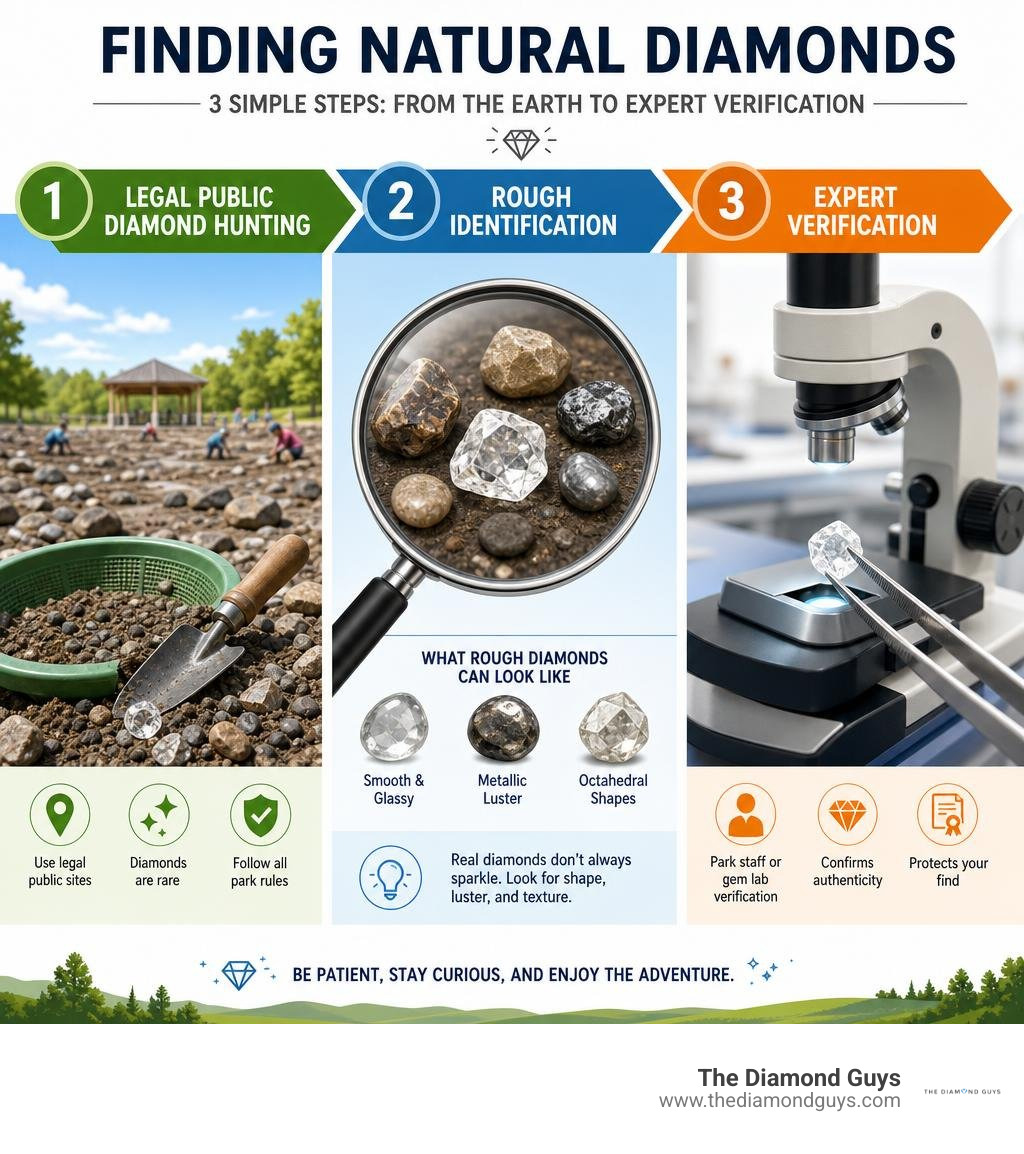
Finding natural diamonds is possible, but it is not as simple as walking onto public land with a shovel. For most people, the clearest legal option is Crater of Diamonds State Park in Murfreesboro, Arkansas, where visitors may search a diamond-bearing field and keep verified finds.
- Search legally: Use a designated public diamond-search site or get clear permission on private land.
- Set realistic expectations: Diamonds are rare. Most mine material contains about one part diamond per one million parts of host rock.
- Learn what rough looks like: A natural diamond found in soil is more likely to resemble a smooth, glassy, or metallic-looking pebble than a sparkling jewelry-store gem.
- Verify every possible find: Park staff or an independent gem laboratory can help distinguish diamond from quartz, glass, moissanite, or other look-alikes.
Natural diamonds formed deep in Earth's mantle, usually more than a billion years ago, under immense heat and pressure. Fast volcanic activity carried some of those crystals upward in rocks called kimberlite and lamproite, leaving rare deposits that weather can slowly expose.
Crater of Diamonds is the best-known public example. The Arkansas site has produced more than 35,000 visitor-found diamonds since becoming a state park in 1972, including the 40.23-carat Uncle Sam diamond, still the largest diamond found in the United States. That history makes diamond hunting exciting, but it also shows why patience matters: many visitors find no diamond at all, while the typical registered stone is small.
I am Morgan Price, a research-driven outreach specialist who builds trustworthy content through careful sourcing and clear explanations. In researching finding natural diamonds, I focus on helping readers separate a memorable public prospecting trip from the bigger questions of gem quality, provenance, and ethical buying.
Essential finding natural diamonds terms:
The Science of Formation: How Natural Diamonds Reach the Surface
To understand the challenge of finding natural diamonds, we first have to appreciate the extreme deep-Earth geology required to create them. Diamonds are the only gemstones composed entirely of a single element: carbon. Under everyday conditions, carbon forms soft, flakey graphite (the material inside your wooden pencil). However, under high-temperature and extreme-pressure environments roughly 90 to 120 miles (100 miles on average) beneath the Earth's surface in the mantle, carbon atoms arrange themselves into a tight tetrahedral crystal lattice.
This tetrahedral structure gives natural diamonds their incredible physical properties. Measuring a maximum 10 on the Mohs hardness scale, diamonds are the hardest known natural substance—58 times harder than anything else found in nature! While graphite can be scratched by a fingernail, a diamond can only be scratched by another diamond. Most natural diamonds we find today formed deep in the mantle over one to three billion years ago.
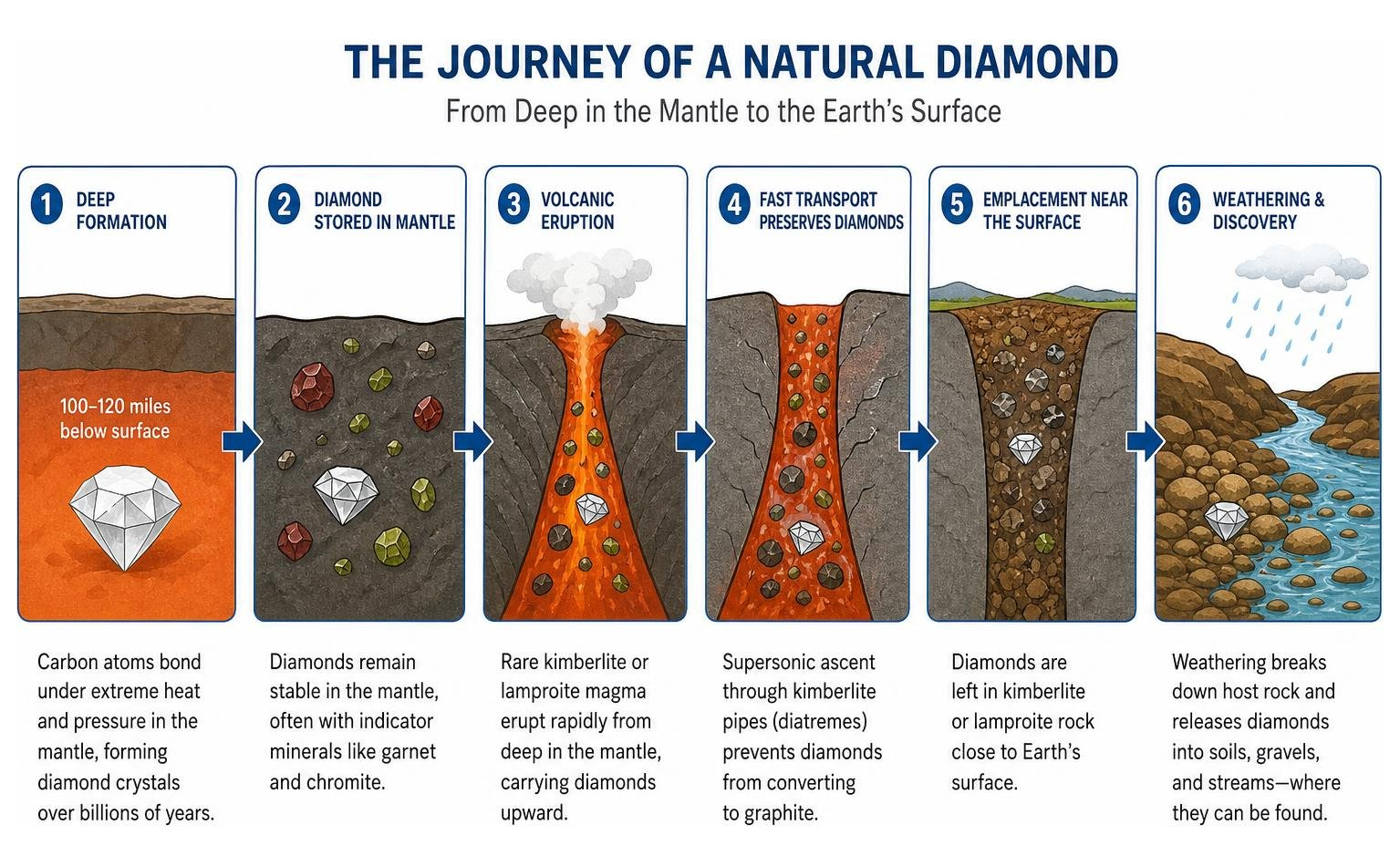
So how do these ancient deep-mantle treasures reach the surface where we can find them? They ride up during violent, deep-source volcanic eruptions driven by rare magmas known as kimberlite and lamproite. These magmas travel at supersonic speeds from the mantle through narrow geological conduits called diatremes or pipes, acting like natural elevator shafts. If the volcanic ascent were slow, the diamonds would simply graphitize (turn into worthless carbon dust) due to pressure release and high heat. Fortunately for us, fast-moving volcanic eruptions preserved the diamond crystals, embedding them near the surface in volcanic rock matrixes. To learn more about how raw stones become finished heirlooms, explore our Natural Diamond Jewelry Complete Guide.
Geological Origins and Indicator Minerals
Geologists and experienced prospectors rarely look for diamonds directly at first because of their extreme scarcity. Instead, they hunt for "indicator minerals." When kimberlite and lamproite magmas travel upward, they bring along heavy minerals formed in the same mantle conditions:
- Pyrope Garnet: Distinctive wine-red to purple-red heavy garnets.
- Chromian Diopside: Vibrant, neon-emerald-green silicate minerals.
- Picroilmenite: Magnesium-rich, metallic black iron-titanium oxides.
Most major North American diamond discoveries occur above ancient continental cores known as Archean cratons—stable rocks older than 2.5 billion years. For instance, in the Colorado-Wyoming State Line kimberlite district, geologists discovered over 130,000 diamonds by sampling stream sediments and soils for indicator minerals. Weathered kimberlite pipes break down into montmorillonite clay soils, which hold water differently than surrounding rocks. In the field, these areas often show up as vegetative anomalies—lush, green grass growing vigorous patches where woody bushes refuse to take root.
Natural vs. Lab-Grown vs. Simulants: Knowing What You Found
If you pick up a bright, shiny crystal in the field or in a shop, how do you know what it really is? Understanding the material differences saves a lot of heartache.
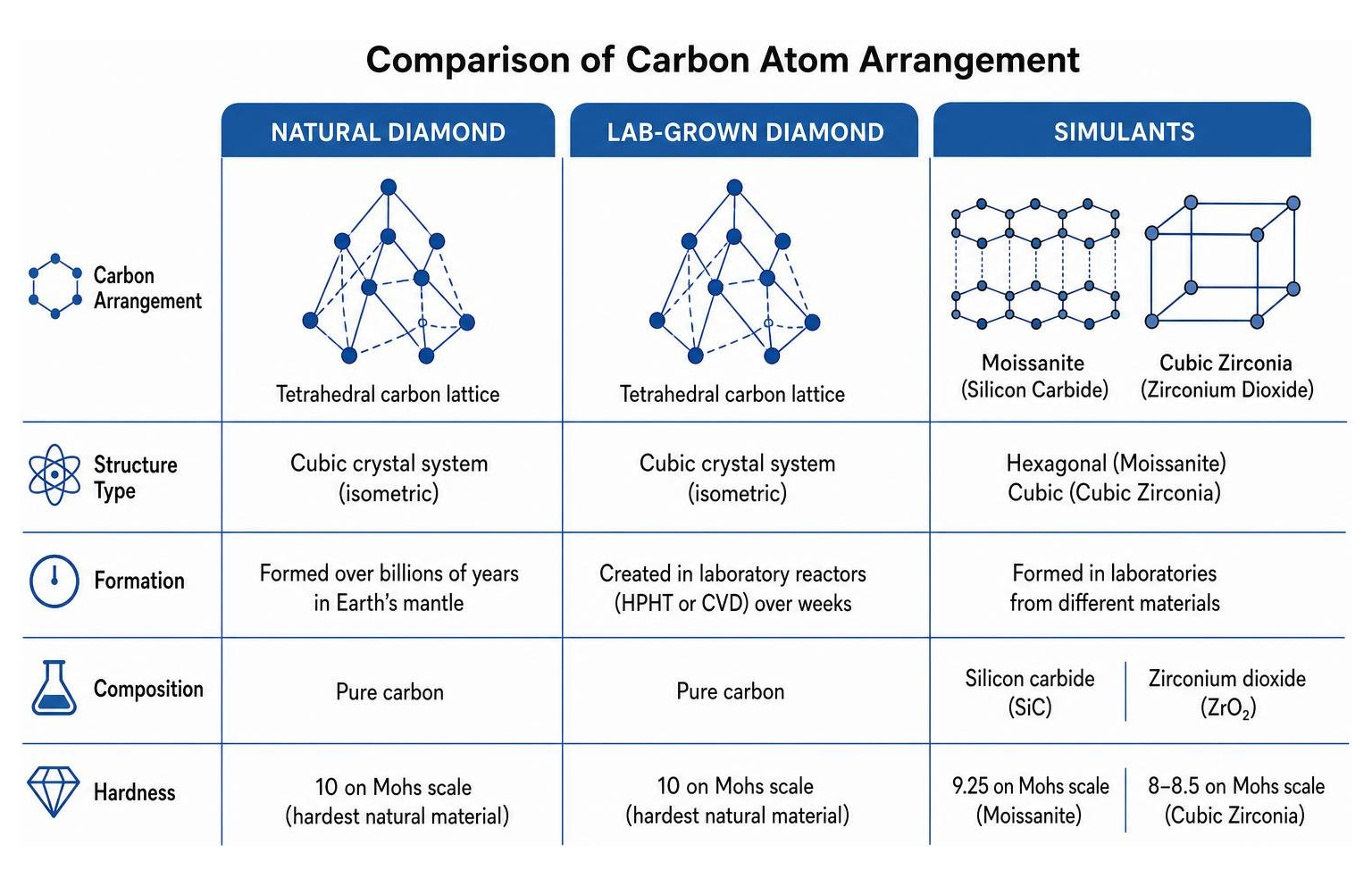
- Natural Diamonds: Formed over billions of years in Earth's mantle. They possess identical chemical, physical, and optical properties to lab-grown stones, but carry distinct natural growth structures, mineral inclusions, and historical rarity.
- Lab-Grown Diamonds: Created in laboratory reactors using High Pressure High Temperature (HPHT) or Chemical Vapor Deposition (CVD) methods over weeks. They are chemically real diamonds, but lack geological age or natural origin. Read our breakdown on Are Lab-Grown Diamonds Real Diamonds and see the detailed physical comparison in Difference Between Real and Synthetic Diamonds.
- Diamond Simulants: Materials like Moissanite (silicon carbide) or Cubic Zirconia (zirconium dioxide) look sparkly, but have completely different chemical compositions, lower hardness, and different light refractive indexes.
A Step-by-Step Guide to Finding Natural Diamonds in the Wild
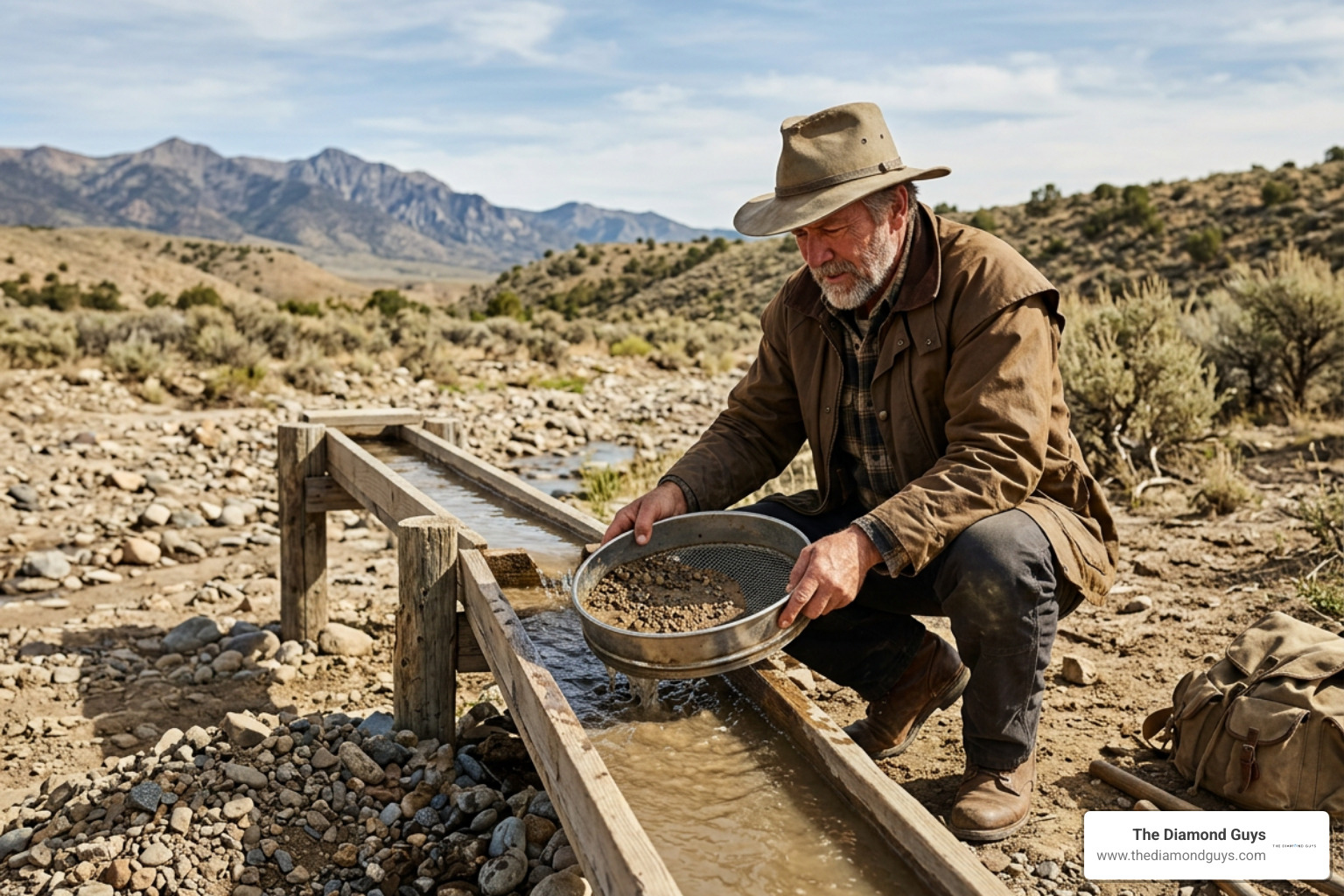
If you are eager to try finding natural diamonds with your own hands, preparation is everything. Field digging is physical, messy work that requires patience and methodical technique. According to report details from An extinct volcano in Arkansas hosts the only public diamond mine on Earth - Ars Technica, anyone can access designated public searching fields for a modest admission fee and keep whatever gems they manage to dig up.
Top Locations for Finding Natural Diamonds Publicly
While commercial diamond extraction takes place in restricted industrial mines globally (in nations like Canada, Botswana, Namibia, and Angola), public access is strictly regulated. For amateur treasure hunters, three notable North American locations stand out:
- Crater of Diamonds State Park (Murfreesboro, Arkansas): The premier public diamond site in the world. Visitors pay a $15 adult fee to search a 37.5-acre plowed field located directly on the surface of the eroded Prairie Creek lamproite volcanic pipe.
- Wyoming-Colorado State Line Kimberlite District: Historical prospecting sites along ancient Archean cratons where over 130,000 diamonds have been recovered during past commercial exploration and bulk sampling.
- Diamond Point (Tonto National Forest, Arizona): Located right here near our home base in Arizona. While Diamond Point is famous for double-terminated quartz crystals known as "Apache Tears" or "Diamond Point Quartz" rather than true mantle carbon, it remains a fantastic geological destination for local mineral collectors. Check official forest guidelines at Diamond Point - Tonto National Forest before planning your trip.
Essential Tools and Techniques for Finding Natural Diamonds
To maximize your chances when searching public fields like Crater of Diamonds, try these three primary field methods:
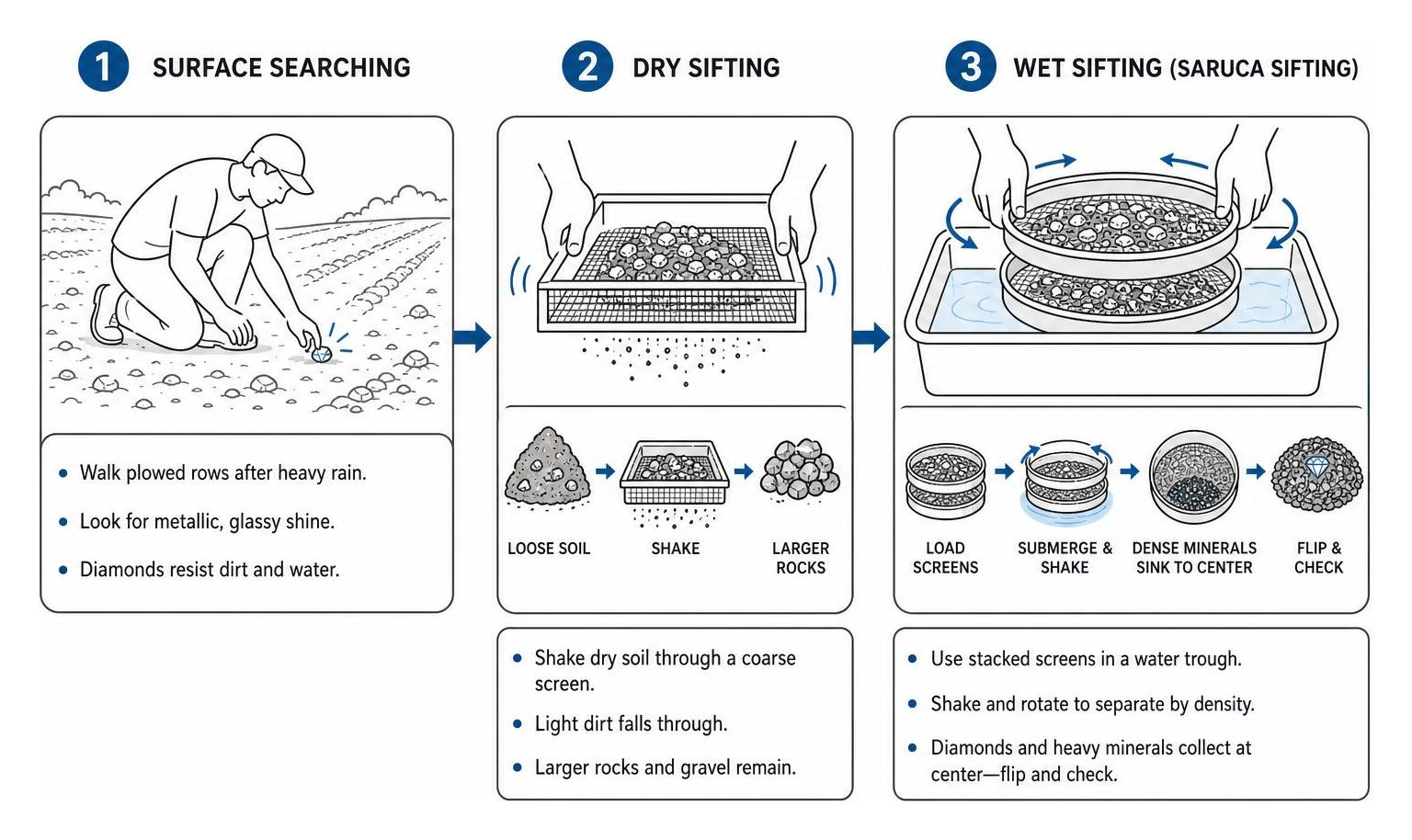
- Surface Searching: Walk slowly between plowed rows of moist dirt after heavy rainstorms. Summer storms wash away loose, dark soil (known locally as "black gumbo"), exposing heavier, clean minerals on top. Keep your eye out for a metallic, glassy shine catching the sunlight. Dirt does not stick easily to diamond surfaces because diamonds are hydrophobic (water-repellent) and lipophilic (grease-loving).
- Dry Sifting: Shake dry, loose soil through a coarse wire mesh screen to separate light dirt from larger rocks and gravel.
- Wet Sifting (Saruca Sifting): This is the most effective technique. Load gravel into a set of stacked sifting screens (a coarse top screen and a fine bottom screen) and submerge them in a water trough. Shake and rotate the screens in a circular motion. This creates a centrifugal sorting action: dense minerals like garnets, spinels, and diamonds sink directly to the center bottom of the fine screen. Flip the screen upside down onto a flat table; any diamond present will sit right on top of the pile!
Pro Tip: Always bring heavy-duty rubber gloves! Sifting wet rocks and coarse gravel with bare hands for hours will quickly tear up your skin.
Evaluating Your Find: The 4Cs, Value, and Historical Discoveries
When you find a stone or select one at a showroom, how is its overall value calculated? The Gemological Institute of America (GIA) established the universal standard known as the 4Cs: Cut, Color, Clarity, and Carat Weight.
| 4Cs Quality Factor | What It Measures | Rough Found Diamond Considerations | Finished Cut Diamond Value Impact |
|---|---|---|---|
| Carat Weight | Metric unit of weight (1 carat = 200 milligrams). | Rough stones lose 40% to 60% of their weight during cutting. | Larger weights are exponentially rarer and more valuable per carat. |
| Color | Absence of body color (D to Z scale, or fancy colors). | Raw diamonds usually show yellowish, brownish, or clear glassy tones. | Colorless (D-F) and vivid fancy colors command top market prices. |
| Clarity | Absence of internal inclusions or external blemishes. | Natural inclusions, fractures, or graphite spots affect transparency. | Flawless to VVS grades are extremely valuable; inclusions lower price. |
| Cut | Proportion, symmetry, and human polish quality. | Natural rough exhibits rounded octahedron or dodecahedron crystals. | Cut directly drives light reflection, fire, brilliance, and optical beauty. |
When evaluating rough gems discovered in the wild versus finished diamonds, uncut stones lose roughly half their mass during faceting. For example, a 2.00-carat rough crystal may yield only a 0.85-carat finished gem once polished! Explore our curated selection of Engagement Rings with Natural Diamonds to see how expert cutting unleashes natural fire.
Famous Public Discoveries and Their Gemological Value
Public search fields have produced incredible, historic gem discoveries:
- The Uncle Sam Diamond (1924): Discovered at the Arkansas field prior to becoming a state park, this breathtaking 40.23-carat white diamond remains the largest natural diamond ever found in the United States. It was later cut into a gem-quality 12.42-carat stone.
- The Fox-Ballou Diamond (Recent Discovery): As reported by NY woman finds rare diamond in Arkansas for engagement ring - Upworthy, a visitor spent three weeks persistently sifting soil before spotting a sparkling 2.30-carat natural rough diamond on her final day. She plans to set her self-found stone into a custom engagement ring!
- Commercial Market Context: At retail, a fine quality 2.3-carat cut natural diamond averages around $27,037 on current gem markets (with ranges between $7,000 and $66,000 depending on color and clarity performance).
Ethical Sourcing, Mining Economics, and Traceability

Commercial diamond mining yield statistics reveal just how rare these gems truly are. In major commercial diamond mines, the average yield is approximately 1 part diamond per 1,000,000 parts host rock (or about 5 to 15 carats per 100 tons of mined ore). Because extracting diamonds demands vast energy and machinery, modern diamond buyers care deeply about ethical sourcing and environmental sustainability.

Today, modern consumers want full confidence that their natural diamond supported local communities without funding conflict. The natural diamond industry operates under rigorous global standards:
- The Kimberley Process: A international certification scheme established to prevent conflict diamonds from entering the global market supply chain.
- Blockchain Provenance: Leading luxury jewelers use digital ledger technology to log a natural diamond's exact journey from the mine in Canada or Botswana directly to the final setting.
- Socioeconomic Impact: Responsible commercial diamond mining funds public infrastructure, hospitals, schools, and employment for local populations in developing nations.
At The Diamond Guys, we are deeply committed to these standards. As a 5-star rated custom jeweler with showrooms in Scottsdale, AZ and Los Angeles, CA, we specialize in offering transparent, ethically sourced natural diamonds. Whether clients prefer natural gems or are comparing options like in our guide Do Women Prefer Natural Diamonds vs Lab Grown, our team provides expert, non-pushy guidance every step of the way.
Frequently Asked Questions About Finding Natural Diamonds
Where in the world can the public legally search for and keep natural diamonds?
Crater of Diamonds State Park in Murfreesboro, Arkansas, is the only active public diamond site in the world where anyone can pay an admission fee, search a 37.5-acre volcanic field, and keep every single diamond they find with zero royalties. On private property, you must have explicit legal permission from the landowner to search or retain mineral finds.
How hard is it to find a natural diamond at a public site?
It requires patience, hard work, and good fortune! The park averages about one to two diamond finds per day across all searching visitors, totaling over 600 certified diamonds annually. However, because thousands of people visit, individual daily odds are low. Most discovered diamonds are roughly the size of a paper match head (around 0.20 carats), though larger gems over 2 carats are unearthed every year by dedicated searchers.
What does a raw uncut natural diamond look like in the field?
Uncut natural diamonds do not look like polished, multi-faceted engagement ring stones. In nature, they resemble smooth, rounded, glassy or metallic-looking pebbles. They frequently form eight-sided octahedrons or twelve-sided dodecahedrons. Because diamonds are water-repellent, dirt and mud rarely stick to their surface, meaning they stand out with a distinct, brilliant shine even when wet.
Conclusion
Finding natural diamonds in the wild is one of the most thrilling geological adventures you can experience. Whether you are sifting through volcanic soil in Arkansas or surface searching after a heavy storm, unearthing a piece of Earth's ancient history is unforgettable.
However, if you want a magnificent, high-performing natural diamond set into a dream ring without spending weeks digging in the mud, we are here to help! At The Diamond Guys, our expert jewelers in Scottsdale, AZ provide personalized guidance, ethical mine-to-market sourcing, and unmatched custom ring design.
Ready to discover your perfect natural diamond? Explore the Natural Diamond Jewelry Complete Guide or visit our Scottsdale showroom to consult with our natural diamond experts today!


