

The Honest Truth About the Resale Value of Man-Made Diamonds
The Truth About the Resale Value of Man-Made Diamonds (Before You Buy)
The resale value of man made diamonds is one of the most searched — and most misunderstood — topics in the jewelry world right now. Here is the short answer:
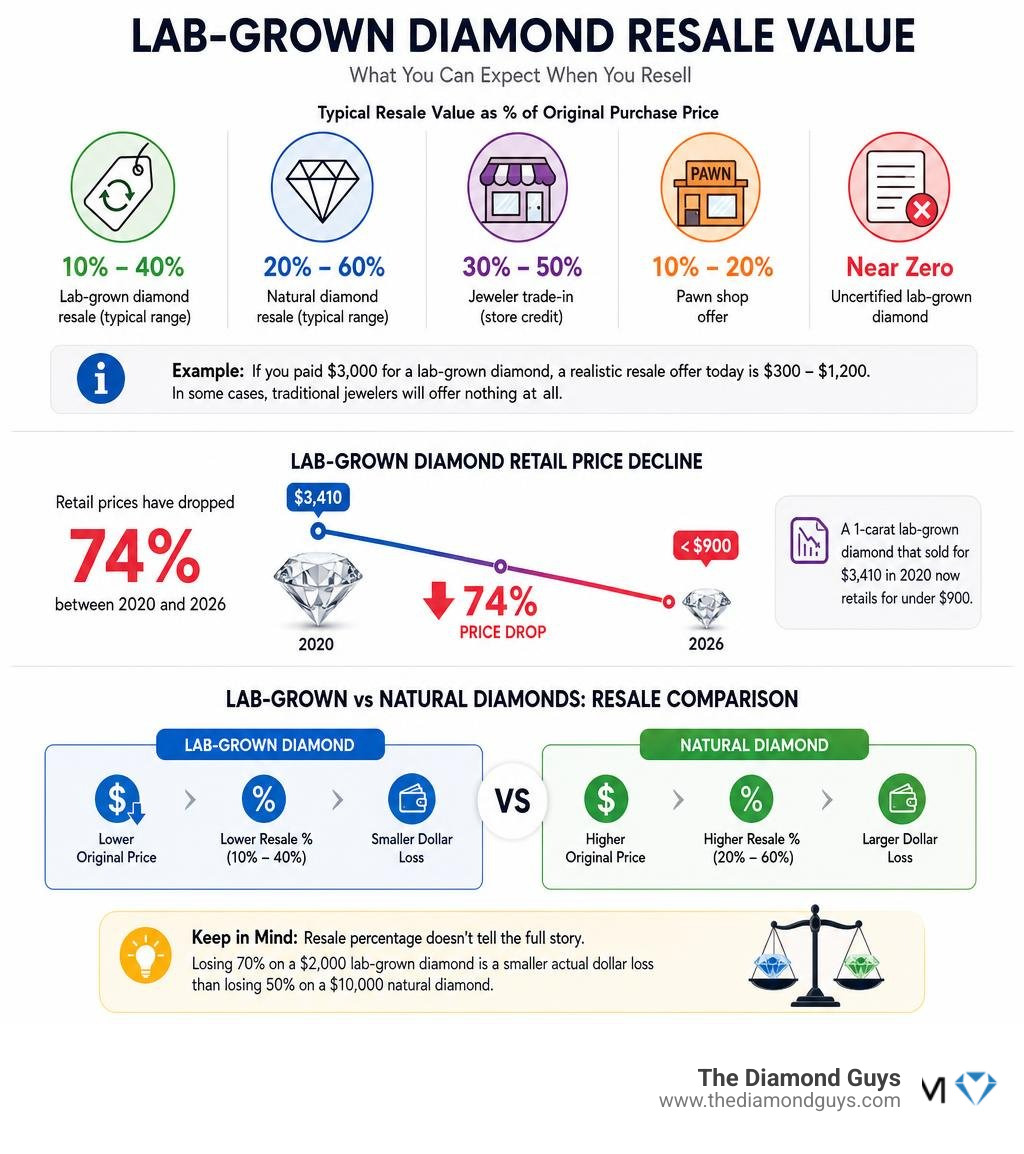
Quick Answer: What Is a Lab-Grown Diamond Worth at Resale?
| Situation | Resale Value |
|---|---|
| Lab-grown diamond resale (typical range) | 10% to 40% of original purchase price |
| Natural diamond resale (typical range) | 20% to 60% of original purchase price |
| Jeweler trade-in (store credit) | 30% to 50% of current market value |
| Pawn shop offer | 10% to 20% of retail price |
| Uncertified lab-grown diamond | Near zero — expect 20-40% lower offers |
The bottom line: if you paid $3,000 for a lab-grown diamond, a realistic resale offer today is somewhere between $300 and $1,200 — and in some cases, traditional jewelers will offer nothing at all.
That gap exists for a clear reason. Lab-grown diamond retail prices have dropped roughly 74% between 2020 and 2026, driven by falling production costs and global oversupply. A one-carat stone that sold for $3,410 in 2020 now retails for under $900. Jewelers can buy brand-new, certified stones directly from manufacturers at very low wholesale prices — so they have little incentive to buy a used one from you.
But here is what most articles miss: the resale percentage does not tell the full story. Losing 70% on a $2,000 lab-grown diamond is a smaller actual dollar loss than losing 50% on a $10,000 natural diamond. That math matters — and we will break it down clearly.
I'm Morgan Price, a strategic content and outreach specialist with deep expertise in the diamond market, including the evolving dynamics of the resale value of man made diamonds across primary and secondary markets. In the sections ahead, I will walk you through everything you need to make a confident, eyes-open decision.
Discover more about resale value of man made diamonds:
What is the Actual resale value of man made diamonds in 2026?
To understand the actual resale value of man made diamonds today in July 2026, we have to look closely at the mechanics of the secondary jewelry market. When you walk out of a retail jewelry store with a brand-new diamond ring, its immediate liquidation value drops. This is not unique to man-made stones; natural diamonds also experience an immediate drop due to retail markups, sales tax, and jeweler margins.
However, the drop for lab-grown diamonds is significantly steeper. Today, lab-grown diamonds typically resell for somewhere between 10% and 30% of their original retail purchase price. In contrast, natural diamonds traditionally retain about 50% to 60% of their original price when sold back into the trade.
To put this in perspective, let's look at how the secondary market treats these two options:
| Metric | Lab-Grown Diamonds | Natural Diamonds |
|---|---|---|
| Upfront Cost (1.00ct D/VS1) | ~$1,000 or less | ~$4,200 to $6,200 |
| Typical Resale Percentage | 10% to 30% | 30% to 60% |
| Secondary Market Liquidity | Low (few jewelers buy back) | High (highly liquid cash market) |
| Primary Value Driver | Technology & Manufacturing | Geological Scarcity |
The primary reason for this massive gap is the difference between retail markup and wholesale liquidation value. When you buy a lab-grown diamond at retail, the price includes the jeweler's overhead, marketing, design, and profit margin. But when you try to sell that diamond back, a jeweler or wholesale buyer evaluates it based on what it would cost them to buy an identical, brand-new stone directly from a manufacturer. Because wholesale prices have dropped dramatically, their cash offer will reflect today's low wholesale costs, not what you paid years ago.
For a deeper look into how these stones differ beyond just their price tags, you can Learn more about lab diamonds vs. real diamonds.
Why the resale value of man made diamonds Drops 15-20% Annually
If you bought a lab-grown diamond ring in 2020, you might be shocked to learn how much its market value has changed. The continuous decline in the resale value of man made diamonds is driven by a predictable economic force: technology.
Lab-grown diamonds are produced using two primary high-tech methods:
- Chemical Vapor Deposition (CVD): Growing diamonds from a carbon-rich gas plasma in a vacuum chamber.
- High-Pressure High-Temperature (HPHT): Replicating the extreme heat and pressure of the Earth's mantle using massive mechanical presses.
As manufacturing technology improves, the cost to run these machines drops. The cost to produce a lab-grown diamond has collapsed by more than 90% over the last decade. By 2025 and into 2026, industry estimates placed the production cost of a one-carat CVD stone below $300.
At the same time, massive production facilities in countries like China and India have scaled up operations, leading to a global oversupply. China now produces roughly 40% of gem-quality lab-grown diamonds (primarily via HPHT), while India cuts and polishes over 50% of the world's supply.
This combination of falling production costs and unlimited supply means that brand-new lab diamonds get cheaper every year. Because older lab diamonds have no structural or optical differences from newly minted ones, their value is tied directly to the falling cost of new inventory. This is why retail and resale prices drop 15% to 20% annually, acting much like consumer electronics.
The Percentage Trap: Actual Dollars Lost vs. Percentage Depreciation
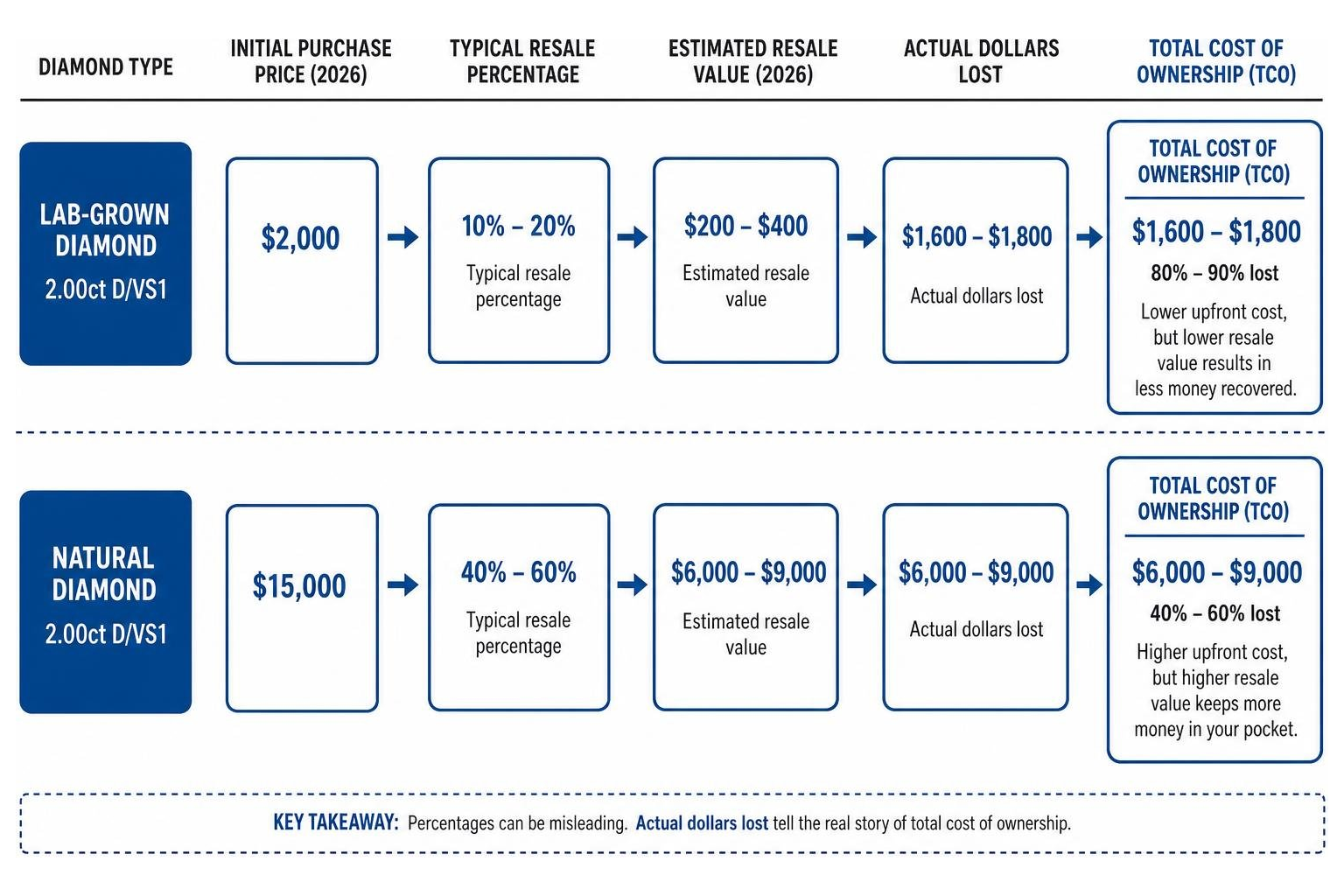
When comparing the resale value of man made diamonds to natural diamonds, it is incredibly easy to fall into "The Percentage Trap." Financial advisors and traditional diamond dealers often warn buyers away from lab-grown stones by pointing out that they lose up to 80% or 90% of their value, while natural diamonds only lose about 40% to 50%.
While those percentages are mathematically accurate, they completely ignore the Total Cost of Ownership (TCO) in actual dollars. Let's look at a realistic comparison of two couples shopping for an engagement ring with similar visual goals in 2026:
Scenario A: The Natural Diamond Buyer
- Initial Purchase Price: $15,000 for a high-quality 2-carat natural diamond.
- Resale Value (retaining 50%): $7,500.
- Actual Dollars Lost: $7,500.
Scenario B: The Lab-Grown Diamond Buyer
- Initial Purchase Price: $2,000 for an optically identical 2-carat lab-grown diamond.
- Resale Value (retaining 15%): $300.
- Actual Dollars Lost: $1,700.
Even if the lab-grown diamond's resale value dropped to absolute zero, the buyer of the lab-grown stone is still financially ahead by $5,500 in actual cash. They saved $13,000 upfront, which could be redirected into a high-yield savings account, a home down payment, or index funds.
Losing a high percentage of a very small initial investment is almost always cheaper than losing a moderate percentage of a massive luxury purchase. To explore this concept further, read our detailed analysis: Are diamonds a good financial investment?.
Key Factors That Influence Lab-Grown Diamond Resale Prices
Not all lab-grown diamonds are treated equally on the secondary market. If you are looking to sell a man-made stone, several critical factors will determine whether you receive a reasonable offer or a polite rejection.
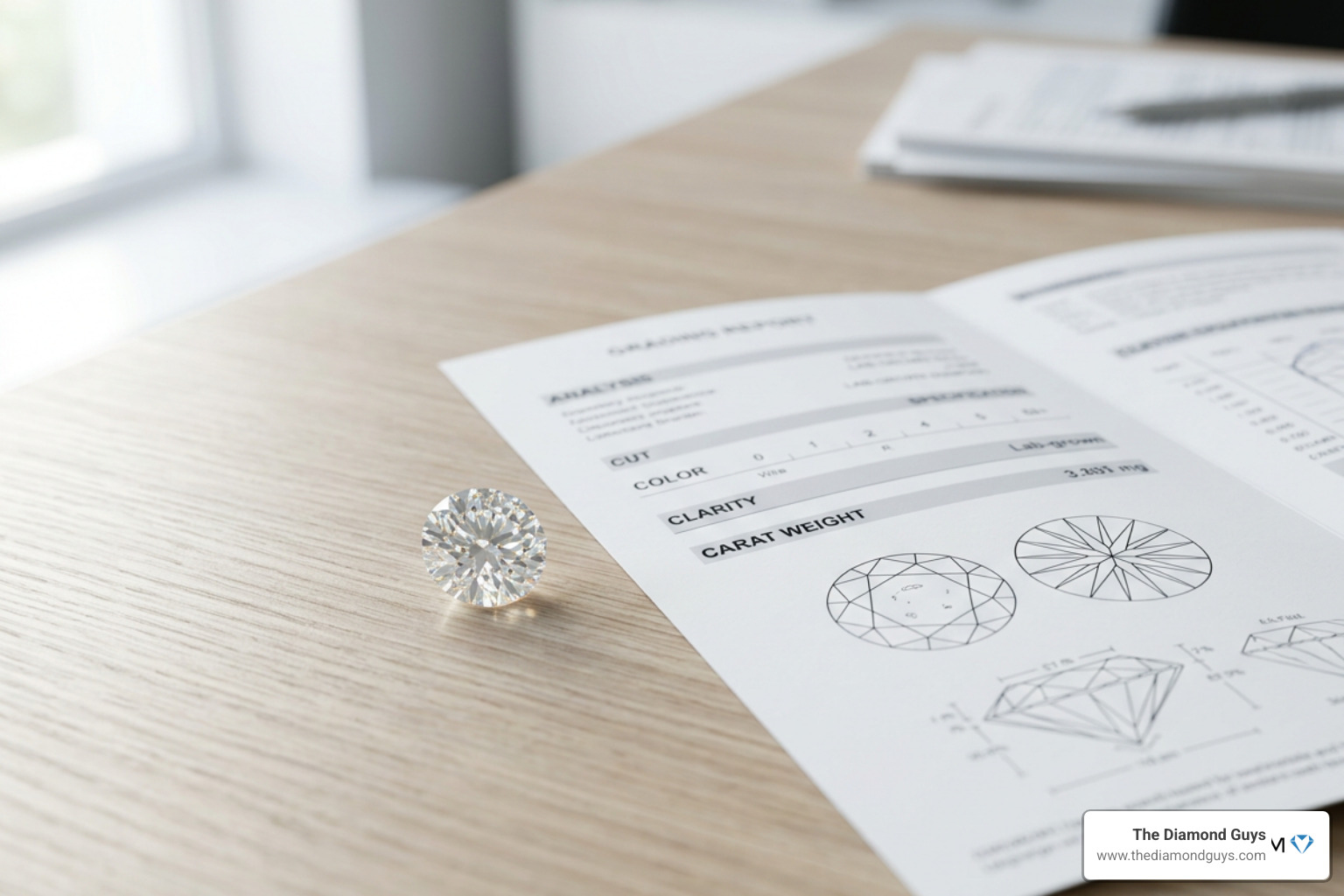
- Certification and Grading Reports: A grading report from a highly respected, independent laboratory is the single most important document you can possess. The Gemological Institute of America (GIA) and the International Gemological Institute (IGI) are the gold standards. An uncertified lab diamond is incredibly difficult to sell; buyers will grade the stone conservatively, often offering 20% to 40% less because they must assume the worst-case quality grades.
- Cut Quality: In the secondary market, cut is king. A diamond with an "Excellent" or "Ideal" cut grade maximizes light performance, giving the stone its signature brilliance and fire. Poorly cut lab diamonds look flat and glassy, making them nearly impossible to resell because there is zero retail demand for them.
- Carat Weight and Liquidity: The most liquid size range for lab-grown diamonds on the secondary market is between 1.00 and 2.00 carats. This is where the pool of everyday buyers is largest. While massive 4-carat or 5-carat lab diamonds exist, their target market is much smaller, which actually reduces their liquidity on the resale market.
- Color and Clarity: Colorless stones (graded D, E, or F) and eye-clean clarity grades (VS2 and above) remain the easiest to resell. It is also worth noting that fancy colored lab-grown diamonds (such as pink, blue, or yellow) sometimes hold their value slightly better than white equivalents due to their lower production volumes and consistent niche demand.
To see how carat weight and quality grades translate to current retail pricing, Check out our 1-carat man-made diamond price guide.
Where and How to Sell a Man-Made Diamond
If you find yourself needing to sell a lab-grown diamond, it is vital to set realistic expectations and choose the right channel. Traditional brick-and-mortar jewelers are rarely an option for cash buybacks of lab-grown stones because they can source brand-new, fully certified stones from wholesale factories for pennies on the dollar.
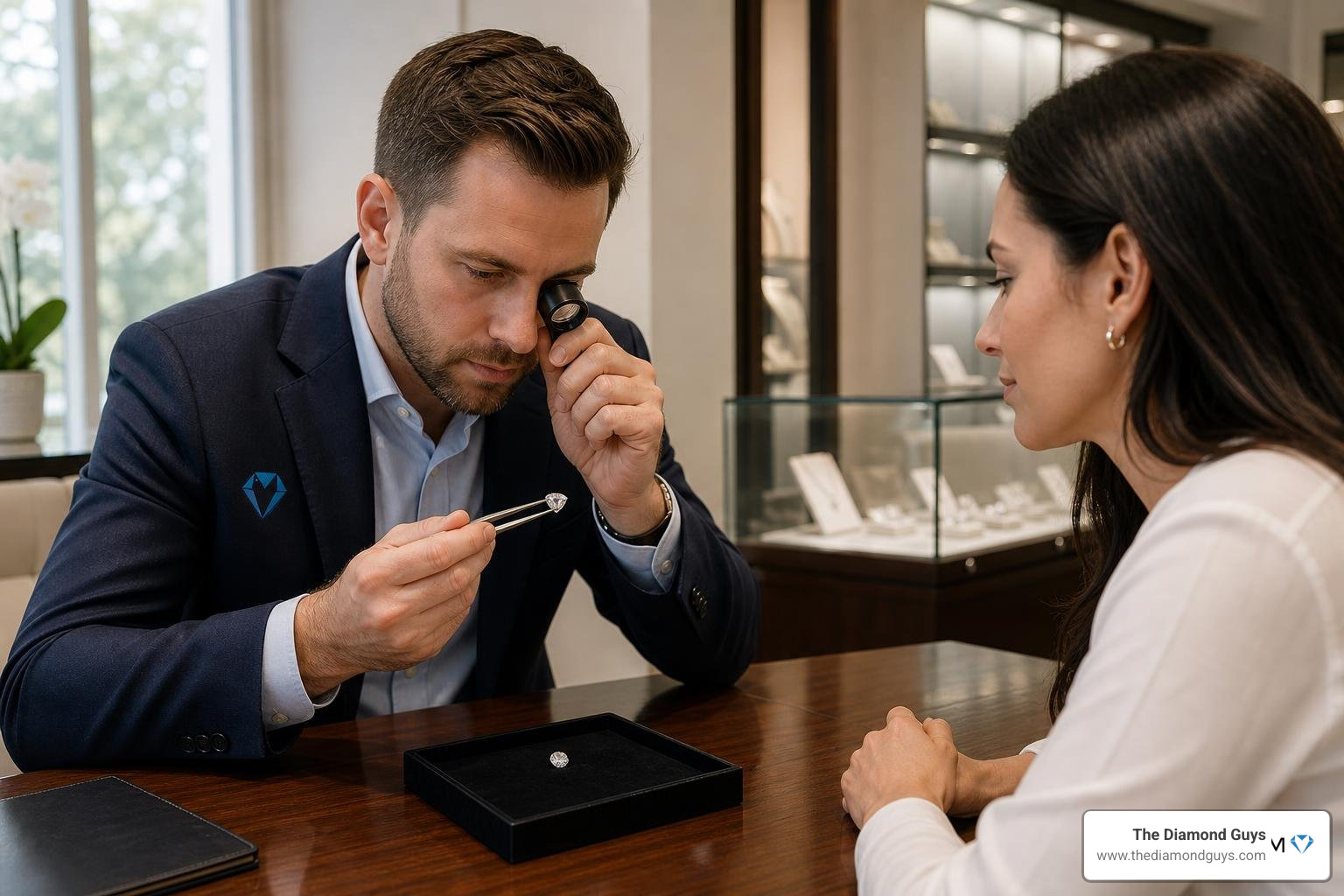
Here are the most common avenues for reselling a man-made diamond in 2026:
1. Peer-to-Peer Marketplaces (Best for Highest Return)
Platforms like eBay, Poshmark, or specialized jewelry consignment sites like Loupe Troop and Louped are your best bet for recovering some of your initial investment. By listing directly to private buyers, you can bypass the wholesale discount and aim to recover 20% to 30% of your original retail price. However, this path requires patience, as it can take several months to find a buyer, and you must protect yourself against online payment scams.
2. Consignment with Local Jewelers
Some independent, family-owned jewelry stores may agree to sell your lab-grown diamond ring on consignment. They will display the piece in their showroom and take a percentage (usually 20% to 30%) of the final sale price. This option takes time but often yields a higher return than a direct cash sale because the ring is sold as a finished piece of jewelry rather than a loose stone.
3. Retailer Trade-In and Upgrade Programs
Many premier jewelers offer trade-in programs where they allow you to apply the value of your current lab-grown diamond toward a more expensive purchase. While this is not a cash-out option, it is an excellent way to upgrade your jewelry. That these programs usually require you to spend at least double the original purchase price on the new item.
4. Pawn Shops (The Last Resort)
Pawn shops should only be used if you need immediate cash. Because pawn shops operate on rapid liquidation, they will heavily discount the lab-grown diamond—often valuing the stone at near-zero and paying you strictly for the scrap gold or platinum weight of the setting.
Maximizing the resale value of man made diamonds Before You Sell
If you decide to list your diamond for sale, taking a few simple steps can dramatically improve your chances of securing a serious offer:
- Get a Professional Steam Cleaning: A clean diamond looks larger, brighter, and higher in quality. For about $20 (or often for free at a friendly local jeweler), a professional steam cleaning can remove everyday oils and dirt, instantly improving the stone's visual appeal to potential buyers.
- Gather and Preserve All Original Documentation: Locate your original GIA or IGI grading certificate, sales receipt, and any insurance appraisals. Having these documents in their original sleeves proves authenticity and builds immediate trust with private buyers.
- Consider Separating the Stone from the Setting: If you are selling to a jeweler or a specialized buyer, they may only want the loose diamond. Separating the stone allows them to evaluate it cleanly, and it allows you to sell the gold or platinum setting separately for its scrap metal value based on current spot prices.
- Time Your Sale Strategically: The jewelry market experiences massive demand spikes during specific times of the year. Listing your ring for sale between November and February (peak proposal and holiday season) or right before Valentine's Day will expose your listing to a much larger pool of active buyers.
Frequently Asked Questions About Lab Diamond Value
Do lab-grown diamonds have any resale value at all, or is it effectively zero?
Yes, lab-grown diamonds do have resale value, but it is highly dependent on how and where you sell them. If you walk into a traditional jewelry store expecting a direct cash buyback, you may receive offers of zero because the jeweler can buy brand-new wholesale stones cheaper. However, on peer-to-peer marketplaces and consignment platforms, high-quality, certified lab-grown diamonds consistently sell for 10% to 30% of their original retail price. The setting itself will always retain its scrap metal value based on the weight of the gold or platinum.
Should I care about resale value if I plan to keep the ring forever?
For the vast majority of engagement ring buyers, resale value is a purely theoretical metric that has no impact on their daily lives. An engagement ring is a symbol of love, commitment, and shared future goals. If you never intend to sell the ring, its future market value is irrelevant. Choosing a lab-grown diamond allows you to secure a larger, visually stunning stone while keeping thousands of dollars in your pocket for practical life goals like buying a home, traveling, or investing.
Are there retailers that offer guaranteed buyback or trade-in value?
Yes, some progressive independent jewelers and specialized online retailers offer guaranteed trade-in policies for lab-grown diamonds. These programs typically allow you to trade in your original lab-grown stone for a 100% credit toward a new diamond that is at least double the value of the original. Always ask for the specific terms and conditions of these policies in writing before purchasing, as buyback programs for direct cash are incredibly rare due to falling market prices.
Conclusion
At the end of the day, navigating the resale value of man made diamonds comes down to aligning your budget with your personal values. If your primary goal is to purchase an heirloom asset that retains a predictable percentage of its cash value over decades, a natural diamond remains the traditional choice.
But if you view a diamond as a beautiful, durable symbol of love rather than a financial investment, choosing a lab-grown diamond is an incredibly smart financial move. The massive upfront savings inherently offset the lower resale value, leaving you with more real-world capital to build your life together.
At The Diamond Guys, we pride ourselves on being a 5-star rated jewelry store with showrooms in Scottsdale, AZ and Los Angeles, CA. We specialize in custom engagement rings, offering both ethically sourced natural diamonds and premium lab-grown stones. Our mission is to provide expert, pressure-free guidance and a deeply personalized shopping experience that sets us apart from big-box retailers. Whether you are looking to design a custom ring or simply want to understand your options, our team is here to help you shop with open eyes.
To explore your options and find the perfect setting for your story, Explore our comprehensive lab diamond jewelry store guide.


