

The Ultimate Guide to Professional Ring Sizing Services
Understanding Ring Sizing Costs and At-Home Sizing

When you send a ring to a bench jeweler, pricing depends heavily on the precious metal, whether you are sizing up or down, and how many sizes need adjusting. Sizing down requires cutting out a small section of metal and soldering or laser-welding the band back together. Sizing up usually requires cutting the shank, pulling the metal open, inserting a new piece of matching precious metal alloy, and welding it seamlessly.
Here is a general pricing overview for standard resizing across common metal types:
| Metal Type | Resizing Down Cost | Resizing Up (1 Size) Cost | Resizing Up (4 Sizes) Cost |
|---|---|---|---|
| Sterling Silver | $40 – $45 | $40 | $100 |
| Yellow / White Gold | $45 – $79 | $44 – $85 | $104 – $180 |
| Stainless Steel | $45 – $60 | $60 | $120 |
| Platinum | $79 – $100 | $194 | $254 |
Prices vary based on metal density, current gold and platinum market values, and structural complexity. For instance, learned jewelers must account for stone resetting or re-tipping if a band's curvature shifts dramatically. If you are wondering whether a piece with delicate accent stones can handle this work, check out our guide on Can Engagement Rings Be Resized.
How to Measure Your Ring Size at Home
Finding an accurate ring measurement at home requires taking finger fluctuations into account. Fingers swell in warm weather, shrink in the cold, and expand after exercise.
- The Sizing Strip Method: Wrap a flexible paper strip or cloth tape measure around the base of your finger. Mark the point where the paper overlaps, measure the distance in millimeters, and compare it to a standard sizing chart.
- The Existing Ring Method: Print a calibrated ring sizing chart and align an existing, perfectly fitting ring over the printed circles until the inner diameter matches precisely.
- Sizing Kit: Many online jewelry services offer plastic sizer loops. This is the most accurate home method because it mimics a metal band over your knuckle.
For a deep dive into ideal tension, read our breakdown on How Should Engagement Rings Fit.
Cost Factors for Sizing Up vs. Sizing Down
Sizing down is usually less expensive because labor is the primary expense. The jeweler removes metal, welds the seam, and polishes the ring.
Sizing up costs more because it requires raw material additions. Adding gold or platinum to a thick band increases material costs instantly. Platinum demands specialized torch equipment and higher melting temperatures, making platinum adjustments significantly higher in price. Detailed information on wedding ring alterations can be found in our Resizing Wedding Band Complete Guide.
Metal Compatibility: Which Rings Can Be Resized?
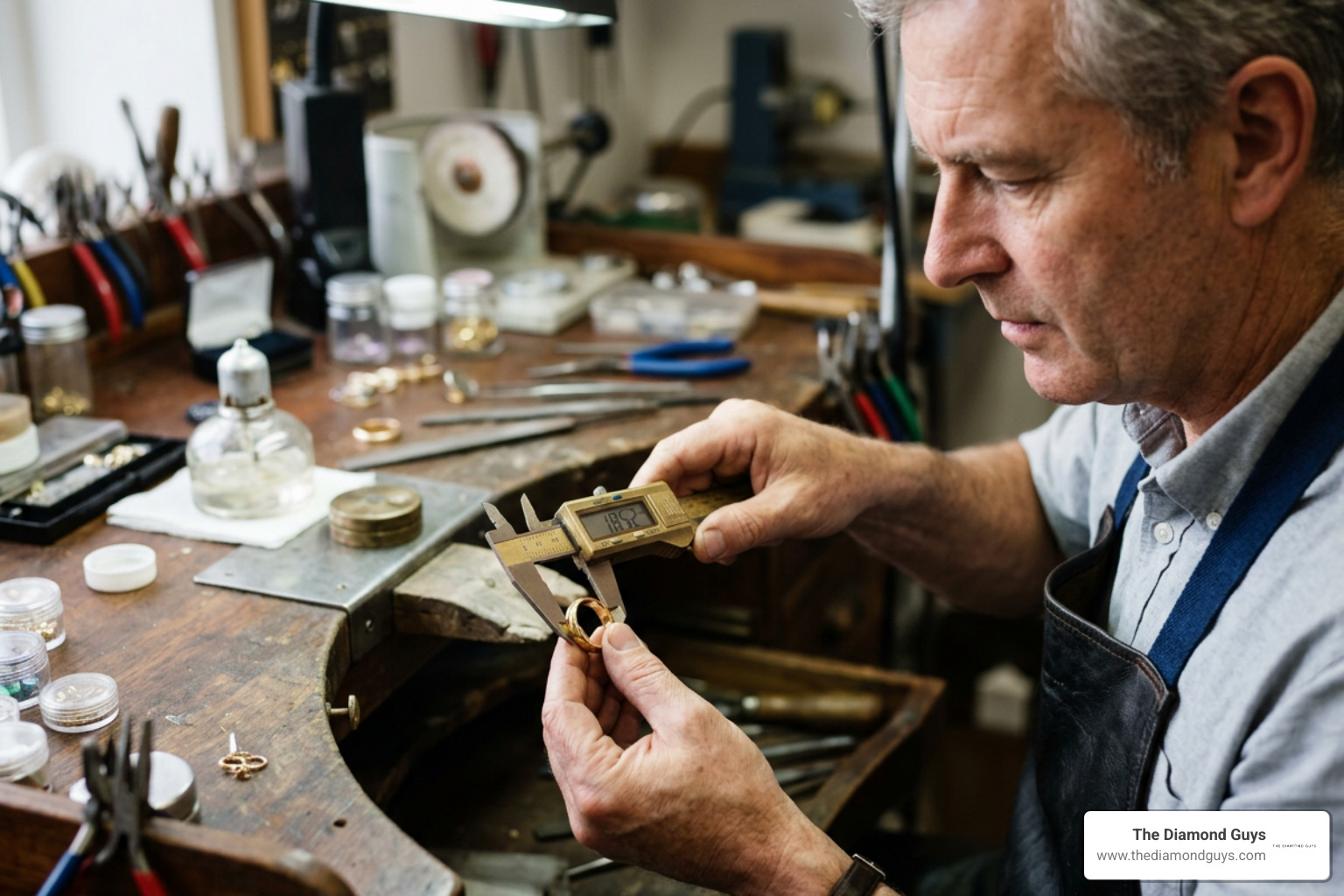
Not all jewelry metals behave the same under intense heat or mechanical pressure. Precious metals yield well to jeweler tools, whereas modern alternative metals do not allow traditional manipulation.
Resizable Precious Metals
- Yellow Gold & Rose Gold: Highly ductile and easily workable. Jewelers add matching Karat alloy to ensure seam lines disappear completely.
- White Gold: Excellent candidate for resizing, though it requires a fresh rhodium plating coat afterward to restore its bright silver finish.
- Platinum: Densest and most durable fine jewelry metal. Resizing requires master-level bench skills and direct high-heat laser welding to prevent micro-porosity at the weld seam. Review our Platinum Ring Resizing Complete Guide for more on working with this metal.
- Sterling Silver: Easily resized up or down, offering lower costs for basic labor.
For standard precious metal maintenance advice, consult our Gold Jewelry Repair Guide 2026.
Alternative Metals That Cannot Be Resized
- Tungsten Carbide: Extremely hard and brittle. Tungsten cannot be cut or soldered; attempting to alter it will shatter the ring.
- Titanium: Titanium has an exceptionally high melting point and high structural memory, making traditional jeweler soldering impossible.
- Stainless Steel & Cobalt: While some industrial facilities can compress stainless steel slightly, most local and mail-in jewelry shops will not resize these metals due to tool damage risks.
Sizing Complex Ring Styles: Eternity Bands, Engravings, and Settings

Structural elements, continuous patterns, and delicate gemstone settings alter the resizing process considerably.
Resizing Channel-Set and Engraved Bands
Channel-set bands lock accent stones in place between two parallel metal tracks. Changing the band's curvature expands or tightens these tracks, potentially loosening accent diamonds or crushing their girdles. Jewelers must check prong and channel tension under high magnification following any size shift.
When working with continuous machine or hand engravings, traditional sizing breaks the seamless pattern. Skilled craftsmen use fine laser welding to join metal and re-engrave the missing section by hand. Learn more about structural repairs in our comprehensive Ring Repair Guide 2026.
The Challenges of Full Eternity Rings
Full eternity bands present a distinct challenge because diamonds or gemstones circle the entire perimeter without leaving bare metal for cutting.
- Minor Adjustments: A jeweler may shave off a fraction of a millimeter from the inside wall of the ring to make it slightly larger without disturbing settings.
- Major Adjustments: Adding or removing sizes typically requires unmounting stones, remaking the underlying metal band entirely, and resetting every gem. In many cases, remaking the piece from scratch is safer for the gemstones.
Alternative Solutions for Loose Rings: Sizing Beads and Spring Shanks
If your ring spins constantly or slips off easily, complete metal cutting isn't always required. Non-destructive mechanical options work wonders—especially for top-heavy center diamonds or enlarged knuckles.
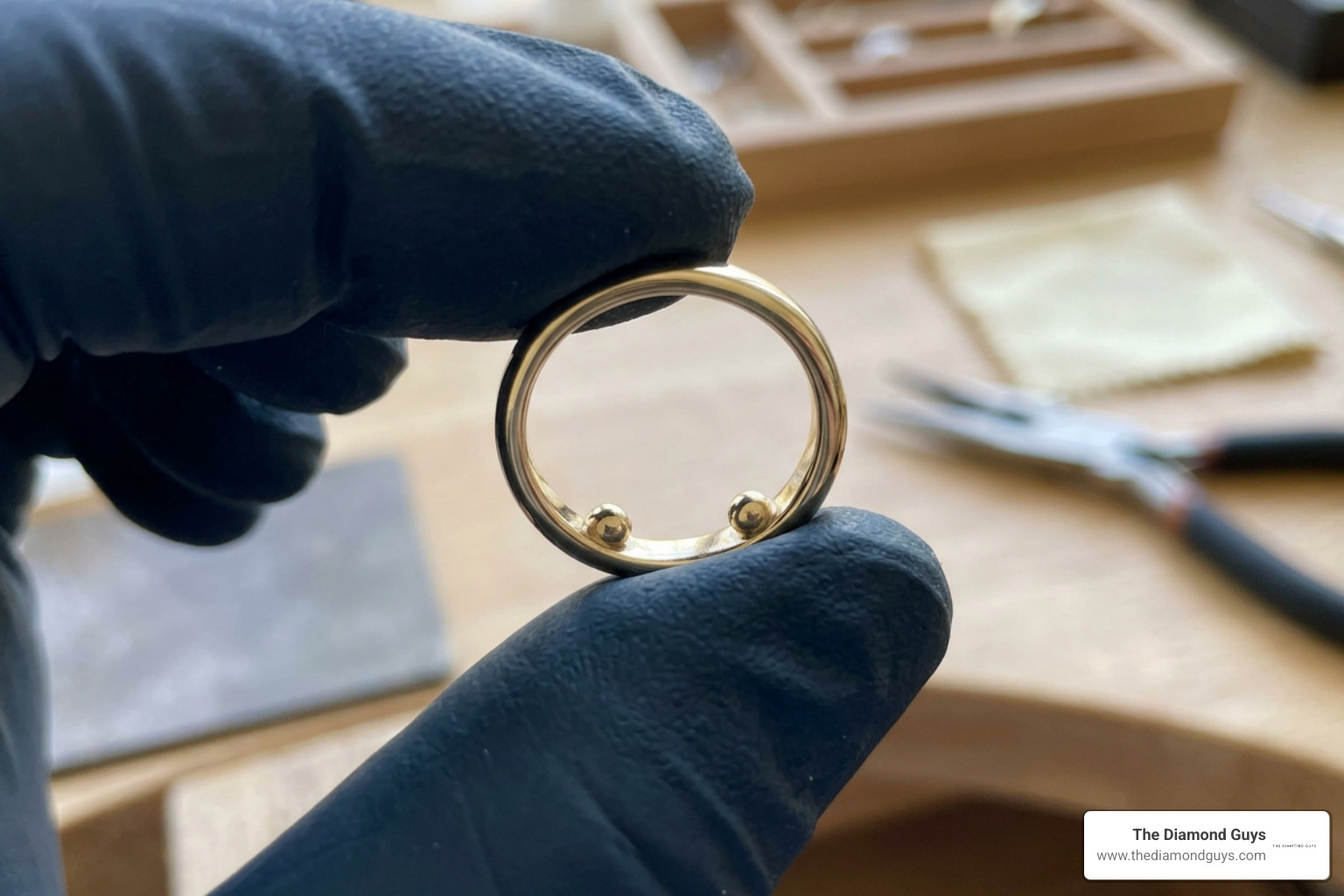
Stabilizing Beads and Inserts
- Sizing Beads: Two small metal spheres soldered onto the inside lower shank. They provide friction against your finger to stop top-heavy rings from flipping over while allowing the ring to pass comfortably over larger knuckles.
- Speed Bumps / Inserts: A flat inner bridge that subtly reduces ring diameter without structural alterations.
Stabilizing options like sizing beads and spring shanks usually start around $149. Read more about managing loose rings in our article Can an Engagement Ring Be Too Big.
Hinged Mechanics and Re-shanking
For severe swelling or arthritic joint passages, force-fitting a small ring over a large knuckle causes pain and damage. Jewelers solve this with an expandable hinged shank (like a Cliq shank mechanism) or by replacing a worn lower ring band entirely. Explore structural shank replacement in detail through our article on Re-shanking a Ring.
Choosing the Right Professional Ring Resizing Service
Choosing between local in-person bench service and nationwide mail-in repair depends on convenience, turnaround speed, and personal preference.
Local Bench Jewelers vs. Mail-In Ring Resizing Service
- Local Bench Jewelers: Offer in-person measurements, face-to-face consultations, and often faster turnarounds without shipping transit times.
- Mail-In Services: Provide convenience for clients without immediate access to specialized master jewelers. Reliable providers supply fully insured shipping containers (often covering up to $10,000 in transit value) and precise tracking updates.
What to Expect From a Professional Ring Resizing Service
A high-grade ring resizing service follows a disciplined quality assurance path:
- Microscopic Metallurgical Inspection: Checking for hidden structural stress, thin solder joints, or loose stones.
- Laser Welding & Alloy Matching: Joining metal using identical gold/platinum purities to prevent discolored seams.
- Prong Tightening & Stone Security Check: Checking every gem under high-power magnification after altering band curvature.
- Professional Polish & Cleaning: Refinishing metal surfaces and steam-cleaning stones to deliver a brand-new appearance.
For ongoing care tips, see our full Engagement Ring Maintenance Guide 2026.
Frequently Asked Questions About Ring Sizing
How long does a ring resizing service take?
Standard turnarounds at local bench jewelers range between 3 to 5 business days after order approval. Direct mail-in programs or specialized brand turnarounds can take anywhere from 1 to 2 weeks (or up to 8 weeks for complex custom rebuilds).
Will resizing damage my ring or leave visible seam lines?
No. Master jewelers match metal alloys perfectly and apply seamless laser welding techniques. Once fully buffed and polished, no seam or structural weakness remains visible.
What should I do if my ring still doesn't fit after resizing?
Finger sizes shift seasonally and throughout the day due to temperature changes and water retention. If a newly resized ring remains uncomfortably loose or tight after a two-week wear period, return to your jeweler for a fit evaluation or consider adding removable sizing clips before committing to another metal alteration.
Conclusion
A treasured ring should feel comfortable, secure, and effortless to wear every day. Whether you need a simple size-down adjustment, platinum sizing, or specialized stabilizing beads, working with trusted professionals ensures your fine jewelry stays structurally sound for a lifetime.
At The Diamond Guys, we pride ourselves on providing custom guidance, ethical sourcing, and expert jewelry services tailored to your needs. If you're in Scottsdale, AZ or the greater Phoenix area, visit us or reach out today to get your ring fitted perfectly!


