

Real Truth Behind Lab Grown Diamond Reviews and Resale Value
What Lab Grown Diamond Reviews Tell Buyers
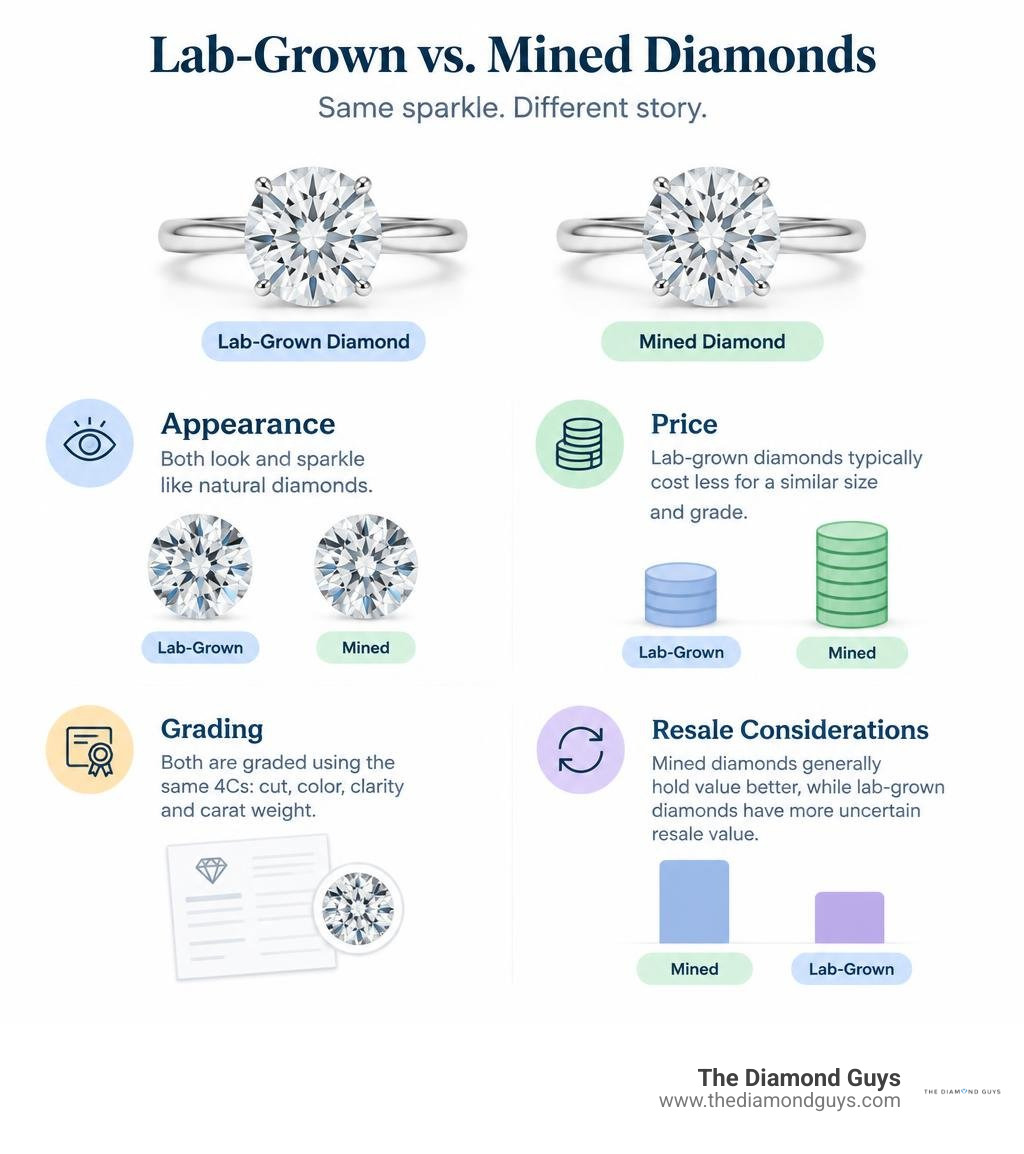
The short answer: Buyers generally find that lab-grown diamonds look and sparkle like mined diamonds. They are real diamonds, not cubic zirconia or moissanite. Their main draw is a lower price for a similar size and grade; their main trade-off is uncertain resale value. For an engagement ring, focus on cut quality, check an independent grading report, and make sure the recipient is happy with a lab-grown stone.
Individual stones still vary. Some may show a tint or growth features, so photos, video, and a clear return policy matter when you buy online.
I'm Morgan Price, and my work in research-led editorial outreach has taught me to check claims against reliable sources rather than take marketing at face value. In this guide, I'll use that approach to make lab grown diamond reviews more useful for your decision.
Easy lab grown diamond reviews word list:
For broader context on how synthetic stones are classified, the synthetic diamond entry on Wikipedia explains the same carbon crystal structure and production methods used in modern lab-grown gems.
Analyzing Real Lab Grown Diamond Reviews: Appearance, Quality, and Sparkle
When buyers dive into lab diamond feedback across consumer forums and verified purchase logs, the very first question is almost always visual: Can anyone tell?
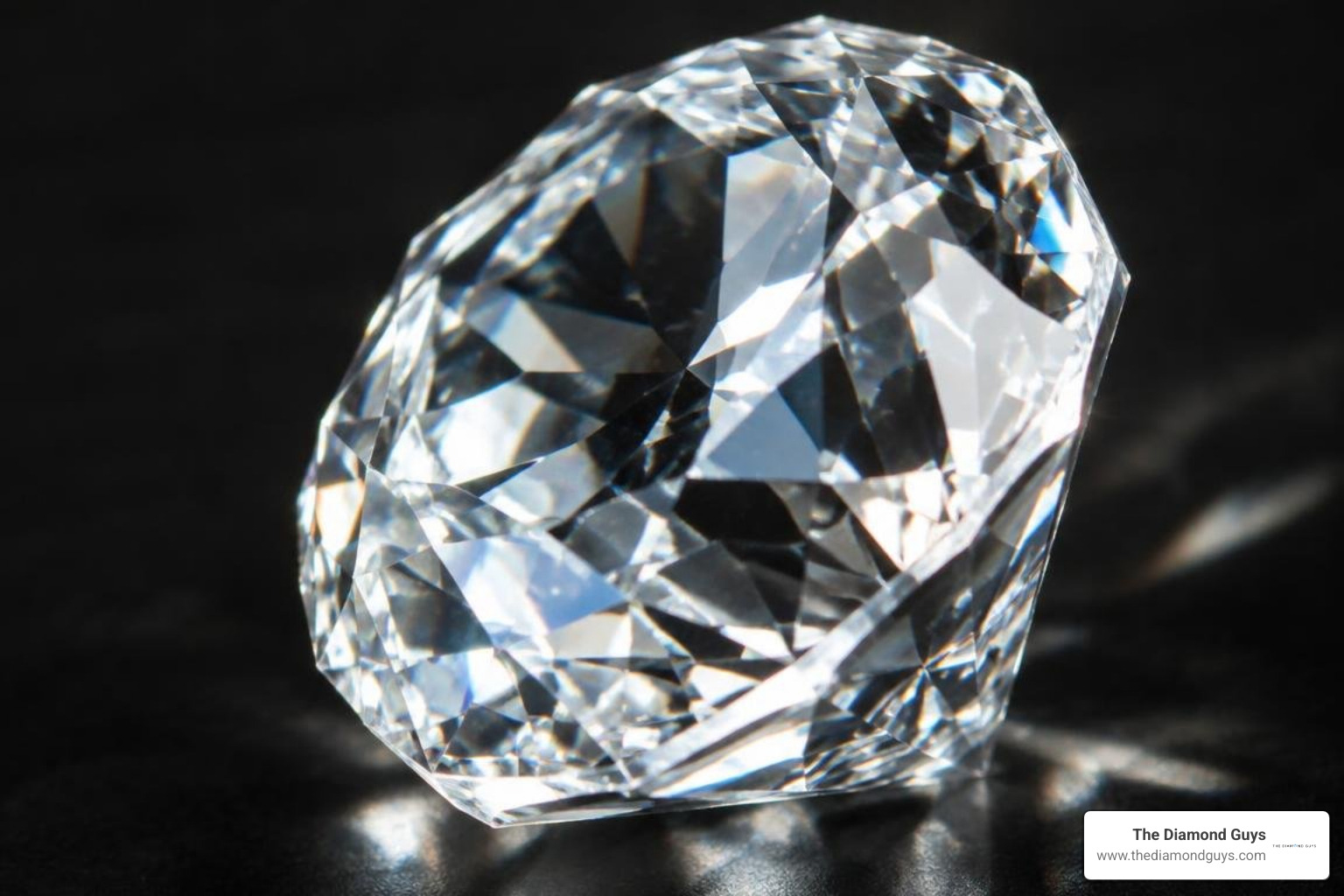
The overwhelming consensus among both everyday shoppers and master gemologists is an emphatic no. When placed under standard jewelry lighting or daylight, lab-created diamonds exhibit identical optical properties to Earth-mined gems. They are not diamond imitations, synthetic lookalikes, or simulant stones. Mined and lab diamonds share the exact same refractive index (2.42) and dispersion rate (0.044), which dictate how light enters, bends, and bounces back to your eye as brilliant flashes of white and rainbow fire.
A common misconception circulating in outdated forums is whether lab diamonds develop a haze over time. As we cover in our guide exploring do lab grown diamonds get cloudy, a genuine laboratory-grown diamond will never cloud, discolor, or degrade on its own. Because its pure carbon lattice is identical to a natural gem, its clarity and brilliance remain permanent for life, requiring only routine cleaning to remove everyday lotions and oils.
What Lab Grown Diamond Reviews Say About Visual Differences and Sparkle
Real buyers consistently report that when they mix natural and lab diamonds—such as setting a lab-grown center stone into a ring with natural side stones—there is zero distinguishable difference to the naked eye. Both stones react to light with the same scintillation, brilliance, and dispersion.
Simulants like cubic zirconia (CZ) or moissanite often stand out because of their different optical behaviors. Moissanite has a higher refractive index and double refraction, which produces a characteristic "disco-ball" rainbow flash. Cubic zirconia, conversely, lacks diamond's depth of scintillation and easily scratches or fogs over time. A lab diamond delivers the authentic, sharp, deep sparkle of pure crystallized carbon. Understanding the optical architecture of facet angles is key, as highlighted in our breakdown of what makes a lab grown solitaire shine.
The 4Cs Comparison: Cut, Color, Clarity, and Carat
Lab-grown diamonds are assessed using the identical universal 4Cs grading system created by the Gemological Institute of America (GIA) and utilized by the International Gemological Institute (IGI). Whether created in a plasma reactor or mined from deep underground, each stone is individually mapped, cut, polished, and graded on its independent merits.
| 4Cs Parameter | Lab-Grown Diamonds | Natural Mined Diamonds | Practical Buyer Takeaway |
|---|---|---|---|
| Cut | Graded from Poor to Excellent / Ideal based on facet proportions and symmetry. | Graded from Poor to Excellent / Ideal based on facet proportions and symmetry. | Cut grade is the single biggest factor determining sparkle in both diamond types. |
| Color | Graded on the D-to-Z scale; fancy colors (pink, blue, yellow) available. | Graded on the D-to-Z scale; natural fancy colors occur via rare geological impurities. | Colorless (D–F) and near-colorless (G–H) grades look identical across both origins. |
| Clarity | Graded from Flawless (FL) to Included (I3); internal growth traces may occur. | Graded from Flawless (FL) to Included (I3); natural mineral inclusions may occur. | Eye-clean VS1–VS2 grades offer optimal value in both categories without visible flaws. |
| Carat Weight | Grown in controlled batches to precise weight targets up to large carat sizes. | Dependent on natural mineral discovery; large rough crystals are exceptionally rare. | Lab diamonds allow buyers to select significantly higher carat weights within the same budget. |
Independent grading reports verify these attributes. Premium lab-created gems carry an inscription on the girdle with a unique certificate number, ensuring full transparency regarding their laboratory origin and quality metrics.
Manufacturing Methods: HPHT vs CVD Diamonds Explained
Modern laboratory diamonds are produced using two advanced technological processes: High Pressure High Temperature (HPHT) and Chemical Vapor Deposition (CVD).
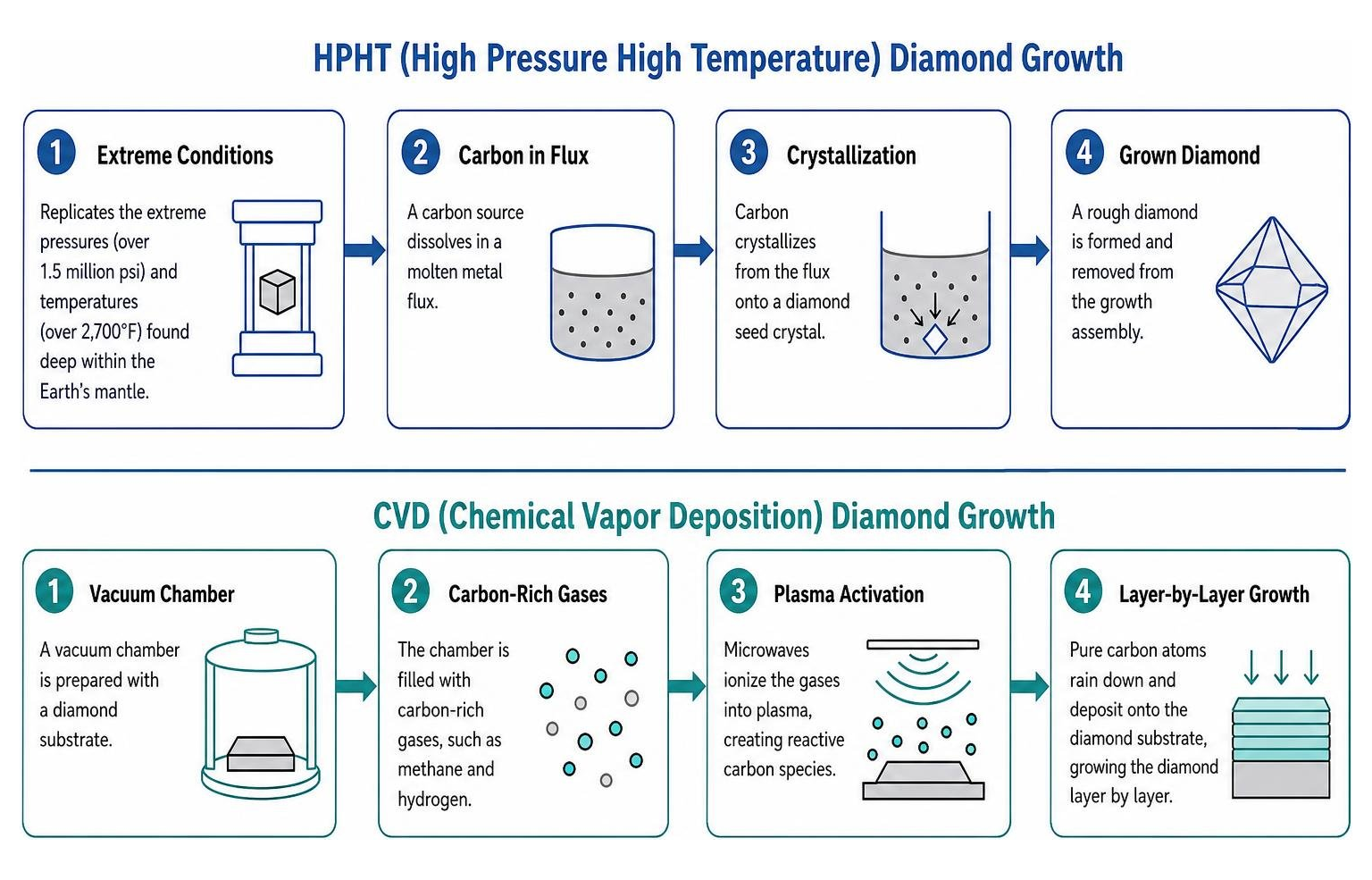
- HPHT (High Pressure High Temperature): This method replicates the extreme geological pressures (over 1.5 million pounds per square inch) and temperatures (over 2,700°F) found deep within the Earth's mantle. A carbon source dissolves in a molten metal flux and crystallizes onto a diamond seed crystal.
- CVD (Chemical Vapor Deposition): This technique uses a vacuum chamber filled with carbon-rich gases (such as methane and hydrogen). Microwaves ionize the gas into plasma, causing pure carbon atoms to rain down and deposit onto a diamond substrate layer by layer.
Growth Lines, Graining, and Blue Nuance Nuances
While both production methods yield genuine diamonds, each process can leave behind microscopic growth characteristics that specialist gemologists look for during laboratory grading.
- Internal Graining & Growth Striations: Because CVD diamonds grow in thin upward sheets, rapid growth cycles can occasionally produce subtle internal grain lines or striations. If severe, these can scatter light and reduce crispness.
- Blue Nuance (Phosphorescence): In some HPHT diamonds, trace amounts of the element boron are used during synthesis to accelerate growth. This can occasionally impart a very faint blue-gray tint known as "blue nuance."
High-grade stones vetted by experienced jewelers show no visible strain patterns or unwanted tints. When evaluating stones, working with dedicated gem experts ensures your chosen diamond exhibits crisp clarity and pristine light reflection.
Advantages, Downsides, and the Resale Value Reality
The primary advantage highlighted in consumer reviews is financial efficiency. Lab-created diamonds typically cost 30% to 40% less than natural mined diamonds of equivalent cut, color, clarity, and carat weight. This pricing differential lets buyers maximize their setting budget, select a higher clarity and cut grade, or choose a larger center stone. You can explore exact market figures in our lab grown diamond ring cost guide and our 1 carat man made diamond price guide.
Evaluating Lab Grown Diamond Reviews on Long-Term Resale Value
The most significant trade-off discussed in lab diamond reviews centers on long-term resale value. Mined diamonds have a centuries-old secondary market with established liquidity, even though retail buyers still experience depreciation when selling back to wholesalers.
Lab-grown diamonds, by contrast, possess a much softer secondary resale market. As manufacturing technologies continue to advance and supply scales globally, the cost to produce new lab diamonds continues to decline. As a result, pawn shops, secondary jewelers, and consignment platforms offer minimal buyback value for pre-owned lab diamonds.
Reviews from practical buyers suggest viewing a lab diamond the same way you view fine electronics or a custom wedding dress: an emotional purchase meant to be worn, celebrated, and cherished for a lifetime, rather than an investment asset or financial hedge.
Ethical Sourcing, Sustainability, and Ring Insurance
For many modern couples, the ethical and environmental benefits are the deciding factor. Lab-created diamonds eliminate the need for open-pit earth mining, avoiding associated habitat disruption, soil erosion, and heavy industrial excavation. As detailed in our overview of lab diamonds as an ethical source, lab synthesis offers a fully traceable supply chain free from conflict concerns.
Furthermore, protecting your fine jewelry is straightforward. As covered in our guide on can you insure lab grown diamonds, major specialty insurers provide full coverage for lab-created engagement rings against loss, theft, and damage, basing premiums directly on the retail replacement value listed on your grading appraisal.
Choosing Lab Diamonds for Engagement Rings: Recipient Sentiment and Buying Advice
Recipient sentiment toward lab-grown diamonds has reached all-time highs, particularly among couples who value design customization and budget flexibility. However, transparent communication is essential before making a final purchase.
Reviews show that while most partners are thrilled to receive a substantially larger, visually flawless stone within budget, some individuals still place high sentimental value on the geological rarity of a natural diamond formed over billions of years. Having an open conversation about preferences ensures both partners feel confident in the choice.
For those who choose the lab route, pairing a premium center stone with bespoke craftsmanship transforms the ring into a true personal statement. You can explore design inspirations in our custom lab grown diamonds guide and discover the endless possibilities of lab diamond custom jewelry.
Key Considerations When Buying Lab Grown Diamonds Online and In-Store
Buying an engagement ring requires balancing convenience with visual verification. While online vendors offer extensive searchable databases, in-store consultations allow you to examine cut performance and color face-to-face.
| Purchasing Factor | Online Retail Platforms | In-Store Specialty Jewelers (The Diamond Guys) |
|---|---|---|
| Visual Inspection | Limited to 360-degree digital videos and static 2D grading plots. | Side-by-side physical inspection under varied, real-world lighting environments. |
| Quality Verification | Buyer must self-screen for nuanced defects like CVD graining or HPHT blue nuance. | Expert gemologists curate only clean, high-performance stones free from optical defects. |
| Custom Design Service | Standard catalog settings with limited bespoke modification options. | Fully custom, hands-on design consultations tailored to your exact ring vision. |
| Ongoing Maintenance | Requires shipping rings back via mail for basic cleanings and prong re-tipping. | Direct, local access to complimentary cleanings, inspections, and sizing support. |
| Return Policies | Typically 30-day mail return windows, often requiring insured return shipping fees. | Personalized service backed by clear local store guarantees and dedicated support. |
Whether you browse collections online or visit us directly at our showrooms in Scottsdale, AZ, or Los Angeles, CA, having an expert guide you through the 4Cs guarantees you get exceptional light performance without hidden flaws.
Frequently Asked Questions About Lab Grown Diamonds
Can a jeweler tell if a diamond is lab-grown?
A jeweler cannot distinguish a top-quality lab-grown diamond from a natural diamond using standard jeweler's loupes or basic handheld thermal testers. Because both diamond types share identical chemical, thermal, and optical properties, traditional diamond testers will read both as "real diamond."
To identify a lab diamond, gemologists use specialized laboratory spectrometers that analyze photoluminescence patterns, deep-UV fluorescence reactions, and crystal growth structures. Additionally, almost all certified lab diamonds feature a microscopic laser inscription on their girdle (such as "LG" followed by the report number) visible under 30x magnification.
Do lab-grown diamonds lose their sparkle or change color over time?
No. Lab-grown diamonds do not lose their sparkle, fade, or shift color over time. Because they possess a hardness rating of 10 on the Mohs scale—the highest possible mineral hardness—they are completely resistant to scratches from daily wear, chemical degradation, and sunlight exposure.
Any perceived loss of sparkle over months or years of wear is simply caused by the natural buildup of hand lotions, body oils, and dust on the underside of the stone's pavilion. A quick soak in warm water with mild dish soap followed by a gentle brushing with a soft toothbrush immediately restores the diamond's original brilliance.
Are lab-grown diamonds considered real diamonds by grading authorities?
Yes. In 2018, the United States Federal Trade Commission (FTC) officially updated its Jewelry Guides, ruling that a diamond is a diamond regardless of whether it was extracted from the earth or created in a laboratory. The FTC confirmed that the definition of a diamond is pure crystallized carbon in the isometric system.
Leading independent gemological institutions, including the Gemological Institute of America (GIA) and the International Gemological Institute (IGI), issue full diamond grading certificates for lab-grown stones, evaluating them against identical cut, color, clarity, and carat standards.
Conclusion
Consumer reviews and real-world buyer experiences tell a clear story: lab-grown diamonds provide exceptional beauty, uncompromising durability, and remarkable value. By offering identical physical and optical brilliance at a fraction of the cost, they allow couples to create breathtaking, ethically minded engagement rings without compromise.
At The Diamond Guys, we pride ourselves on delivering a transparent, personalized shopping experience that sets us apart from impersonal online warehouses and big-box retailers. For more expert advice on selecting the right setting and stone, explore our comprehensive guide to choosing the right lab diamond jewelry store or visit our master jewelers to find your perfect diamond today.


