

Why a 3 Carat Round Lab Grown Diamond Ring is the Ultimate Flex
The Smartest Way to Go Big: What to Know Before You Buy a 3 Carat Round Lab Grown Diamond Ring

A 3 carat round lab grown diamond ring is one of the most impressive pieces of jewelry you can buy — and in 2026, it's finally within reach for most budgets.
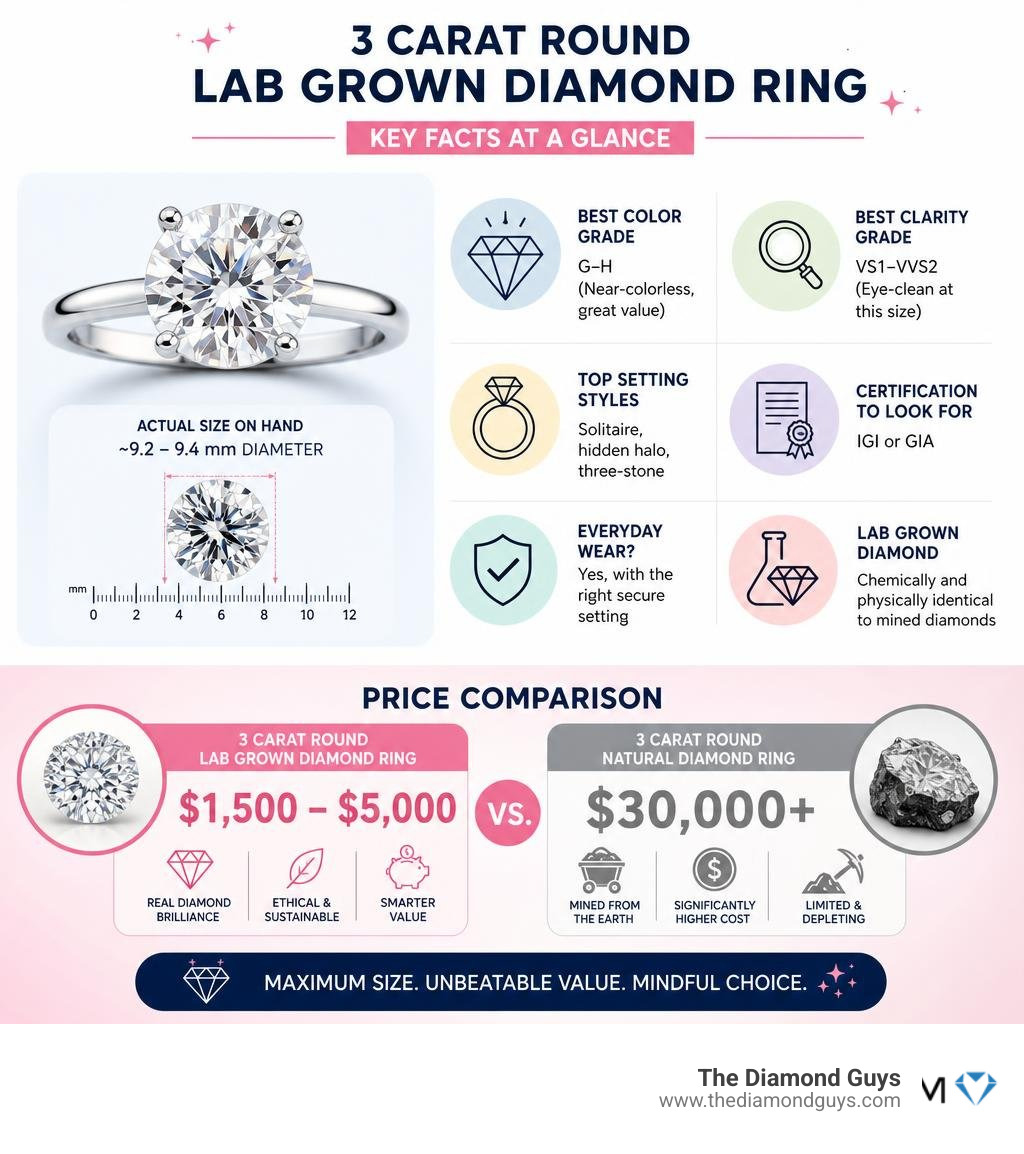
Here's a quick snapshot of what you need to know:
| What You're Asking | The Short Answer |
|---|---|
| Average price range | $1,500 – $5,000 (vs. $30,000+ natural) |
| Physical size on hand | ~9.2–9.4 mm diameter |
| Best color grade | G–H (near-colorless, great value) |
| Best clarity grade | VS1–VVS2 (eye-clean at this size) |
| Top setting styles | Solitaire, hidden halo, three-stone |
| Certification to look for | IGI or GIA |
| Everyday wear? | Yes, with the right secure setting |
Lab grown diamonds are chemically and physically identical to mined diamonds. Even trained jewelers can't tell them apart without specialized equipment. The only real difference? The price tag — and where the diamond came from.
A 3 carat stone is a big diamond. It commands attention. It fills the finger. And when it's cut well, the brilliance is genuinely breathtaking. For couples who want maximum visual impact without compromising on quality or ethics, it's hard to beat.
I'm Morgan Price, a strategic SEO and content specialist with deep experience researching and sourcing information on 3 carat round lab grown diamond rings across the fine jewelry market. In this guide, I'll walk you through everything The Diamond Guys' clients ask before making this purchase, so you can buy with total confidence.
Important 3 carat round lab grown diamond ring terms:
The Anatomy of a 3 Carat Round Lab Grown Diamond Ring
When we talk about a 3 carat diamond, we are talking about a serious statement piece. But what does "3 carats" actually mean in terms of physical presence?
First, let's clear up a common misconception: carat is a measure of weight, not size. A 3 carat diamond weighs exactly 0.6 grams. Because weight can be distributed differently depending on how a stone is cut, two diamonds with the exact same carat weight can look slightly different in size.
However, when you choose a classic round brilliant cut, the physical dimensions are remarkably consistent. A well-cut 3 carat round diamond typically measures between 9.2 mm and 9.4 mm in diameter. To put that in perspective, that is nearly a full centimeter across. On the average hand, a stone of this diameter provides incredible finger coverage, making it look undeniably substantial and eye-catching.
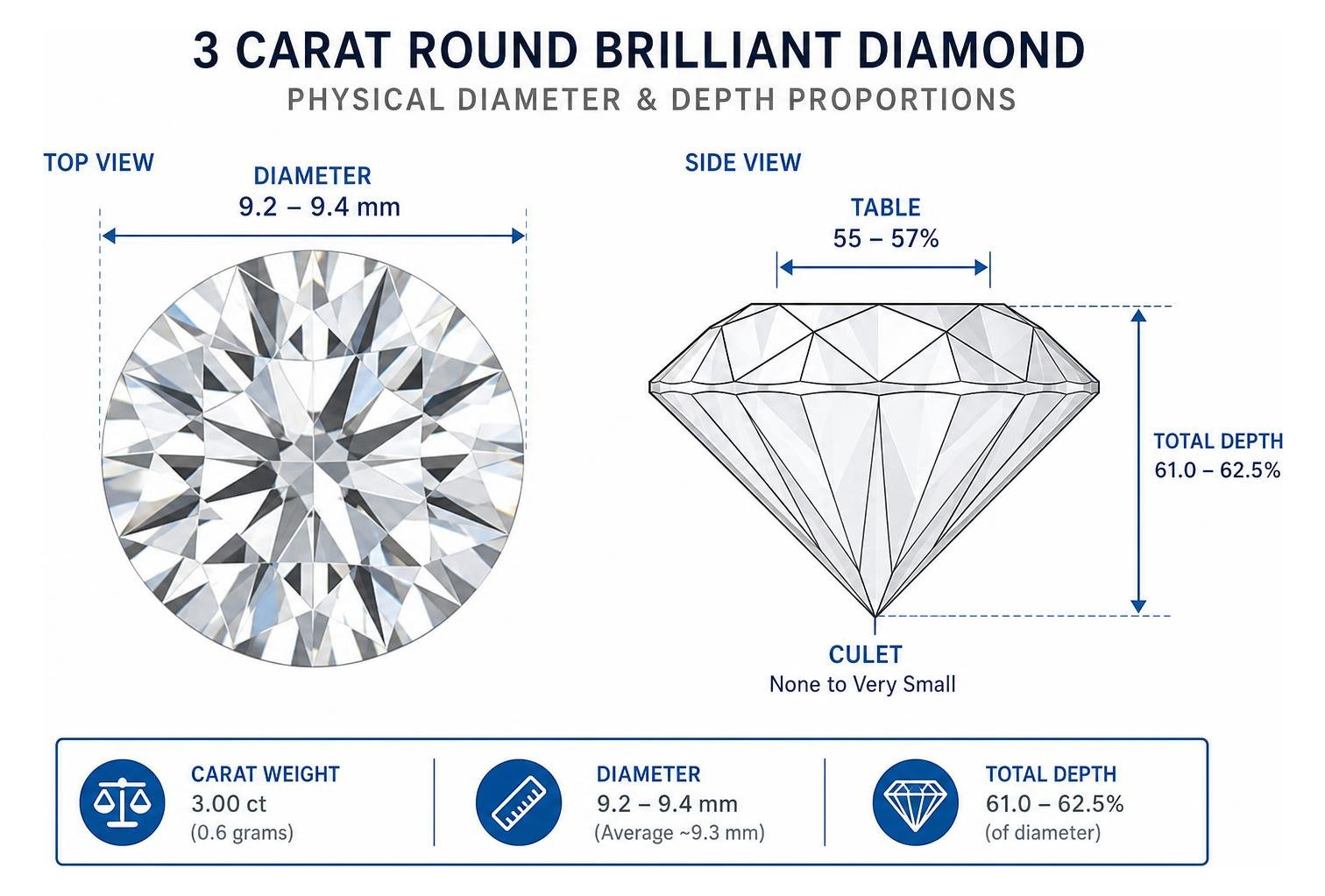
Understanding the relationship between weight, cut, and visual footprint is essential when shopping. If you want to dive deeper into how diamond weight translates to real-world dimensions, check out our guide on What is Diamond Carat Size.
Choosing a round cut is particularly advantageous for a 3 carat stone. The round brilliant cut is engineered with 57 or 58 facets designed specifically to maximize light return. This means your 9.3mm stone won't just sit there looking large—it will actively dance with light, flashing brilliant white sparkle and rainbow-colored fire with every movement of your hand.
The Economics of Luxury: Lab-Grown vs. Natural Diamonds
Let's address the most shocking part of buying a 3 carat round lab grown diamond ring: the price tag.
Historically, a 3 carat natural diamond was an ultra-luxury item reserved for the ultra-wealthy. A natural 3 carat round diamond of high color and clarity easily commands $30,000 to over $100,000 depending on its exact specifications. In contrast, a premier 3 carat lab grown diamond of equivalent (or even superior) quality typically ranges from $1,500 to $5,000.
This represents an incredible 80% to 90% savings.
| Feature | 3 Carat Lab Grown Diamond | 3 Carat Natural Diamond |
|---|---|---|
| Average Price | $1,500 – $5,000 | $30,000 – $100,000+ |
| Chemical Composition | Pure Carbon (Crystalline) | Pure Carbon (Crystalline) |
| Physical Properties | Identical (Mohs Hardness: 10) | Identical (Mohs Hardness: 10) |
| Optical Properties | Identical Brilliance & Fire | Identical Brilliance & Fire |
| Sourcing | Controlled Lab Environment | Geological Mining |
| Eco-Impact | Significantly Lower Footprint | High Ecological Footprint |
Why is there such a massive price difference? It all comes down to supply chain efficiency. Natural diamonds require massive mining operations, geopolitical navigation, and complex global distribution networks. Lab-grown diamonds are created by scientists and master technicians using advanced technology. We are bypassing the costly, ecologically disruptive mining process and passing those massive savings directly to you.
By choosing lab-grown, you optimize your budget entirely. Instead of settling for a smaller natural stone with visible inclusions, you can secure a massive, flawless-looking 3 carat center stone and still have budget left over for a custom platinum setting, a dream honeymoon, or a down payment on a home.
If you are still wondering if lab-grown diamonds are "real" diamonds, the answer is a resounding yes. They are chemically, physically, and optically identical to mined stones. You can read our detailed breakdown on Lab Diamonds vs Real Diamonds to understand the science behind this modern luxury.
How to Select the Perfect 3 Carat Round Lab Grown Diamond Ring
Because a 3 carat diamond has a large surface area, any imperfections or color tints will be much easier to spot than they would be on a 1 carat or 2 Carat Solitaire Ring. This means you have to be a bit more strategic when selecting your stone.
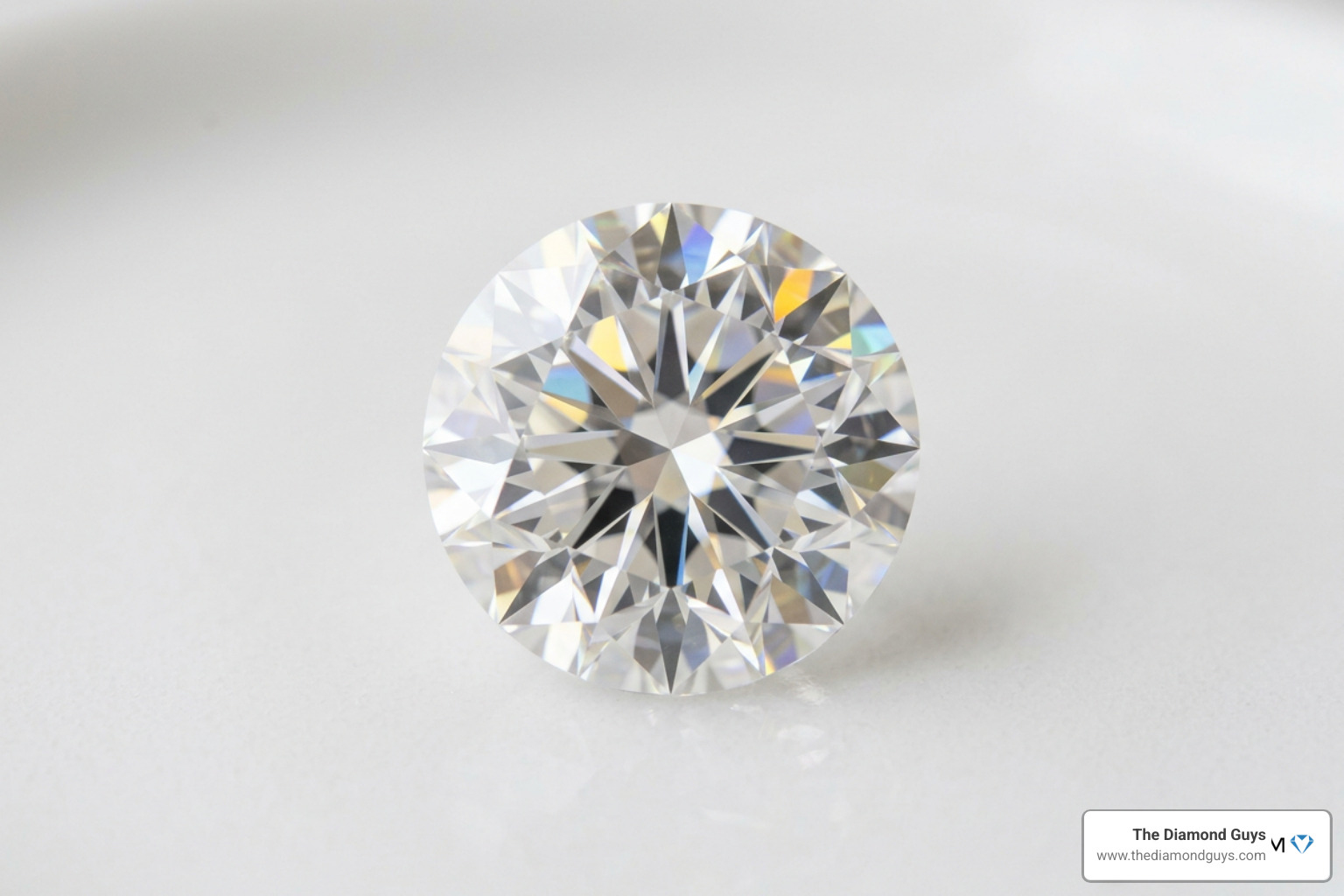
When shopping for a lab-grown diamond, it helps to understand how they are made. There are two primary growth methods:
- HPHT (High Pressure High Temperature): This process mimics the intense heat and pressure of the earth's mantle. It often produces exceptionally clean, highly structured crystals.
- CVD (Chemical Vapor Deposition): This process uses a carbon-rich gas plasma to deposit carbon atom-by-atom onto a diamond seed.
Most premium lab diamonds are classified as Type IIa, which is the chemically purest form of diamond (representing less than 2% of natural diamonds). Type IIa diamonds have no measurable nitrogen impurities, giving them exceptional transparency and brilliance.
To make sure you get a stone that looks absolutely flawless to the naked eye, you need to navigate the 4Cs with care. Our comprehensive Lab Created Diamond Engagement Ring Guide 2026 is an excellent resource to help you master these details, alongside our expert Custom Engagement Rings Guide.
Maximizing Brilliance in a 3 Carat Round Lab Grown Diamond Ring
If you remember only one thing from this guide, let it be this: Cut is king.
The cut grade of your diamond dictates how well it handles light. If a diamond is cut too shallow or too deep, light will leak out of the sides or bottom, leaving the stone looking dull, dark, or lifeless. But when a 3 carat round diamond is cut to Ideal or Excellent proportions, light enters through the crown, reflects off the pavilion facets, and bounces back to your eye in an explosion of brilliance, fire, and scintillation.
Because lab-grown diamonds do not carry the same raw material cost pressures as natural stones, cutters do not have to compromise on proportions to preserve carat weight. Therefore, you should never settle for anything less than an Excellent (GIA) or Ideal (IGI) cut grade.
For a deeper dive into the physics of diamond sparkle, read our article: Are Lab Grown Diamonds Real Diamonds.
The Sweet Spot for Color and Clarity
With a 3 carat diamond, you might think you need to buy a D-color, Flawless-clarity stone to get a beautiful ring. Fortunately, you don't. You can save thousands of dollars by finding the "sweet spot" where the diamond looks completely perfect to the naked eye, even if it isn't technically graded as flawless.
- Color Sweet Spot: G to H. Diamonds graded D, E, and F are technically "colorless" and carry a premium price. However, G and H grades are "near-colorless." When set in a ring, a G or H color diamond looks icy white to the naked eye. The slight body color is virtually impossible to detect unless placed face-down next to a D-color master stone under laboratory lighting.
- Clarity Sweet Spot: VS1 to VVS2. At 3 carats, inclusions (internal flaws) are easier to see. While an SI1 or SI2 diamond might have eye-visible inclusions, a VS1 or VVS2 diamond is guaranteed to be completely "eye-clean." Any microscopic characteristics will be entirely invisible without a jeweler's 10x loupe.
By targeting G/H color and VS1/VVS2 clarity, you get a breathtakingly clear, bright white diamond without paying for grading metrics that you can't even see.
The Importance of IGI and GIA Certification
Never buy a 3 carat diamond without an independent grading report. This certificate is your proof of the diamond's authenticity, origin, and quality metrics.
The two most respected gemological laboratories in the world are:
- GIA (Gemological Institute of America): The gold standard of diamond grading. Historically known for natural stones, the GIA now provides full grading reports for lab-grown diamonds.
- IGI (International Gemological Institute): The pioneer in lab-grown diamond certification. IGI reports are incredibly detailed and highly trusted across the global lab diamond industry.
An independent certificate ensures that your G-color, VS1-clarity diamond has actually been verified by unbiased gemologists. For a complete guide on how to read these reports and what to look for, explore our Ultimate IGI Certified Lab Grown Diamonds Guide and our article on IGI Certified Lab Diamonds.
Popular Settings and Metals for a 3 Carat Round Lab Grown Diamond Ring
A 3 carat diamond is a heavy, prominent stone. This means your choice of ring setting isn't just about aesthetics—it is also about structural integrity and safety.
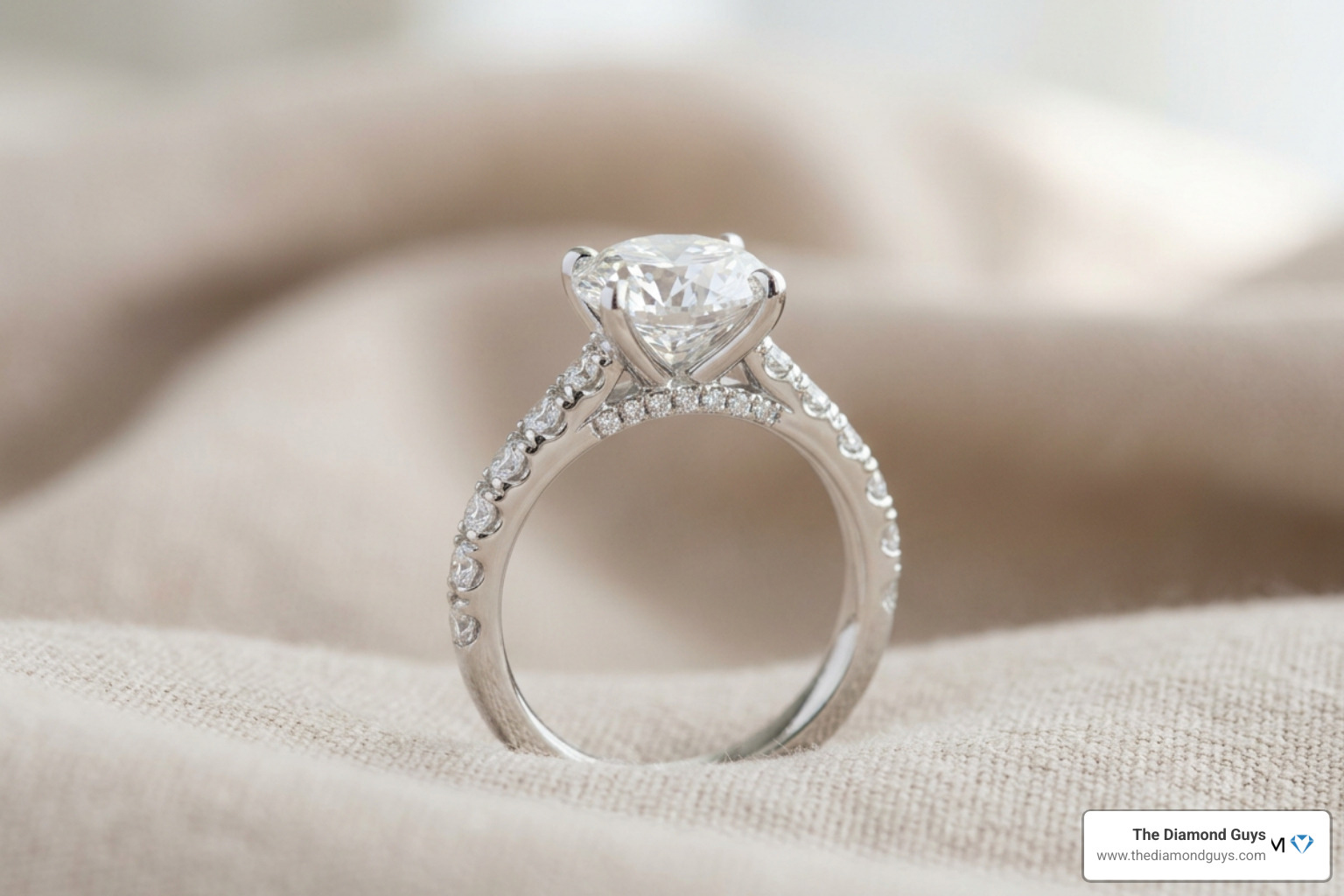
At The Diamond Guys, we specialize in creating bespoke mountings that balance delicate, modern design with the robust engineering required to keep your diamond secure. To explore bespoke ring design, take a look at our Custom Lab Grown Diamond Ring Guide and learn more about Lab Made Diamond Rings.
Setting Styles: Solitaire, Halo, and Hidden Halo
The setting you choose will define the personality of your ring. Here are the most popular styles for a 3 carat round brilliant center stone:
- Classic Solitaire (4 or 6 Prongs): The ultimate timeless design. A simple, unadorned band allows the massive 3 carat stone to take center stage. While a 4-prong setting shows off more of the diamond's profile, a 6-prong setting offers superior security and gives the round stone a perfectly circular silhouette.
- Hidden Halo: A modern favorite. Small accent diamonds are set along the gallery bar just beneath the main diamond's girdle. This adds a subtle, secret touch of sparkle that is visible only from the side profile, without distracting from the classic beauty of the round cut face-up.
- Three-Stone Setting: For those who love maximum finger coverage. Flanking your 3 carat center stone with smaller side stones (such as pear, baguette, or round diamonds) creates an incredibly luxurious, vintage-inspired look.
If you are trying to decide between a clean solitaire or something more elaborate, you might enjoy comparing styles in our article on the 2 Carat Solitaire Ring.
Metal Choices: Platinum vs. White Gold vs. Yellow Gold
The metal you choose affects both the durability of your ring and the color performance of your diamond:
- 950 Platinum: The gold standard for securing large diamonds. Platinum is dense, heavy, and naturally hypoallergenic. Unlike white gold, platinum does not wear away over time; instead, it develops a soft patina. Its cool, bright white luster is the perfect match for a colorless or near-colorless diamond.
- 14K or 18K White Gold: A popular, highly durable alternative to platinum. It is plated with rhodium to give it a brilliant white finish, though it will require replating every few years to maintain its bright white look.
- 14K or 18K Yellow Gold: Yellow gold is incredibly romantic and provides a beautiful, warm contrast to a bright white round diamond. If you choose yellow gold, you can comfortably drop down to an I or J color diamond, as the yellow metal will naturally mask any slight warmth in the stone.
Frequently Asked Questions About 3 Carat Lab Diamonds
Are 3 carat lab grown diamonds suitable for everyday wear?
Absolutely. Lab-grown diamonds are chemically identical to natural diamonds, meaning they score a 10 on the Mohs hardness scale. They are the hardest known substance on Earth and are highly resistant to scratching, chipping, and daily wear.
However, because a 3 carat stone sits relatively high off the finger, it is more prone to catching on clothing or knocking against hard surfaces. To ensure your ring stays beautiful for a lifetime, we recommend pairing a large stone with a sturdy band (at least 1.8mm to 2.0mm wide) and having your prongs checked by a professional jeweler at least once a year.
For tips on keeping your ring in pristine condition, check out our Engagement Ring Maintenance Guide 2026.
Is a 3 carat lab grown diamond ring a good value compared to smaller carat weights?
Yes, a 3 carat lab grown diamond offers phenomenal value. In the natural diamond world, the price-per-carat increases exponentially as stones get larger because raw 3 carat crystals are incredibly rare in nature.
With lab-grown diamonds, the price curve is much flatter. While a 3 carat lab-grown diamond is more expensive than a 1 or 2 carat stone, the price increase is linear rather than exponential. This means you are getting an incredibly large, high-impact diamond at a fraction of the premium you would pay for a natural stone of the same size.
To explore this concept further, read our guide on the 3 Carat Wedding Ring.
What diamond shape looks the biggest on the hand?
While the round brilliant cut is unmatched in its classic beauty and sparkle, it is not actually the shape that looks the largest. Elongated diamond shapes—such as oval, emerald, pear, and marquise cuts—distribute more of their weight across the top surface of the stone.
This means an oval or marquise cut diamond of the exact same carat weight will often have a larger visual footprint on the finger than a round cut. However, the round brilliant cut remains the undisputed champion for light performance and fire.
To see how different cuts compare in visual size, check out our article: What Diamond Shape Looks the Biggest.
Conclusion
A 3 carat round lab grown diamond ring is the ultimate combination of modern technology, ethical sourcing, and uncompromising luxury. It allows you to make a breathtaking statement of commitment without the astronomical price tag of a mined stone.
At The Diamond Guys, we are proud to offer a highly personalized, 5-star shopping experience in our Scottsdale, AZ and Los Angeles, CA showrooms. We reject the high-pressure, cookie-cutter approach of big-box retailers. Instead, we focus on education, ethical sourcing, and expert guidance to help you design a custom ring that perfectly matches your love story.
Whether you are ready to start designing your custom dream ring or simply want to view our curated selection of certified lab-grown diamonds in person, we are here to help.
Explore our latest insights, design trends, and expert guides on The Diamond Guys Blog to begin your journey today.


