

Sustainable Sparkle: Everything You Need to Know About Blue Lab Diamonds
The Rise of Blue Lab Diamonds: Rare Color, Modern Value

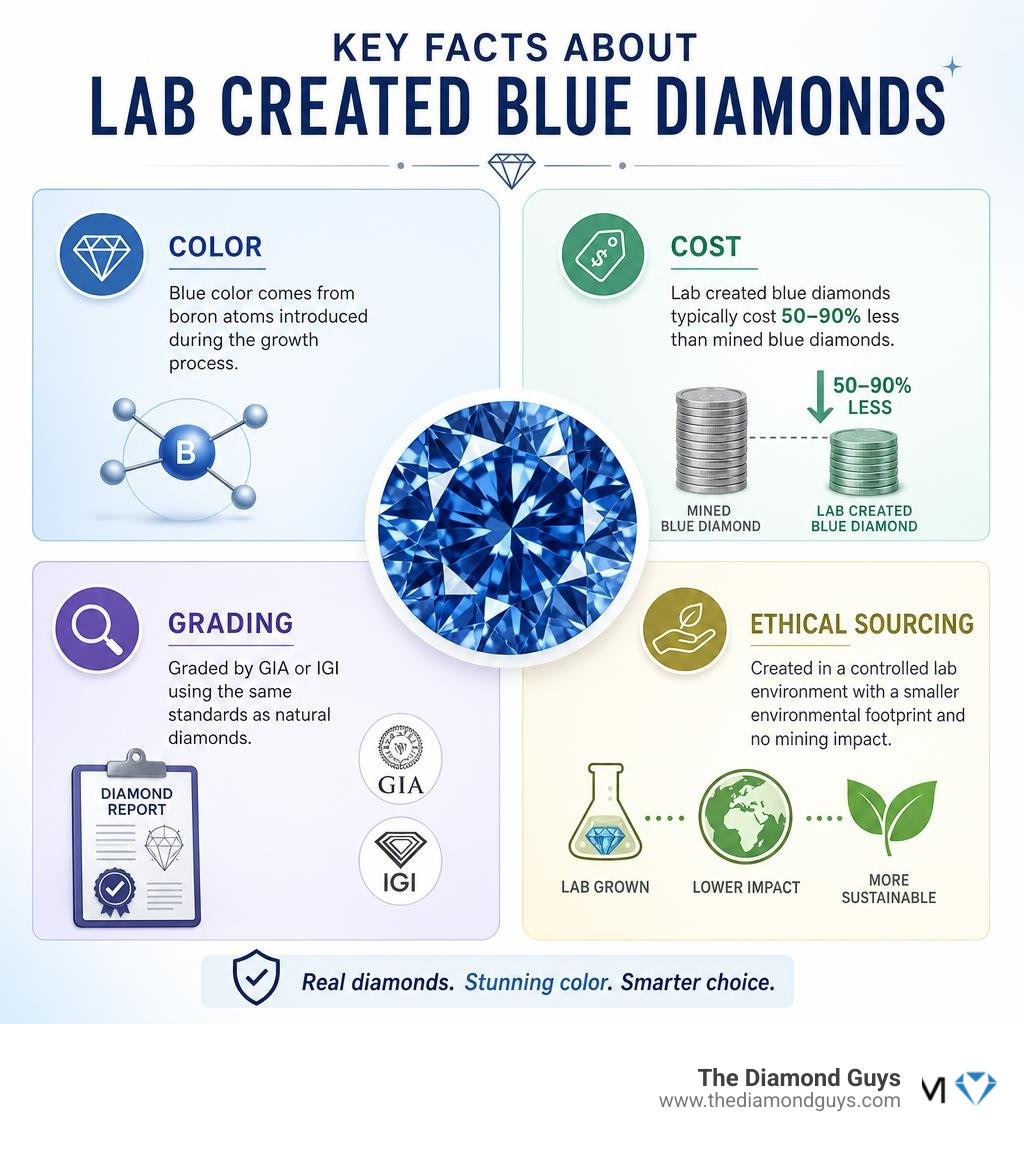
Lab created blue diamonds are real diamonds — grown in a laboratory — that share the exact same chemical, physical, and optical properties as mined blue diamonds, but at a fraction of the cost.
Here's what you need to know at a glance:
| Question | Quick Answer |
|---|---|
| Are they real diamonds? | Yes — chemically and physically identical to mined diamonds |
| What makes them blue? | Boron atoms introduced during the growth process |
| How are they made? | HPHT or CVD methods in a controlled lab |
| How much do they cost? | A 1ct Fancy Vivid Blue can start around $360–$500 |
| Are the colors permanent? | Yes — the color does not fade over time |
| Are they certified? | Yes — graded by GIA or IGI, just like natural diamonds |
Natural blue diamonds are extraordinarily rare. They make up less than 0.02% of all diamonds in circulation, and the odds of finding one in nature are roughly 1 in 10,000. That rarity comes with a staggering price tag — the famous 14.62-carat Oppenheimer Blue sold at auction for over $57 million.
Lab-grown blue diamonds make that same breathtaking color accessible. Typically 50–90% more affordable than their mined counterparts, they open the door for everyday buyers to own a gemstone that was once reserved for the ultra-wealthy.
I'm Morgan Price, a backlink outreach and content specialist with deep expertise in the lab-grown diamond space, including the nuances of sourcing and evaluating lab created blue diamonds. In this guide, I'll walk you through everything — from how they're made, to how they're graded, to how to buy one with confidence.
Basic lab created blue diamonds glossary:
What Are Blue Lab Diamonds and How Do They Compare to Mined Stones?
When evaluating fancy colored gemstones, the main question on most buyers' minds is whether a laboratory-grown alternative behaves like a "real" diamond. To put it simply: yes. When comparing lab diamonds vs real diamonds, there is no chemical, physical, or optical difference. They are both pure carbon crystallized in an isometric cubic system.
The primary difference lies entirely in their origin. A mined blue diamond is pushed to the Earth's surface over billions of years, while a lab-grown blue diamond is cultivated in a matter of weeks using cutting-edge technology. Because we bypass the massive environmental and financial costs of deep-earth mining, we can offer these stunning colored gems at a highly accessible price point.
| Metric | Natural Blue Diamond | Lab-Created Blue Diamond |
|---|---|---|
| Chemical Composition | Carbon with trace Boron (C) | Carbon with trace Boron (C) |
| Crystal Structure | Isometric cubic | Isometric cubic |
| Rarity in Nature | < 0.02% of all mined diamonds | Created on demand in specialized facilities |
| Mohs Hardness | 10 | 10 |
| Resale Value | Extremely high (heirloom/auction pricing) | Minimal resale value; valued for personal wear |
| Cost (1 Carat) | $10,000 to $100,000+ | $360 to $500+ |
While a natural blue masterpiece like the 14.62-carat Oppenheimer Blue remains an ultra-rare collectible for museums and billionaire investors, lab created blue diamonds allow jewelry lovers to enjoy the same mesmerizing "ocean-in-crystalline-form" aesthetic without the multi-million dollar price tag. Best of all, when asking are lab-grown diamonds as strong as real diamonds, the answer is a resounding yes. Scoring a perfect 10 on the Mohs hardness scale, they are highly resistant to scratching and ideal for daily wear.
The Science of Boron and Diamond Coloration
The captivating blue shade of a blue lab diamond is not paint, film, or surface coating. It is baked directly into the diamond’s atomic lattice.
In a standard colorless diamond, the crystal structure consists entirely of carbon atoms. However, when trace amounts of the element boron are introduced during the growth process, boron atoms substitute for carbon atoms within the diamond's crystal lattice.
Because of their unique atomic structure, these boron impurities absorb light in the red, yellow, and green wavelengths of the visible spectrum. The light that is not absorbed and instead reflects back to your eye is the stunning, cool blue hue we all admire.
HPHT vs. CVD Growth Methods
Scientists use two primary methods to grow gem-quality blue diamonds in a laboratory setting: High Pressure High Temperature (HPHT) and Chemical Vapor Deposition (CVD).
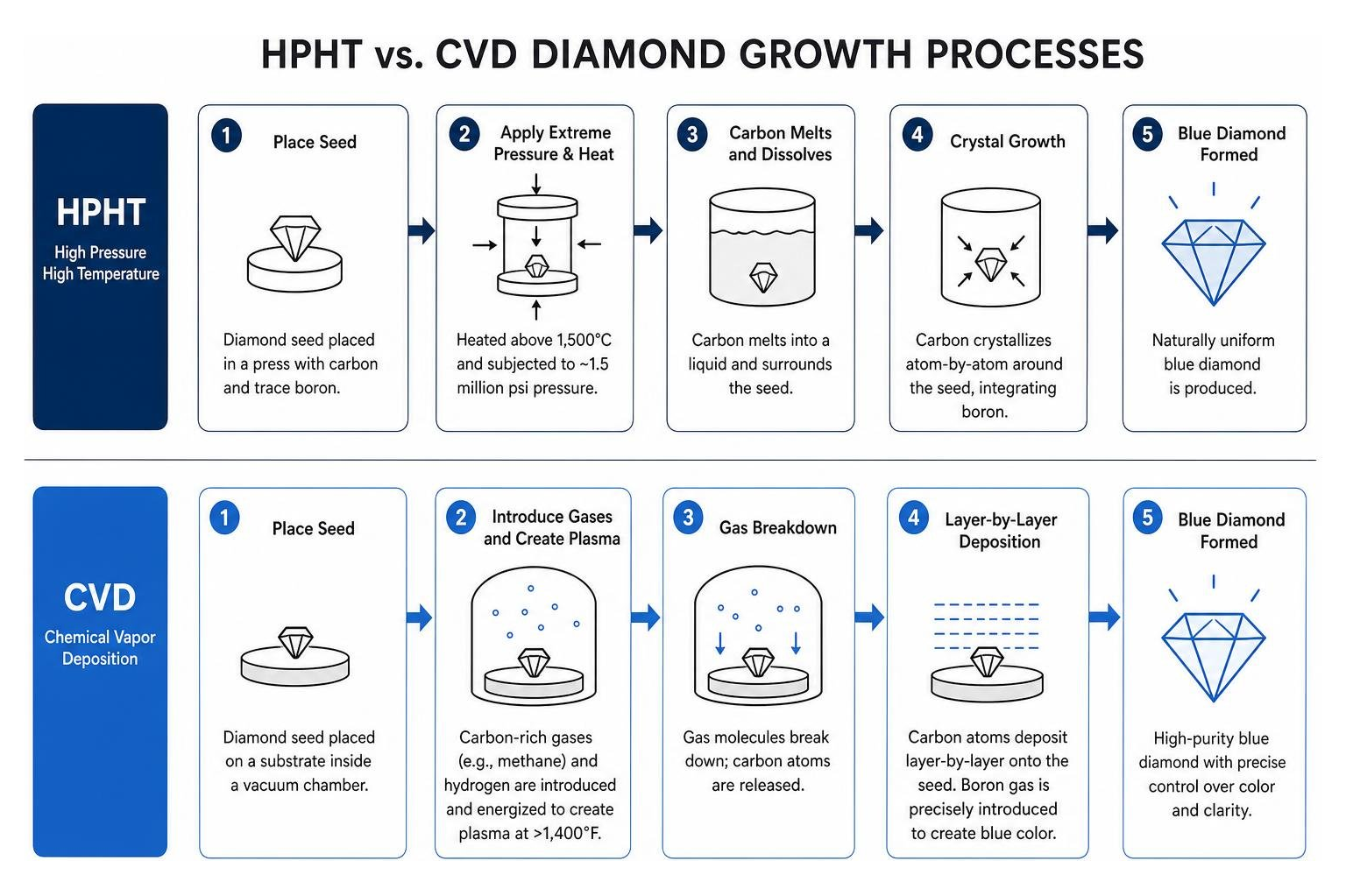
- High Pressure High Temperature (HPHT): This method closely mimics the natural geological conditions that form diamonds deep within the Earth. A tiny diamond seed is placed in a press alongside carbon and trace amounts of boron. The chamber is heated to temperatures exceeding 1,500°C and subjected to pressures of around 1.5 million psi. The carbon melts and crystallizes atom-by-atom around the seed, integrating the boron to produce a naturally uniform blue diamond.
- Chemical Vapor Deposition (CVD): In this highly controlled process, a diamond seed is placed inside a vacuum plasma chamber. Carbon-rich gases (like methane) and hydrogen are introduced and heated to over 1,400°F, creating a plasma state. The gas molecules break down, and carbon atoms rain down to deposit layer-by-layer onto the seed. Boron gas is precisely introduced during this deposition phase to cultivate the blue color.
Both methods yield stunning results, and the resulting crystals are crafted into gorgeous lab-grown blue diamond jewelry. CVD is highly favored by modern growers because it allows for incredibly precise control over color zoning and clarity.
Quality, Durability, and Ethical Sourcing
Choosing a lab-grown gemstone is a wonderful way to align your luxury purchases with modern ethical standards. Because these diamonds are grown in controlled facilities, they are guaranteed to be 100% conflict-free. This offers peace of mind that is often difficult to guarantee with mined stones, even under modern tracking frameworks.
Furthermore, because they are structurally identical to natural diamonds, you never have to worry about long-term degradation. A common question among first-time buyers is: do lab-grown diamonds get cloudy? The answer is absolutely not. Unlike cheap diamond simulants like cubic zirconia, a certified lab diamond will never yellow, fade, or cloud over time.
If you are looking to design a custom piece, exploring a custom ethical engagement rings guide 2026 can help you pair your blue diamond with responsibly sourced metals like recycled platinum or 14k white gold.
Grading and Pricing of Lab Created Blue Diamonds

Just like white diamonds, lab created blue diamonds are evaluated using the traditional 4Cs: Carat, Cut, Clarity, and Color. However, when it comes to fancy colored diamonds, the "Color" category is by far the most important factor determining the stone's overall visual impact and value.
When shopping, you can use our synthetic diamond price guide and our 1 carat man-made diamond price guide to benchmark pricing and ensure you are getting the best value for your budget.
Understanding Fancy Color Grading Scales
Colorless diamonds are graded on a D-to-Z scale (from completely colorless to light yellow or brown). Fancy colored diamonds, however, are graded on a completely different scale that measures three key attributes:
- Hue: The primary color of the diamond (e.g., blue), as well as any secondary modifying colors (e.g., greenish-blue or grayish-blue).
- Tone: The relative lightness or darkness of the color.
- Saturation: The strength, purity, or intensity of the color.
The Gemological Institute of America (GIA) and the International Gemological Institute (IGI) grade fancy blue diamonds using the following color intensity terms:
- Faint Blue
- Very Light Blue
- Light Blue
- Fancy Light Blue
- Fancy Blue
- Fancy Intense Blue
- Fancy Vivid Blue
- Fancy Deep Blue
For maximum visual impact, many buyers seek out Fancy Intense and Fancy Vivid blue stones. These grades offer a rich, saturated color that beautifully mimics the deep blue of the ocean. To learn more about how these color reports are structured, check out our ultimate igi certified lab-grown diamonds guide.
Cost Factors and Price Comparisons
The price of a lab-grown blue diamond is incredibly reasonable compared to natural stones. Because of manufacturing efficiencies, the price per carat has dropped significantly over the last several years.
- 1-Carat Blue Diamonds: A loose 1.03-carat round Fancy Vivid Blue VS1 lab diamond can be found for as low as $360.00.
- Larger Carat Weights: Excellent-cut, VVS-to-VS clarity round blue lab diamonds ranging from 1 to 5 carats typically start around $499.99 and scale up based on weight. A premium 2.50-carat Fancy Vivid Blue round lab diamond with VS1 clarity can retail for around $1,100.00.
To see how these prices compare to colorless options of a similar size, consult our 2 carat synthetic diamond price guide.
Designing Jewelry with Blue Lab Diamonds
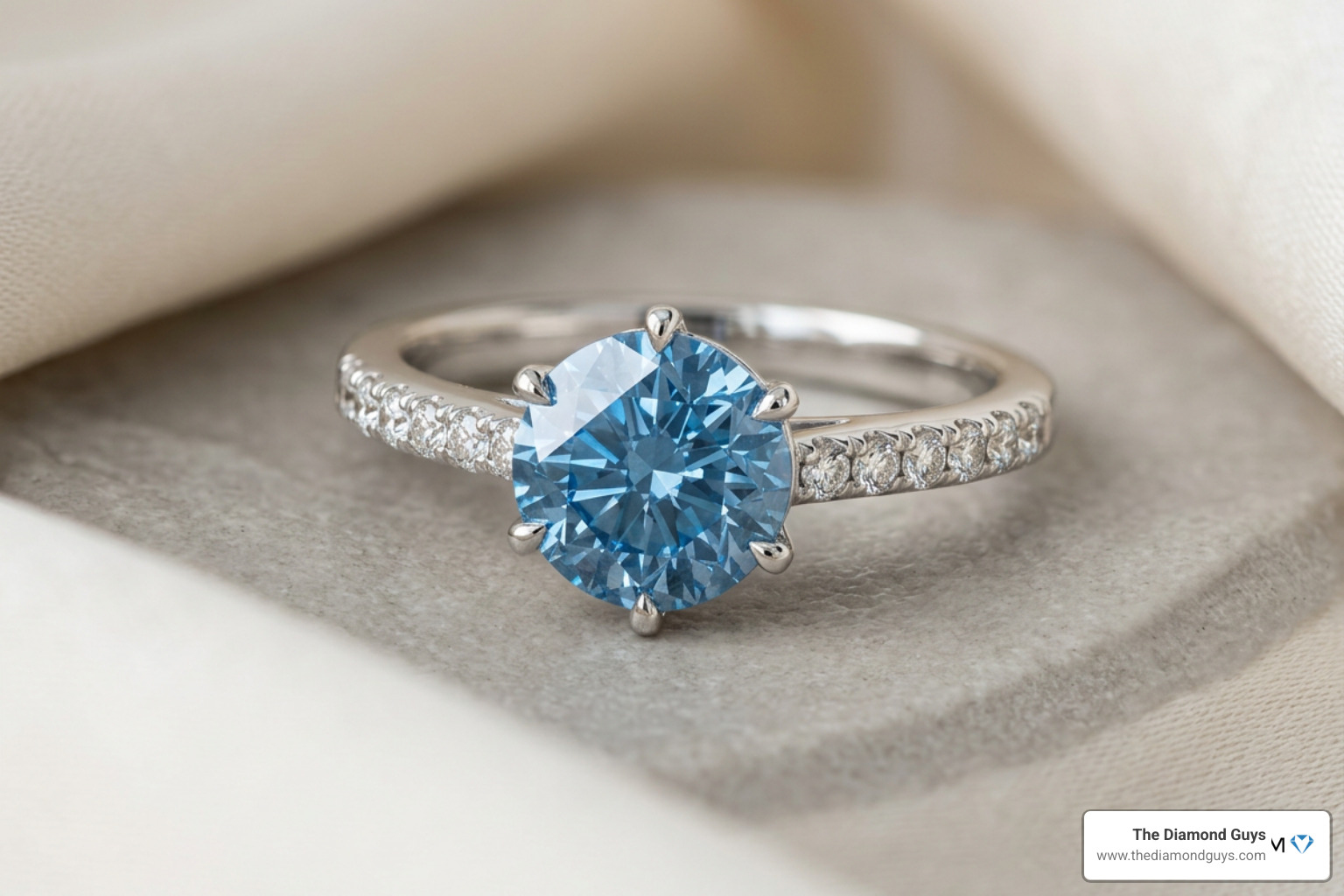
Because blue is a cool, calming color associated with trust, loyalty, and peace, it makes a spectacular choice for fine jewelry. Whether you are designing a custom cocktail ring, a pair of eye-catching stud earrings, or a non-traditional engagement ring, blue lab diamonds pair beautifully with a variety of precious metals.
We highly recommend mounting blue diamonds in white gold or platinum. The bright, neutral white of these metals acts like a mirror, reflecting the blue sparkle and making the color appear even more vibrant. If you prefer a warmer, vintage aesthetic, yellow gold or rose gold can create a striking, high-contrast look. To explore your options, dive into our lab-created engagement rings guide 2026.
Popular Cuts and Settings for Lab Created Blue Diamonds
Certain cuts are engineered to maximize light return (brilliance), while others are designed to concentrate and enhance color saturation. When choosing your stone:
- Round Brilliant Cut: This classic cut is excellent for maximizing sparkle and fire. It blends the blue color with flashes of white light for a highly lively look.
- Radiant and Cushion Cuts: These fancy shapes are cut with deeper pavilions, which trap light inside the stone longer. This concentrates the color, making the blue hue appear deeper and richer.
- Pear and Oval Cuts: These elongated shapes offer a flattering, finger-lengthening effect and look beautiful in romantic, nature-inspired settings. Read our pear shaped lab-grown diamond guide to learn more.
- Emerald Cut: For an elegant, architectural look, an emerald cut showcases the diamond's clarity and color zoning through long, parallel facets, making it a sophisticated choice for custom designs.
For settings, the Toi et Moi (You and Me) style — featuring a blue diamond paired alongside a colorless diamond — has exploded in popularity. Halo settings are also highly favored, as a border of small colorless accent diamonds will make the blue center stone pop dramatically.
How to Verify and Authenticate Lab Created Blue Diamonds
Because high-quality lab-grown diamonds look identical to mined ones, you cannot tell them apart with the naked eye. To ensure you are getting a genuine diamond (and not a cheap simulant like cubic zirconia or moissanite), you can utilize a few simple verification methods:
- The Diamond Tester: Since lab-grown diamonds have the exact same thermal and electrical conductivity as mined diamonds, they will easily pass a standard hand-held diamond tester. If you are curious about how this works, read our detailed breakdown: do lab diamonds pass a diamond tester.
- Laser Inscription: Reputable gemological laboratories (like IGI or GIA) laser-inscribe a microscopic report number onto the diamond's outer edge (the girdle). You can read this inscription under a jeweler's loupe to verify the stone's grading report and confirm its lab-grown origin.
- Professional Gemological Appraisal: A trained gemologist using advanced photoluminescence spectroscopy equipment can easily detect the subtle differences in growth patterns and trace elements. To understand what jewelers look for, read can a jeweler tell the difference between lab-grown diamonds.
Frequently Asked Questions About Blue Lab Diamonds
Are lab-created blue diamonds real diamonds?
Yes! They are 100% real diamonds. They consist of a carbon crystal structure with a hardness of 10 on the Mohs scale, identical refractive indices, and the exact same physical properties as mined stones. They are entirely different from simulants like moissanite or cubic zirconia. For a deep dive into the science, read our article: are lab-grown diamonds real diamonds.
Do lab-grown blue diamond colors fade over time?
No. The gorgeous blue hue of a lab-grown diamond is completely permanent. Because the boron atoms are locked directly into the diamond's carbon crystal lattice during growth, the color will never fade, change, or dull, even when exposed to sunlight, heat, or daily wear.
Can a jeweler tell if a blue diamond is lab-grown?
A jeweler cannot tell the difference using standard tools like a magnifying loupe or basic thermal tester. However, they can easily identify it by checking for a laser inscription on the girdle or by sending the stone to a gemological laboratory where specialized UV and spectroscopy equipment can analyze its growth structure.
Conclusion
Choosing a lab created blue diamond is a beautiful way to celebrate your personal style, a major milestone, or a lifetime commitment. By opting for a lab-grown stone, you gain access to one of the rarest and most striking colors in the gem kingdom at a price that leaves room in your budget for a stunning custom setting.
At The Diamond Guys, we specialize in helping you navigate the exciting world of custom jewelry. Whether you are shopping in Scottsdale, AZ, or Los Angeles, CA, our 5-star rated team of experts is here to provide personalized, pressure-free guidance to help you design the ring of your dreams.
Ready to begin your custom design journey? Visit our blog for more expert tips, or contact us today to schedule your private design consultation!


