

Real Sparkle and Enduring Value in Genuine Natural Diamonds
How to Recognize a Genuine Natural Diamond

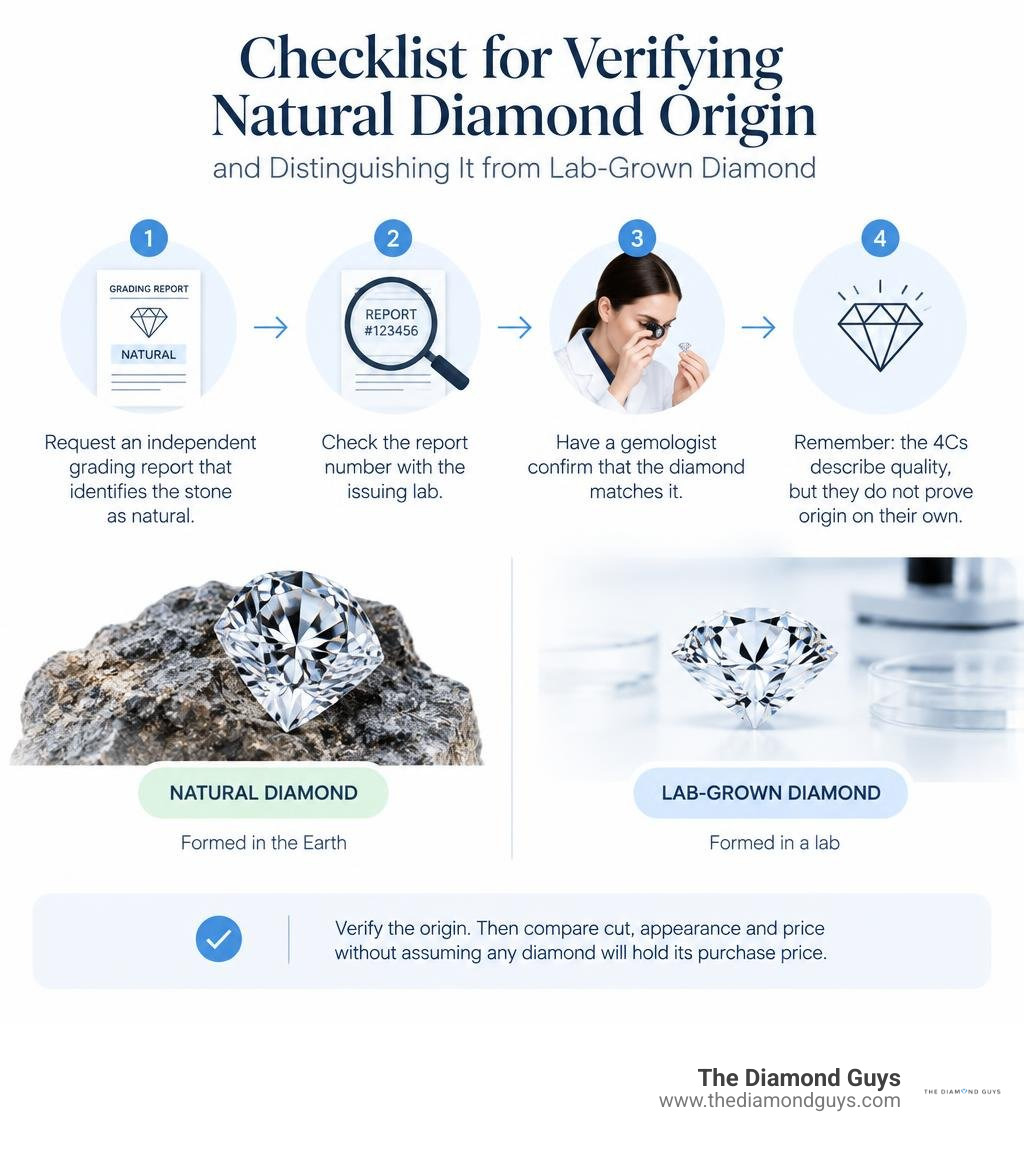
A genuine natural diamond formed in the Earth rather than in a lab. Before you buy, ask for an independent grading report that identifies the stone as natural. Check the report number with the issuing lab, then have a gemologist confirm that the diamond matches it. The 4Cs describe quality, but they do not prove origin on their own.
Lab-grown diamonds are real diamonds, too; they simply have a different origin. If an earth-mined stone matters to you, verify that origin first. Then compare cut, appearance, and price without assuming any diamond will hold its purchase price.
I'm Morgan Price. I draw on my research and editorial outreach experience to check claims about a genuine natural diamond; next, we'll look at the grades and buying details that help you choose with confidence.
Genuine natural diamond basics:
- best natural diamond engagement rings
- engagement rings with natural diamonds
- natural diamonds price chart
What Defines a Genuine Natural Diamond: The 4Cs and Beyond
A natural diamond represents one of nature's most extraordinary feats: pure crystallized carbon formed under intense heat and crushing pressure deep within the Earth's mantle over billions of years. When brought to the surface through ancient volcanic kimberlite pipes, rough diamonds possess an internal atomic structure known as a carbon lattice, yielding unparalleled hardness and optical brilliance.
To evaluate these treasures systematically, the industry relies on the universal 4Cs framework established by the Gemological Institute of America (GIA): Cut, Color, Clarity, and Carat Weight.
| 4Cs Component | Quality Tier Spectrum | Visual Impact on the Diamond | Recommended Budget Allocation |
|---|---|---|---|
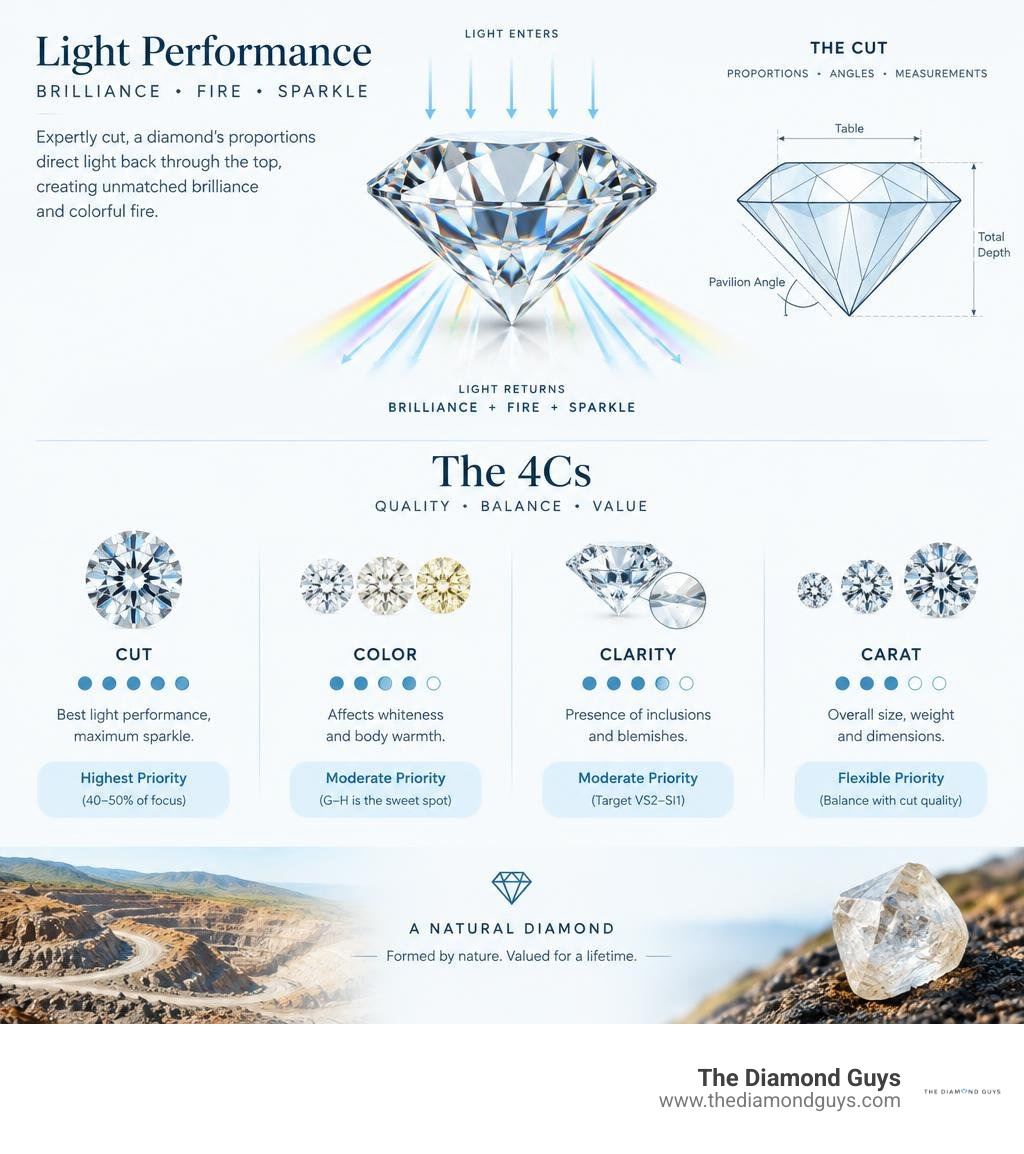
| Cut | Poor, Fair, Good, Very Good, Excellent / Ideal | Determines light refraction, fire, sparkle, and visual spread | Highest Priority (Allocate 40–50% of focus) |
| Color | D–F (Colorless), G–J (Near Colorless), K–Z (Faint to Light) | Affects face-up whiteness and body warmth | Moderate Priority (G–H offers the best sweet spot) |
| Clarity | FL/IF, VVS1–VVS2, VS1–VS2, SI1–SI2, I1–I3 | Presence of internal inclusions and surface blemishes | Moderate Priority (Target "eye-clean" VS2–SI1) |
| Carat | Metric Carat (1.00 ct = 200 mg / 100 points) | Overall size, weight, and physical dimensions | Flexible Priority (Balance against cut quality) |
Anatomy and Light Performance: Proportions, Angles, and Measurements
The cut grade is not merely the shape (round, oval, emerald); it is the engineering that directs incoming light back through the top of the stone. An expertly proportioned diamond creates a balance of:
- Brilliance: The total white light reflected back to the viewer's eyes.
- Fire: The dispersion of white light into vivid rainbow spectral colors.
- Scintillation: The dynamic sparkle and pattern of light and dark areas created when the stone moves.
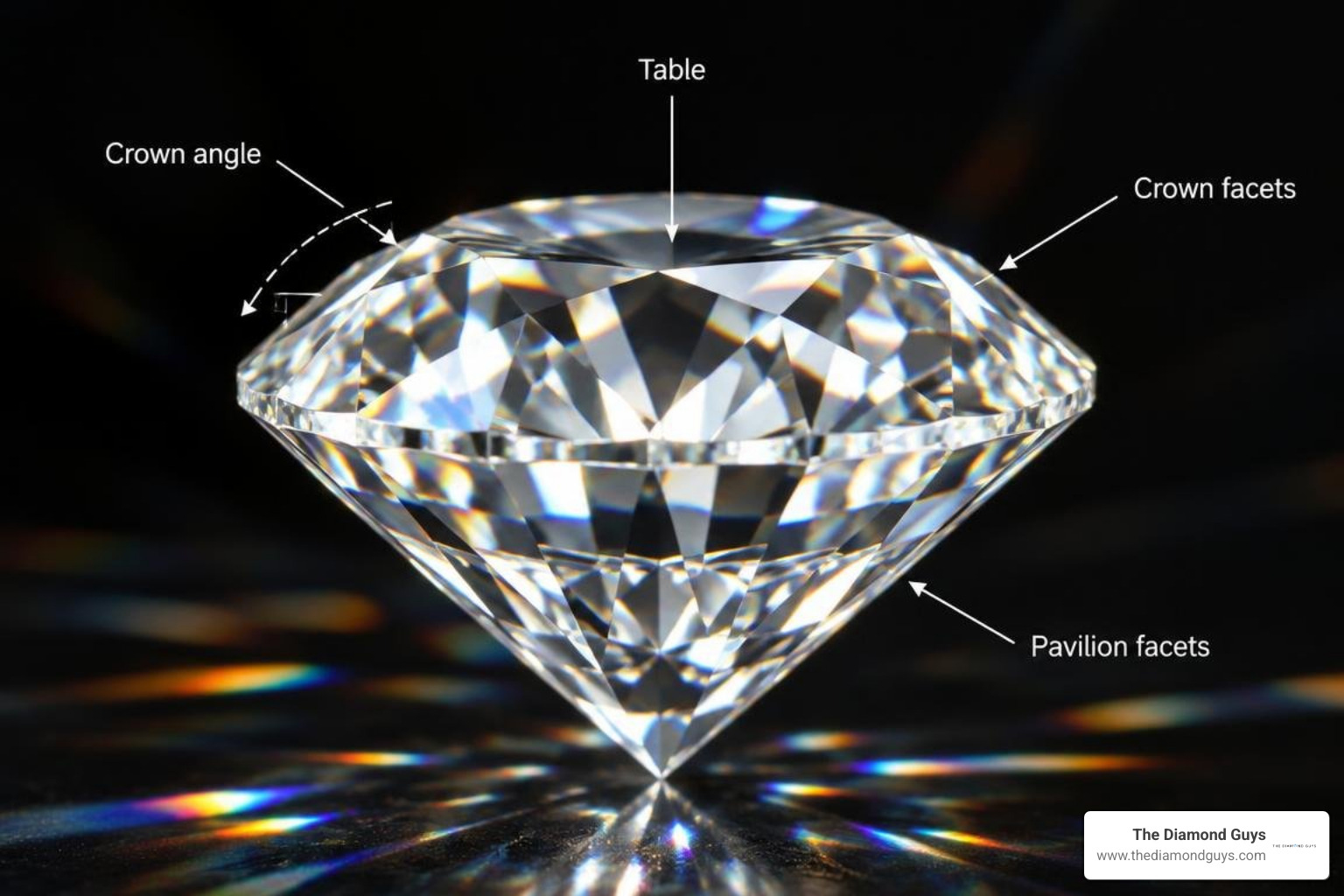
To achieve maximum light performance in a round brilliant diamond, exact proportion tolerances are essential:
- Table Percentage: The width of the top flat facet relative to the diamond's overall diameter. Ideal range: 54% to 61%.
- Total Depth Percentage: The height from the table to the culet divided by the average diameter. Ideal range: 59% to 62.5%.
- Crown Angle: The angle of the upper bezel facets relative to the girdle plane. Ideal range: 32.0° to 35.0°.
- Pavilion Angle: The critical lower angle driving internal total reflection. Ideal range: 40.6° to 41.8°.
- Girdle Thickness: The outer perimeter edge. Medium to slightly thick (around 3.0% to 4.5%) prevents chipping while avoiding unnecessary hidden weight.
- Culet: The tiny facet at the bottom point, ideally graded as None or Pointed to prevent light leakage.
Assessing Clarity and Eye-Clean Characteristics in a Genuine Natural Diamond
Clarity evaluates internal characteristics (inclusions) and surface irregularities (blemishes) under 10x gemological magnification. Because natural diamonds grew in chaotic geological conditions, almost all feature microscopic crystal growth lines, internal mineral crystals, feathers (tiny fissures), or pinpoints.
An eye-clean diamond is one where inclusions cannot be spotted with the naked, unmagnified eye from a typical viewing distance of 8 to 12 inches under natural lighting. A VS2 (Very Slightly Included) grade represents the sweet spot for natural diamonds. At this tier, inclusions like small central crystals or faint clouds are practically invisible face-up, providing pristine visual luster without the steep price premiums of Flawless or VVS stones.
Earth-Mined vs. Laboratory-Grown: Understanding Authenticity and Value Retention
While laboratory-grown diamonds share identical optical and chemical properties with earth-mined stones, they occupy vastly different market positions. Understanding the lab diamonds vs real diamonds landscape helps buyers align their purchases with their personal values and financial expectations.
| Factor | Earth-Mined Natural Diamond | Synthetic Lab-Grown Diamond |
|---|---|---|
| Origin & Formation | Formed 1–3.5 billion years ago in Earth's mantle | Synthesized in weeks via HPHT or CVD reactors |
| Rarity & Supply | Finite geological supply; global mine output declining | Unlimited manufacturing capacity and scalable yield |
| Long-Term Market Value | Retains inherent resale, trade-in, and auction value | High depreciation due to falling production costs |
| Heirloom Perception | Traditional luxury prestige and enduring emotional weight | Modern, budget-friendly tech innovation |
The fundamental difference between real and synthetic diamonds lies in supply elasticity. Because factories can produce lab-grown stones without natural limits, earth-mined diamonds command a premium driven by geological scarcity and historic cultural provenance.
Formation History, Rarity, and Historic Precedents
Natural diamonds are ancient geological time capsules, with the vast majority crystallizing between 1 and 3.5 billion years ago—long before dinosaurs roamed the Earth. The romance of possessing a gemstone that survived deep mantle pressures and explosive volcanic transport cannot be manufactured.
Historically, legendary finds like the Cullinan—one of the biggest natural diamond discoveries in recorded history—captivated world royalty and shaped global trade routes. Even today, finding a rough natural stone capable of yielding a flawless 1-carat or larger finished gem requires sifting through hundreds of tons of rock.
Market Longevity and Price Trajectories
Natural diamond prices historically experience steady market support due to finite supplies, escalating mining costs, and closing deposits worldwide. For businesses and collectors tracking broader wholesale diamond market trends, natural stones represent stable luxury inventory. The secondary market, major auction houses, and established jewelers maintain active trade-in liquidity for natural diamonds that manufactured alternatives do not replicate.
Verifying Authenticity: Diamond Grading Reports and Testing Tools
Because advanced lab synthesis techniques create stones identical to mined diamonds under standard jewelers' loupes, third-party laboratory verification is vital for every natural diamond purchase.
How to Read a GIA Report for a Genuine Natural Diamond
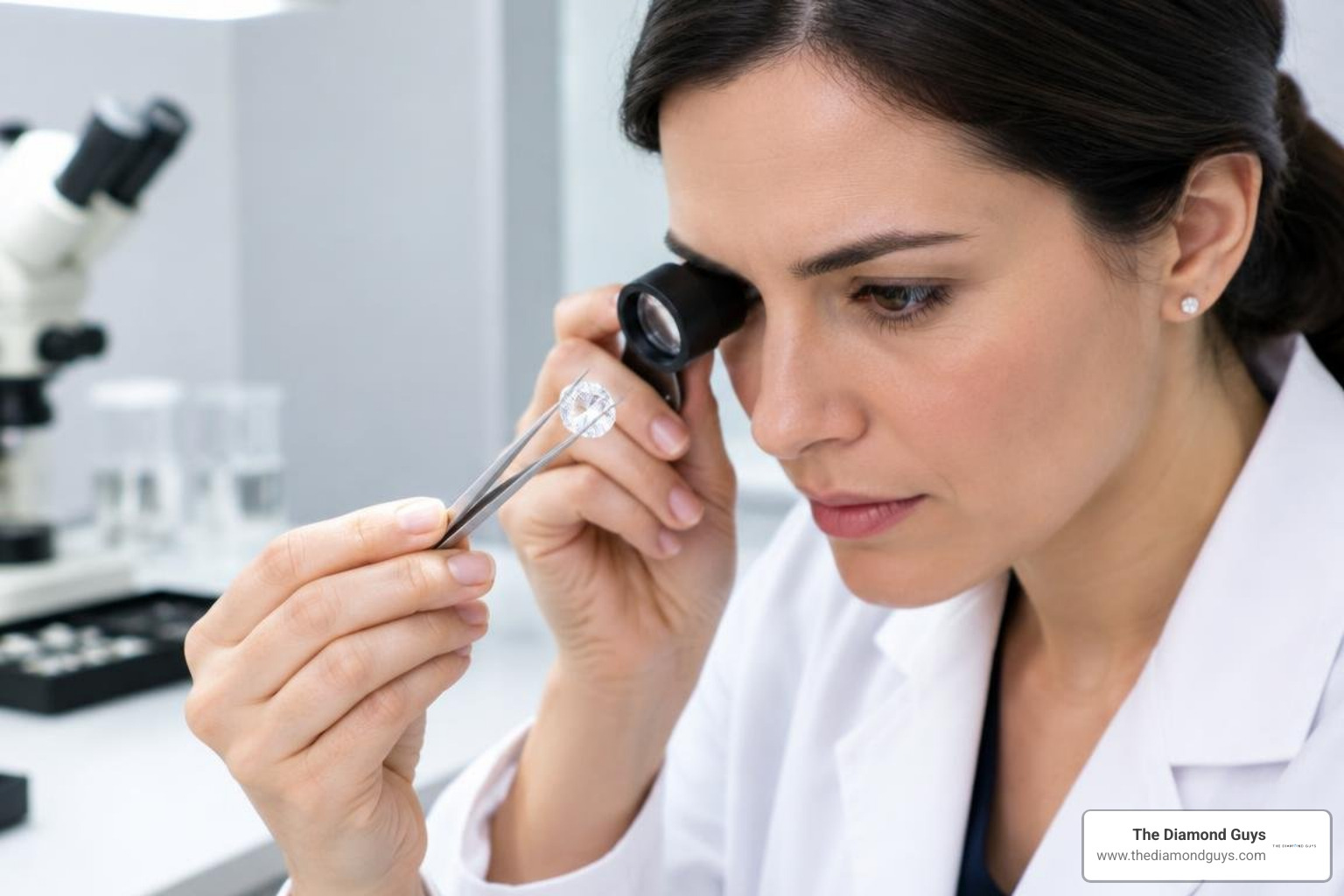
The Gemological Institute of America (GIA) remains the benchmark for diamond grading. When evaluating GIA certified diamonds in Encino CA or our Scottsdale showroom, look for key components on the report:
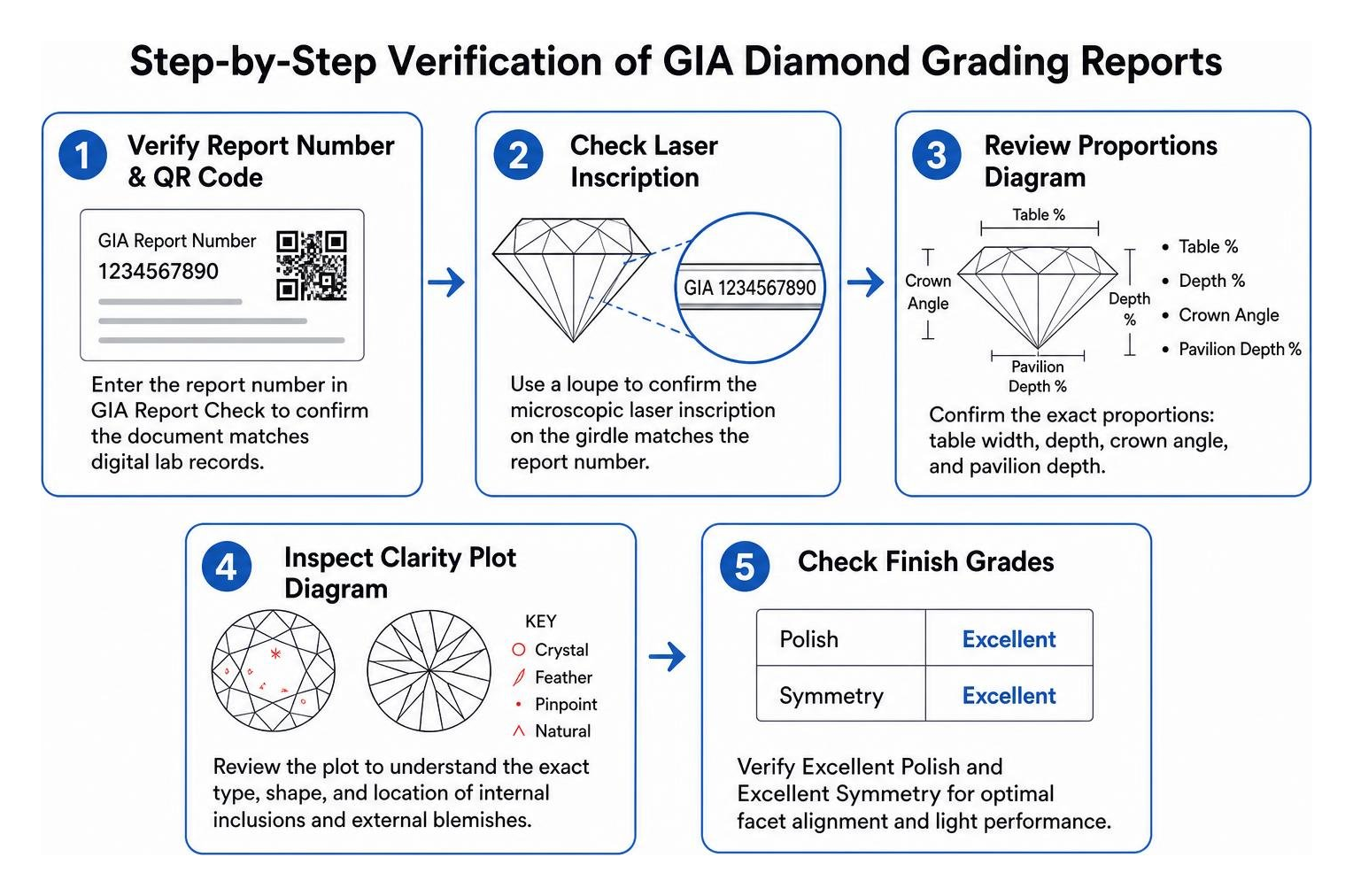
- GIA Report Number & Digital QR Code: Input this number directly into the GIA online database (Report Check) to verify that the physical document matches digital lab records.
- Laser Inscription Registry: High-grade stones feature microscopic laser inscriptions on the girdle that match the official certificate number.
- Proportions Diagram: Review exact percentages for table width, depth, crown angle, and pavilion depth.
- Clarity Plotting Diagram: A graphic map illustrating the exact shape, type, and location of internal inclusions and external blemishes.
- Finish Grades: Check for Excellent Polish and Excellent Symmetry ratings to ensure sharp facet alignment and uniform light reflection.
Advanced Gemological Screening and Testing Technology
Standard thermal diamond testers cannot distinguish between earth-mined and lab-grown stones because both conduct heat identically. Professional jewelers utilize sophisticated bench instruments, including the Gemlogis Vista natural diamond segregator and photoluminescence spectrometers.
These devices analyze short-wave ultraviolet absorption and microscopic nitrogen aggregation patterns to screen Type Ia natural diamonds from Type IIa lab-created stones in seconds.
Diamond Pricing Transparency: Analyzing True Cost Breakdown
Diamond pricing is driven by standardized international trade indices, rough production yields, and market liquidity.
To illustrate how transparent retail pricing works, consider a popular benchmark stone: a 1.01 Carat Round Brilliant Diamond featuring an Ideal Cut, H Color, and VS2 Clarity (measuring 6.50 x 6.45 x 3.93 mm with a 60.7% Depth and 61% Table):
| Cost Breakdown Component | Value / Cost Allocation | Percentage of Retail Price | Description |
|---|---|---|---|
| Diamond Sourcing Cost | $2,771.52 | ~78.3% | Wholesale rough diamond procurement, cutting, polishing, and GIA lab certification fees |
| Fulfillment & Logistics | $194.65 | ~5.5% | Fully insured secure transport, vault handling, import clearance, and custom packaging |
| Retailer Markup | $572.83 | ~16.2% | Transparent business margin supporting expert gemological guidance, warranty, and overhead |
| Final Consumer Price | $3,539.00 | 100% | Comprehensive price reflecting a "Best Value" tier compared to prevailing market averages |
Breaking Down Wholesale Sourcing, Fulfillment, and Retail Markups
Traditional retail jewelers often mark up natural diamonds by 100% to 300% to cover expensive shopping mall leases and broad corporate overhead. Modern boutique jewelers operate on transparent, modest margins (often under 20%), giving consumers direct access to wholesale-tier pricing paired with custom craftsmanship.
Evaluating Fluorescence and Cut Proportions for Maximum Value
Fluorescence refers to the soft glow (typically blue) emitted when a diamond is exposed to ultraviolet light.
- In Near-Colorless Stones (I–K): Medium to Strong Blue fluorescence can act as a natural color filter, making a slightly warm diamond face up whiter in daylight.
- In Colorless Stones (D–F): Strong fluorescence can occasionally cause a hazy or "milky" appearance, resulting in market price discounts of 5% to 15%.
- Faint/None: Stones with faint or no fluorescence maintain optical purity across all ambient lighting conditions without risk of cloudiness.
By selecting an H-color diamond with an Ideal cut and faint fluorescence, buyers capture the visual brilliance of an E or F color diamond while saving substantially on price.
Smart Buying Strategies: Online Best Practices and Expert Consultation
Navigating natural diamond purchases requires balancing digital research with hands-on gemological expertise. For local buyers exploring our Arizona inventory, our comprehensive Phoenix diamond buying guide breaks down regional showroom consultation benefits.
Return Policies, Insured Shipping, and Virtual Gemologist Reviews
When ordering fine jewelry online or reserving a stone for an in-store custom design:
- Insist on Free, Fully Insured Overnight Shipping: High-value parcels should require an adult signature upon delivery.
- 30-Day Inspection Periods: Ensure you have ample time to verify the diamond with an independent appraiser.
- Virtual Gemologist Previews: Review 360-degree 40x HD video footage with an in-house gemologist to examine inclusion types, facet sparkle, and millimeter spread before completing payment.
Selecting Timeless Settings and Finished Fine Jewelry
A natural diamond's brilliance is amplified by the metalwork cradling it. Whether setting a loose stone into a platinum solitaire, a rose gold halo, or a matching natural mined diamond band, the setting must provide both security and maximum light entry.
Prong mounts expose the diamond's pavilion to ambient light, while bezel mounts offer a modern profile and edge protection for active wearers.
Frequently Asked Questions About Natural Diamonds
How can I verify if a diamond is genuinely earth-mined at home?
While basic diamond testers detect thermal conductivity to confirm that a stone is diamond material (distinguishing it from cubic zirconia or glass), they cannot differentiate natural from lab-grown diamonds. To verify earth-mined authenticity at home, inspect the diamond's girdle with a 10x or 20x jeweler's loupe to locate the GIA laser inscription number, then match that number with the GIA online database report. Absolute confirmation requires laboratory spectroscopy screening.
Does fluorescence lower the price and beauty of a natural diamond?
Fluorescence lowers market pricing in colorless diamonds (D through F grades) due to trade tradition and the rare risk of milky haziness. However, in near-colorless diamonds (G through J grades), medium blue fluorescence often enhances face-up whiteness under sunlight without compromising clarity, offering significant visual value at a lower price point.
What makes a 1-carat natural diamond have a "Best Value" rating?
A diamond earns a "Best Value" designation when it pairs an Ideal/Excellent cut with balanced, eye-clean clarity (VS2) and near-colorless grading (H or G), while sitting at the bottom price quartile of comparable certified market stones. This combination maximizes face-up sparkle and millimeter spread (around 6.5 mm) while avoiding the steep price jumps associated with flawless clarity or D-color grades.
Conclusion
A genuine natural diamond combines geological history, optical fire, and lasting value. By prioritizing an Ideal cut grade, confirming eye-clean clarity, and verifying every detail through an independent GIA grading report, you can secure an heirloom piece with total confidence.
At The Diamond Guys, our 5-star rated team in Scottsdale, AZ, and Los Angeles, CA, provides transparent pricing, ethical sourcing, and personalized one-on-one guidance to bring your custom vision to life. Ready to find the perfect stone or custom setting? Explore our complete natural diamond jewelry guide to start your journey today.


