

A Realistic Guide to Average Lab Grown Diamond Costs
Average Cost of Lab Grown Diamonds: A Quick 2026 Snapshot
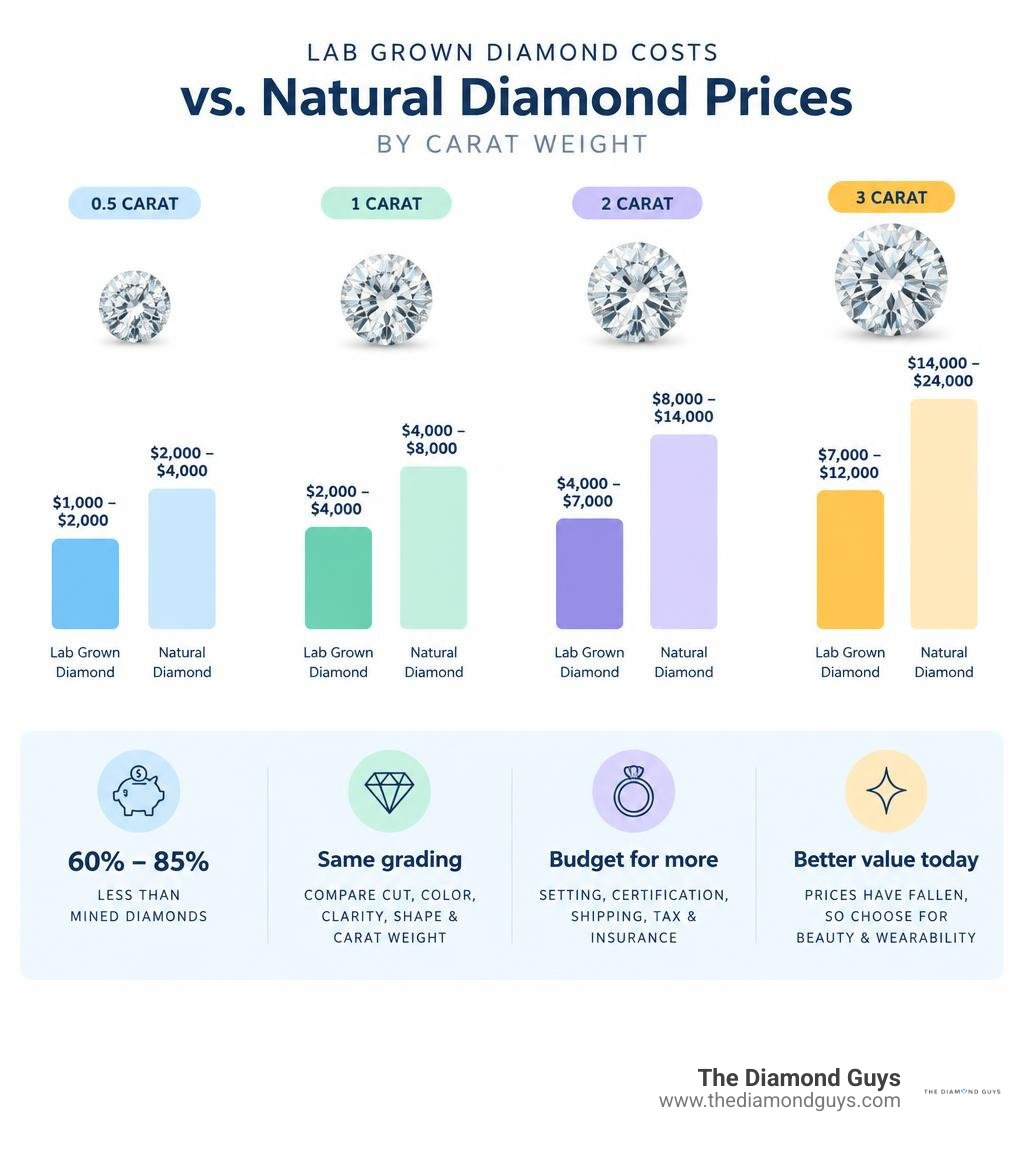
In 2026, the average cost of lab grown diamonds is usually far below that of a comparable mined diamond. As a practical starting point, expect a well-graded 1-carat lab diamond to cost roughly $2,000 to $4,000, while a similar natural diamond may cost $4,000 to $8,000. Lab diamonds commonly sell for 60% to 85% less than mined diamonds, though the final price changes sharply with cut, color, clarity, shape, and carat weight.
For engagement-ring shoppers, the useful rule is simple: compare diamonds with the same grading details, then budget separately for the setting, certification, shipping, tax, and insurance. A larger lab diamond can be an excellent value, but it is not automatically the better buy if its cut quality is poor.
Lab diamond prices have fallen as production has become more efficient and supply has grown. That makes today’s market favorable for buyers, but it also means lab-grown diamonds should be chosen for beauty and wearability rather than expected resale value. For broader context on how synthetic stones are priced, see this overview of synthetic diamond pricing.
I’m Morgan Price, a research-focused outreach specialist who helps create clear, evidence-based resources for major purchase decisions, including the average cost of lab grown diamonds. In the sections ahead, we’ll break down realistic price ranges and the tradeoffs that matter before you buy.
Key average cost of lab grown diamonds vocabulary:
Understanding the Average Cost of Lab Grown Diamonds in 2026
The market landscape for fine jewelry has evolved rapidly over the past several years. When evaluating the price of synthetic diamonds, the most dramatic change is how accessible higher carat weights have become. Production efficiency in plasma reactors and high-pressure presses has increased yields while lowering operational overhead.
Back in 2018, the global average price per carat for a lab-created stone hovered around $2,500. By 2023, that figure dropped to roughly $1,200, and today in 2026, market stability has created predictable, transparent pricing tiers for consumers. Over the past five years alone, overall lab stone prices have dropped by approximately 50%, putting luxury center stones well within reach for everyday budgets.
The table below illustrates typical pricing across popular carat sizes, assuming excellent cut, near-colorless grades (F–H), and eye-clean clarity (VS1–VS2):
| Carat Weight | Average Lab Grown Price | Average Mined Diamond Price | Typical Savings |
|---|---|---|---|
| 1.00 Carat | $2,000 – $4,000 | $4,000 – $8,000 | 50% – 60% |
| 1.50 Carat | $3,000 – $5,500 | $9,000 – $16,000 | 65% – 70% |
| 2.00 Carat | $4,000 – $8,000 | $20,000 – $40,000 | 75% – 80% |
| 3.00 Carat | $7,000 – $13,000 | $40,000 – $85,000+ | 80% – 85% |
As the table shows, the pricing curve for natural diamonds climbs exponentially as carat weight increases due to natural rarity. By contrast, laboratory-created gems scale in a much more linear fashion.
Factors Influencing the Average Cost of Lab Grown Diamonds
Just like earth-mined stones, the price of lab cultured diamonds is dictated by the universal 4Cs established by the Gemological Institute of America (GIA): Cut, Color, Clarity, and Carat Weight.
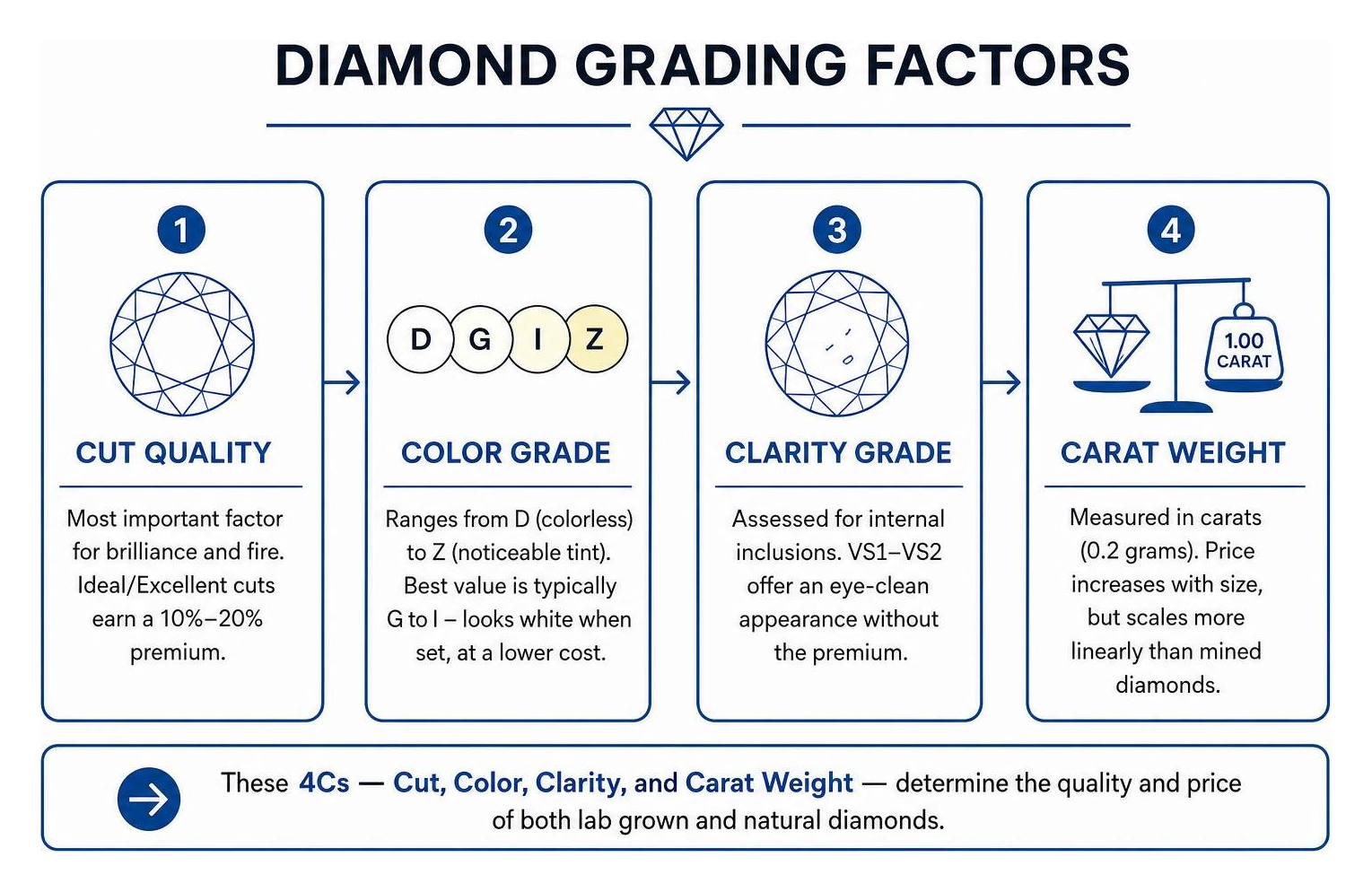
- Cut Quality: Cut is the single most important factor determining a stone's brilliance and fire. An "Ideal" or "Excellent" cut commands a 10% to 20% premium over lesser cuts, but it ensures light returns properly rather than leaking out the sides or bottom.
- Color Grade: Lab stones range from D (completely colorless) to Z (noticeable yellow/brown tint). The sweet spot for value is often in the G to I range, which looks bright white once mounted in precious metal but costs significantly less than D or E stones.
- Clarity Grade: Laboratory growth environments can leave tiny internal inclusions (such as metallic flux or graphite pinpoints). Flawless (FL) and Internally Flawless (IF) stones demand higher prices, whereas stones graded VS1 or VS2 offer an eye-clean appearance without the luxury surcharge.
- Carat Weight: Weight is measured precisely in carats (0.2 grams). While price increases with size, laboratory gems do not suffer from the extreme rarity premiums seen with large mined stones.
Why Lab Created Diamonds Cost Less Than Mined Gems
The significant cost difference between earth-mined gems and created stones comes down to overhead, logistics, and resource intensity. Natural diamonds require massive open-pit or underground mining operations, heavy earth-moving equipment, complex international shipping networks, and layers of middle-tier wholesalers.
In contrast, modern created stones are produced via two cutting-edge methods:
- Chemical Vapor Deposition (CVD): A diamond seed is placed inside a vacuum chamber filled with carbon-rich gases, which are ionized into plasma. The carbon slowly deposits layer by layer onto the seed.
- High Pressure High Temperature (HPHT): Large mechanical presses replicate the extreme heat (over 2,000°F) and crushing pressure (over 1.5 million psi) found deep within the Earth's mantle.
Because these methods take weeks rather than billions of years, the supply chain is streamlined, reducing labor, extraction, and transport expenses.
Typical Price Ranges by Carat Weight and Quality
When planning your purchase, looking at specific carat tiers helps you allocate your budget between the center gem and the ring setting. A thorough review of our 1 carat man made diamond price guide reveals that standard sizes are predictable, but quality nuances always shift the final invoice.
How Carat Size Dictates the Average Cost of Lab Grown Diamonds
To help you visualize how your budget translates into real-world ring styles, consult our lab created engagement rings guide 2026. Here is how the most requested carat tiers break down:
- 1.00 to 1.49 Carats: The classic standard for engagement jewelry. A top-tier 1-carat lab stone generally ranges between $2,000 and $4,000, offering an accessible entry point for pristine clarity and cut.
- 1.50 to 1.99 Carats: An increasingly popular tier that provides substantial visual presence on the finger without crossing the 2-carat price threshold. Typical prices range from $3,000 to $5,500.
- 2.00 to 2.99 Carats: A 2-carat lab diamond averages between $4,000 and $8,000. For comparison, an identical natural diamond easily commands $20,000 to $40,000, making this the size range where buyers experience the most noticeable savings.
- 3.00 Carats and Above: Premium stones in this range cost between $7,000 and $13,000, whereas mined counterparts enter high-end collector territory at $40,000 to over $85,000.
Premium Fancy Colors and Shapes
While round brilliant stones remain the industry standard, fancy shapes and vibrant colors offer unique styling opportunities. Fancy shapes—such as oval, emerald, radiant, pear, and cushion cuts—often cost 10% to 25% less per carat than round cuts because they utilize rough crystal material more efficiently during the faceting process.

For those drawn to non-traditional shades, our lab grown colored diamonds ultimate guide covers the full spectrum from canary yellows to deep blues. In the natural world, fancy colored stones are astronomically expensive. However, specialized laboratory processes allow enthusiasts to acquire stunning lab grown pink diamonds for a tiny fraction of mined auction prices.
Hidden Costs and Added Expenses to Consider
When budgeting for a piece of custom jewelry, the loose gem is only one piece of the puzzle. Factoring in secondary expenses ensures you avoid unexpected surprises at checkout.
- Ring Settings and Precious Metals: Platinum, 18k gold, and 14k gold vary in price based on market metal spot rates. A simple solitaire band may cost $600 to $1,200, while an intricate pavé, hidden-halo, or multi-stone setting can range from $1,500 to $3,500+.
- Independent Certification: Reputable gems must be graded by independent laboratories such as the IGI (International Gemological Institute) or GIA. While loose stones usually include certification in the retail price, custom appraisals for insurance require a separate fee (typically $75 to $150).
- Maintenance and Sizing: Routine prong retipping, ultrasonic cleaning, and finger resizing should be considered over the lifetime of the piece.
- Insurance Protection: Protecting your investment against loss, theft, or damage is essential. Many buyers wonder, can you insure a lab grown diamond? The answer is yes—specialized jewelry insurers and homeowners policies cover lab-created gems based on their replacement value.
Long-Term Financial Value and Resale Expectations
Before making a final choice, it is vital to understand the secondary market dynamics. When asking, "should I buy a lab grown diamond engagement ring?", buyers must align their emotional goals with practical financial expectations.
The reality of the resale value of man made diamonds is that lab stones, like most retail luxury items, depreciate substantially immediately after purchase. Because manufacturing technology continues to advance and wholesale supply is strong, secondary jewelers and pawn shops will not pay retail replacement value for pre-owned lab gems.
Mined diamonds also carry heavy retail markups and routinely lose 30% to 50% of their paper value upon leaving a showroom, but they retain residual commodity pricing tied to natural scarcity. Lab-created gems should be purchased for their personal beauty, ethical appeal, and upfront savings—not as speculative financial assets.
Frequently Asked Questions About Lab Diamond Pricing
Do lab grown diamonds hold their value over time?
No, lab-grown diamonds should not be treated as financial investments. As manufacturing technologies continue to improve, production costs decrease, which limits secondary resale potential. The primary financial benefit of a lab stone is realized on the day of purchase, when you save thousands of dollars compared to a mined gem.
Can a jeweler tell the difference between lab and natural diamonds?
To the naked eye, under a standard 10x jeweler's loupe, or with a basic thermal tester, the two are indistinguishable because they share the exact same chemical, optical, and physical properties. However, as explained in our guide on whether can a jeweler tell the difference between lab grown diamonds, trained gemologists using advanced spectroscopy and photoluminescence devices can identify distinct laboratory growth patterns and laser-inscribed girdle registry numbers.
Do lab grown diamonds ever get cloudy or degrade?
A genuine lab diamond will never lose its brilliance, fade, or become cloudy over time. Because they are 100% crystallized carbon, they score a maximum 10 on the Mohs hardness scale. For details on regular maintenance, see our overview on whether do lab grown diamonds get cloudy, or learn why are lab grown diamonds as strong as real diamonds.
Conclusion
Understanding the true market cost of fine jewelry allows you to design an engagement ring or custom piece that matches your aesthetic vision without overspending. By prioritizing cut quality and balancing the 4Cs, you can maximize your center stone's beauty while enjoying the substantial savings that modern lab creation provides.
At The Diamond Guys, we believe every couple deserves transparent pricing, ethical sourcing, and dedicated personal service. Whether you are shopping in Scottsdale, AZ, Phoenix, AZ, or visiting our boutique in Los Angeles, CA, our master jewelers are here to guide you through every step of the custom design journey.
Ready to find the perfect stone for your setting? Explore custom lab grown diamonds with our expert gemological team today.


